

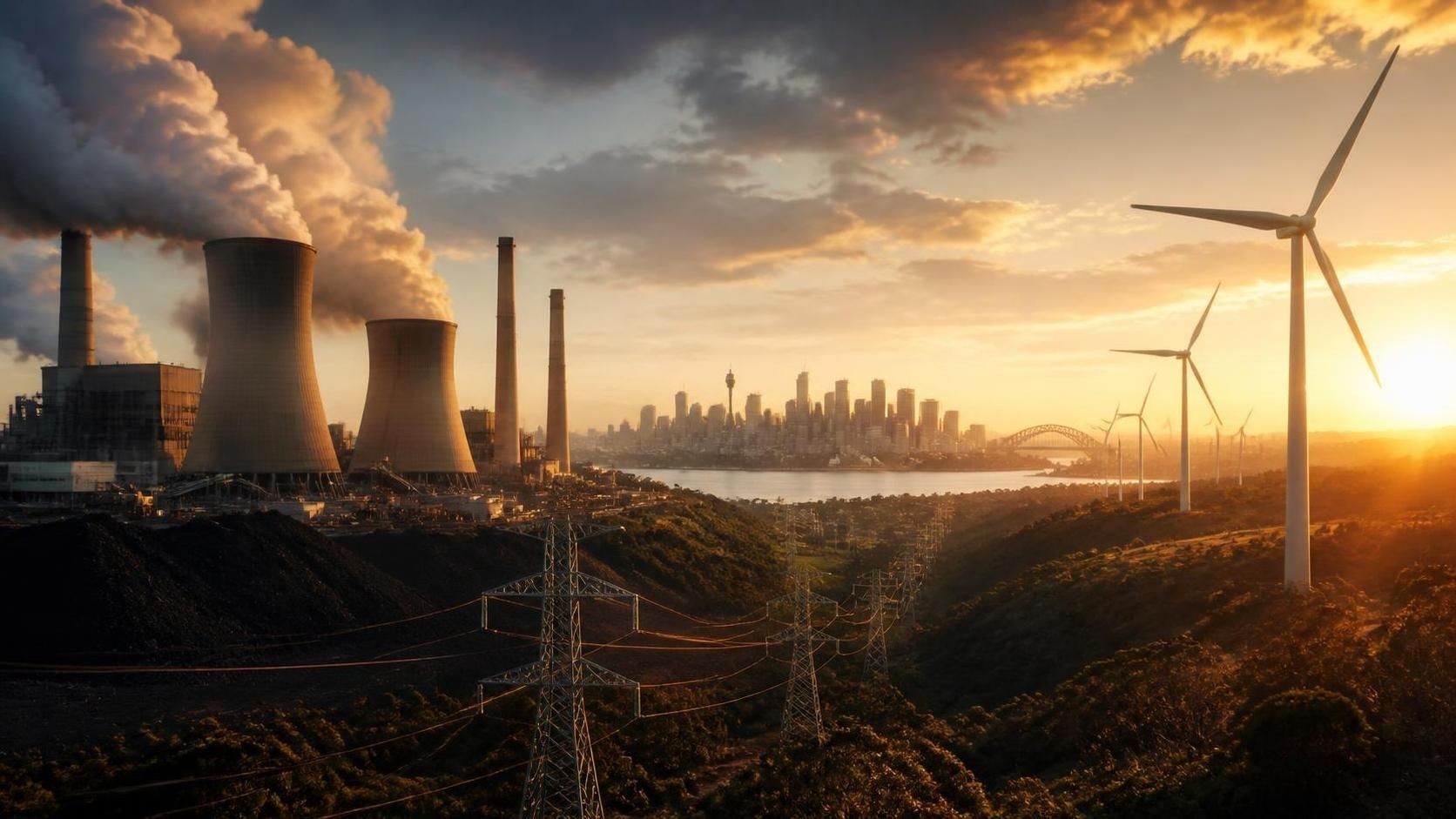
Australia’s official grid planner has rewritten the script. The Australian Energy Market Operator’s 2026 Integrated System Plan still describes renewables, storage, transmission and gas backup as the “least-cost” path to 2050. The same documents show coal staying until 2049, wind delivery falling well short of earlier ambition, transmission scaled back after cost blowouts of up to 100 percent, and flexible gas treated as essential insurance against dusk solar collapse and multi-day wind lulls.
That is not the story sold when net-zero targets and an 82 percent renewable electricity goal by 2030 were locked in. It is the story the physics and the project pipeline forced AEMO to write.
What AEMO actually said
In the 2024 ISP Step Change case, remaining coal was modeled out by 2038. The 2026 ISP now has most of the fleet gone by the mid-2030s and the last units—chiefly in Queensland, aligned with that state’s energy roadmap—running to 2049. Two-thirds of remaining coal still exits by about 2035; the rest is asked to operate more flexibly, two-shifting to cover gaps rather than running as baseload. AEMO notes the aging plants are being driven past design limits and that a major unit failure would raise reliability risk.
The capital number attached to the transition has also moved. Draft-era reporting put the system cost at $128 billion through 2050 (up about 3 percent on the 2024 plan after inflation and financing). The final 2026 ISP quotes a present-value annualized capital cost of about $106 billion for generation, storage, transmission, distribution, and system security under Step Change, plus tens of billions more in consumer-owned rooftop solar and batteries. New transmission is now about 6,000 km by 2050—an extension of the existing 44,000 km network by roughly 14 percent—down from earlier planning figures near 10,000 km after project cancellations, downsizing and cost shocks. Transmission line estimates have risen 25–55 percent in real terms, and nearly 100 percent in some cases.
Gas is no longer a footnote. The optimal path includes about 17 GW of flexible gas-powered generation and new gas-supply-chain assets. AEMO is explicit: gas is the strategic backup when solar drops at dusk and during multi-day wind droughts—the same conditions that already produced emergency warnings.
Wind forecasts met reality
The Electroverse summary that circulated this week captured the direction of travel: earlier high wind targets have been compressed. In the 2026 ISP Step Change case, onshore wind is around 26 GW by 2029–30. AEMO itself flags the delivery problem: roughly 18 GW of new wind is needed by 2030, yet only about half that volume sits in the current connections pipeline. Solar is closer to target; wind is not. Offshore wind is modeled with higher capital costs and, in constrained-delivery cases, delays. Rising wind and transmission costs offset falling solar and battery costs.
Weather is not a modeling footnote. AEMO reliability work uses decades of historical reference years precisely because low-wind sequences coincide with high demand. Capacity factors vary sharply by region and season. South Australia has recorded multi-day stretches with average wind capacity factors below 5 percent. Those events are why coal life extensions (Eraring to April 2029, others under review) and gas keep appearing in official documents even as renewable share of annual energy climbs.
The 2026 Electricity Statement of Opportunities is more optimistic to 2030 than last year’s edition—about 9.1 GW reached full output in 2025–26, and the committed-plus-anticipated pipeline is now around 40 GW—but AEMO still warns that later-decade reliability gaps open as coal retires and demand grows with electrification and data centers. Delivery, not announcements, is the constraint.

The energy mix Australians actually have
National electricity generation in calendar 2025 was still majority fossil: coal about 42.7 percent, gas 16.2 percent, oil 1.7 percent, renewables 39.5 percent. In the National Electricity Market, the renewable share is higher—around 45 percent of energy in the 2026 financial year and over 50 percent in some recent quarters—because rooftop solar and wind have grown fast. Coal capacity in the NEM is down from about 30 GW a decade and a half ago to roughly 21 GW across 15 stations. That decline is real. So is the fact that coal and gas still provide the firm, synchronous services the grid was built around.
Q2 2026 NEM figures illustrate the daily bargain: black and brown coal still supplied more than half of generation in that quarter even as wind and solar set seasonal records and gas generation fell. When the wind blows, and the sun shines, fossils drop. When they do not, they do not. That is why “net zero” and “coal to 2049” now sit in the same official document.
An Australian nuclear battery the country will not allow
While AEMO extends coal and adds gas, an Australian engineer is proving a different firm-power product—in Idaho.
Bobby Gallagher, a Queenslander with a background in the Australian military, oil and gas, and shipbuilding, is co-founder and CEO of Houston-based Deployable Energy. The company’s Unity “nuclear battery” is a roughly 1 MWe (about 3 MWth) gas-cooled microreactor designed as a sealed, swap-and-go module: ship it like a propane tank, run it for years, send it back for service. Gallagher has described a unit that can travel on a truck or ute. In late June 2026, the Unity demonstration reactor achieved zero-power fuelled criticality at Idaho National Laboratory in about 150 days from project kickoff—the third U.S. advanced reactor to hit the Trump administration’s 4 July 2026 criticality target, and the first under DOE’s Nuclear Energy Launch Pad. Commercial deployments are targeted around 2028.
Australia cannot host it. Civil nuclear power generation is prohibited under the Environment Protection and Biodiversity Conservation Act 1999 and the Australian Radiation Protection and Nuclear Safety Act 1998. The country operates the OPAL research reactor at Lucas Heights and is a major uranium exporter. It does not allow the electricity product Gallagher is building. The technology, the testing, and the first markets are in the United States.
That is the policy contrast in one sentence: extend 1970s–80s coal plants past design life, build thousands of kilometers of new wires, keep gas turbines on standby for wind droughts—and ban a factory-built, truck-portable reactor designed by an Australian.
Costs rose. Balance did not arrive.
Households have not experienced a smooth, cheap transition. Electricity was a major CPI driver in 2025; the index jumped sharply when rebates rolled off, and annual network/retail resets hit. ACCC data showed quarterly residential bills up 18–22 percent year-on-year in several NEM regions in Q3 2025 including rebates, and still up 6–15 percent excluding them. The Energy Bill Relief Fund ended in December 2025. Default Market Offers for 2026–27 then fell in NSW and south-east Queensland and rose slightly in South Australia—relief after a spike, not a structural collapse in system cost.
The Australian Energy Market Commission’s 2025 price-trends work projects residential unit prices falling about 5 percent over five years if renewables and batteries arrive on time, then rising about 13 percent in the following five years if the build lags coal exits and demand growth. Delays to wind and transmission could add up to 20 percent. CSIRO GenCost work has shown a higher-fossil path could be a few percent cheaper by 2050—at the price of abandoning legislated climate targets and accepting a large emissions increase. Official modeling still calls firmed renewables the cheapest compliant path. The consumer experience is the gap between those two sentences: wholesale prices can fall on sunny, windy days while bills, networks, firming and reliability insurance stay expensive.
Think-tank and opposition analyses put household electricity and gas prices up on the order of 40 percent since the net-zero commitment, against earlier political promises of bill cuts. Government and industry replies correctly note that the 2022 gas-price shock after Russia’s invasion of Ukraine, coal-mine disruptions, and network investment all matter—and that more solar and batteries have since cut exposure to fossil fuel spikes. Both can be true: renewables have lowered some wholesale hours, and the system required to make them reliable has not delivered the cheap, balanced outcome households were told to expect.
The unsustainable part is the imbalance
A durable system needs energy that is cheap and available when people use it. Australia’s current policy stack maximizes variable generation, then discovers it must keep the old thermal fleet, add gas peakers, overbuild transmission, and socialize cost blowouts. It simultaneously forbids the class of firm, low-emission machines other countries are racing to commercialize—including one designed by an Australian and already critical in a U.S. national lab.
Wind forecasts were cut because projects did not appear at the assumed rate and cost. Coal was extended because the replacement stack is late and weather is not optional. Gas was upgraded from “transition fuel” to “strategic backup” because multi-day lulls are in the historical record. Transmission kilometers were slashed after prices doubled in places. None of that is a conspiracy. It is what happens when a target is treated as a substitute for engineering.
Consumers do not need another slogan. They need a mix that still works at 6 p.m. on a still, cloudy winter evening in 2032—without hoping the last coal units hold together and without shipping the country’s nuclear talent to Idaho. AEMO has now said, in official language, that coal is required until 2049. The rest of the policy apparatus has not yet caught up to that sentence.
Australia, please look for energy practices that put consumers first, and keep Stu Turley from doing his Yoda imitations on the Energy News Beat Podcast. “Hypocrisy strong him is,” Says Yoda. Australia has some of the greatest natural resources, including net-zero nuclear, and they won’t use it for the betterment of Australians.
At Energy News Beat, we Make Appendices Great Again.
Appendix: sources and links
AEMO primary documents
- 2026 Integrated System Plan (final): https://www.aemo.com.au/-/media/files/major-publications/isp/2026/2026-integrated-system-plan-isp.pdf
- 2026 ISP explainer: https://www.aemo.com.au/-/media/files/major-publications/isp/2026/aemo-2026-isp-explainer.pdf
- 2026 ISP Appendix A2 (development opportunities): https://www.aemo.com.au/-/media/files/major-publications/isp/2026/appendices/a2-isp-development-opportunities.pdf
- 2026 ISP Appendix A5 (network investments): https://www.aemo.com.au/-/media/files/major-publications/isp/2026/appendices/a5-network-investments.pdf
- Draft 2026 ISP Appendix A5: https://www.aemo.com.au/-/media/files/major-publications/isp/draft-2026/a5-network-investments.pdf
- 2026 Electricity Statement of Opportunities: https://www.aemo.com.au/-/media/files/electricity/nem/planning_and_forecasting/nem_esoo/2026/2026-electricity-statement-of-opportunities.pdf
- 2026 ESOO overview: https://www.aemo.com.au/-/media/files/electricity/nem/planning_and_forecasting/nem_esoo/2026/2026-esoo-overview.pdf
- QED Q2 2026: https://www.aemo.com.au/-/media/files/major-publications/qed/2026/qed-q2-2026.pdf
Reporting on ISP revisions, coal to 2049, costs and wind shortfall
- The Australian, “Reality for ALP as coal will be needed until 2049”: https://www.theaustralian.com.au/nation/politics/reality-for-alp-as-coal-will-be-needed-until-2049-says-aemo-report/news-story/5a205385c936d16701769f4a69fc09a0
- AFR (archived), coal to 2049 and $128bn: https://archive.is/2025.12.11-041617/https://www.afr.com/companies/energy/coal-fired-power-until-2049-as-energy-grid-costs-rise-to-128b-20251208-p5nltq
- Renew Economy, wind shortfall vs 2030 target: https://reneweconomy.com.au/big-shortfall-in-wind-will-put-australias-2030-renewable-target-out-of-reach-aemo-says-in-latest-blueprint/
- The Australian, Eraring extension: https://www.theaustralian.com.au/business/mining-energy/origin-energys-eraring-coal-power-station-gets-2year-extension/news-story/4aebbbe67c632cbf0a96a18a13a355c6
- Energy Networks Australia on 6,000 km vs earlier 10,000 km: https://www.energynetworks.com.au/news/final-isp-2026-makes-clear-transmission-and-whole-of-system-coordination-are-critical-to-least-cost-delivery/
- The Energy, ESOO reliability: https://theenergy.co/articles/aemos-high-wire-supply-risks-fall-to-2030-but-increase-later
- pv magazine, 40 GW pipeline: https://www.pv-magazine.com/2026/08/25/40-gw-project-pipeline-has-australias-energy-transition-on-track/
Energy mix
- energy.gov.au, electricity generation fuel mix: https://www.energy.gov.au/energy-data/australian-energy-statistics/data-charts/australian-electricity-generation-fuel-mix
- Ember Australia: https://ember-energy.org/countries-and-regions/australia/
- Clean Energy Council, Clean Energy Australia Report 2026: https://cleanenergycouncil.org.au/getmedia/f1cb75ef-dfb4-4978-af60-79da65651e19/clean-energy-australia-report-2026.pdf
- DCCEEW quarterly GHG inventory (Dec 2025): https://www.dcceew.gov.au/sites/default/files/documents/quarterly-update-australias-national-greenhouse-gas-inventory-dec-2025.pdf
Prices, bills and cost modelling
- AEMC Residential Electricity Price Trends 2025: https://www.aemc.gov.au/sites/default/files/2025-12/Price%20Trends%202025_Report%20%281%29.pdf
- AEMC media release: https://www.aemc.gov.au/news-centre/media-releases/faster-renewable-buildout-and-electrification-key-affordable-energy-transition
- ACCC NEM inquiry, June 2026: https://www.accc.gov.au/system/files/inquiry-national-electricity-market-report-june-2026.pdf
- AER / ministerial DMO 2026–27: https://minister.dcceew.gov.au/bowen/media-releases/record-renewables-drive-down-bills
- SMH / CSIRO GenCost coverage: https://www.smh.com.au/politics/federal/coal-plants-would-cut-power-costs-by-2050-but-with-a-massive-price-to-pay-20260714-p60f1w.html
- Treasury net-zero modelling: https://treasury.gov.au/sites/default/files/2025-11/p2025-700922.pdf
- Page Research Centre, Delivering a High-Energy Australia: https://www.page.org.au/wp-content/uploads/2025/11/The-Page-Research-Centre-Delivering-a-High-Energy-Australia.pdf
- KPMG inflation note (electricity CPI): https://kpmg.com/content/dam/kpmgsites/au/pdf/2025/australian-inflation-and-cost-dynamics-report-november-2025.pdf.coredownload.inline.pdf
- The Guardian, international price comparison and drivers: https://www.theguardian.com/australia-news/2025/nov/17/are-australians-really-paying-more-for-electricity-than-other-countries
Microreactor / Bobby Gallagher / Deployable Energy
- Deployable Energy criticality PR: https://www.prnewswire.com/news-releases/deployable-energy-announces-unity-demonstration-reactor-achieves-criticality-at-idaho-national-laboratory-302816255.html
- Power Magazine: https://www.powermag.com/deployable-energys-unity-nuclear-reactor-achieves-criticality-at-inl-third-under-doe-nuclear-push/
- Nuclear Engineering International: https://www.neimagazine.com/news/criticality-for-third-us-reactor/
- Reuters, four U.S. microreactors to criticality: https://www.reuters.com/business/energy/four-us-microreactors-hit-criticality-milestone–reeii-2026-07-22/
- Nuclear for Australia on Gallagher / Deployable: https://www.nuclearforaustralia.com/us_hits_key_nuclear_milestone_with_australian-led_advanced_reactor
- Atomic Insights / Atomic Show #345: https://atomicinsights.com/atomic-show-345-bobby-gallagher-ceo-deployable-energy/
- Axios Houston on the truck-moved module: https://www.axios.com/local/houston/2026/04/29/houston-nuclear-startup-deployable-energy-idaho-reactor
- Daily Telegraph video, “Aussie’s transformational nuclear battery”: https://www.youtube.com/watch?v=Ed-fgiUlWZw
- Nuclear for Australia on the federal ban and microreactors: https://www.nuclearforaustralia.com/u_s_microreactor_milestone_highlights_emerging_opportunities_for_australia
- ANA 2025 paper, case for microreactors in Australia: https://www.nuclearaustralia.org.au/wp-content/uploads/2025/10/P07_Irwin_ANA2025.pdf
- ANSTO on OPAL (research reactor, not power): https://www.ansto.gov.au/news/20-years-of-opal-reactor-powering-australian-science-medicine-and-innovation
Originating social post
- Electroverse, 4 September 2026: https://x.com/Electroversenet/status/2095889632303235213
Figures in secondary commentary (including the Electroverse post) sometimes compress draft-versus-final ISP tables, 2022 versus 2024 versus 2026 transmission kilometers, and “total system cost” versus present-value annualized capital. The AEMO PDFs above are the controlling sources.
