ENB Pub Note: This article first ran on the Energy News Beat Substack.
The U.S. is facing an $89 billion liability in the wind industry that nobody is talking about.
Scotland’s first commercial wind farm is being held up as proof that wind power can be circular. A Mott MacDonald report for ScottishPower Renewables says 99.9 percent of materials from 26 decommissioned turbines at Hagshaw Hill in South Lanarkshire were recycled or reused—79.5 percent recycled and 20.4 percent reused. The blades went to Plaswire in Northern Ireland to become a polymer used in fencing, marker posts, drainage parts and other construction products. Industry voices call it a “great result” and a rebuttal to critics.
The result is real for this site. It is also tiny against the scale of the industry, incomplete on land restoration questions that matter to landowners, and silent on who paid for three decades of subsidized generation and the eventual teardown. Sustainable energy is critical. Projects that require ongoing subsidies and treat land reclamation as an afterthought are not.
What Actually Happened at Hagshaw Hill
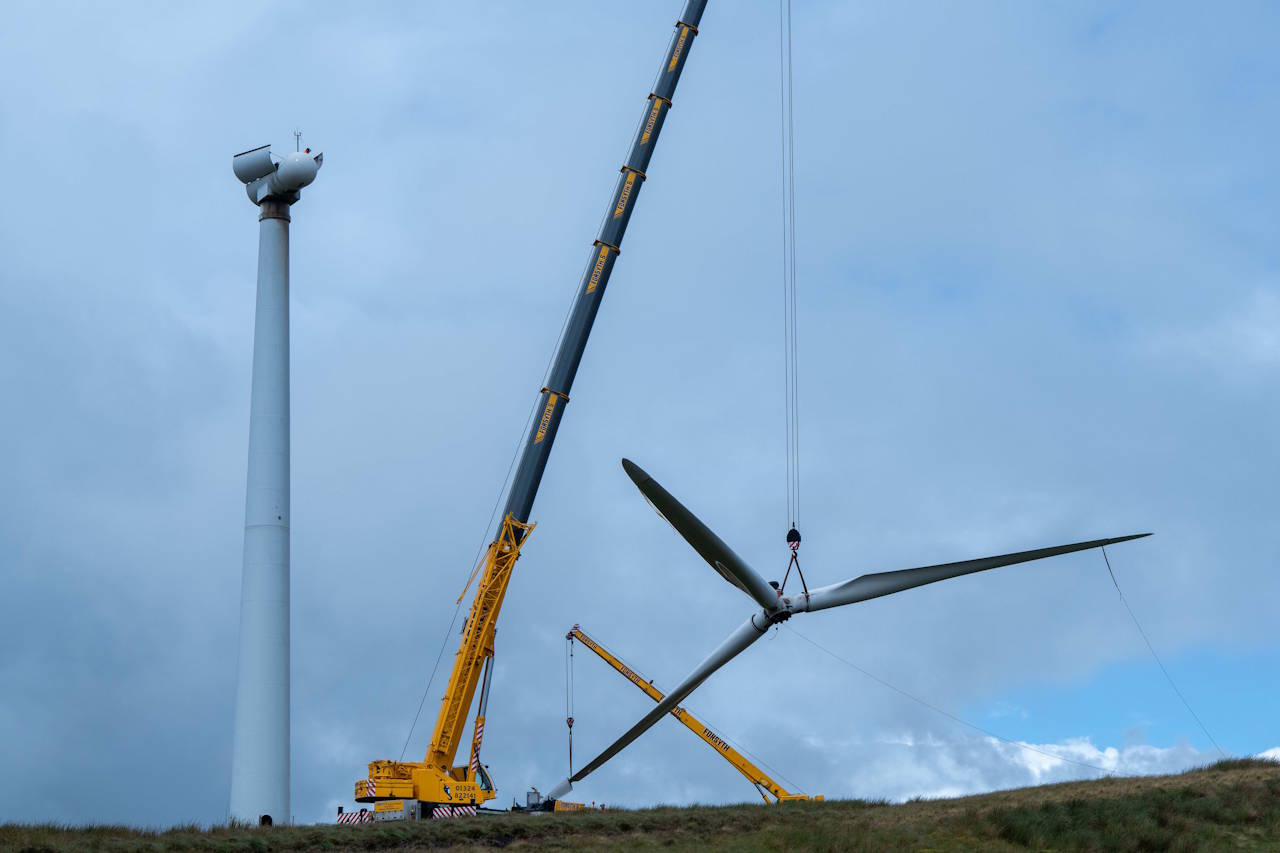
Hagshaw Hill began operating in 1995 with 26 Bonus 600 kW turbines totaling 15.6 MW. A further 20 turbines were added in 2008. The original 26 machines were dismantled in 2023 and replaced with 14 larger turbines totaling more than 79 MW—enough, the company says, to power the equivalent of about 57,000 homes. The site is now part of a wider “Hagshaw Energy Cluster.” Community benefit payments rose from roughly £15,000 a year to nearly £400,000 a year.
Steel towers, nacelles and most metal components have long been recyclable through conventional scrap markets. The hard part has always been the composite blades. Plaswire’s process is mechanical, not a return of glass fiber and resin to virgin-quality feedstock. Blades are cleaned, cut, shredded and granulated, then blended with waste plastics and extruded into RX Polymer products that substitute for concrete, timber and virgin plastics. The company says the process diverts material from incineration. That is recycling in the industrial sense. It is not closed-loop blade-to-blade recycling.
BBC reporting from the 2023 dismantling stated that concrete foundations were scheduled for removal after the towers came down. Planning conditions for the original farm required decommissioning and restoration within six months of ceasing generation. The repowering consent required a decommissioning method statement and later a detailed restoration plan. Public reporting of the Mott MacDonald circular-economy figures focuses on materials from the turbines themselves; it does not publish a line-item confirmation that every cubic meter of foundation concrete was excavated and that the land was returned to pre-1995 condition. That distinction matters. Many wind leases historically allowed foundations and cables to be left in place below a certain depth because full removal is expensive.
26 Turbines Versus Scotland and the World
Scotland had 4,228 operational onshore turbines and 495 offshore turbines as of late September 2025—4,723 machines in total. Onshore wind capacity is about 10.4–10.7 GW. The original 15.6 MW array was roughly 0.15 percent of today’s Scottish onshore capacity. Twenty-six turbines are about 0.6 percent of Scotland’s onshore turbine count. After repowering, 79 MW is still a small fraction of national capacity.
Globally, installed wind capacity reached about 1,299 GW by the end of 2025. Manufacturers installed 28,395 new turbines in 2025 alone. A 2024 remote-sensing inventory counted more than 416,000 onshore turbines worldwide; adding offshore machines and 2025–2026 installations puts the global fleet well above 400,000 units. Twenty-six turbines are a rounding error—on the order of 0.006 percent of the world fleet. One well-executed Scottish pilot does not describe the global market.
ScottishPower has said it has a gigawatt of turbines due to come down over the next decade. Whitelee, the UK’s largest onshore farm with 215 turbines and 539 MW, is slated for phased replacement with fewer, taller machines and a claimed 99 percent recycling rate. Those projects will be the real test, not a 15.6 MW first-generation site.
How Many End Up Abandoned or in Landfills?
Most of a turbine by mass—steel, copper, iron—is recyclable today. Blades are not. They are glass- or carbon-fiber composites designed to last 20–25 years in harsh weather. Until recently, the cheapest option in many jurisdictions was landfill or incineration.
Documented cases include more than 1,100 blades buried at the Casper, Wyoming landfill after being cut into thirds; abandoned blade piles in Grand Meadow, Minnesota that sat for years until regulators forced action; and older California sites where first-generation machines were left standing. Europe is moving toward bans on composite landfilling.
WindEurope has projected tens of thousands of tonnes of blade waste this decade. Studies have warned that thousands of blades could still be landfilled or burned in Europe by 2040 if recycling capacity and rules lag. “Most farms are abandoned” is not accurate. “Blade waste has routinely gone to landfill or incineration, and full-site restoration has often been incomplete” is accurate.
Zero Waste Scotland estimated that recycling all Scottish turbines decommissioned between 2025 and 2050 could recover more than 1 million tonnes of steel plus significant iron and copper. That assumes the work is actually done and paid for.
Costs, Bonds, Subsidies and Ratepayers
UK onshore decommissioning benchmarks commonly fall in the £100,000–£250,000 per turbine range, covering dismantling, transport, foundation and cable works, and restoration. Bonds and letters of credit exist on many modern consents; historic averages have often been far lower than full estimated costs. Viking Wind Farm in Shetland eventually posted a £40 million security—about £90,000 per MW—after a lengthy dispute. Early 1990s projects did not always have robust, inflation-linked funds ring-fenced from day one.
Hagshaw Hill was not a subsidy-free pioneer. It was commissioned under the Scottish Renewables Obligation, the Scottish counterpart to the Non-Fossil Fuel Obligation, and later earned Renewables Obligation Certificates. ScottishPower bought the farm in 1996 for £15 million amid a dispute over contracted prices. Those support mechanisms were paid through electricity bills. Community benefit funds are operator payments linked to installed capacity; they are not a substitute for the levy and certificate costs already socialized onto consumers.
The new 79 MW array is presented as commercially viable in a market where technology costs have fallen. That does not erase the 30 years of policy support that made the original project bankable.
Public materials on the 2023–2025 works do not itemize a standalone decommissioning bill or state that ratepayers were levied a special charge for recycling. The operator and its contractors carried out the work. The original economics, however, rested on mandated support. That is the pattern across much of the first two generations of onshore wind, solar and storage: construction is subsidized or de-risked; end-of-life obligations are left thinner, later, or optional in practice.
The Missing Piece
Repowering Hagshaw Hill increased output with fewer machines and created local contracts. Blade recycling at Plaswire is better than burial in Wyoming. Planning conditions at this site contemplated foundation removal and restoration. Those are facts.
They do not answer the larger questions. Twenty-six turbines are not a meaningful share of Scottish or global capacity. Thousands of blades have already gone to landfill. Many leases still allow partial foundation burial. Decommissioning bonds have frequently been set below realistic future costs. First-generation farms were built with large subsidies paid by electricity customers. Land reclamation and full material recovery were not universally capitalized at financial close.
Sustainable energy is critical.
We need to quit calling wind and solar “Renewable”. Their fuel source is not under current technology and business use cases.
An industry that needs subsidies to get built and then treats soil, concrete, and composite waste as a later problem is not yet sustainable. Land reclamation and end-of-life funding should be locked in—bonded, inflation-linked, and enforceable—before the first foundation is poured.
That standard is still missing across large parts of the wind, solar, and storage market. Hagshaw Hill shows what is possible when a well-capitalized utility chooses to do the work. It does not show that the work is already the default.
Make no mistake, I am all for solar, wind, and storage at the edge, and used to secure off-grid power for homes. Even some at scale in certain places makes sense, but the business model seems built to support climate grifters like Al Gore and Gretta rather than solve a problem.
The United States has a clear problem looming on the horizen. Utilities are letting consumers know they need to prepare for rolling blackouts, and wind and solar farms are within a couple of years of hitting the 20-year life cycle limit. Subsidies are running out, and the true economics of wind, solar, and climate grifting is about to be laid bare. The $89 billion land reclamation bill coming due will ruin a lot of land and ocean areas. Can we hand the bill to the Al Gores of the world who made millions and built homes next to the beach?
We are looking at the global energy markets, and the Trump administration is facing some uphill problems with diesel, gasoline, and the global shortage of refining capacity. Copper, diesel, and gasoline are all on the way up, so buckle up; it is about to get interesting.
I hope the Ukraine war gets resolved quickly, as it seems there was some headway made this weekend.
It is clear that the Fed cannot affect inflation caused by diesel. So, this is a rhetorical question. Do we actually need the Fed?
__________________________________________________________________________________
Check out the World’s Greatest Podcast Show Notes at EnergyNewsBeat.co or EnergyNewsBeat.com.
Appendix: Sources and Links
- RenewEconomy: “A great result: 26 turbines from first commercial wind farm almost completely recycled and reused” — https://reneweconomy.com.au/a-great-result-26-turbines-from-first-commercial-wind-farm-almost-completely-recycled-and-reused/
- BBC: Scotland’s first wind farm ‘supercharged’ after upgrade — https://www.bbc.co.uk/news/articles/cwyn22z24ndo
- BBC: Hagshaw Hill turbines dismantled (2023) — https://www.bbc.co.uk/news/uk-scotland-66187317
- The Scotsman: Wind industry blade recycling — https://www.scotsman.com/business/wind-industry-starts-turning-tables-on-critics-with-blade-recycling-8959266
- Iberdrola / ScottishPower circular economy statement — https://www.iberdrola.com/press-room/news/detail/iberdrola-strengthens-commitment-circular-economy-refurbishment-uk-wind-farms
- Scottish Government: operational turbines FOI — https://www.gov.scot/publications/foi-202500494482/
- Scottish Government: Energy Statistics Q4 2025 — https://www.gov.scot/publications/energy-statistics-for-scotland-q4-2025/pages/renewable-electricity-capacity/
- GWEC Global Wind Report 2026 coverage — https://www.gwec.net/news/global-wind-installations-rise-record-40-as-industry-charts-way-out-of-energy-crisis
- GWEC OEM installations 2025 — https://www.gwec.net/news/gwec-records-sharp-rise-in-wind-turbine-installations-as-five-oems-exceed-100-gw
- Global onshore turbine inventory (GonshoreWT2024) — https://essd.copernicus.org/articles/18/4523/2026/
- Plaswire process descriptions — https://plaswire.com/plaswire-partners-with-global-wind-giant-to-recycle-onshore-wind-turbine-farms/ and https://www.farmersjournal.ie/more/renewables/turning-wind-turbine-blades-into-picnic-tables-828843
- Guardian: race to recycle turbine blades — https://www.theguardian.com/business/2025/sep/21/recycle-turbine-blades-windfarms-uk-europe
- Casper, Wyoming landfill blades — reporting summarized at https://cowboystatedaily.com/2024/08/21/why-old-wind-turbine-blades-arent-being-buried-in-landfills-anymore/
- NYT / landfill blade waste — https://www.nytimes.com/2024/08/30/climate/wind-turbine-recycling-climate.html
- UK decommissioning cost ranges — https://lumifyenergy.com/blog/decommissioning-a-wind-farm/
- Viking decommissioning bond — https://www.scottishbeacon.com/news/environment/viking-energy-bond-well-worth-waiting-for-says-shetland-council-chief-executive/
- Windpower Monthly: 1996 Hagshaw sale / SRO — https://www.windpowermonthly.com/article/953855/utility-adds-wind-portfolio-hagshaw-hill-sold
- Planning / EIA documents (Hagshaw repowering) via ScottishPower Renewables document portal
- Whitelee repowering — https://www.bbc.co.uk/news/articles/cvgl9vp4vqvo
- Common Weal comment on community benefit levels — https://www.commonweal.scot/articles/magazine-d6cz3
- Zero Waste Scotland decommissioning material estimates (via secondary reporting)
- WindEurope / Rabobank end-of-life European context — https://www.rabobank.com/knowledge/d011409804-beyond-design-life-what-to-do-with-aging-wind-turbines-in-europe