

Berlin is talking to its own energy companies about filling gas storage without the government walking into the market and buying molecules itself. That is the story Bloomberg reported today, and it is the tell that Germany’s summer refill has not gone to plan.
Officials have been discussing how Uniper SE and SEFE — both effectively state-controlled after the 2022 rescue — could support stockpiling after the first Middle East ceasefire failed and TTF prices started climbing again. The government still insists the market should fill storage. It just wants its own companies to do more of the filling.
That is not a small distinction. Outright state buying would signal scarcity, drive prices higher, and punish every industrial consumer still hanging on. Quiet help through Uniper and SEFE is the political middle path: keep the free-market slogan, get more gas into caverns.
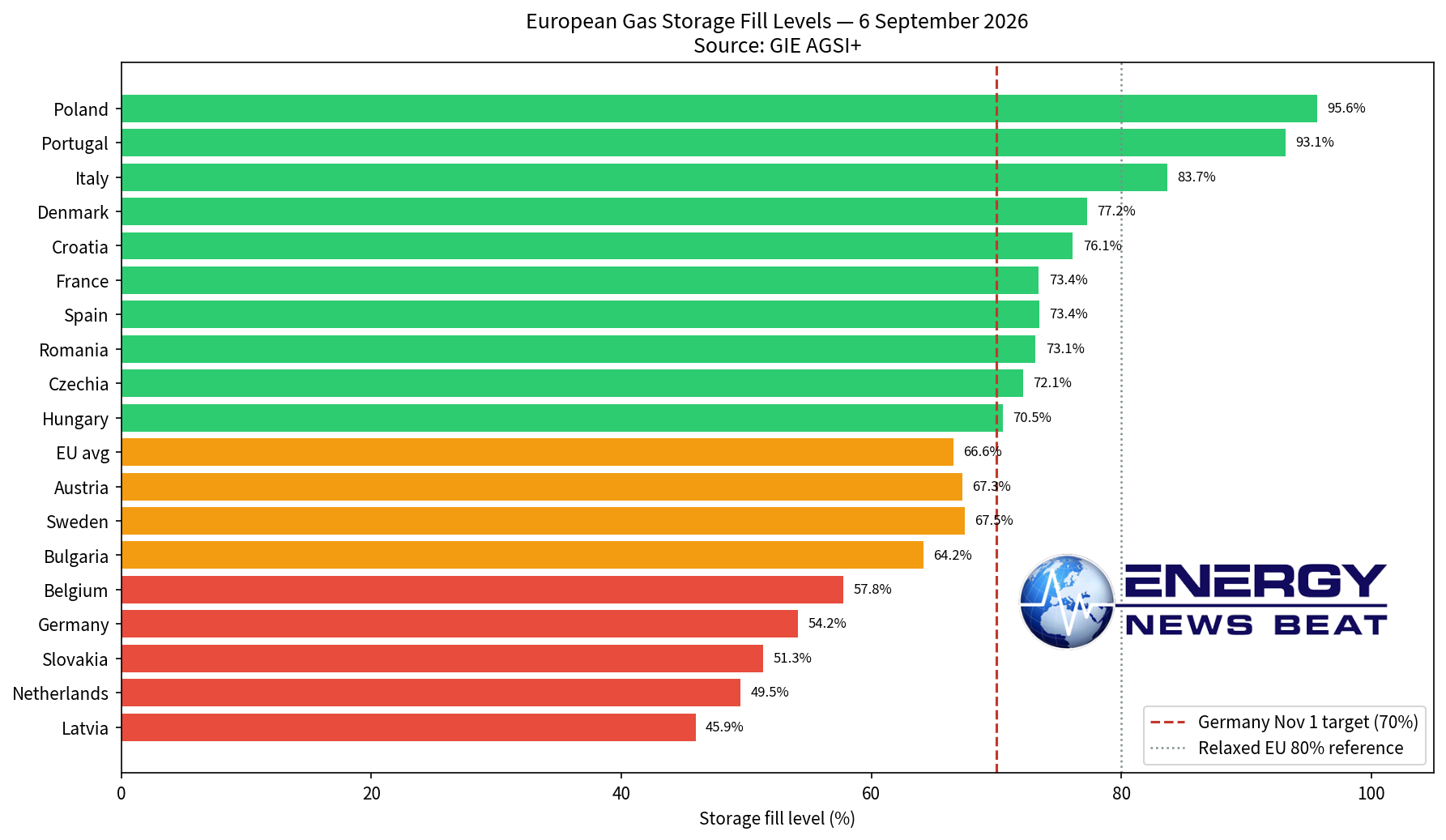
Germany’s own target is now 70 percent by November 1 — already cut from the old 90 percent rule. As of September 6, German storage sat at 54.16 percent. That is far behind September 2025 (~74 percent) and September 2024 (~95 percent). Italy is at 83.7 percent. Poland is at 95.6 percent. The Netherlands is at 49.6 percent. The EU average is 66.6 percent.
The German storage association INES already asked last week for conversion-levy relief, lower network charges at storage connection points, and subsidized state-backed loans. It estimated those measures could cut storage-related costs by about €1.16/MWh. Berlin has so far refused to order Uniper or SEFE to buy “at any price.” The talks reported today are the next step short of that order.
Europe’s summer refill is late and uneven
Europe entered the 2026 injection season thin. A colder late winter left inventories near 28 percent in early April. Then two shocks hit at once: a tight global LNG market after the Strait of Hormuz disruption cut Qatari supply, and an Asian bid that pulled flexible U.S. cargoes east. Hot weather also burned more gas in power plants for air conditioning, leaving less for storage.
The result is a refill year that looks nothing like 2023–2024.
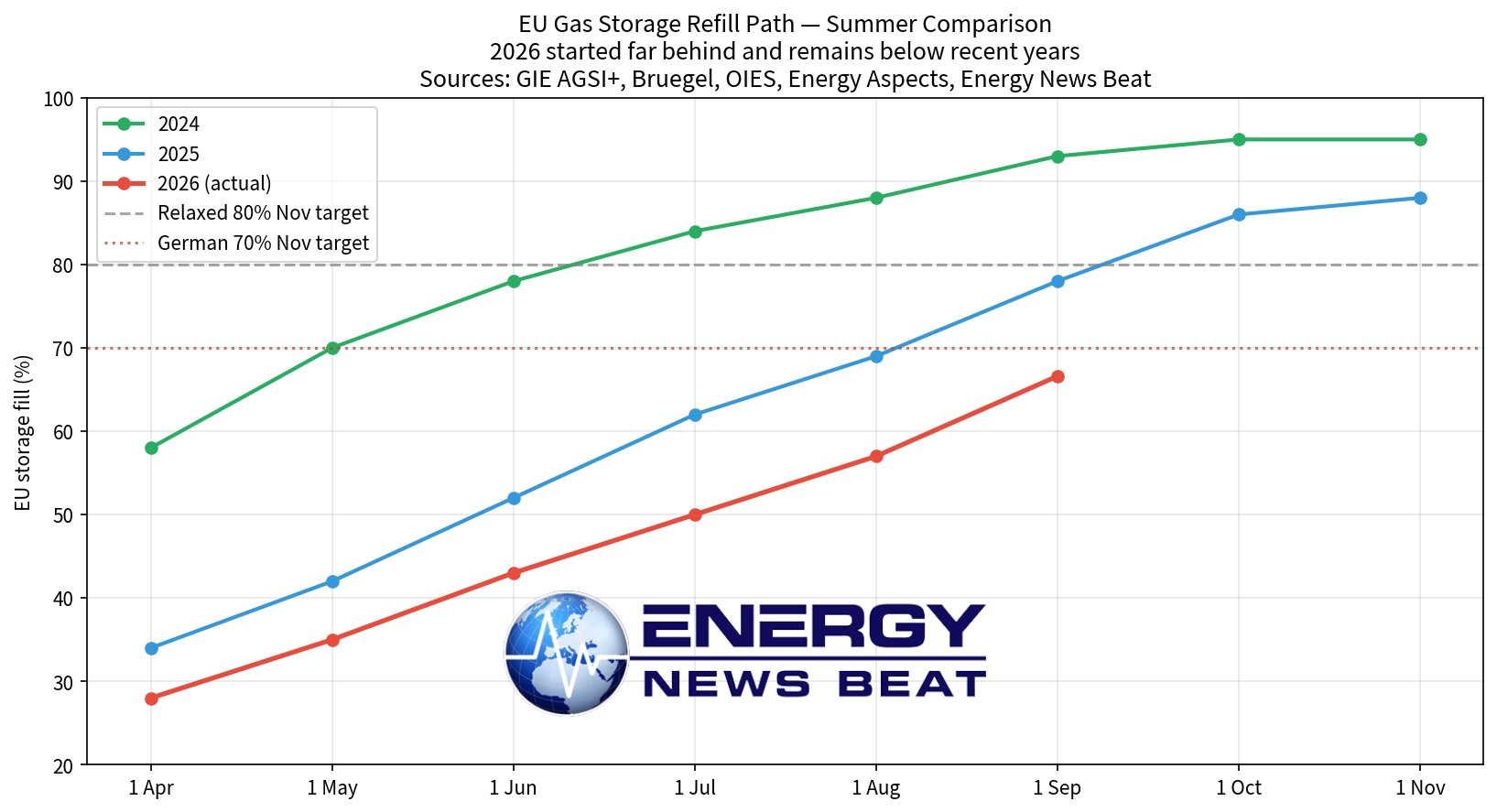
Analysts at OIES and Energy Aspects have been warning since June that matching last year’s November stocks would require summer LNG imports close to 2025 levels. That did not happen. June LNG into the EU fell about 18 percent year-on-year. July European LNG imports plunged 32 percent year-on-year to 6.22 million tonnes, the lowest July since 2021, as U.S. cargoes chased Asian netbacks. GECF data show EU+UK LNG send-out at 8.23 bcm in July, down from 11.02 bcm a year earlier. Pipeline gas actually rose, taking a larger share of the mix.
A relaxed EU target of around 80 percent by November is still mathematically possible if injections stay near 0.3 percentage points a day. Comfortable is another word. Winter 2026/27 will lean more on just-in-time LNG than planners wanted.
Who supplied Europe’s LNG this summer?
First-half 2026 EU LNG imports totaled 53.7 million tonnes, roughly flat with H1 2025 even as the monthly path deteriorated after March. That is about 73 bcm of gas equivalent. The supplier list is short, and it is not the diversified stack Brussels likes to describe.
|
Supplier
|
Volume
|
Share of EU LNG
|
Notes
|
|---|---|---|---|
|
United States
|
31.6 Mt
|
59%
|
Up from 55% in H1 2025. IEEFA: 57% of EU LNG in Q1; 63% of broader European LNG
|
|
Russia
|
9.8 Mt
|
~18%
|
Almost all Yamal LNG. Record H1. Up from ~15% in H1 2025
|
|
Nigeria
|
3.2 Mt
|
~6%
|
Third-largest; rose as Qatar faded
|
|
Qatar
|
Sharply lower
|
6.6% of EU LNG in Q1; near-absent later
|
Hormuz disruption and Ras Laffan damage
|
|
Others
|
~9.1 Mt residual
|
~17%
|
Algeria LNG, Angola, Egypt (when available), Trinidad, Norway LNG (small), Oman, Peru, Mozambique, Equatorial Guinea and spot odds-and-ends
|
Eurostat’s Q1 snapshot matches the same ranking: United States 57.4 percent, Russia 17.3 percent, Qatar 6.6 percent, Nigeria 6.2 percent. IEEFA adds that Nigeria overtook Qatar and Algeria as Europe’s third LNG supplier in Q1. Algeria remains a major pipeline supplier to Italy and Spain, not a top LNG name this year.
The “all countries” list of physical LNG arriving in Europe in 2026 is therefore: United States, Russia, Nigeria, Qatar, Algeria, Angola, Egypt, Trinidad and Tobago, Norway, Oman, Peru, Mozambique, Equatorial Guinea, Malaysia (occasional), and small residual cargoes. The first three plus a shrinking Qatar book dominate the tonnes.
Pipeline gas is a different map. Norway is still the EU’s largest pipeline supplier (about 54–55 percent of pipeline imports). Algeria is second. Russian pipeline gas now arrives only via TurkStream. Azerbaijan supplies Italy via TAP. Libya still sends a thin stream to Italy. The UK interconnectors swing both ways.
Summer 2026 was the season when pipeline gas regained share because LNG lost the spot contest with Asia.

How much is Europe still buying from Russia?
More than the phase-out speeches imply, and less than 2021.LNG:
The EU took a record 9.89–9.97 million tonnes from Yamal LNG in January–June 2026 — 16 to 18 percent more than H1 2025. That is roughly 13.6 bcm. France (about 3.6 Mt), Belgium (about 2.9 Mt) and Spain (about 2.7 Mt) took the bulk. The Netherlands and Portugal took the rest. Urgewald estimates the H1 bill near €6 billion. In Q1, Russia was still 13 percent of all European LNG and 17.3 percent of EU LNG. Some months later, Belgium took every LNG cargo it received in July from Russia as total Belgian LNG volumes collapsed.
Short-term Russian LNG contracts have been banned since late April 2026. Long-term contracts remain legal until January 1, 2027. Buyers with those contracts used flexibility and make-up rights. They also used Yamal because Qatar was missing and U.S. spot cargoes were expensive.
Pipeline:
Only TurkStream still delivers Russian pipeline gas into the EU — mainly Hungary, Slovakia, Greece and Bulgaria. Flows have been relatively stable, on the order of 11–13 bcm per year, with ACER reporting pipeline imports up 7 percent year-on-year in January–May 2026. Short-term pipeline contracts face tighter limits; long-term pipeline gas is scheduled to end in autumn 2027.
Combined:
ACER puts authorized 2026 Russian contracts (LNG plus pipeline) at 45–55 bcm. Actual imports sit inside that band. Russia’s combined share of EU gas imports in early 2026 has been cited around 12–15 percent, versus nearly 40 percent before 2022. That is a collapse in market power. It is not zero. And the LNG slice rose this year, while the pipeline slice survived through the Balkans.

Why Germany is on the phone with Uniper and SEFE
Germany is the swing problem inside the EU average. It has the largest storage system on the continent (about 247 TWh working gas) and one of the weakest fill rates among large users. The government already lowered the November target to 70 percent and told the market it would not send Trading Hub Europe in as a buyer. Storage bookings look better than physical gas in the ground. Booked capacity is not molecules.
Uniper and SEFE are the two companies that can move the needle without a formal strategic reserve. Both buy LNG and pipeline gas. Both store gas. Both answer, ultimately, to Berlin. Using them is a way to inject without announcing a sovereign stockpile — a stockpile Germany has studied since 2025 and still has not built at scale.The risk is obvious. If Uniper and SEFE start paying up for summer gas, they validate the high price. If they wait, November arrives at 60-something percent and winter weather decides the rest. That is why these talks started after the ceasefire failed. Price is the signal. Storage is the buffer. Germany is short of buffer.
The winter setup
Europe can still get through a normal winter. It cannot pretend this refill was a success. U.S. LNG is the backbone. Russian LNG is the awkward residual that disappears in 2027. Nigerian cargoes filled part of the Qatar hole. Norway and Algeria kept the pipes reasonably full. Asia won a lot of the flexible molecules that used to come to Zeebrugge, Fos and Wilhelmshaven in July.
Germany’s conversation with its state-owned companies is the local version of that continental problem: the market was supposed to refill the barns. The barns are half full. Winter is ten weeks away.
At Energy News Beat, we Make Appendices Great Again.
- Bloomberg, “Germany Discusses Gas Storage Help With State-Owned Companies,” Sept. 7, 2026: https://www.bloomberg.com/news/articles/2026-09-07/germany-discusses-gas-storage-help-with-state-owned-companies
- Reuters, “German gas storage group calls for fee cuts, state loans to boost stocks,” Sept. 3, 2026: https://www.reuters.com/business/energy/german-gas-storage-group-calls-for-fee-cuts-state-loans-boost-stocks-2026-09-03/
- POLITICO, “Germany’s gas gamble puts Europe’s winter at risk,” Aug. 7, 2026: https://www.politico.eu/article/germany-gas-reserve-low-europe-winter-energy/
Storage data
- Gas Infrastructure Europe / AGSI+: https://agsi.gie.eu/
- Gasspeicher.app (Germany live AGSI+): https://gasspeicher.app/en/
- Proplanta Europe storage snapshot, Sept. 5, 2026: https://www.proplanta.de/karten/gasversorgung-europa-uebersichtskarte14072022.html
- Bundesnetzagentur storage page: http://www.bundesnetzagentur.de/DE/Gasversorgung/aktuelle_gasversorgung/_svg/Gasspeicher_Fuellstand/Speicherfuellstand.html
- OIES, “European Storage Refill in Summer 2026,” July 2026: https://www.oxfordenergy.org/wpcms/wp-content/uploads/2026/07/European-Storage-Refill-in-Summer-2026.pdf
- OIES, “LNG and Europe Storage,” June 2026: https://www.oxfordenergy.org/wpcms/wp-content/uploads/2026/06/Comment-LNG-and-Europe-Storage.pdf
- Energy Aspects, Europe storage/TTF outlook, June 2026: https://www.energyaspects.com/resources/insights/europe-gas-storage-ttf-outlook-summer-2026
- Energy News Beat, “Europe Gas Buffer Hits 18-Year Seasonal Low,” Aug. 3, 2026: https://energynewsbeat.co/geopolitical/europe-gas-buffer-hits-18-year-seasonal-low-with-little-upside-hope/
LNG and import flows
- IEEFA European LNG Tracker: https://ieefa.org/european-lng-tracker
- IEEFA EU Gas Flows Tracker: https://ieefa.org/eu-gas-flows-tracker
- Bruegel European natural gas imports dataset: https://www.bruegel.org/dataset/european-natural-gas-imports
- Eurostat, “EU imports of energy products – latest developments”: https://ec.europa.eu/eurostat/statistics-explained/index.php?title=EU_imports_of_energy_products_-_latest_developments
- Eurostat news, Q1 2026 energy imports: https://ec.europa.eu/eurostat/web/products-eurostat-news/w/ddn-20260626-2
- energynews.pro, “EU LNG Imports Drop 18% in June 2026”: https://energynews.pro/en/eu-lng-imports-drop-18-in-june-2026-amid-hormuz-disruptions
- GECF Monthly Gas Market Report, July 2026: https://www.gecf.org/Portals/0/xBlog/uploads/2026/7/19/GECFMonthlyGasMarketReport-July2026.pdf
- GECF Monthly Gas Market Report, August 2026: https://www.gecf.org/Portals/0/xBlog/uploads/2026/8/25/GECFMonthlyGasMarketReport-August2026.pdf
- OIES Quarterly Gas Review, Issue 33, July 2026: https://www.oxfordenergy.org/wpcms/wp-content/uploads/2026/07/OIES-Quarterly-Gas-Review-Issue-33-.pdf
- ENTSOG Summer Supply Outlook 2026: https://www.entsog.eu/sites/default/files/2026-04/SO0069-26_Summer%20Supply%20Outlook%202026.pdf
Russian volumes
- Financial Times, “EU buys record amount of gas from Russia’s flagship plant,” July 13, 2026: https://www.ft.com/content/de9bbc3a-c317-4e5f-a324-6ec0dde45722
- ACER, Russian gas imports report 2026: https://www.acer.europa.eu/sites/default/files/documents/Publications/ACER-Report-Russian-gas-imports-2026.pdf
- ACER monitoring page: https://www.acer.europa.eu/monitoring/russian-gas-phase-out-2026
- energynews.pro, Yamal H1 record: https://energynews.pro/en/eu-imports-record-997-mt-of-russian-lng-from-yamal-in-h1-2026
- European Gas Hub, Russian LNG H1 record: https://europeangashub.com/russian-lng-imports-into-the-eu-hit-record-high-in-h1-2026.html
- Offshore Energy / Urgewald cargo breakdown: https://www.offshore-energy.biz/eus-arctic-lng-appetite-hits-new-high-with-e5-96-billion-bill-for-136-russian-cargoes-in-h1-2026/
Chart data compiled from GIE AGSI+ (Sept. 6, 2026), CERA/energynews.pro H1 LNG totals, Kpler figures as reported by FT and Urgewald, Eurostat Q1 partner shares, IEEFA, GECF and OIES. Conversion used throughout: 1 million tonnes LNG ≈ 1.36–1.38 bcm.