On October 14, 2026, President Donald Trump posted on Truth Social that “Massive Oil, Gas, and Mineral Exploration is getting ready to begin in our new and beautiful Greenland.” He added that experts claim the amount of easily available oil is far greater than that of almost any land anywhere in the world, and that Greenland’s position is unmatched for the defense of the United States and Europe. Any future attack on the U.S., he said, would have to come across Greenland, where defenses could routinely intercept drones, missiles, or future weapons.NY Post
The statement came roughly three weeks after the United States, Denmark, and Greenland signed a security agreement on September 22, 2026, on the sidelines of the UN General Assembly. The pact expands the U.S. military role while reaffirming Danish sovereignty and Greenlanders’ right to self-determination. It allows the U.S. to establish or expand bases at Narsarsuaq (south) and Mestersvig (east), modernize Pituffik Space Base, support the Golden Dome missile defense concept, and gain broad air, land, and sea access. It also creates a trilateral screening process that effectively blocks non-NATO, non-NATO-partner, and non-EU investors from controlling or significantly influencing sensitive sectors such as critical minerals extraction and infrastructure without unanimous approval.Atlanticcouncil
Greenland’s government quickly pushed back. Deputy mining minister Jørgen Hammeken-Holm told CNN that while U.S. companies are active, the territory is “very far away from ‘massive’ exploration.” Smaller efforts could take years to become operational. Greenland stopped issuing new oil and gas exploration licenses in 2021 for environmental and climate reasons; only pre-existing licenses remain valid.CNN
The Main Oil Project: Jameson Land Basin and Greenland Energy
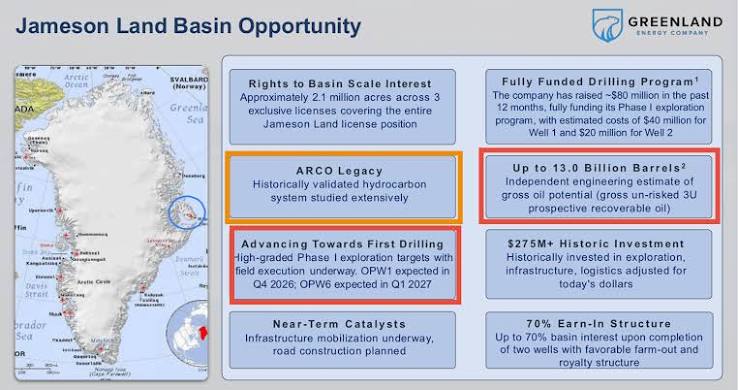
The most advanced U.S.-linked oil effort is in the Jameson Land Basin on Greenland’s east coast, near Scoresby Sound and the remote settlement of Ittoqqortoormiit (Scoresbysund). The licenses are held by White Flame Energy A/S, a subsidiary of London-listed 80 Mile Plc. Texas-based, Nasdaq-listed Greenland Energy Company (GLND) is the U.S. partner and operator under a farm-out agreement. Greenland Energy is funding exploration wells in exchange for up to a 70% interest.
An independent Sproule ERCE assessment has estimated up to roughly 13 billion barrels of gross un-risked prospective recoverable oil across dozens of prospects (highly speculative until drilled). Company materials have described potential value in the hundreds of billions to $1 trillion range under optimistic scenarios. The basin has never been drilled in the modern era; the geology is compared by proponents to the North Sea petroleum system.Oilprice
Progress has been delayed. Equipment was brought ashore in summer 2026 without full prior approval from Greenland’s Mineral Resources Authority, prompting a formal warning. Authorities later stated that the necessary regulatory reviews (including environmental and social processes) could not be completed in time for the 2026–27 winter season. The partners are now targeting a winter 2027 permitting and drilling window. Greenland Energy has contracted Halliburton for project management and logistics support and engaged Stampede Drilling for an Arctic-capable rig. The company has also completed government-approved environmental baseline work.CNBC
Robert Price, CEO of Greenland Energy (and president of related firm USFM Corporation), has linked the project to energy security amid Strait of Hormuz disruptions. Trump special envoy and Louisiana Governor Jeff Landry has claimed Greenland could export 2 million barrels per day and that barrels could reach production in roughly 10 months—figures widely viewed as optimistic given the lack of infrastructure, Arctic conditions, and remaining approvals.
Critical Minerals Activity
On the minerals side, Critical Metals Corp (Nasdaq: CRML) holds the Tanbreez rare earth project in southern Greenland (between Narsaq and Qaqortoq). In early October 2026, Greenland approved the mining and closure plans through 2050, covering 19 critical elements including heavy rare earths (terbium, dysprosium, yttrium) and magnet metals (neodymium, praseodymium). Remaining activity-specific operating permits are still required before construction. The company targets first ore in late 2028 or early 2029, with concentrate exports potentially following in 2029. A preliminary economic assessment has pointed to significant value for Western supply chains outside China.Northernminer
USFM Corporation has explored nickel, copper, palladium, and cobalt prospects around Disko Island in western Greenland. Price has described the district’s potential as large, though still early-stage. Historical major-company exploration (ExxonMobil, Shell, Eni and others) occurred for decades without commercial discoveries. A 2007 USGS assessment of the East Greenland Rift Basins Province estimated a mean of about 31.4 billion barrels of oil equivalent of undiscovered conventional resources (mostly offshore); a 2023 USGS assessment of the West Greenland–East Canada Province put mean undiscovered oil at 7.8 billion barrels. These are technically recoverable undiscovered volumes, not proven reserves.Usgs
The September security agreement explicitly acknowledges minerals cooperation and economic development while giving the three parties leverage to screen foreign investment in resource extraction.
How Fast Can Oil Come Online?
Exploratory drilling in Jameson Land is realistically targeted for the winter 2027 season at the earliest, assuming permits clear. Even a successful discovery would face multi-year timelines for appraisal, development planning, infrastructure (ports, roads, processing, export routes), financing, and further approvals. Arctic logistics, short seasonal windows, high costs, lack of existing energy infrastructure, and environmental requirements make rapid commercialization difficult. Analysts note that past Greenland exploration campaigns have not yielded commercial production. Claims of near-term large-scale exports or “easily available” oil on a world-leading scale remain unproven by drilling.
Critical mineral projects such as Tanbreez are further along on the permitting side and could see construction activity sooner, but first production is still years away.
Benefits for Consumers in Greenland and the United States
For Greenland, successful projects could generate royalty and tax revenue (licensing terms have been cited as potentially returning up to around 15% of eventual oil revenues to the government in one description), jobs, and infrastructure investment. This could support economic diversification and long-term discussions around greater autonomy or independence. Local communities have raised concerns about environmental impacts, consultation, and the pace of activity in remote areas.
For U.S. consumers and industry, the primary potential benefits are strategic: reduced dependence on China for rare earths and critical minerals used in defense, electronics, EVs, and renewable technologies, and an additional source of oil and gas that could improve energy security and help diversify away from volatile Middle East supply routes over the long term. Lower global energy and mineral prices would ultimately benefit consumers if large, economic volumes reach the market, but that outcome depends on discoveries, economics, and development success. The security agreement’s investment-screening provisions aim to keep adversarial influence out of these supply chains.Newsweek
Stocks tied to Greenland projects, including Greenland Energy, rose sharply on the day of Trump’s announcement.
Check out the World’s Greatest Podcast Show Notes at EnergyNewsBeat.co or EnergyNewsBeat.com. And subscribe to: The Energy News Beat Substack.
Appendices
At Energy News Beat we Make Appendices Great Again.
Appendix: Sources and Links
- New York Post / Reuters coverage of Trump’s October 14, 2026, announcement: https://nypost.com/2026/10/14/business/trump-says-massive-oil-gas-mineral-exploration-to-begin-in-greenland/
- Reuters: https://www.reuters.com/business/energy/trump-says-oil-gas-mineral-exploration-begin-greenland-2026-10-14/
- CNN on Greenland government response: https://www.cnn.com/2026/10/14/politics/trump-greenland-oil-gas-minerals-intl-hnk
- OilPrice.com summary: https://oilprice.com/Latest-Energy-News/World-News/Trump-Announces-Massive-Greenland-Oil-Exploration-Plans.html
- White House text of the September 22, 2026, agreement: https://www.whitehouse.gov/briefings-statements/2026/09/agreement-between-the-government-of-the-united-states-of-america-and-the-government-of-the-kingdom-of-denmark-together-with-the-government-of-greenland-to-amend-and-supplement-the-agreement-of-27-apri/
- Atlantic Council and POLITICO analyses of the security deal
- CNBC and New York Times reporting on Greenland Energy / 80 Mile delays and Jameson Land project
- USGS assessments of East and West Greenland resource potential
- Critical Metals Corp announcements on Tanbreez approvals (October 2026)
- Fox News and Newsweek interviews with Greenland Energy CEO Robert Price
This remains a frontier story. Exploration is advancing in specific licensed areas under existing rules, but “massive” production is not imminent. The combination of the new security framework, private U.S. capital, and Greenland’s resource potential has put the Arctic island firmly on the energy and critical minerals map.