The oilfield-services giant earned $0.60 a share on an adjusted basis and kept buying back stock. North America slipped 5% from the second quarter while the Middle East and Asia grew 8%.
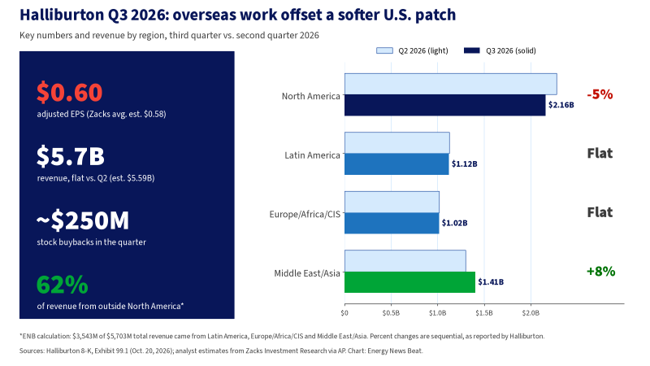
Halliburton was among the first energy companies to report third-quarter results, and on Tuesday morning it beat Wall Street’s forecasts. The Houston company reported adjusted earnings of $0.60 a share on $5.7 billion in revenue (Halliburton 8-K). The nine analysts surveyed by Zacks Investment Research had expected $0.58, and eight analysts expected $5.59 billion in revenue (AP).
On a standard accounting (GAAP) basis, net income was $417 million, or $0.50 a share. The gap comes from a $107 million net pre-tax charge, primarily $107 million of severance tied to what the company called “the rationalization of our global headcount.” Inventory and asset write-offs in the charge were offset by a $36 million gain on the sale of part of an equity investment (8-K). Revenue was flat with the second quarter and up about 2% from a year ago (ENB calculation).
Two different oil patches
The quarter tells a tale of two markets. North America revenue fell 5% from the second quarter to $2.2 billion, which Halliburton blamed on “lower pressure pumping services in U.S. Land.” That’s the fracking work that brings new shale wells online. International revenue rose 3% to $3.5 billion (8-K).
The Middle East and Asia led the way, up 8% sequentially to $1.4 billion on higher activity in Saudi Arabia and Kuwait. Latin America and Europe/Africa/CIS were both flat. Altogether, about 62% of revenue came from outside North America (ENB calculation from the company’s regional table).
Those are quarter-over-quarter moves. Against the third quarter of 2025, North America was down about 9%, Middle East/Asia was roughly flat, and Latin America and Europe/Africa/CIS grew about 13% and 23% (ENB calculations from the 8-K).
The deal list points the same way. The release cites an Eni contract for the Cronos ultra-deepwater development off Cyprus, a bp appraisal job at the Bumerangue field off Brazil, and an agreement with Kuwait Oil Company to support a research center (8-K).
What the CEO said
Jeff Miller, Halliburton’s Chairman, President and CEO, tied the outlook to the supply shock. “We are another three months into one of the largest energy disruptions in history,” he said. He said he expects “the work to restore production, rebuild inventories and strengthen energy security will drive multi-year demand growth for oilfield services” (8-K). The company’s risk language refers to “the current conflict in Iran.”
Looking to 2027, Miller expects mid-single-digit revenue growth and operating margins of about 15%, which he called an approximately 200-basis-point improvement. That outlook “assumes a flat North America market and does not require any recovery in North America hydraulic fracturing,” he said (8-K).
Cash back to shareholders
Halliburton bought back about $250 million of its stock in the quarter and paid a $0.17-a-share dividend, which totaled $141 million. Operating cash flow was $368 million and free cash flow was $156 million, so shareholder payouts topped free cash flow. Cash fell $205 million to $1.84 billion (8-K).
What it means for you
- Drivers: Halliburton sold less U.S. fracking work this quarter, and fracking is how new shale wells get finished. Halliburton itself isn’t counting on a U.S. frac rebound in 2027. That’s worth watching for the supply side of pump prices.
- Investors: Look past the headline beat to three lines: the $0.50 GAAP versus $0.60 adjusted figure, free cash flow ($156 million) versus buybacks plus dividends, and how much growth comes from overseas versus North America (8-K).
| Stu’s Take (opinion)
When we talk about American energy dominance, we usually mean barrels and LNG cargoes. But American know-how is an export too. About 62% of Halliburton’s revenue this quarter came from outside North America (ENB calculation). Its fastest-growing region was the Middle East and Asia, up 8% to $1.4 billion. A Houston company’s services and technology are at work in Saudi Arabia and Kuwait, and it just won jobs off Cyprus and Brazil. That’s energy dominance too. The worry is here at home. North America revenue fell 5%, and Miller’s 2027 plan doesn’t count on a U.S. frac recovery at all. When I hear “one of the largest energy disruptions in history,” I want American service crews working in American shale too, not just overseas. Policy should make it easy to drill here. |