


The Dutch benchmark closed above €100 a megawatt-hour for the first time since 2022, and the same week U.S. gas futures traded near $3.00. One continent is bidding for winter. The other is drowning in its own supply. That gap is a policy choice, not weather.
By Energy News Beat | Oct. 29, 2026 | Prices read 7:00 a.m. CT; TTF close of Oct. 28
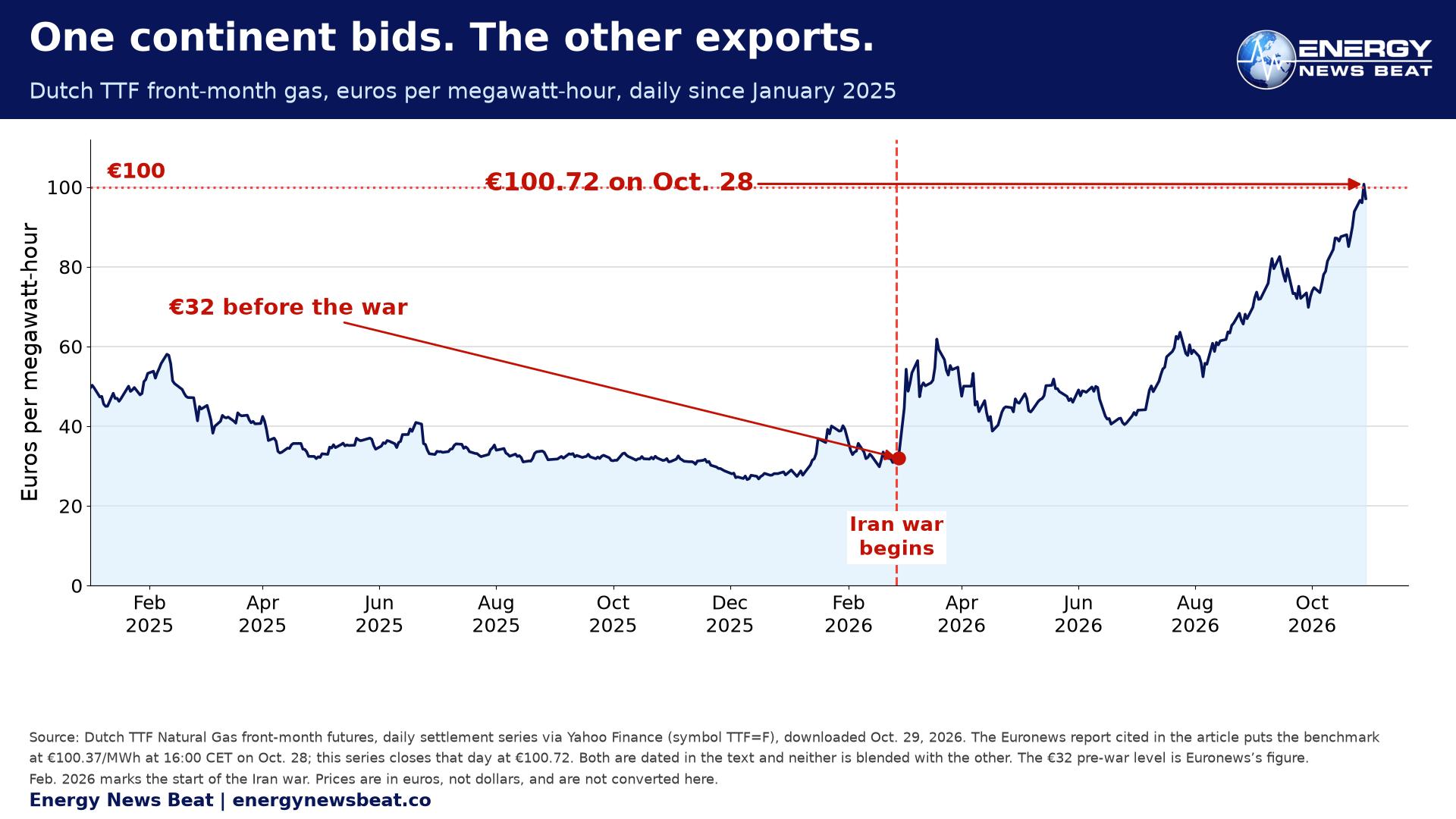
On Wednesday afternoon in Europe, the front-month Dutch TTF contract traded at €100.37 per megawatt-hour at 16:00 CET, up more than 4% on the day and the first time the benchmark crossed €100 since December 2022. It was about €32 before the Iran war began in late February. It has more than tripled this year and is still less than a third of its €340 peak from August 2022.
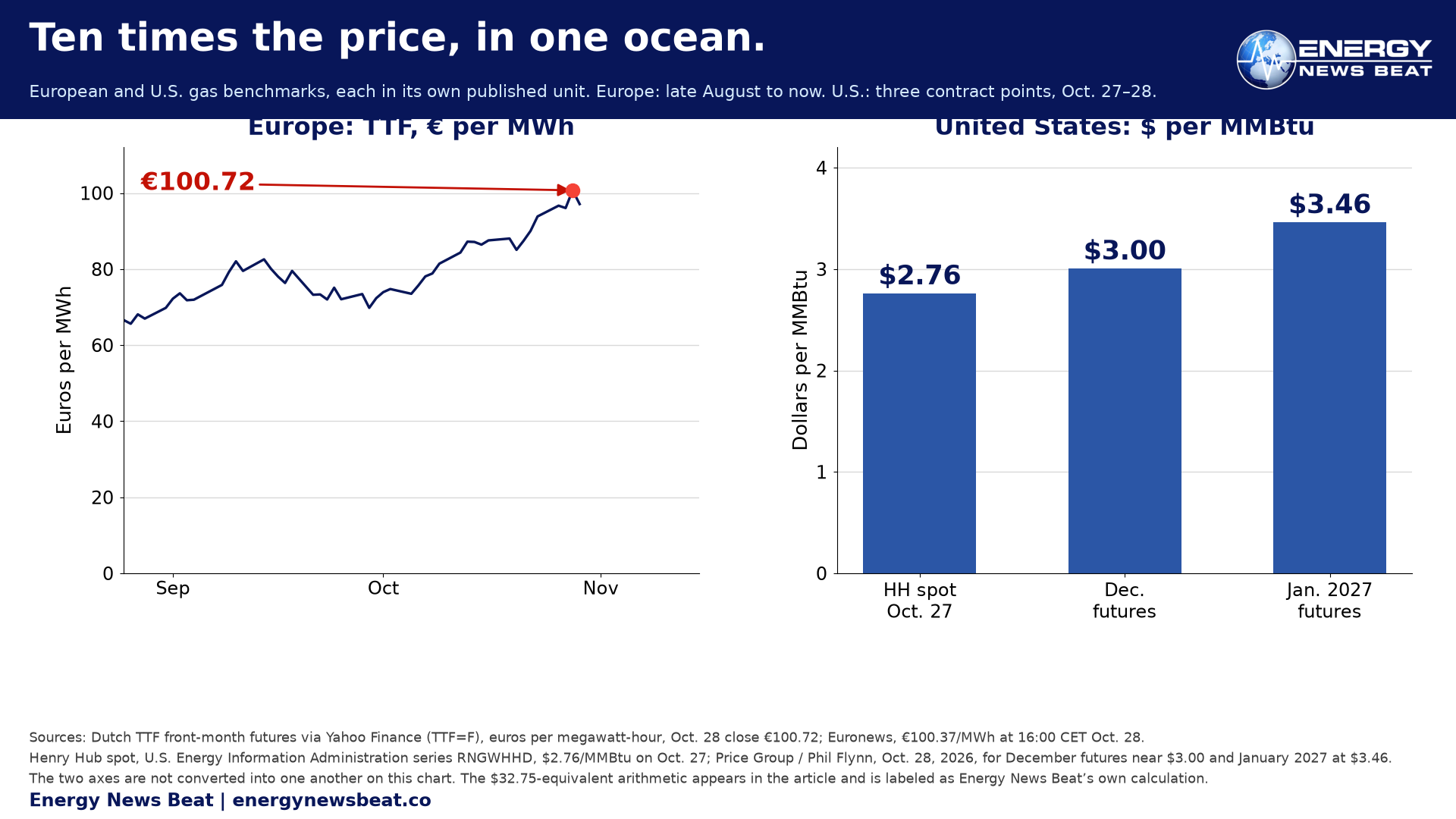
That same week, U.S. December gas futures sat near $3.00, January 2027 at $3.46, a four-year low. These are not the same instrument. But at the ECB reference rate, €100.37 equals roughly $32.75 per million Btu, about ten times the American contract. That conversion is our arithmetic.
Why Europe is paying this
“Once again, due to geopolitical turbulence, Europe faces another energy crisis,” Dan Jørgensen told reporters in Brussels on Wednesday. “We know that this winter will be difficult for European citizens and for our economy in general.” He said bills were “skyrocketing.”
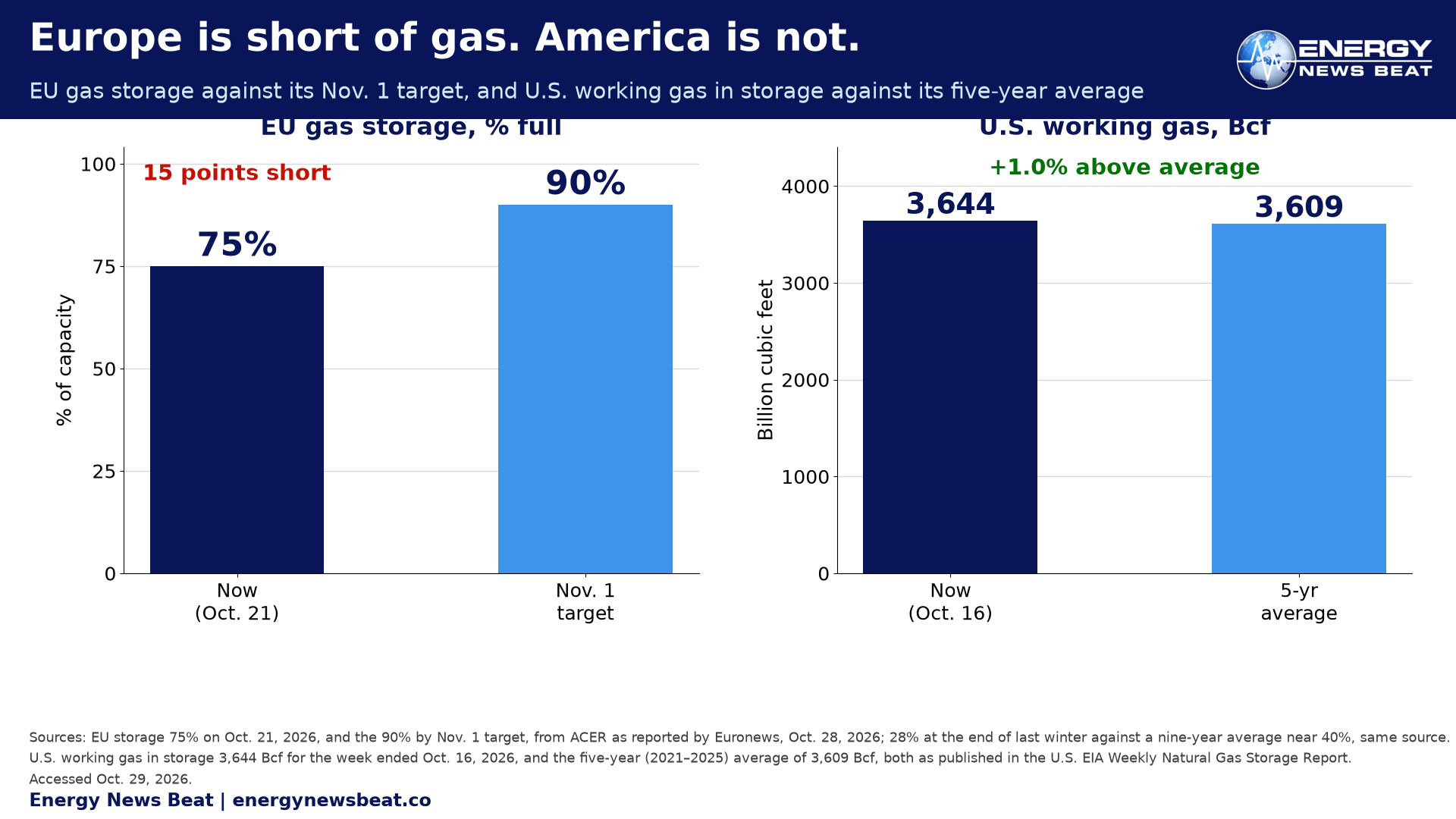
The mechanics are simpler than the rhetoric. European storage stood at 75% on Oct. 21, against the bloc’s usual 90% target for Nov. 1, after finishing last winter at just 28% full. And almost no Qatari LNG reached the EU over the summer, leaving the bloc leaning on American cargoes; the U.S. now supplies roughly 30% of Europe’s gas. Regulators estimate the war has already added €18 billion to €33 billion to Europe’s import bill. European demand is about 20% below pre-2022 levels, so the gas in the ground stretches further.
The Commission also sees the worldwide diesel market staying tight into 2027 and wants more output from European refineries, about a quarter of which have closed in two decades. Same shrinking-capacity story as the U.S., from the other end.
Why America’s price is the odd one out
American gas is cheap for physical reasons that have nothing to do with virtue. Henry Hub spot settled at $2.76 per million Btu on Oct. 27. Storage stood at 3,644 billion cubic feet the week of Oct. 16, 1.0% above the five-year average. The export machine is running flat out to soak up the surplus: feedgas flows to U.S. terminals have been around 19–20 billion cubic feet a day, near records.
America’s gas is cheap because it can get rid of the surplus at a price set abroad. Europe’s is expensive because it has to buy it back. The arbitrage works right up until the day it does not. Who Pays for the Wires? made the same point about transmission: the bill for a thin system arrives later, to someone else.
The Canadian thread
Europe is shopping for a third source. A draft statement for the EU–Canada summit in Montreal on Oct. 29 and 30, seen by Euronews, has the two sides studying long-term LNG exports to Europe alongside grids, storage and infrastructure protection. It promises to assess “long-term energy connectivity, investment and offtake arrangements that contribute to European energy security and Canadian economic development while supporting our shared climate objectives.”
Prime Minister Mark Carney has backed plans that could double LNG export capacity on Canada’s west coast. The draft leaves unanswered how much, at what price, through which terminal. The steel question follows the project. LNG Canada confirmed to CBC News that the Phase 2 modules will again be built in China by state-owned COOEC, because it says no Canadian yard can handle modules of that size, and Canada’s steel institute disputes that claim outright.
The case against it
Not everyone sees a rescue. Esther Bollendorff of Climate Action Network Europe called the feasibility study a “dangerous distraction” that “risks locking in fossil fuel infrastructure, stranded assets and higher bills” for consumers on both sides of the Atlantic. And the draft commits nobody to anything.
What it means at home
For an American household the cheap gas is a quiet subsidy nobody sends a letter about: it is why a January heating bill can stay flat while the rest of the world bids. For a European household the €100 print lands on a January bill with a lag, and the diesel that brings the groceries arrives with it. Same molecule, two very different winters.
The investor view
The trade is no longer about direction but about the spread between two continents. Every cargo leaving the Gulf Coast for Rotterdam tightens the American market and loosens the European one. EBW flags an elevated risk of gas nearing $2.00 by spring 2027 if the weather stays mild. Europe would take that trade in a heartbeat, and cannot, because the pipes run the wrong direction.
| STU’S TAKE
Opinion. Every number is linked to its source. This is my opinion, and take it as one. Two price tags, one week: €100.37 a megawatt-hour on the Dutch TTF and $2.76 per million Btu at Henry Hub. Those two numbers describe the same commodity on the same planet, and the only reason they coexist is that one continent can move it and the other has to bid for it. Europe did this to itself on purpose. It closed the wells, then closed a quarter of the refineries, then discovered that a continent which imports its energy from a war zone does not set its own price. The 75% storage number against a 90% target is what happens when policy meets winter. America’s advantage is real and it is temporary. Our gas is cheap because we can export the surplus, and exporting the surplus is exactly what raises the domestic price over time. We are one bad winter, one export terminal, and one Hormuz incident away from learning the European lesson at home. The fix is not a subsidy and it is not a slogan. It is pipes, plants and permission to build them, and a Congress that stops pretending the price at the pump is a moral question rather than a plumbing one.
|
Appendix
Sources, verbatim excerpts, data tables and methodology notes for “Europe’s Gas Crosses €100 While America’s Stays Cheap.”
A. Sources (all accessed Oct. 29, 2026)
- Euronews, “European gas price crosses €100 for first time since 2022 as EU warns of new crisis,” Oct. 28, 2026
- Euronews, “EU and Canada explore LNG deal as Europe grapples with gas crisis,” Oct. 28, 2026
- CBC News, Janyce McGregor, “LNG Canada to use Chinese steel on $33B expansion project in Kitimat, B.C.,” Oct. 2, 2026 (includes LNG Canada’s statement and the Canadian Institute of Steel Construction’s response)
- Price Group / Phil Flynn, “Short and Intense: The Energy Report 10/28/2026,” Oct. 28, 2026
- Trading Economics, EU Natural Gas (Dutch TTF), accessed Oct. 29, 2026, for the Oct. 29 level
- S. Energy Information Administration, Henry Hub Natural Gas Spot Price, series RNGWHHD, daily through Oct. 27, 2026
- S. Energy Information Administration, Weekly Working Gas in Underground Storage, Lower 48, series NW2_EPG0_SWO_R48_BCF, week ended Oct. 16, 2026
- S. Energy Information Administration, Weekly Natural Gas Storage Report, week ended Oct. 16, 2026, including the published five-year (2021–2025) average
- European Central Bank, euro foreign exchange reference rates, daily XML, reference date Oct. 28, 2026 (EUR/USD 1.1133)
- Energy News Beat, “Who Pays for the Wires? Data Centers and Transmission Costs,” Substack
- Dutch TTF Natural Gas front-month futures, daily settlement series, symbol TTF=F via Yahoo Finance, downloaded Oct. 29, 2026 (504 daily observations)
B. Key excerpts, verbatim
B1. Dan Jørgensen, EU Energy Commissioner, Brussels, Oct. 28, 2026
“Once again, due to geopolitical turbulence, Europe faces another energy crisis.” Link
“We know that this winter will be difficult for European citizens and for our economy in general.” Link
He said fuel bills in the EU were “skyrocketing.” Link
B2. The price and the storage numbers, as published
“The front-month Dutch TTF contract, the benchmark for gas prices in Europe, traded at €100.37 per megawatt-hour at 16:00 CET, up over 4% on the day. It stood at around €32 before the Iran war began in late February, though it remains well below its record of about €340 in August 2022.” Link
“EU gas storage stood at 75% on 21 October, according to the EU Agency for the Cooperation of Energy Regulators (ACER), well short of the bloc’s usual target of 90% by 1 November.” Link
“Storage sites were just 28% full at the end of last winter, compared with a nine-year average of around 40%, and refilling has been slow and costly. ACER estimated the war has pushed up Europe’s bill for gas imports by between €18 billion and €33 billion.” Link
“Almost no Qatari LNG made it to the EU over the summer, leaving the bloc increasingly reliant on the US, which now supplies roughly 30% of its gas, ACER added.” Link
“However, gas demand is around 20% lower than before the 2022 crisis, making the gas that is in storage stretch further.” Link
B3. The EU–Canada draft statement
“The EU and Canada will explore long-term exports of liquefied natural gas (LNG) to Europe as the bloc grapples with soaring gas prices and historically low storage levels, according to a draft joint statement for the EU-Canada summit in Montreal on October 29–30, seen by Euronews.” Link
“The two sides plan to conduct a feasibility study on LNG exports to Europe, alongside closer cooperation on electricity grids, battery storage and the physical and cyber protection of energy infrastructure.” Link
“We will assess opportunities for long-term energy connectivity, investment and offtake arrangements that contribute to European energy security and Canadian economic development while supporting our shared climate objectives,” the draft says. Link
“However, the draft leaves unanswered key questions about how much LNG Canada could supply, at what cost and what infrastructure would be needed to deliver it to European markets.” Link
“Canadian Prime Minister Mark Carney has backed plans that could double LNG export capacity on Canada’s west coast.” He has also signalled openness to New Brunswick gas if the province reverses its fracking ban, saying: “We will change things at the federal level that need to be changed in order for projects to move forward.” Link
B4. The American side, from the Price Group report of Oct. 28
“Feedgas flows to U.S. export terminals have been hovering near record highs, recently around 19–20 Bcf/d, with Europe remaining the dominant destination amid ongoing needs to refill inventories and replace other supplies.” Link
“Still, December fell to $3.004 while January 2027 reached $3.46/MMBtu to hit fresh four-year lows.” Link
“Weather-driven demand has shed about 25 gas heating degree days since Friday.” EBW Analytics, as reported by Flynn. Link
“Storage set to approach 3.9 Tcf coupled with extremely mild November weather may eventually erode the December contract into Thanksgiving.” EBW Analytics, as reported by Flynn. Link
“Chances for exceptional price weakness nearing $2.00/MMBtu in spring 2027 appear to be an elevated risk.” EBW Analytics, as reported by Flynn. Link
B5. The steel behind the modules, from CBC News, Oct. 2, 2026
“For the plant construction in Kitimat, the challenge is not a preference for offshore steel, but the specialized fabrication capability required for modules of this scale and complexity,” LNG Canada spokesperson Paul Hagel wrote in an email. “There are no fabrication yards in Canada that can manufacture and deliver the additional modules required for Phase 2.” Link
“Members of the Canadian Institute of Steel Construction (CISC) dispute the suggestion that Canadian steel fabricators aren’t capable of building modules for Kitimat.” Spokesperson Rita Rahmati: “We are confident that Canadian fabricators can deliver a substantial portion of the work, including the modules required for Phase 2.” Link
The new compression stations along the pipeline will be “targeting almost 15,000 tonnes of steel from Canadian suppliers or mills, representing approximately 70 per cent of the steel required for that work,” per LNG Canada. Link
“LNG Canada told CBC News there are no tariffs now on importing steel components from its Chinese supplier.” The duties in effect when the issue first arose in 2018 expired after five years and were not renewed. Link
C. Data tables
C1. The two benchmarks, each in its own unit and its own session
| Measure | Value | Unit | Date / session | Source |
| Dutch TTF front-month | €100.37 | per MWh | 16:00 CET, Oct. 28 | Euronews |
| Dutch TTF front-month | €100.72 | per MWh | Oct. 28 close | TTF series |
| Dutch TTF front-month | €97.46 (−2.87%) | per MWh | Oct. 29, latest | Trading Economics |
| TTF before the Iran war | about €32 | per MWh | late February 2026 | Euronews |
| TTF record | about €340 | per MWh | August 2022 | Euronews |
| Henry Hub spot | $2.76 | per MMBtu | Oct. 27 | EIA |
| U.S. December futures | $3.004 | per MMBtu | Oct. 28 | Flynn |
| U.S. January 2027 futures | $3.46 | per MMBtu | Oct. 28 | Flynn |
Three TTF prints from three sources on two days. They are never averaged and never presented as one number. The article quotes the Euronews 16:00 CET print in the body, because that is the figure the story is about, and Chart 1 plots the Yahoo Finance settlement series, which is labeled on the chart. Trading Economics puts Thursday’s level at €97.46, down 2.87% against its own previous-day value of €100.34. That change is measured from Trading Economics’s own prior price, not from the €100.72 settlement above it, so the percentages do not line up across rows and are not meant to. The pullback is noted in the appendix rather than the body because the piece is about the Wednesday crossing.
C2. Storage, both continents, as of the latest published reading
| Measure | Europe | United States | Source |
| Latest level | 75% full on Oct. 21 | 3,644 Bcf, week ended Oct. 16 | Euronews, EIA |
| Comparable benchmark | 90% target by Nov. 1 | Five-year average 3,609 Bcf | Euronews, EIA |
| Position against benchmark | 15 points short | 1.0% above | ENB subtraction of EIA figures |
| Prior winter end | 28% full | — | Euronews |
| Historical reference | nine-year average near 40% | — | Euronews |
| Import dependence | U.S. supplies roughly 30% of EU gas | net exporter | Euronews |
The U.S. five-year average is published by EIA, not computed by us: the Weekly Natural Gas Storage Report for the week ended Oct. 16, 2026 puts working gas at 3,644 Bcf against a five-year (2021–2025) average of 3,609 Bcf, describing stocks as 35 Bcf above that average. The 1.0% above-average figure is those two published numbers subtracted and divided. An earlier draft of this article computed the average from the raw weekly series instead, which gave 3,602 Bcf and about 1.2%; that difference came from week alignment between years, and the published column is the right number to use. Europe’s percentages are as ACER published them.
C3. The conversion, done once and labeled
| Step | Value | Note |
| TTF, Euronews print | €100.37/MWh | 16:00 CET Oct. 28 |
| TTF, U.S. equivalent | $32.75/MMBtu | ENB arithmetic at the ECB rate |
| ECB reference rate | 1.1133 USD/EUR | Oct. 28, 2026 |
| Conversion factor | 3.4121 MMBtu/MWh | Standard thermal conversion |
| December U.S. futures | $3.004/MMBtu | Price Group, Oct. 28 |
| Ratio | about 10.9x | ENB arithmetic |
This is a reference conversion, not a claim that the two contracts are interchangeable. European gas is priced on a hub with different delivery terms, different quality specifications and a different contract length than a Henry Hub futures contract. The number is here so a reader can see the order of magnitude, and the article says every time it appears that the arithmetic is ours.
D. Background and methodology
Why the two continents diverged. Europe imports about 30% of its gas from the United States now, having replaced much of the Russian supply it used to buy by pipeline, and a large share arrives as LNG priced at a global margin. When a supplier is disrupted, as Qatari cargoes have been, Europe competes with Asia for whatever is left. The United States produces more gas than it consumes, stores the surplus and exports what it cannot use at a price set by those same global buyers, so the domestic price reflects domestic abundance minus whatever the terminals pull out of the system.
Units. TTF is quoted in euros per megawatt-hour. Henry Hub is quoted in dollars per million British thermal units. One megawatt-hour equals about 3.4121 MMBtu, so a euro price per MWh can be converted for reference, which this article does once, explicitly, and never inside a sentence that implies the contracts are equivalent. The chart plots each market on its own axis for that reason.
Which price is in the body. Three TTF prints exist for this week: the Euronews 16:00 CET quote of €100.37, the settlement of €100.72 on the same day from the futures series, and Thursday’s €97.46 on Trading Economics. The body uses the Euronews figure because that is the crossing the story is about, and because it is the number the Energy Commissioner was responding to. The others are disclosed in Appendix C1. No average of the three appears anywhere.
Storage. European storage percentages come from ACER as reported by Euronews and are quoted as published. The U.S. figure is the EIA weekly series for the week ended Oct. 16. The two are not the same kind of measure: one is a percentage of capacity across a bloc, the other is a volume in billion cubic feet for a country, and the chart places them side by side with separate axes rather than in a common unit.
The Canada thread. The EU–Canada LNG arrangement described here is a draft statement seen by Euronews, not a signed agreement. No volume, price or terminal has been named, and the article says so. The steel point is sourced to CBC News of Oct. 2, 2026, which reported LNG Canada’s own confirmation that the Phase 2 modules will again be fabricated in China by state-owned COOEC, the company’s stated reason (no Canadian yard can handle modules of that scale, and marine access is essential), and the Canadian Institute of Steel Construction’s dispute of that claim. CBC also reported that the pipeline compression stations will target about 15,000 tonnes of Canadian steel, roughly 70% of the steel for that work, and that the anti-dumping duties that applied during Phase 1 have expired. All of that is public and linked; the article cites CBC rather than any internal work.
What could not be verified. The draft EU–Canada statement has not been published; Euronews reports having seen it. The U.S. five-year storage comparison uses EIA’s own published five-year average (3,609 Bcf) rather than a figure computed here. The $32.75 conversion depends on the ECB rate for Oct. 28. Stu’s Take is labeled opinion and every figure in it links to the publisher of that figure.
