A letter from the Vice President is the most senior American outreach to Tehran in months, and crude drifted lower on the news. The same reporting says Washington and Israel are still preparing a week of strikes after the Nov. 3 election. Both things are true, and the gap between them is what you are paying for at the pump.
By Energy News Beat | Oct. 29, 2026 | Prices read 6:50 a.m. CT; London trading 0922 GMT
Vice President JD Vance sent a letter to Mohsen Rezaei, the secretary of Iran’s Supreme National Security Council, and the message inside it is narrow. Any negotiation meant to head off American military strikes, Vance wrote, “require discussions on the nuclear issue,” according to a U.S. official who described the letter to Axios. That is the whole opening position. Not a peace plan, not a ceasefire. A condition.
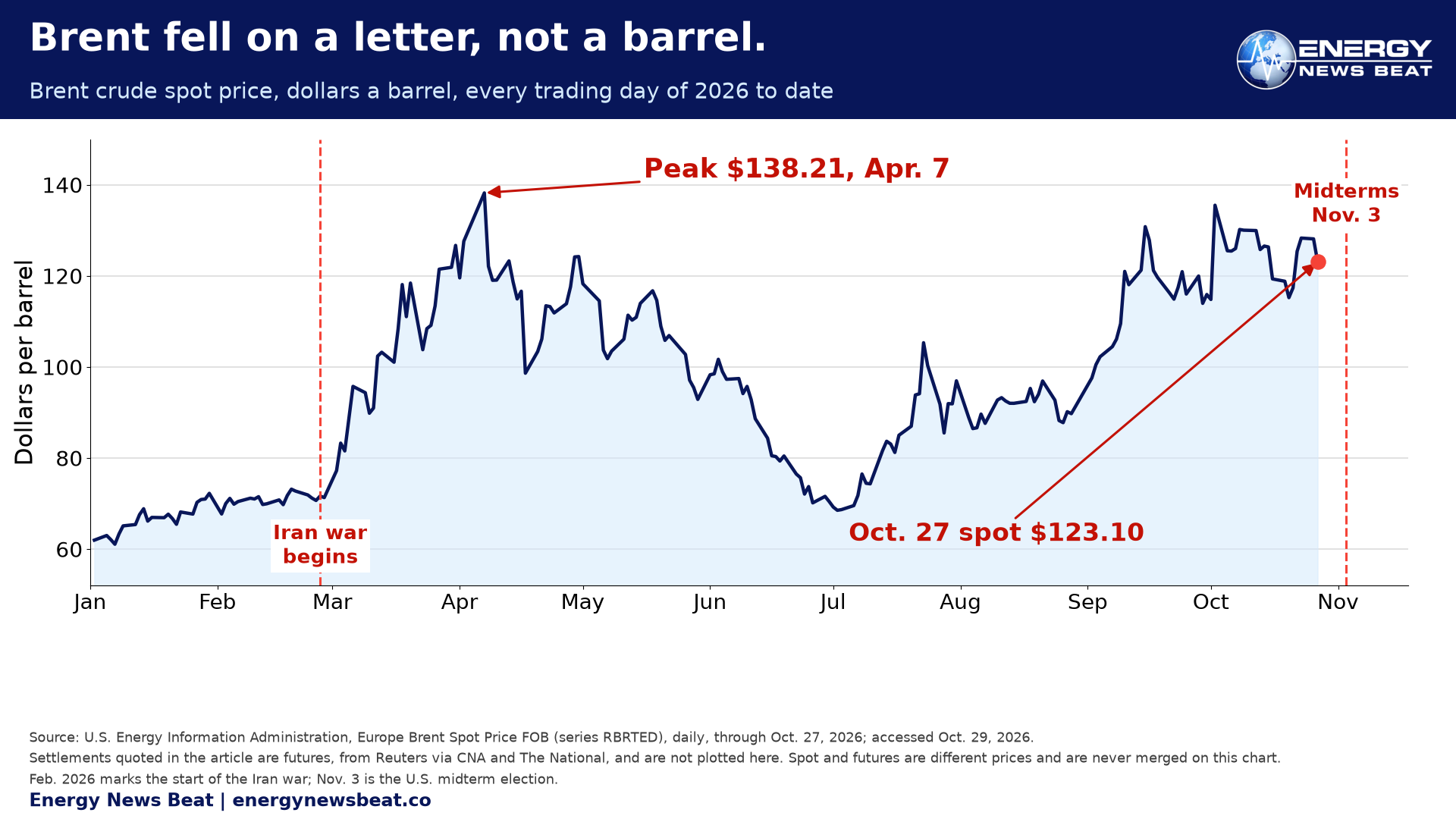
The market’s answer was immediate. Brent crude fell $1.27, or 1.1%, to $114.05 a barrel by 0922 GMT, and West Texas Intermediate dropped $1.51, or 1.5%, to $101.27. Both benchmarks had gained the day before, when Brent settled at $115.32. Thursday’s move gave back less than the week’s run-up. That is the tell: traders are not pricing peace, they are pricing the possibility of a phone call.
What the letter actually says
Axios reported that the letter focused on “the possibility of restarting negotiations between the U.S. and Iran” and called it “the most senior-level outreach by the U.S. to Iran in several months”. Vance proposed the letter himself; Rezaei has a direct line to Supreme Leader Mojtaba Khamenei. A U.S. official told Axios that “The President was enthusiastic about the letter.” The Journal first reported it; Axios confirmed it with its own official.
President Trump spent Wednesday lowering expectations rather than raising them. Asked whether he had directed the outreach, he said no. “They need help with medical supplies and various things. He asked me what I thought. I said, ‘if you want to do that, that’s OK,’” Trump told reporters. “Basically, it’s getting supplies in to help people that are not well,” he said. Read that against Axios’s account and you have two briefings of one envelope.
That contradiction is not a detail. If the letter is about medicine, nothing changes for a barrel. If it is the first move in a nuclear negotiation, a war premium built since February starts to come out.
What Iran wants first
The sticking point has not moved. Iran’s price for talking is that Washington lift its naval blockade, release frozen funds and allow oil sales. The American position is the reverse: nuclear concessions first, sanctions relief after. Axios put it plainly, that the U.S. “wants Iran to restart nuclear negotiations before receiving any sanctions relief.”
Qatar is running the mediation, with Pakistan, Saudi Arabia, Egypt and Turkey behind it. One proposal would let IAEA inspectors visit nuclear facilities damaged in the war in exchange for limited sanctions relief, including waivers to export oil and use frozen money for food and medicine. A regional source told Axios: “There is some movement. We are waiting for the Iranian response.”
There is a second track, reported by Reuters: daily confidence-building steps over seven days, several guarantor countries, an Iranian answer expected by week’s end. A senior Iranian official told Reuters that Qatar had presented no formal proposal at all, only “ideas Tehran considered unacceptable”, and that Iran would show no flexibility on the nuclear file.
The strike option is still on the table
This is reporting, not a decision, and it needs to be read that way. Axios, citing U.S. and Israeli officials, reported that a potential operation could involve “a week of extensive strikes against Iranian leadership, energy infrastructure, nuclear facilities and other targets”. The Wall Street Journal reported that Washington warned several Gulf states to prepare for a possible short, intense campaign after the election. Israel’s military chief, Eyal Zamir, spoke with the head of U.S. Central Command on Monday, and American forces have been moving missile defenses and restocking munitions.
No decision has been announced, and the reporting ties the timing to the Nov. 3 midterms. That is why the premium has not collapsed: the calendar is doing the work. A letter sent before an election and a campaign scheduled after it are not contradictory. They are a sequence.
What it costs you at the pump
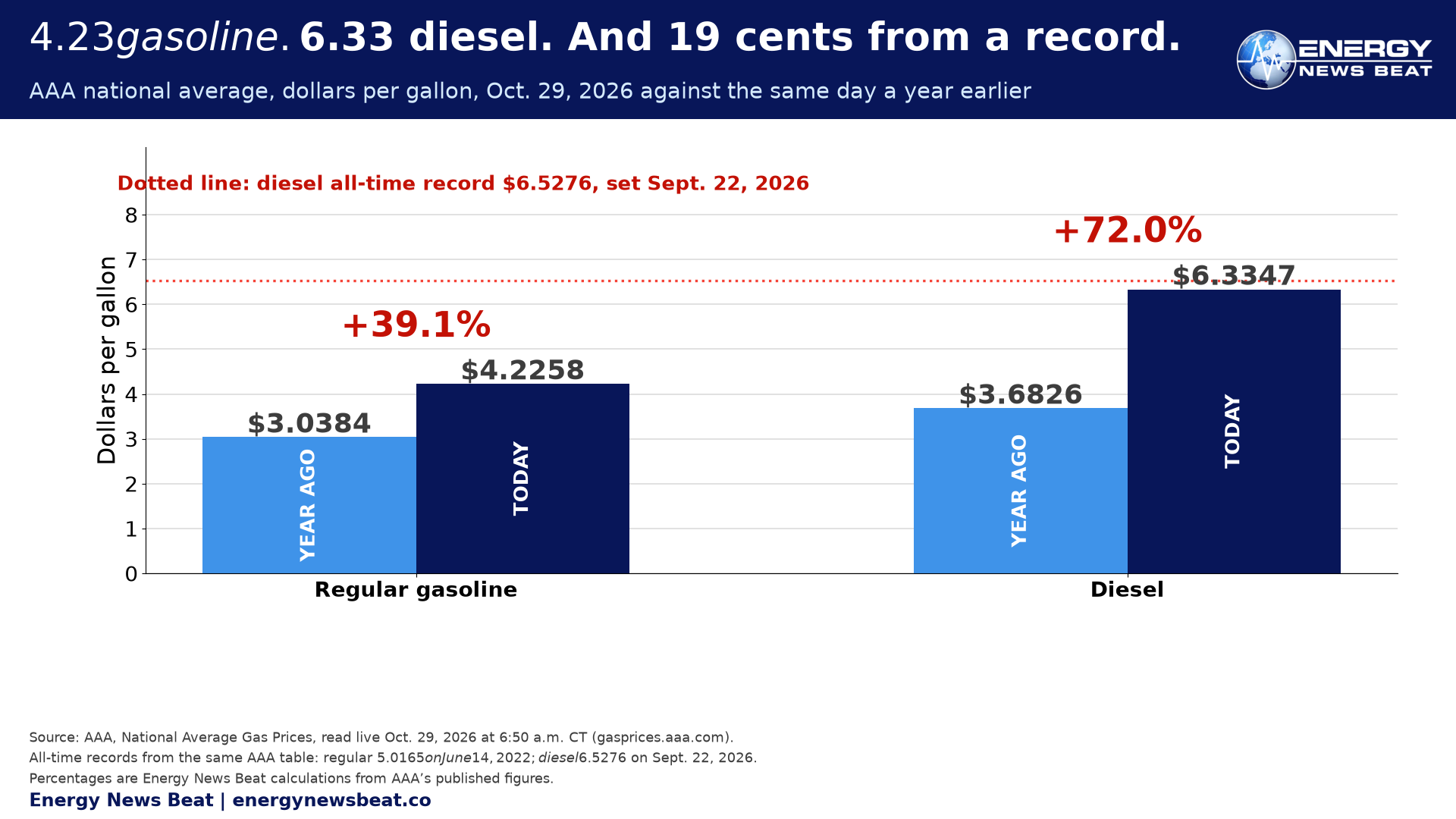
AAA had regular at $4.2258 a gallon Thursday morning, down 2.1 cents overnight and 23 cents on the month, but 39% above the $3.0384 of a year ago. Diesel is the number that travels into everything you buy: $6.3347, down 1.5 cents overnight and 72% above last year’s $3.6826. The record is $6.5276, set Sept. 22. The country is 19 cents from breaking it again.
The federal survey samples a different day and lands in the same place: EIA’s week of Oct. 26 put regular at $4.269 and diesel at $6.352, up 40.7% and 70.8% from a year earlier. The two surveys differ because they sample on different days. Neither is adjusted to match the other here.
Why diesel is the tight one is not mysterious. Distillate stocks stood at 102.8 million barrels in the week ended Oct. 23, down 9.4 million from the same week last year, a decline of 8.3%. Refineries ran at 92.8% of operable capacity that week. There is not much slack left to absorb a shock, and the shock being priced is a missile, not a maintenance schedule.
The thin margin is the story
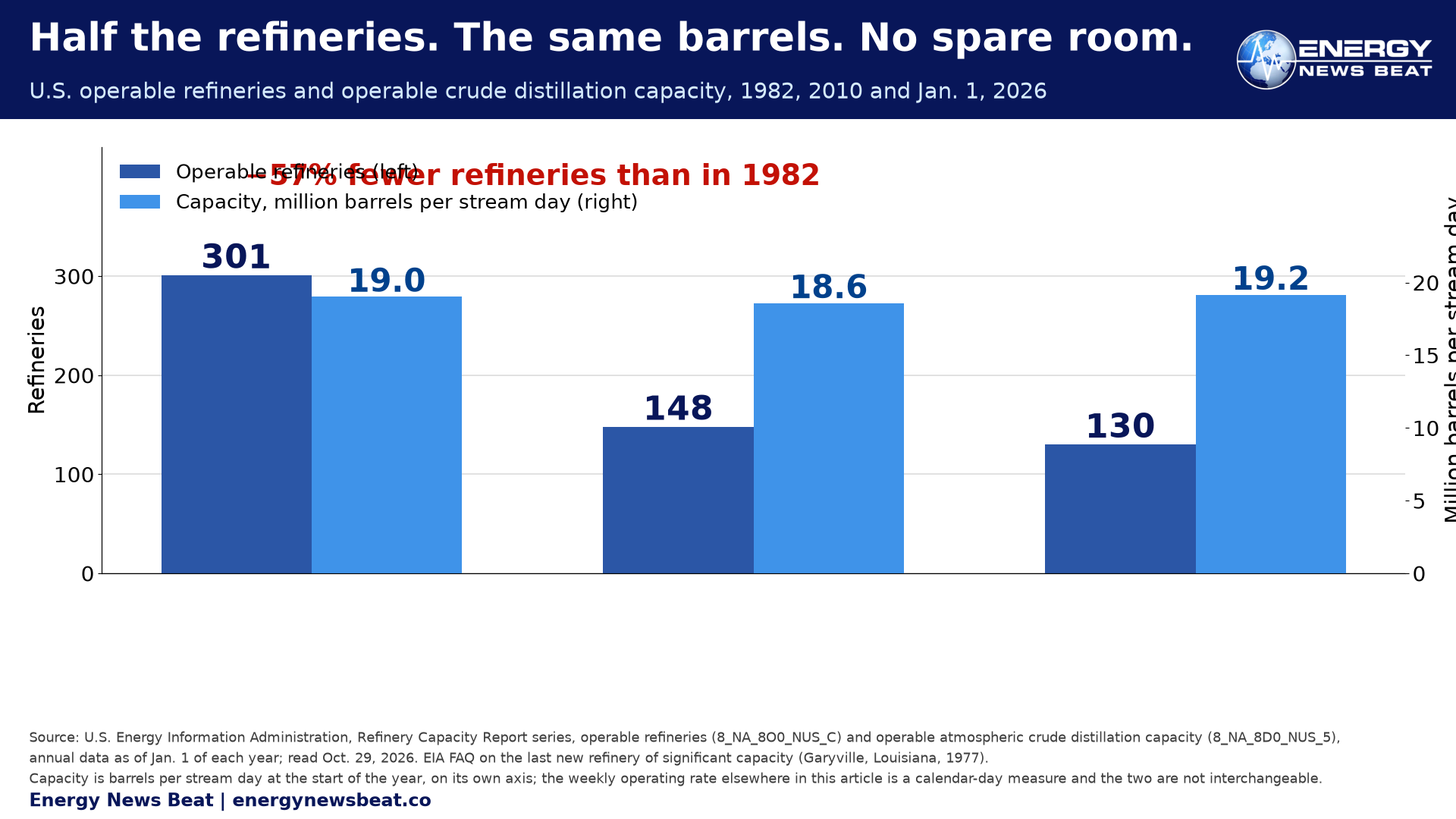
This is where the refinery argument stops being about California and becomes about the country. The United States had 301 operable refineries in 1982 and 130 as of Jan. 1, 2026, with operable crude distillation capacity essentially flat near 19 million barrels per stream day. The newest with significant downstream capacity is Marathon’s Garyville, Louisiana, which came online in 1977.
Flat capacity against a growing export book means every foreign disruption lands on a smaller buffer. When two California refineries closed, EIA warned the lost barrels were less than 2% of U.S. refining capacity but 17% of California’s, and could not be replaced from elsewhere because little pipeline capacity runs from the Gulf Coast to the West Coast. The same logic applies nationally, one accident at a time. The thin-margin arithmetic is the one we laid out in Who Pays for the Wires?, except that spare refining capacity, unlike spare transmission, cannot be built in a decade.
The investor view
For anyone holding energy, the next six days are a binary event with a date on it. A credible framework takes Brent toward $100 and the diesel crack with it. A week of strikes does the opposite, and diesel is the market that would gap, because stocks are already 8.3% below last year and Europe is bidding for the same barrels.
The asymmetry is the point. Wednesday’s settlement had priced much of the strike case; Thursday’s headline gave back 1.1%. That is a small move against a large story, which means the market is not convinced. UBS expects Brent near $110 at year-end, and its analyst Giovanni Staunovo points at inventories: “Global inventories have fallen sharply, with pledged strategic oil reserves releases largely completed.” A deal has to overcome that. A strike confirms it.
The gas market barely noticed. Henry Hub settled at $2.76 per million Btu on Oct. 27 with December futures near $3.00. This is a crude and diesel premium, not yet a gas one.
What would change the story
Three things. If Tehran formally answers the Qatari draft this week, the seven-day track becomes real and the premium comes out fast. If Iran repeats that there is no flexibility on enrichment, the track dies and the strike case hardens.
One caution. Nearly every detail traces to anonymous officials, and the principals describe the same letter in incompatible ways. Trump called it medical supplies; Axios reported it demands nuclear talks. Both can be true of a document nobody has published.
The other side of the argument
The case against reading this as de-escalation deserves a hearing. A letter restating a precondition Iran has rejected for years is not a concession; it is a restatement with better stationery. Tehran’s demands, an end to the blockade and access to frozen money, are the ones it made before the war.
There is a cost to the strike case that the barrel price misses. Hitting Iranian energy infrastructure raises the risk to Hormuz traffic, and the Revolutionary Guards said Thursday that three tankers hit sea mines and burned trying an unauthorized route south of the strait. Insurance, freight and whether crews will sail are all part of the price, and none show up in a Brent quote.
And the humanitarian reading is not nothing. If the letter really is about medical supplies reaching a population under blockade, then the cynicism is misplaced and the outcome is worth having on its own terms. The problem is that nobody outside the administration can tell which reading is correct.
| STU’S TAKE
Opinion. Every number is linked to its source. This is my opinion, so take it as such. A letter moved 1.1% off the price of crude on Thursday. A letter. Not a barrel of supply, not a decision, not a signature. That is how thin the world’s cushion has become, and it is the number I want you to sit with. Here is what the cushion looks like. Diesel is $6.3347 a gallon, 72% above last year, and the record is $6.5276 set five weeks ago. Distillate stocks are 8.3% below last year. Refineries ran at 92.8%. And the country has 130 refineries where it had 301 in 1982, with nothing of scale built since 1977. We spent twenty years closing capacity and calling it efficiency, then called the resulting price spikes a supply chain problem. When a missile lands on a Saudi refinery or a tanker hits a mine near Hormuz, the United States no longer has the spare barrels at home to shrug it off. We pay, and then we argue about who to blame. The war premium either evaporates or doubles in the week after Nov. 3. I do not know which. What I know is that a country that cannot refine its own demand is a country that does not get to choose.
|
Appendix
Sources, verbatim excerpts, data tables and methodology notes for “Vance Tells Iran: Talks Must Cover the Nuclear Program.”
A. Sources (all accessed Oct. 29, 2026 unless stated)
- Axios, Barak Ravid, “Vance tells top Iranian official negotiations must address nuclear program,” Oct. 28, 2026
- Iran International, “Trump confirms Vance’s outreach to Tehran as US weighs strikes after midterms,” Oct. 29, 2026
- Reuters via Channel NewsAsia, “Oil falls as diplomacy hopes outweigh Middle East escalation fears,” Oct. 29, 2026, 0922 GMT version
- CNBC, “Oil price today: WTI, Brent,” Oct. 29, 2026 (intraday quotes)
- The National (Abu Dhabi), “Oil prices decline after diplomatic push in Iran war,” Oct. 29, 2026 (Oct. 28 settlements)
- AAA, National Average Gas Prices, gasprices.aaa.com, read live Oct. 29, 2026 at 6:50 a.m. CT
- S. Energy Information Administration, Weekly U.S. Retail Gasoline and Diesel Prices, week of Oct. 26, 2026 (released Oct. 27, 2026)
- S. Energy Information Administration, Weekly Petroleum Status Report, week ended Oct. 23, 2026 (released Oct. 28, 2026), summary PDF
- S. Energy Information Administration, Petroleum and Other Liquids weekly data hub (WPSR tables and stocks)
- S. Energy Information Administration, Europe Brent Spot Price FOB, series RBRTED, daily through Oct. 27, 2026
- S. Energy Information Administration, Cushing WTI Spot Price FOB, series RWTCD, daily through Oct. 27, 2026
- S. Energy Information Administration, Henry Hub Natural Gas Spot Price, series RNGWHHD, daily through Oct. 27, 2026
- S. Energy Information Administration, Refinery Capacity Report series: operable refineries, 8_NA_8O0_NUS_C; operable atmospheric crude distillation capacity, 8_NA_8D0_NUS_5 (annual, as of Jan. 1)
- S. Energy Information Administration, Refinery Capacity Report, annual editions
- S. Energy Information Administration, FAQ, “When was the last refinery built in the United States?” (id=29)
- S. Energy Information Administration, Today in Energy, “Refinery closures present risk for higher gasoline prices on the West Coast,” July 9, 2025, id=65704
- S. Energy Information Administration, Today in Energy, “U.S. refining capacity decreased during 2025,” June 29, 2026, id=67807
- Price Group / Phil Flynn, “Short and Intense: The Energy Report 10/28/2026,” Oct. 28, 2026
- Energy News Beat, “Who Pays for the Wires? Data Centers and Transmission Costs,” Substack
B. Key primary-document excerpts, verbatim
B1. The letter, as reported by Axios
“The letter stressed that any negotiations to head off U.S. military strikes require discussions on the nuclear issue,” per a U.S. official. The article quotes the phrase as “require discussions on the nuclear issue.” Link
Axios describes the letter as “the most senior-level outreach by the U.S. to Iran in several months” and says it focused on “the possibility of restarting negotiations between the U.S. and Iran.” Link
“The President was enthusiastic about the letter,” a U.S. official told Axios. Link
Iran’s position, per Axios: the U.S. would first “lift its naval blockade, release frozen funds and allow oil sales.” The U.S. position: it “wants Iran to restart nuclear negotiations before receiving any sanctions relief.” Link
Rezaei is described as holding “a direct line to Supreme Leader Mojtaba Khamenei.” The Wall Street Journal first reported the letter; Axios confirmed it. Link
B2. The President, on the record
“They need help with medical supplies and various things. He asked me what I thought. I said, ‘if you want to do that, that’s OK.’” (Trump to reporters, as reported by Iran International) Link
“Basically, it’s getting supplies in to help people that are not well.” (Trump, as reported by Axios) Link
“We need to finish the job — either through a deal or another way — we will find out if negotiations can succeed.” (Trump, as reported by Iran International) Link
B3. The strike reporting, and how it is labeled
Every sentence in this article about a possible military campaign is attributed reporting, not a decision. The reporting is specific and it is not confirmed by any government on the record. Axios, citing U.S. and Israeli officials, described a potential operation as “a week of extensive strikes against Iranian leadership, energy infrastructure, nuclear facilities and other targets.” The Wall Street Journal reported that Washington warned several Gulf states to prepare for a possible short, intense campaign after the election. Iran International reported that Israel’s military chief, Eyal Zamir, spoke with the head of U.S. Central Command on Monday. No decision has been announced, and this article does not assert that one has been made.
That framing matters for readers trading off the headline. A reported plan is a data point about intentions. It is not a launch order, and it can be walked back without any public trace.
B4. Market quotes, each with its own timestamp
“Selling pressure is prevailing amid expectations that peace talks may resume. However, the decline remains limited.” (Yuki Takashima, Nomura, via Reuters, 0720 GMT version, syndicated by CNBC) Link
“Oil prices are under pressure today amid renewed diplomatic efforts to de-escalate the conflict in the Middle East.” (Giovanni Staunovo, UBS, via Reuters) Link
“Global inventories have fallen sharply, with pledged strategic oil reserves releases largely completed. An under-supplied market could push commercial stocks lower and should sustain oil prices.” (Staunovo, via The National) Link
“ideas Tehran considered unacceptable” — a senior Iranian official to Reuters, on what Qatar has presented so far, as carried by Iran International. The same official said Iran would show no flexibility on the nuclear issue. Link
C. Data tables
C1. Crude oil: every quote in this article, by outlet, timestamp and session
| Quote | Brent | WTI | Session / timestamp | Source |
| Settlement, Wed. Oct. 28 | $115.32 (+1.3%) | $102.78 (+2.9%) | Wednesday close | The National |
| Intraday, Thu. Oct. 29 | $114.05 (−$1.27, −1.1%) | $101.27 (−$1.51, −1.5%) | 0922 GMT | Reuters via CNA |
| Intraday, Thu. Oct. 29 | $113.32 (−1.73%) | $100.66 (−2.06%) | CNBC live quote | CNBC |
| Intraday, Thu. Oct. 29 | $114.10 | above $101 | 7:48 a.m. UAE time | The National |
| Spot, Tue. Oct. 27 | $123.10 | $103.37 | EIA daily spot | EIA Brent, EIA WTI |
These are five different prices from four different sources at five different moments, and they are never blended in the text. The two Thursday Reuters versions (0720 GMT and 0922 GMT) differ because the market moved between them; the article quotes the later one and attributes it. The EIA spot figures are a separate series from the futures settlements and are used only in Chart 1, which is labeled as spot.
C2. Retail prices: two surveys, two methods, same direction
| Measure | Current | Yesterday | Week ago | Month ago | Year ago | Change y/y | Source |
| AAA regular | $4.2258 | $4.2471 | $4.2701 | $4.4558 | $3.0384 | +39.1% | AAA |
| AAA midgrade | $4.7485 | — | — | — | — | — | AAA |
| AAA premium | $5.1417 | — | — | — | — | — | AAA |
| AAA diesel | $6.3347 | $6.3499 | $6.3090 | $6.4391 | $3.6826 | +72.0% | AAA |
| EIA regular, week of Oct. 26 | $4.269 | — | $4.284 | — | $3.035 | +40.7% | EIA |
| EIA diesel, week of Oct. 26 | $6.352 | — | $6.276 | — | $3.718 | +70.8% | EIA |
AAA is a daily survey of stations; EIA is a Monday sample of retail outlets published the following Wednesday. They sample different days and different stations, which is why the two current figures differ by about four cents. Year-over-year percentages in the EIA rows are as published by EIA; the AAA percentages are Energy News Beat calculations from AAA’s own table. Records, both from AAA: regular $5.0165 (June 14, 2022); diesel $6.5276 (Sept. 22, 2026).
C3. The physical picture: stocks, runs and capacity, week ended Oct. 23, 2026
| Measure | Latest | Change vs. prior week | Year ago | Change y/y | Source |
| Crude oil, total (million barrels) | 693.2 | −2.0 | 825.1 | −131.9 (−16.0%) | WPSR |
| Commercial crude ex-SPR | 410.6 | — | — | — | WPSR |
| Strategic Petroleum Reserve | 282.6 | — | 409.1 | −126.5 (−30.9%) | WPSR |
| Total motor gasoline | 209.2 | +3.9 | 210.7 | −1.6 | WPSR |
| Distillate fuel oil | 102.8 | −1.5 | 112.2 | −9.4 (−8.3%) | WPSR |
| Refinery crude inputs (thousand b/d) | 16,526 | — | — | — | WPSR |
| Refinery utilization, U.S. | 92.8% | — | — | — | WPSR |
| Utilization: East Coast / Midwest | 81.7% / 88.1% | — | — | — | WPSR |
| Utilization: Gulf Coast / West | 94.9% / 95.1% | — | — | — | WPSR |
| Domestic crude production (thousand b/d) | 13,992 | — | — | — | WPSR |
Utilization is crude inputs as a share of operable atmospheric crude distillation capacity. The West Coast at 95.1% is the number to keep in mind when reading about California refinery closures: that region is already running close to its ceiling, and the finding that the Los Angeles and Benicia refineries made up less than 2% of U.S. refining capacity but 17% of California’s comes from EIA’s Today in Energy of July 9, 2025.
C4. Refineries: fewer plants, flat capacity, no new scale since 1977
| As of Jan. 1 | Operable refineries | Operable capacity (million bbl/stream day) | Source |
| 1982 | 301 | 19.02 | EIA |
| 2010 | 148 | 18.58 | EIA |
| 2020 | 135 | 20.09 | EIA |
| 2026 | 130 | 19.16 | EIA |
The 2020 row is included because it is the local peak in operable capacity in the published series; capacity has since come down as plants closed. Garyville, Louisiana, 617,000 barrels per calendar day, came online in 1977 and is the newest refinery of significant capacity in the country. The newest of any kind is Texas International Terminals in Galveston, 45,000 barrels per calendar day, which began operating in February 2022. Calendar-day and stream-day capacity are different measures; the weekly operating rate in this article is a calendar-day measure and is not compared with the stream-day figures above.
C5. Who said what: the Iran file, dated
| Date | Event | Source |
| Wed. Oct. 28 | Vance’s letter to Rezaei reported; Vance proposed it himself; Trump told reporters he did not direct it | Axios, Iran International |
| Wed. Oct. 28 | Brent settles $115.32, WTI $102.78 | The National |
| Wed. Oct. 28 | Qatar-led mediation continues; Ali al-Thawadi visits Tehran; IAEA-inspection-for-relief proposal reported | Iran International |
| Thu. Oct. 29 | Trump confirms the outreach, frames it as medical supplies | Iran International |
| Thu. Oct. 29 | Brent $114.05, WTI $101.27 at 0922 GMT | Reuters via CNA |
| Thu. Oct. 29 | Revolutionary Guards say three tankers struck sea mines south of Hormuz in 24 hours | Reuters via CNA |
| Thu. Oct. 29 | Senior Iranian official: no formal Qatari proposal, no flexibility on the nuclear file | Reuters via CNA |
| Tue. Nov. 3 | U.S. midterm elections | — |
D. Background and methodology
Why a letter moves a barrel. The United States entered this autumn with the lowest commercial crude stocks in years relative to demand, a Strategic Petroleum Reserve drawn down by more than 30% year over year, and a refining system that has lost more than half its plants since 1982 while holding capacity roughly flat. In that configuration the price of crude is set at the margin by expectations about the next disruption, not by the cost of the last barrel produced. A letter that makes a strike less likely is therefore worth more than a letter that makes one more likely is worth less, and the market reprices on the headline rather than the text.
The three Thursday snapshots. This article quotes three intraday Brent prints from Oct. 29, each with its own outlet and timestamp, because they moved within the morning and blending them would produce a number no source published. The 0922 GMT Reuters figure is the one used in the body. The CNBC figure is used only in the appendix table. The National’s 7:48 a.m. UAE print is used only in the appendix table. No average of the three appears anywhere.
Futures and spot. Settlement prices (Brent $115.32, WTI $102.78) are futures closes. The EIA series plotted in Chart 1 is a daily spot assessment. The two are different instruments and are never merged here. The chart is labeled as spot and carries the date range explicitly.
Reporting versus decision. Statements about a possible military campaign are attributed to the outlets that published them and to the officials those outlets cited, in every instance. No sentence in this article asserts that a strike decision has been made. Where the reporting rests on anonymous officials, the article says so and treats the sequencing as reported rather than established.
The retail surveys. AAA and EIA measure retail fuel prices with different methods on different days. The article quotes both and explains the gap rather than picking the more dramatic number. The AAA figures were read live on the morning of publication; they will differ from any figure a reader checks later the same day, and the article dates them to the minute for that reason.
Refining capacity. Operable capacity in the EIA Refinery Capacity Report is stated in barrels per stream day as of Jan. 1. Weekly utilization in the WPSR is crude inputs over operable capacity in barrels per calendar day. The two are not interchangeable, and this article does not convert one into the other; where both appear, each is labeled with its own unit.
What could not be verified. The text of Vance’s letter has not been published. Its contents are known only through officials who described it to Axios and the Journal. The existence and scope of any planned military operation is known only through the same kind of sourcing. Readers should treat both as reporting and weigh them accordingly. Nothing in the market data depends on either.
Opinion. Stu’s Take is labeled opinion and every figure in it links to the publisher of that figure.
E. What would settle the open questions
Five things would move this story from reporting to record. Each is listed with the specific document or statement that would do it, so readers can check for themselves rather than waiting for a summary.
- The text of the letter. Nothing in the public record shows the document itself. Publication of the letter, or an on-record description from the White House or the State Department, would settle whether it is a nuclear-opening or a humanitarian gesture.
- A statement on the military option from a named official. The strike reporting rests on anonymous officials speaking to Axios and the Journal. A Pentagon or National Security Council statement, or a denial, would resolve it in one direction or the other.
- Iran’s formal answer through Qatar. Reuters reported an answer expected by the end of the week and a possible seven-day process starting early next week. A formal response, or its absence, is checkable.
- Confirmation of any IAEA arrangement. The inspection-for-relief idea is reported, not agreed. The IAEA would be the body to confirm it, and its public statements are the place to look.
- Next week’s EIA data. Distillate stocks at 102.8 million barrels and utilization at 92.8% are the physical facts behind the diesel price. The Wednesday report either confirms the tightness or relieves it.
Until those arrive, the honest position is the one this article takes: the market is trading a headline about a letter, and the underlying shortage of refining capacity, distillate stocks and spare barrels is unchanged by anything in it.