Repower? Whitelee’s £1.5 billion proposal is real. What it means for American electricity bills is a different question.
By Energy News Beat | As of November 8, 2026 CST
The bill matters more than the ribbon-cutting
There is nothing wrong with replacing an old machine with a better one. Families do it with cars and furnaces. The question is whether the replacement earns its keep—and who carries the risk if it does not. Wind farms deserve that same common-sense test.
David Turver’s new Whitelee analysis raises a fair challenge: bigger turbines do not automatically mean cheaper electricity. His starting number checks out. ScottishPower Renewables itself describes a £1.5 billion repowering proposal for the Scottish wind farm. But a development budget is not a customer bill, and a sensitivity model is not an awarded electricity contract. Those distinctions matter on both sides of the Atlantic.
Whitelee: a major redevelopment, not a tune-up
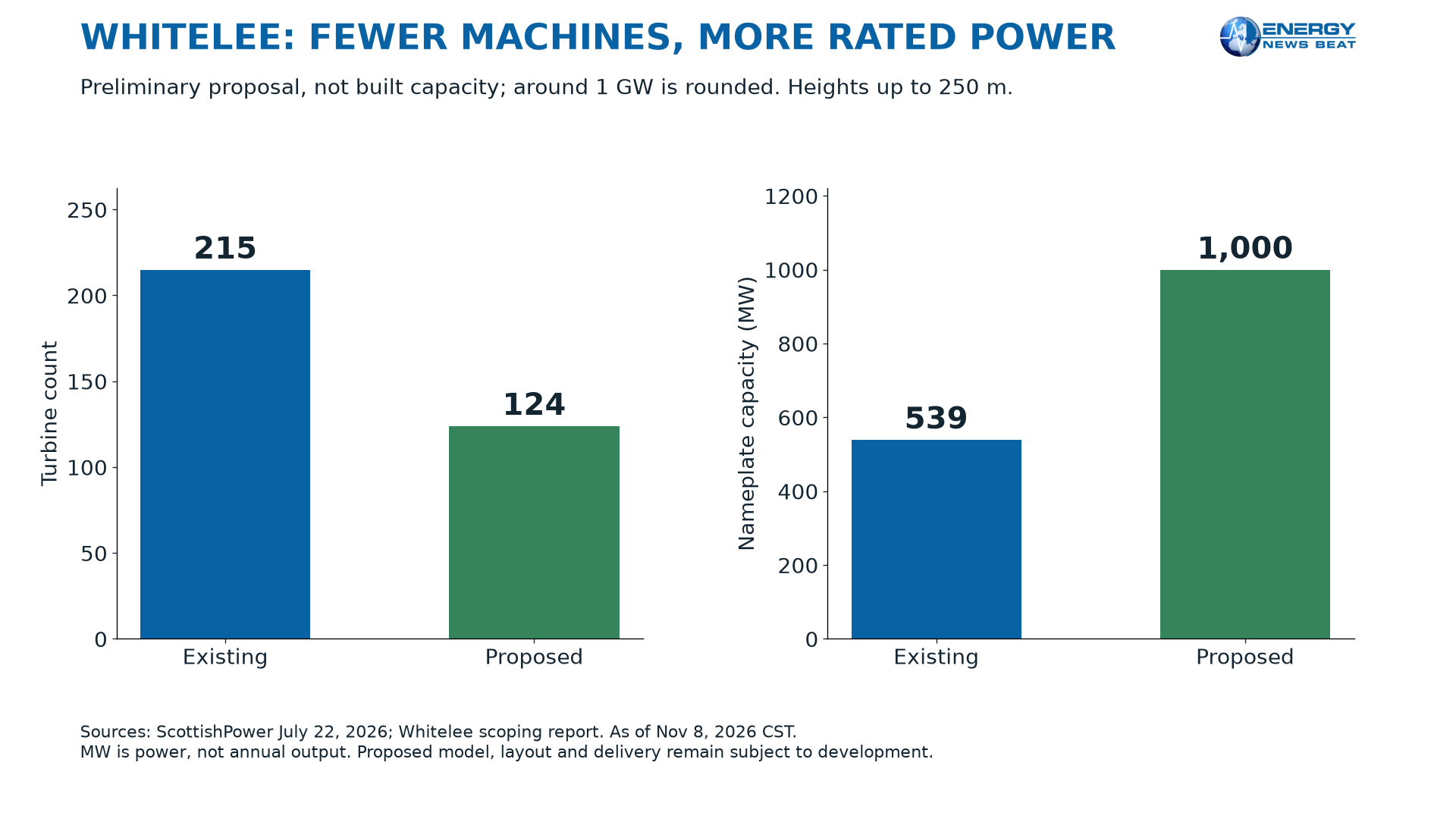
The developer proposes replacing 215 turbines totaling 539 megawatts with 124 turbines totaling around 1,000 MW. That is 91 fewer machines and 461 MW more nameplate capacity. Proposed tip heights reach 250 meters, compared with existing turbines ranging from about 100 to 140 meters. The scoping report includes new foundations, cabling and a new substation, while seeking to reuse suitable infrastructure. This is substantially different from putting longer blades on an existing tower.
It is also not a construction approval. The Scottish Energy Consents Unit register calls the case ‘Scoping’ and ‘Pre Application Complete,’ with an October 15, 2026 determination. That means the pre-application scoping step was completed—not that ministers approved the redevelopment. ScottishPower’s announced timetable envisages a December 2027 planning application and operation by 2035.
Divide the announced £1.5 billion by the proposed 1,000 MW and the result is £1.50 million per total MW. Divide it by the 461-MW increase and it is approximately £3.25 million per incremental MW. Both calculations are correct; they answer different questions. The latter also charges the replacement of the existing 539 MW entirely against the expansion, so it is not a like-for-like new-build cost comparison.
The announcement does not identify a constant-price base, an awarded construction price, financing terms or a complete itemized lifetime budget. It separately anticipates continuing operating and maintenance investment. There is no sound basis here for silently converting pounds into dollars or presenting this early headline as a fixed, inflation-adjusted delivered cost.
What Turver gets right—and what remains a scenario
The government’s published cost annex supports Turver’s £58/MWh generic onshore-wind benchmark for projects commissioning in 2030, in 2024 real pounds. It also lists a 35-year operating life, 36% load factor and 7.6% central hurdle rate. Its central construction, pre-development and infrastructure assumptions imply about £1.70 billion for a hypothetical 1,000-MW plant. That is broadly the same scale as Whitelee’s announcement, but not identical scope or price year.
Turver’s £120.49/MWh combined downside case is his modeled sensitivity, not Whitelee’s approved tariff or an independently established cost. Lower output and higher financing costs can plainly make a project more expensive per unit of electricity. Nevertheless, applying the old farm’s claimed performance to different, taller turbines is an assumption, not a forecast validated by a new-site energy assessment. His historical generation, curtailment and subsidy series are not independently reproduced here.
Nor does repowering establish that every original turbine failed early. The scoping report dates the original site’s operation to May 2009 and the extensions to 2013. A phased project targeting 2035 does not, by itself, disclose each machine’s retirement date. Likewise, seeking consent for at least 50 years is not a warranty that one set of components will run unchanged for half a century.
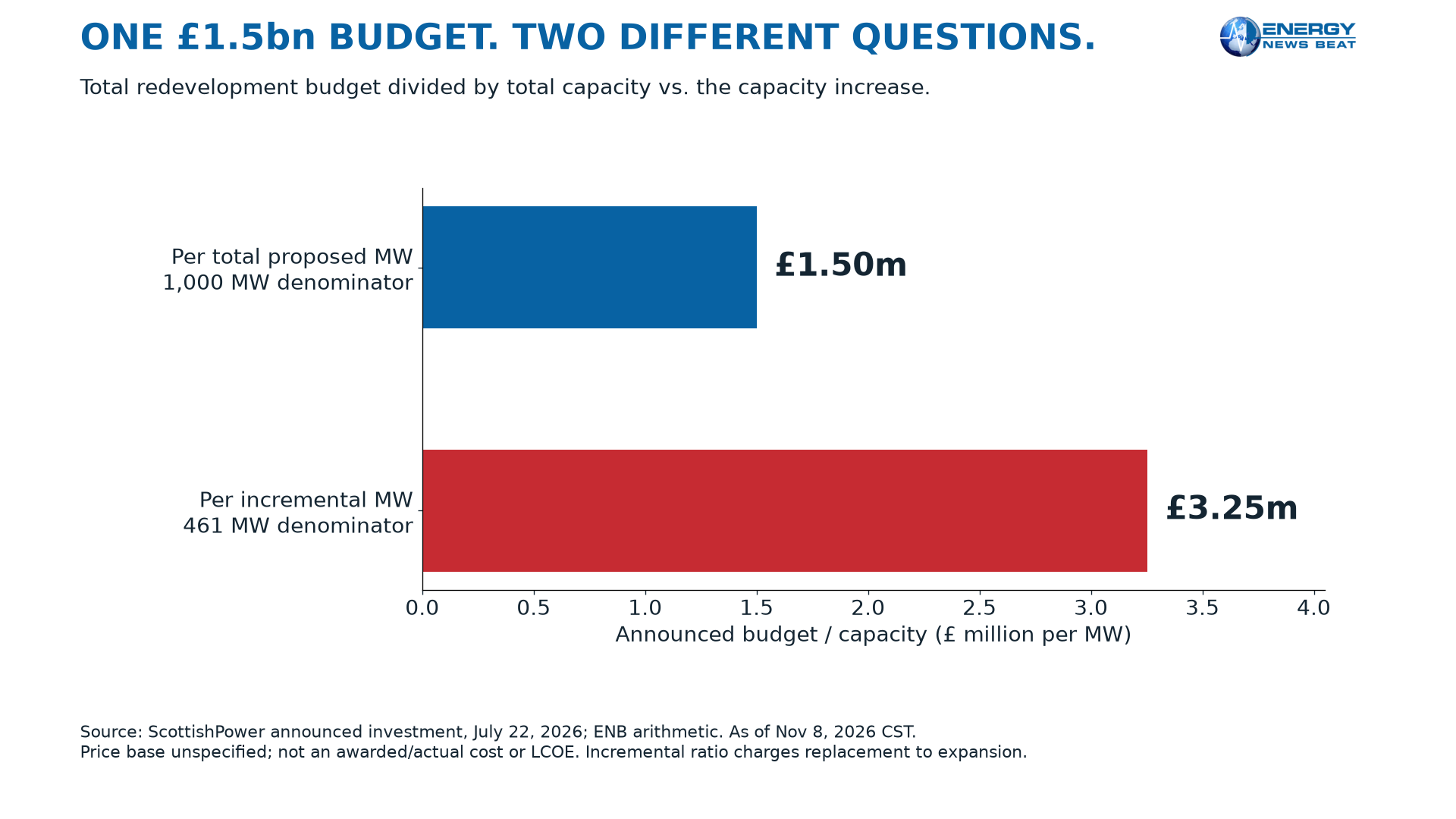
One announced budget, different denominators. Neither ratio is an electricity price. Appendix B gives scope.
America: several different jobs wearing the same label
New York offers current, named examples. The state approved Ellenburg in September 2026: 54 turbines become 25, with capacity increasing from roughly 81 to 91 MW and commercial operation expected by 2029. Chateaugay received its final siting permit in July, targeting 116.5 MW, around 10 MW above its predecessor, also for 2029. These are approved replacement projects, not evidence of completed new production.
AES’s Clinton proposal targets 110.5 MW and operation in 2028; its October update says the repower received a final permit in April 2026 and remains in pre-construction, with construction expected in January 2027, subject to approvals. The existing facility and the proposed repower must not be confused. Project-specific dates and limitations are set out below.
Minnesota’s Elm Creek II proposal is particularly instructive. Larger rotors and replacement nacelles would improve low-wind performance while reducing nameplate capacity below the existing 148.8 MW. The commission approved the repowering in November 2025. More annual energy with fewer rated megawatts is possible; megawatts measure maximum power, not yearly production. No quantified annual-output increase is established by the records cited here.
California’s Sand Hill has a January 2026 wildlife-permit amendment covering larger turbines and operation of up to 13 machines. That is a real permitting milestone, not proof construction has started. By contrast, New York’s Cohocton repower was completed in December 2021, retaining its original towers and foundations. Calling that a newly planned full rebuild would inflate the story.
Yes, officials want more wind. That does not settle its price.
The policy push is documented, not something to infer from a state’s political color. New York’s Hochul administration announced renewable contracts in May 2025, including Valcour Clinton Windpark; Minnesota Attorney General Keith Ellison sought resumed federal onshore-wind reviews in July 2026; California’s energy commission defended offshore-wind development in September. The last is a different technology and market—not an endorsement of Sand Hill’s particular economics. These statements identify the responsible offices; they do not establish unified party control or a statewide cost outcome.
For consumers, compare the cost of keeping the old facility running, replacing it, or buying other energy—not replacement against an imaginary free power plant. Reused roads and grid connections may help. Outages during construction, financing, maintenance, wildlife protections and restoration obligations can offset those benefits. Transmission and dependable supply during low-wind hours need system analysis; neither should be assigned an invented surcharge.
Tax support also changes who pays. IRS Notice 2025-42 explains how sufficiently extensive retrofits can satisfy the 80/20 rule and addresses construction timing under revised federal credits. Eligibility is project-specific, not automatic just because a developer says ‘repower.’ A tax credit can reduce a project’s private cost while shifting support to taxpayers. It does not erase the underlying resource cost.
Investors should demand energy-yield estimates, firm equipment prices, permit conditions and contracted revenues. Ratepayers should demand the corresponding net-cost analysis, including credits and avoided purchases. The evidence supports neither ‘all repowering is a rip-off’ nor ‘bigger turbines guarantee cheaper bills.’ It supports a tougher, project-by-project question: show us the economics before promising the savings.
Stu’s Take
I appreciate David Turver putting the numbers on the table. Energy policy needs more of that, not another round of ribbon-cutting promises. A £1.5 billion redevelopment deserves hard questions about financing, useful life, actual electricity delivered and the bill that reaches a family’s kitchen table. While he states “The scoping report does not specify the foundation removal depth for the existing turbines, nor does it say whether existing underground cables will remain or be removed. Decommissioning of the new turbines from the repowering project is specifically excluded from the scoping report. If they are leaving the old foundations in the ground, cannot be bothered to cover the detail of decommissioning of the new installation and make a virtue out of chopping down trees, perhaps onshore is not as environmentally friendly as we have been led to believe.”
This is a HUGE part of the entire argument, and we see this time and time again. Land reclamation is left off almost all projects, and feasibility studies.
But we should apply the same standard to our own criticism. Whitelee is not a U.S. rate case, and a full Scottish redevelopment is not the same job as replacing components on an American wind turbine. If reuse, better production and a sensible contract make a repower economical, consumers should get that benefit. If subsidies and optimistic assumptions are hiding the cost, regulators should expose it before committing customers.
My test is simple: compare real alternatives, disclose who bears the downside, and stop confusing megawatts with affordable, dependable electricity. Show the math—not just the taller turbine. And include Storage with Wind and Solar for grid resiliency. Couple in Land Reclamation and we can start talking about apples to apple comparison with natural gas or nuclear.
Appendix A | Named U.S. projects: what is actually being repowered?
Status checked against the cited records as of November 8, 2026 CST. Five development/approval examples and one historical comparison. Approval is not construction; construction is not commercial operation. A blank or undisclosed datum is not zero.
Clinton, NY / AES
| Field | Documented basis / limit |
| Status | Approved per October 2026 developer update; pre-construction |
| Physical scope | Full turbine removal/replacement; final foundation treatment not established here |
| Scale / output | 110.5 MW proposed; page range 19–25 new turbines. Old MW, final heights and output not established here |
| Timing | Conditional clearing as early as Nov 2026; construction Jan 2027; operation target 2028 |
| Cost / benefit disclosure | No comparable capex or contract energy price in cited records |
Primary record: linked project evidence. Context: AES project page.
Ellenburg, NY / AES subsidiary
| Field | Documented basis / limit |
| Status | Final siting permit announced Sep 23, 2026; construction start not established |
| Physical scope | Turbines/infrastructure replaced; reuse portions of roads and collection system |
| Scale / output | 54 → 25 turbines; about 81 → 91 MW. Heights and output MWh not in cited release |
| Timing | Commercial operation expected by 2029 |
| Cost / benefit disclosure | No comparable capex; expected $910,000 host bill credits over first 10 years |
Primary record: linked project evidence.
Chateaugay, NY / AES subsidiary
| Field | Documented basis / limit |
| Status | Final siting permit announced Jul 30, 2026; construction start not established |
| Physical scope | Turbine replacement; portions of roads/collection system and existing connection reused |
| Scale / output | 116.5 MW proposed, about +10 MW. Fewer turbines; exact counts, heights and MWh not in cited release |
| Timing | Commercial operation expected 2029 |
| Cost / benefit disclosure | No comparable capex; expected $1,165,000 host bill credits over first 10 years |
Primary record: linked project evidence.
Elm Creek II, MN / Elm Creek Wind II LLC
| Field | Documented basis / limit |
| Status | Repower approved Nov 6, 2025; completion not established |
| Physical scope | Rotors/nacelles/internals replaced; increased hub height; locations unchanged. No documented all-foundation rebuild |
| Scale / output | 148.8 MW → lower; rotor 95 → up to 120 m; hub 78 → up to 86 m; tip 127.5 → up to 146 m; turbine rating 2.4 → 2.2 MW |
| Timing | Permit extended to 2056; no verified completion date |
| Cost / benefit disclosure | No comparable capex/energy price in notice or decision summary |
Primary record: linked project evidence. Additional design and approval: July notice; November decision summary.
Sand Hill, CA / Viracocha Winds LLC in 2026 amendment
| Field | Documented basis / limit |
| Status | CDFW wildlife-permit amendment Jan 22, 2026; current construction not established |
| Physical scope | Redevelopment with larger turbines; not merely a life extension |
| Scale / output | Up to 13 turbines in 2026 wildlife amendment. County legacy summary 50 MW. Final capacity, old count, heights and MWh not established here |
| Timing | No verified current construction/completion date |
| Cost / benefit disclosure | No comparable capex/energy price in cited records; wildlife approval is not all permits |
Primary record: linked project evidence. Legacy capacity/status context: county summary.
Cohocton, NY / New York Wind LLC
| Field | Documented basis / limit |
| Status | HISTORICAL: completed Dec 2021, per May 2024 DEC notice |
| Physical scope | Turbine/component replacement; original towers and foundations retained |
| Scale / output | 35 → 35 turbines; 87.5 → 87.5 MW; maximum rotor-swept height +11 m |
| Timing | Not a newly planned 2026 repower |
| Cost / benefit disclosure | No comparable capex in notice; later species application distinct from repowering |
Primary record: linked project evidence.
Appendix B | Cost bases and calculations
Native currencies are preserved. No UK/U.S. inflation- or exchange-adjusted cost ranking is made. Announced estimates are not procurement awards or outturn costs. Cost and generation scopes must be matched before comparing.
Whitelee developer budget — £1.5bn, announced July 22, 2026
Proposed redevelopment to around 1,000 MW. Price base unspecified; not awarded/actual cost. Source.
Per total proposed MW — £1.50m/MW
£1,500m / 1,000 MW. Replacement plus expansion; not a lifetime energy cost. Source.
Per incremental MW — £3.254m/MW
£1,500m / 461 MW. Assigns whole redevelopment to capacity addition. Source.
Generic government capital scaling — £1.696bn / hypothetical 1,000 MW
2024 real GBP, 2030 central. £1,300/kW construction + £80/kW pre-development + infrastructure £16.3m / 51.6-MW reference plant. Source.
Generic government LCOE — £58/MWh
2030 commissioning, 2024 real GBP; Annex A Additional Estimates 2030 D15. Not Whitelee tariff or retail bill. Source.
Turver combined downside — £120.49/MWh, 2024 prices, author model
22% utilization, 20-year life, 8.5% discount rate. Not independently reconstructed or treated as project cost. Source.
U.S. costs — No normalized $/MW league table
Matched scope, price year and costs not established across selected records. Absence here does not mean no disclosure elsewhere. Source.
Appendix C | Audit of Turver’s Whitelee argument
The public commentary was read in full. The audit below separates corroborated source facts, transparent arithmetic and assumptions that remain untested. Agreement with a sensitivity direction does not validate every numerical output.
£1.5bn budget
CORROBORATED as July 2026 developer announcement, not final cost. No real-price base or tender breakdown given.
215 → 124 turbines; 539 → around 1,000 MW; 250 m tip
CORROBORATED proposal. Final turbine model and rating remain design-dependent. If 124 × 8 MW were used, that would be 992 MW, appropriately around 1 GW, not exactly 1,000 MW.
New foundations/substation; reuse
CORROBORATED preliminary scope, sections 3.2–3.6. Foundation excavation around 5 m is indicative and ground-dependent. Existing two substations retained; a new substation proposed.
At least 50-year operating life
QUALIFY: section 3.2.1 seeks a consent term, not unchanged component life. Further repowering would require a separate application.
Decommissioning
QUALIFY: section 3.2.1 proposes excluding separate final decommissioning-effects assessment because effects are considered similar or less than construction. That is not a statement that no decommissioning will occur. Existing removal details deferred to EIA; final old-foundation/cable treatment and security not established.
Government £58/MWh, 35 years, 36%, 7.6%
CORROBORATED in Annex A. Report Table 3 prints 37% for 2030; technical annex I4 prints 36%. The model basis here is explicitly the annex. No silent reconciliation of the discrepancy.
Government about £1.7bn capital / 1 GW
ARITHMETIC CORROBORATED from central annex inputs including separate infrastructure. Linear generic scale, not a Whitelee estimate.
Historical 20.5% / 16.7% / 22.2% load factors; £686m ROC buyout value
NOT INDEPENDENTLY REPRODUCED. No fresh certificate-level monthly generation/constraint reconstruction. ROC buyout valuation is not necessarily cash received; do not relabel as audited subsidy receipts.
£59.25 baseline and £120.49 downside
AUTHOR MODEL ONLY. Government £58 baseline corroborated, but exact author DCF timing, formulas and full input workbook not reconstructed. Downside output is not independently cleared.
Gilt rise 0.9 percentage point; AR7 around £72; only one FID
NOT VERIFIED HERE; omitted as factual claims. An FID assertion credited by the author to an AI answer is not primary evidence. Market yields and award-price bases require separate records.
Early failure / subsidy motive
NOT ESTABLISHED by a 2035 completion target. Scoping gives original site operation May 2009 and extensions 2013; machine retirement dates not supplied. Contract, consent and physical lifetimes differ; no awarded Whitelee CfD or motive finding claimed.
Appendix D | Method and consumer comparison
- As of November 8, 2026 CST. Each record retains its own publication date and forward schedule. Five U.S. development/approval cases and one historical comparison are selected; this is not a national inventory.
- Permissions are established from regulator records; commercial schedules from dated developer updates. Full foundation replacement is not inferred from the word repower. A life extension is not automatically a rebuild, and an unrelated new wind farm is not a repower.
- Amounts remain in native currency. No exchange conversion or inflation adjustment is made. Whitelee’s announced budget has no identified price base; DESNZ figures are explicitly 2024 real GBP. U.S. costs not established in selected sources are not zero.
- MW measures rated power; MWh/year measures annual energy. Homes-equivalent claims are not measured annual output. At a constant 1,000 MW, 36% utilization would imply 3.154 TWh/year versus 1.927 TWh/year at 22%, holding all else equal. Neither is a validated Whitelee forecast.
- Derivations: £1,500m / 1,000 MW = £1.50m/MW; £1,500m / (1,000−539 MW) = £3.254m per incremental MW. Capacity increase = 85.53%; turbine-count reduction = 42.33%. Rounded proposal values are not final engineering specifications.
- Generic capital scaling: (£1,300 + £80)/kW × 1,000,000 kW + £16.3m / 51.6 MW × 1,000 MW = £1.696bn. This includes the separately listed infrastructure but not discounted lifetime O&M. It is a linear scaling exercise, not a Whitelee quote.
- Consumer comparison requires discounted net costs against realistic alternatives, including tax support, avoided purchases, operating costs, construction interruptions and restoration obligations. LCOE is not retail tariff or full grid-system cost. No blanket transmission or firming surcharge is assigned.
- Host credits are geographically limited benefits, not net statewide savings. U.S. tax credits require project-specific eligibility, construction timing, continuity and other tests; no credit rate or dollar award is assigned to these projects.
- Policy evidence identifies the responsible offices and dated actions. No unified legislative/executive party-control claim or immediate post-election transfer of office is assumed. A political color is not a cost metric.
Appendix E | Linked sources and selected evidence
All source access dates: November 8, 2026 CST. Sources retain their own dates. Selected quotations are not complete reproductions. Forward-looking estimates, benefit claims and legal advocacy retain attribution.
01. David Turver, Whitelee Repowering: Taller Turbines and Higher Costs; November 8, 2026
Selected excerpt: “Scottish Power say the cost of Whitelee repowering development will be around £1.5bn to deliver the 1GW capacity.”
Public article read in full, including conclusion. Commentary is not primary proof. Past ENB guest identity is supplied by Stu, not independently authenticated, and is not used as evidence.
https://davidturver.substack.com/p/whitelee-repowering-taller-turbines-higher-costs
02. ScottishPower Renewables announcement; July 22, 2026
Selected excerpt: “A planning application is set to be submitted in December 2027, with the repowering planned to be operational by 2035.”
Developer announcement: £1.5bn, 539 MW to around 1 GW and 124 proposed turbines. Budget, benefits and timetable are expectations, not awarded or delivered outcomes.
03. Scottish Government ECU00006441
Selected excerpt: “Status: Pre Application Complete”
Scoping case received July 17, 2026 and determined October 15, 2026. Completion of scoping is not construction consent.
https://www.energyconsents.scot/ApplicationDetails.aspx?cr=ECU00006441
04. Whitelee Scoping Report; July 2026
Selected excerpt: “Consent will be sought for an operational life of at least 50 years from the date of final commissioning”
Scoping pp. 8–9 give original operation dates; sections 3.2–3.6 describe preliminary design and scope. Consent life is not component life.
https://docs.planning.org.uk/20260730/233/TIXXGFOP01M00/7zenmgw2pld9yw5p.pdf
05. DESNZ publication page; January 14, 2026, updated March 18, 2026
Selected excerpt: “Inclusion of LCOE Totals row in Annex A.”
2025 denotes report vintage. Publication page dates first release January 14, 2026 and March 18 update adding Annex A LCOE totals.
https://www.gov.uk/government/publications/electricity-generation-costs-2025
06. DESNZ Annex A: Additional estimates and key assumptions 2025
Selected excerpt: “All costs in 2024 real GBP prices”
Additional Estimates 2030 D15 = 58. Technical and Cost Assumptions I3 = 51.6 MW, I4 = .36, I6 = 35, I8 = 80, I20 = 1300, I32 = 16300 and I39 = .076; units in column C.
07. DESNZ Electricity Generation Costs 2025
Selected excerpt: “Full power system modelling is required to evaluate the system costs”
Report distinguishes developer LCOE from system effects. Table 3 prints 37% for 2030; technical annex prints 36%. The annex is the stated model basis here; discrepancy not silently reconciled.
08. AES Clinton Wind project page
Selected excerpt: “110.5 MW planned capacity”
Existing facility is operational; proposed repower is separate. Page gives 110.5 MW, a broad 19–25 replacement-turbine range and 2028 operation target, not final as-built specifications.
https://www.aes.com/sustainability-impact/people-communities/projects/clinton-wind
09. AES October 2026 Clinton town-board update
Selected excerpt: “The existing Clinton Wind facility remains operational while the separate repowering project continues through development and pre-construction activities.”
October update says final permit received April 2026; conditional clearing as early as November 2026 and construction January 2027. EPC agreement executed; price not supplied.
https://www.aes.com/sites/vault/files/2026-10/October-2026-Update-Clinton-Wind.pdf
10. New York DPS Ellenburg final-permit announcement; September 23, 2026
Selected excerpt: “The newly repowered facility will reduce the total number of turbines from 54 to 25”
91 MW, approximately 10 MW increase, 2029 expected operation. Expected host credits are limited to named towns, not statewide net savings.
https://dps.ny.gov/news/dps-announces-approval-repowered-wind-project-clinton-and-franklin-counties
11. New York DPS Chateaugay final-permit announcement; July 30, 2026
Selected excerpt: “The new turbines are expected to reach commercial operation in 2029.”
116.5 MW, approximately 10 MW above existing, operation expected 2029; exact turbine count not in release. Portions of existing roads/collection system and connection reused.
12. Minnesota PUC Elm Creek II docket 09-553
Selected excerpt: “Status active”
Portal lists 2026 filings but retains original project narrative. Active docket does not prove repower construction or completion.
https://puc.eip.mn.gov/web/project/350
13. Minnesota PUC Elm Creek II public notice; July 18, 2025
Selected excerpt: “Decrease total nameplate capacity below the current permitted 150 megawatts”
Existing 148.8 MW; turbine rating 2.4 to 2.2 MW; rotor 95 to up to 120 m; hub 78 to up to 86 m; tip 127.5 to up to 146 m. Requested prior expiry 2040 differs from decision summary’s 2030; only extended endpoint 2056 asserted.
14. Minnesota PUC December 2025 newsletter; November 6 decision
Selected excerpt: “The permit term was also extended from 2030 to 2056.”
Regulator decision summary confirms November 6 approval. Prior expiry differs from notice. Neither record establishes completed construction.
https://content.govdelivery.com/accounts/MNPUBUC/bulletins/3fe3e51
15. CDFW Sand Hill wildlife-permit amendment NOD; January 22, 2026
Selected excerpt: “operation of up to 13 turbines”
CDFW permit 2081-2019-040-03 amendment 1, January 22, 2026. Adds western burrowing owl, larger turbines and associated covered activities; determination limited to CDFW jurisdiction.
16. Alameda County wind-turbine project summary
Selected excerpt: “Sand Hill | sPower | Approved/Unbuilt”
County 50-MW approved/unbuilt entry is legacy context, not proof of November 2026 field status. January wildlife amendment names Viracocha Winds; old summary names sPower.
https://alamedacountyca.gov/cda/planning/landuseprojects/windturbineproject.htm
17. New York DEC complete-application notice; May 8, 2024
Selected excerpt: “The original foundations and towers remained”
DEC: 35 turbines, 87.5 MW, repower completed December 2021, original towers/foundations retained and rotor-swept height increased 11 m. Later wildlife notice is not a new repower.
18. Governor Hochul executed-contract announcement; May 21, 2025
Selected excerpt: “The payments under the contracted projects will only begin once projects are constructed and begin delivering renewable energy to New York”
Mixed renewable contracts include Valcour Clinton Windpark. Aggregate investment and generation figures are not project capex or wind-only prices.
19. Minnesota Attorney General Ellison statement; July 17, 2026
Selected excerpt: “moved to intervene in a lawsuit”
Policy advocacy and legal allegations are attributed to the attorney general, not treated as court findings or economics of the selected projects.
https://www.ag.state.mn.us/Office/Communications/2026/07/17_Wind-Energy.asp
20. California Energy Commission/AG notice; September 1, 2026
Selected excerpt: “California’s offshore wind strategic plan calls for the state to develop 25 gigawatts of offshore wind power by 2045”
Offshore target is not an onshore-repower cost benchmark. Legal allegations are not judicial findings.
21. IRS Notice 2025-42
Selected excerpt: “80/20 Rule”
Section 5.04(1): retained-property fair market value no more than 20% of new-plus-used value, tested by facility. Post-2027 termination applies to facilities beginning construction after July 4, 2026; physical work, continuity and other requirements matter. No named project’s eligibility certified.
https://www.irs.gov/pub/irs-drop/n-25-42.pdf
Appendix F | Limits that change the answer
- Whitelee: no itemized final budget for demolition, foundation removal, equipment, grid works, contingencies, financing or funded restoration security. Price year, tender awards, final net energy yield and machine retirement sequence are not established.
- Turver: historical Ofgem/REF generation and constraints, ROC buyout valuation, and complete DCF workbook are not independently reconstructed. His £120.49/MWh scenario, gilt claim, FID survey and motive inference are not adopted as established project facts.
- U.S.: selected permissions and design records do not establish a comparable public capex, energy-price and annual-output dataset. This does not mean no disclosure exists elsewhere. No statewide bill harm or savings calculation is supported.
- Construction status: Clinton is pre-construction in its October update; Ellenburg and Chateaugay have confirmed 2026 permits but physical construction start is not verified. Elm Creek II completion is not established. Sand Hill has a 2026 wildlife amendment; the county approved/unbuilt label is legacy, not a fresh field-status determination.
- No independent engineering authentication, unit-condition inspection or project-specific tax opinion. Selected excerpts do not reproduce complete records. Developer forecasts and official benefit statements retain attribution and are not independently demonstrated outcomes.