Britain is required to have the capability to restore 60 percent of regional demand in every region within 24 hours, and 100 percent of GB demand within five days, by Dec. 31, 2026. The United States has black-start plans, but no national five-day standard. Official UK guidance tells families to be ready for three days on their own; U.S. guidance says several days.
Energy News Beat cover: GB legal restoration-capability targets, U.S. black-start planning, and official UK three-day household guidance.
On Dec. 5, 2015, a flood on the River Lune cut power to 61,500 people in Lancaster, England. In a Nov. 7 feature, the BBC said streetlights and heat failed, some water supplies failed because they relied on electric pumps, the railway station closed, petrol stations and shops shut, most cash machines did not work, and traffic lights went dark. Planners call that a Black Sky event. The Electric Infrastructure Security Council defines a Black Sky hazard as “a catastrophic event that severely disrupts the normal functioning of our critical infrastructures in multiple regions, for long durations.”
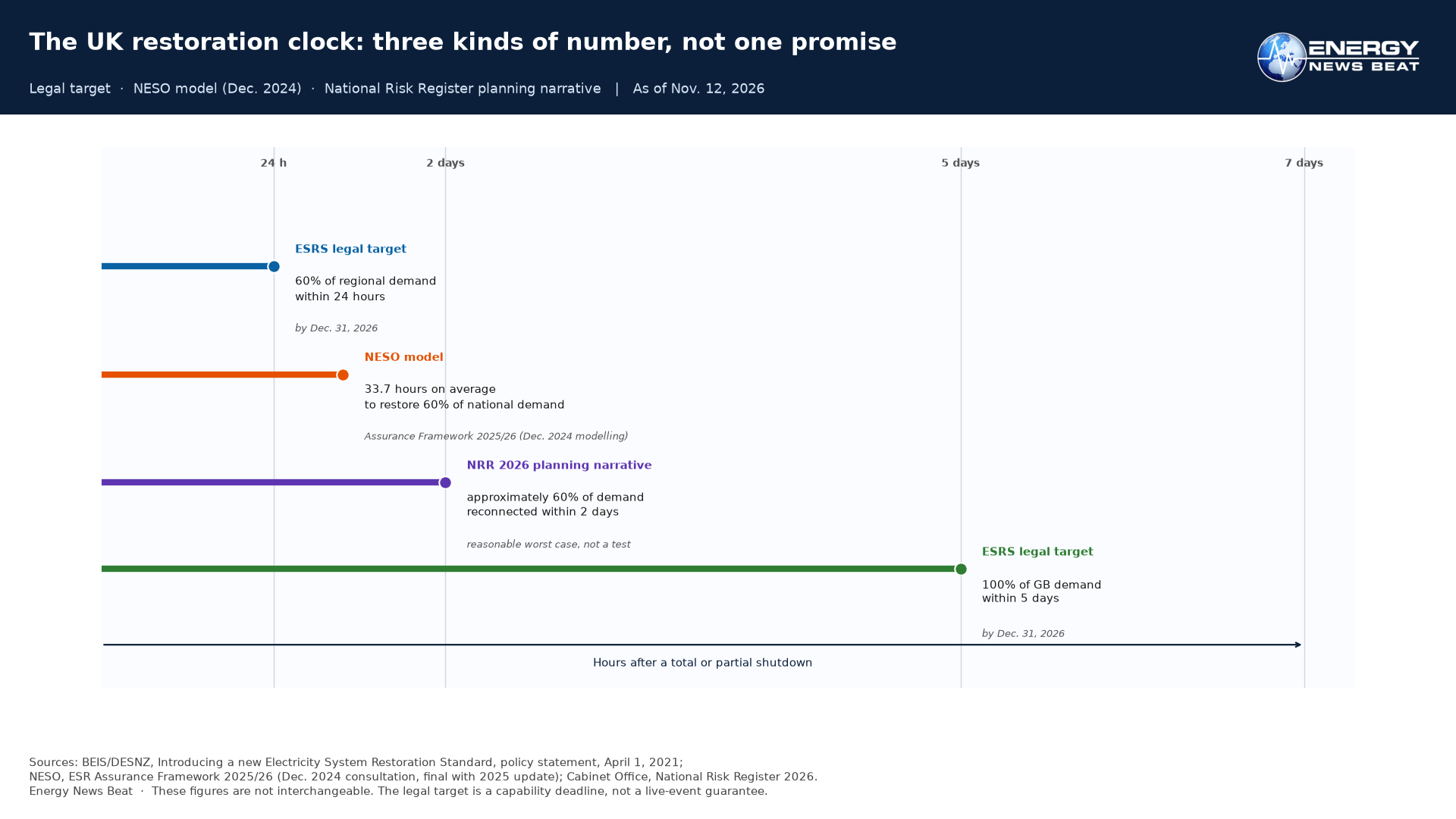
Great Britain has never had a nationwide loss of power. The Cabinet Office’s 2026 National Risk Register, published July 14, 2026, says the likelihood is low, but a failure of the National Electricity Transmission System “has the potential to severely disrupt all other critical systems.” In April 2021, the UK government announced a legally binding Electricity System Restoration Standard. It requires NESO, formerly National Grid ESO, “to have sufficient capability and arrangements in place to restore 100% of Great Britain’s electricity demand within 5 days.” The same policy adds an “interim target of 60% of regional demand to be restored within 24 hours,” to be met by Dec. 31, 2026. NESO also describes the 24-hour test as 60% of national demand “across all seven Restoration Regions.”
The Register’s reasonable-worst-case recovery narrative is not the legal standard. It says some consumers would be reconnected within a few hours, “a significant proportion of demand (approximately 60%) being reconnected within 2 days,” all customers reconnected by day 5 and 6, “however controlled demand disconnections will occur at peak times,” and “beyond 7 days we expect full and stable power restored to all of Great Britain.” NESO’s own 2025/26 Assurance Framework is more cautious about the 24-hour test. Its December 2024 consultation text says “the latest modelling results indicate that, on average, it would take 33.7 hours to restore 60% of National Demand,” and that 61 of 443 Connection and Use of System Code parties (13.8%) had then confirmed full compliance. A 2025 update in the same document says NESO has identified ways to cut that time and that generators with 77% of capacity (56 GW of 72 GW) have confirmed full compliance, which NESO calls sufficient to meet the targets. It has not published a new average restoration time. The BBC quoted an unnamed BBC insider saying NESO’s “latest advice” was that power would “probably” be back “in two to three days.” That is not an official NESO target.
In the first hours, the Register says, consumers without backup generators “lose their mains electricity supply instantaneously and without warning.” Secondary impacts would hit “mobile and internet telecommunications, water, sewage, fuel and gas,” with “significant and widespread disruption to public services provisions, businesses and households, as well as loss of life.” “It is not possible for any domestic customer’s electricity supply to be prioritised during a National Power Outage.” The Register adds that “from Day 5 some pre-determined critical
sites, such as some major hospitals, will have their power supply maintained” — not a claim hospitals go dark until then. Lord Toby Harris, chair of the UK National Preparedness Commission, told the BBC a long outage is “likely to stop the water supply” where electric pumps are needed.
The government’s Be Ready campaign tells households to prepare for three days. Ofcom says BT plans to retire the old public switched telephone network on the Openreach network by Jan. 31, 2027. “Digital landlines need mains electricity and will not work in a power cut unless there is a battery back-up.” Where a customer depends on the landline and has no reliable mobile, providers must offer a free backup “for at least one hour.”
The United States does not have a national five-day restoration clock. The Energy Information Administration describes the Lower 48 grid as three main interconnections that “operate largely independently from each other with limited transfers of power between them”: the Eastern Interconnection, the Western Interconnection, and the Electric Reliability Council of Texas, which “covers most, but not all, of Texas.” NERC EOP-005-3 requires transmission operators to have a Reliability Coordinator-approved restoration plan that identifies blackstart resources, and to verify it at least once every five years. EOP-006-3 requires each Reliability Coordinator to have an area restoration plan and to coordinate reconnection.
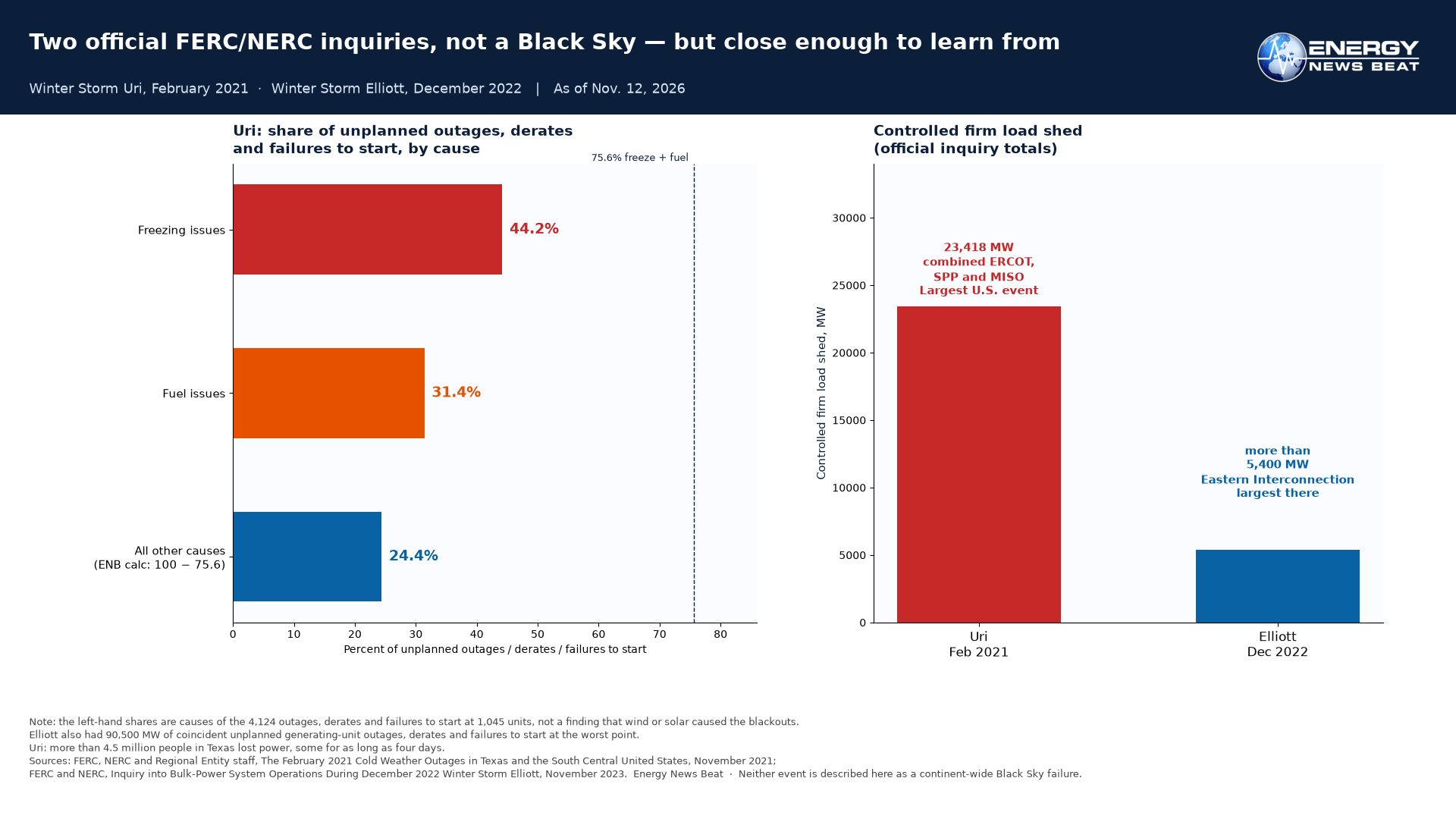
The FERC-NERC staff report on the February 2021 Texas and South-Central cold-weather outages found that 1,045 generating units experienced 4,124 outages, derates or failures to start. ERCOT averaged 34,000 MW unavailable for more than two days. Combined manual firm load shed reached 23,418 MW, “the largest controlled firm load shed event in U.S. history.” The report attributed 75.6 percent of those unplanned outages to freezing issues (44.2 percent) or fuel issues (31.4 percent). Of all 1,045 affected units, 58 percent were natural-gas-fired; wind, 27 percent; coal, 6 percent; solar, 2 percent; other types, 7 percent; nuclear, less than 1 percent. That counts which units had any outage, derate or failure to start, not a finding that wind or solar caused the blackouts. In December 2022, Winter Storm Elliott produced 90,500 MW of coincident unplanned generating-unit outages, derates and failures to start at the worst point. Southeast balancing authorities shed more than 5,400 MW of firm load, “the largest controlled firm load shed recorded in the history of the Eastern Interconnection,” according to the November 2023 FERC-NERC inquiry.
For Medicare and Medicaid hospitals, 42 CFR 482.15(e)(3) requires a hospital with onsite fuel to “have a plan for how it will keep emergency power systems operational during the emergency, unless it evacuates.” That is a planning duty, not a federal fuel-hour number. ASPR TRACIE, citing NFPA 99 and NFPA 110, notes hospital emergency power is Class X, meaning the minimum run time is “other time, in hours, as required by application, code or user.” There is no current federal rule setting a minimum backup duration at U.S. cell sites. The FCC adopted, then deleted in 2011 after a court vacated it, an eight-hour cell-site backup rule, as the 2021 Resilient Networks notice recounts. No later minimum-hour mandate was found. NERC’s December 2021 white paper said grid-forming inverters “provide blackstart capability if needed and designed for this purpose,” while typical grid-following inverters “cannot serve as an initial blackstart resource.”
At 12:33 CEST on April 28, 2025, official ENTSO-E records say “the power systems of continental Spain and Portugal experienced a total blackout.” “The rest of the European power system did not experience any significant disturbance.” ENTSO-E’s summary of the Expert Panel’s final report, published March 20, 2026, says the investigation “concludes that the blackout resulted from a combination of many interacting factors, including oscillations, gaps in voltage and reactive power control, differences in voltage regulation practices, rapid output reductions and generator disconnections in Spain, and uneven stabilisation capabilities,” leading to “fast increases of voltage and cascading generation disconnections in Spain.” The UK Register, not ENTSO-E, describes the same event as “a rare cascading voltage surge.” Neither ENTSO-E’s summary nor the UK Register names wind or solar as a cause.
What It Means for Consumers and Investors
The UK Be Ready checklist is built around three days at home, with 3 litres of drinking water per person per day, food, an FM radio, cash and medicines. Ready.gov, last updated July 1, 2026, tells U.S. households to plan to get by “for several days,” with “one gallon per person per day for several days, for drinking and sanitation.”
In the UK, NESO procures Electricity System Restoration services — formerly called Black Start — through competitive regional tenders. A May 2021 award covered eight Northern Region contracts totaling £53.8 million for three years from May 2022. NESO has since awarded new Northern contracts (May 2024) and nine South East contracts (December 2023). In the United States, black-start service is typically compensated under grid-operator tariffs or bilateral agreements; PJM’s Schedule 6A is one such tariff. Grid-forming batteries have already black-started generators in demonstrations — NERC’s white paper cites a 30 MW battery at California’s Imperial Irrigation District that started a 44 MW gas turbine in 2016 — but NERC treats that as a designed capability, not a system-wide fact.
Caveats
A Black Sky event is a planning term, not a forecast that one is imminent. The UK standard is a capability NESO must have in place by Dec. 31, 2026; it is not a guarantee of restoration times in a real event, and NESO’s last published modelling, from December 2024, showed an average of 33.7 hours to reach 60 percent of national demand against a 24-hour requirement; NESO says it has since identified ways to shorten that. The Register’s “approximately 60% within 2 days” line is a planning narrative, not the legal standard. Official reports are quoted; this article does not claim wind or solar caused the 2021 Texas outages, Winter Storm Elliott, or the 2025 Iberian blackout.
Stu’s Take
A Black Sky event is not a normal outage. It is the night the phone, the water pump, the gas-station pump and the card reader all go together. Britain has done something useful: it required a capability — 60 percent in every region in a day, the rest in five — and tells households to hold three days of water, food and an FM radio. That is not a guarantee. NESO’s last published modelling, from December 2024, had the 24-hour test at 33.7 hours on average, and full compliance was still being chased. America has serious black-start standards and hard lessons from Uri and Elliott, but no national five-day legal target and no federal hour rule for cell-tower fuel. The honest preparation is boring: water, a radio, cash, medicine, and no illusion that a hospital generator or a phone tower is a plan for the whole town. Official reports blamed freezing equipment, fuel, voltage control and tight interdependence. That is the story worth planning around.
We hope there is not Black Sky event, but I highly recommend planing for one, as it might just hit. It is better to walk through a disaster, rather than panic.
Appendix A. Restoration targets, recent events and backup rules
Figures below are taken from the official documents cited in the Sources appendix. They are current as of Nov. 12, 2026, 9:13 a.m. Central Time, and are not forecasts of the next outage. GB legal restoration-capability targets, NESO modelling, and National Risk Register planning language are listed separately on purpose. The seven Restoration Regions are North Scotland, South Scotland, North East, North West, Midlands, South East and South West.
| Date | Item | What the official source says | What it is not |
| Apr 1, 2021 | UK ESRS policy (BEIS/DESNZ) | 100% of GB demand within 5 days; 60% of regional demand within 24 hours; comply by Dec. 31, 2026 | Not a guarantee of actual restoration time |
| 2025/26 | NESO ESR Assurance Framework | December 2024 consultation: modelled average 33.7 hours to restore 60% of national demand; 61 of 443 CUSC parties (13.8%) full assurance compliance; 202 (45.6%) met 72-hour resilience; 2025 update: 77% of generator capacity (56 of 72 GW) confirmed full compliance, 83% (60 GW) 72-hour resilience; no new average published | A model and a compliance snapshot, not a live test of a total shutdown |
| Jul 14, 2026 | UK National Risk Register 2026 | Nationwide NETS failure: low likelihood, severe cascading impacts; ~60% demand reconnected within 2 days in the reasonable-worst-case narrative; all customers by day 5–6, with peak-time controlled disconnections; stable power expected beyond 7 days | Planning narrative, not the legal ESRS text |
| In force Apr 1, 2019 | NERC EOP-005-3 and EOP-006-3 | Restoration plans from blackstart resources; RC coordination; verify at least every five years | No national 24-hour or five-day restoration deadline |
| Feb 8–20, 2021 | FERC/NERC Uri report (Nov 2021) | 1,045 units; 4,124 outages/derates/failures to start; ERCOT averaged 34,000 MW unavailable more than two days; 23,418 MW combined firm load shed; >4.5 million in Texas lost power, some up to four days; 75.6% of unplanned outages from freezing (44.2%) or fuel (31.4%) | Not a finding that wind or solar caused the blackouts |
| Dec 21–26, 2022 | FERC/NERC Elliott inquiry (Nov 2023) | 90,500 MW of coincident unplanned generating-unit outages, derates and failures to start at the worst point; >5,400 MW firm load shed in the Eastern Interconnection, the largest controlled firm load shed recorded there | Smaller firm load shed than Uri; not a continent-wide Black Sky event |
| Apr 28, 2025 | ENTSO-E Expert Panel final report (Mar 20, 2026) | Total blackout in continental Spain and Portugal at 12:33 CEST; brief disruption in southwest France; combination of oscillations, voltage and reactive-power control gaps, regulation differences, rapid output reductions and disconnections, uneven stabilisation; fast voltage increases and cascading disconnections in Spain | ENTSO-E’s summary names no single generation technology as the cause |
| Current U.S. backup rules | CMS 42 CFR 482.15(e)(3); NFPA 110 Class X via ASPR TRACIE; FCC 21-99; EPA 800-R-19-001 (June 2019) | Hospitals: a plan to keep emergency power running during the emergency, unless they evacuate, not a uniform federal fuel-hour number. Cell sites: 2007 eight-hour rule vacated and deleted in 2011; no federal hour mandate found. Water: EPA recommends planning for backup power, no national hour minimum | State and local codes may be stricter; actual run time depends on fuel |
As of 9:13 a.m. Central Time, Nov. 12, 2026. Access dates for each source are in Appendix B. Quoted restoration times and percentages are from the cited official documents and have not been rounded except where the source itself uses an approximation (“approximately 60%”).
Appendix B. Sources
Primary documents were opened on Nov. 12, 2026. Quoted language is taken from the page or PDF cited. Access date for every item below is November 12, 2026.
- BBC, David Sillito, “What happens if all the lights go out? This is the plan for a ‘Black Sky’ event,” published Nov. 7, 2026, 00:31 UTC (evening of Nov. 6, Central Time). Anchor article, read in full. https://www.bbc.com/news/articles/ck5ynnj05z8no
- UK Department for Business, Energy and Industrial Strategy, “Introducing a new ‘Electricity System Restoration Standard’: policy statement,” April 1, 2021. https://www.gov.uk/government/publications/introducing-a-new-electricity-system-restoration-standard/introducing-a-new-electricity-system-restoration-standard-policy-statement
- National Energy System Operator, Electricity System Restoration Standard page. Confirms 100% of GB demand within five days, 60% of regional demand within 24 hours, compliance by Dec. 31, 2026. https://www.neso.energy/industry-information/balancing-services/electricity-system-restoration-standard
- NESO, Frequently Asked Generator ESRS Compliance Questions and Answers. Describes the 24-hour test as 60% of national demand across all seven Restoration Regions, and a 72-hour site-resilience requirement. https://www.neso.energy/document/376466/download
- NESO, Electricity System Restoration Assurance Framework 2025/26, final document (https://www.neso.energy/document/375556/download). December 2024 consultation text plus Appendix 3 2025 update (Ofgem-approved September 2025). Modelled 33.7-hour average and 61/443 (13.8%) figures are from the December 2024 text; the 2025 update reports 77% of generator capacity (56 of 72 GW) confirmed full compliance and 83% (60 GW) 72-hour resilience, which NESO calls sufficient. The December 2024 consultation PDF remains a secondary source for the earlier text. https://www.neso.energy/document/375556/download
- Cabinet Office, National Risk Register 2026, published July 14, 2026 (22.6 MB, 223 pages). National power outage chapter, including cascading impacts and the reasonable-worst-case recovery narrative. https://assets.publishing.service.gov.uk/media/6a50d66b1228eb26a4cab76c/National_Risk_Register_2026.pdf
- Cabinet Office, National Risk Register 2026 landing page. https://www.gov.uk/government/publications/national-risk-register-2026
- Cabinet Office, A Guide to the 2026 National Risk Register. Spotlight risk 4, power outage; “low likelihood but catastrophic”; learning from the 2025 Iberian event, described as a “cascading voltage surge.” https://assets.publishing.service.gov.uk/media/6a7c4412aadaaddf89b6e484/A_Guide_to_the_2026_National_Risk_Register.pdf
- UK government Be Ready campaign, “Be ready for emergencies.” Three-day household checklist, including 3 litres of drinking water per person per day. https://beready.campaign.gov.uk/be-ready-for-emergencies/
- Ofcom, “Your landline is going digital: what you need to know,” last updated Aug. 26, 2026. BT Openreach PSTN retirement planned by Jan. 31, 2027; digital landlines need mains electricity unless battery backup; minimum one-hour backup where a customer depends on the line. https://www.ofcom.org.uk/phones-and-broadband/landline-phones/future-of-landline-calls
- National Grid ESO (now NESO), “Electricity System Restoration Service contracts (formerly Black Start) awarded to providers in the Northern Regions,” May 4, 2021. Eight contracts totaling £53.8 million, services from May 2022 for three years. https://www.neso.energy/news/electricity-system-restoration-service-contracts-formerly-black-start-awarded-providers-northern-regions
- National Preparedness Commission, “Our team.” Source for Lord Toby Harris as chair. The BBC names him only as “Lord Harris.” https://nationalpreparednesscommission.uk/about/our-team/
- NERC, Reliability Standard EOP-005-3, System Restoration from Blackstart Resources, effective April 1, 2019. https://www.nerc.com/globalassets/standards/reliability-standards/eop/eop-005-3.pdf
- NERC, Reliability Standard EOP-006-3, System Restoration Coordination, effective April 1, 2019. https://www.nerc.com/globalassets/standards/reliability-standards/eop/eop-006-3.pdf
- FERC, NERC and Regional Entity staff, The February 2021 Cold Weather Outages in Texas and the South Central United States, November 2021. https://www.nerc.com/globalassets/our-work/reports/event-reports/february_2021_cold_weather_report.pdf
- FERC news release, “Final Report on February 2021 Freeze Underscores Winterization Recommendations,” November 16, 2021. https://ferc.gov/news-events/news/final-report-february-2021-freeze-underscores-winterization-recommendations
- FERC and NERC, Inquiry into Bulk-Power System Operations During December 2022 Winter Storm Elliott, November 2023. https://www.ferc.gov/sites/default/files/2023-11/24_Winter-Storm_Elliot_1107_1300.pdf
- FERC news release, “FERC, NERC Release Final Report on Lessons from Winter Storm Elliott,” November 7, 2023. https://www.ferc.gov/news-events/news/ferc-nerc-release-final-report-lessons-winter-storm-elliott
- U.S. Energy Information Administration, “U.S. electric system is made up of interconnections and balancing authorities,” July 20, 2016. https://www.eia.gov/todayinEnergy/detail.php?id=27152
- U.S. Department of Energy, “Learn More About Interconnections.” Eastern, Western and Texas interconnections. https://www.energy.gov/oe/learn-more-about-interconnections
- NERC, White Paper: Grid Forming Technology, Bulk Power System Reliability Considerations, December 2021. Includes the 2016 Imperial Irrigation District demonstration. https://www.nerc.com/globalassets/our-work/white-papers/white_paper_grid_forming_technology.pdf
- 42 CFR 482.15, Condition of participation: Emergency preparedness, including 482.15(e)(3) on emergency generator fuel. The public eCFR page was read directly. https://www.ecfr.gov/current/title-42/chapter-IV/subchapter-G/part-482/subpart-B/section-482.15
- ASPR TRACIE, CMS Emergency Preparedness Rule — CAH requirements (and related hospital discussion of NFPA 110 Class X). https://asprtracie.hhs.gov/documents/aspr-tracie-cms-ep-rule-cah-requirements.pdf
- FCC, Resilient Networks, Notice of Proposed Rulemaking, FCC 21-99, 2021. Recounts the 2007 eight-hour cell-site backup rule, its vacatur, and deletion of backup-power requirements in 2011. https://docs.fcc.gov/public/attachments/FCC-21-99A1.pdf
- EPA, Power Resilience: Guide for Water and Wastewater Utilities, EPA 800-R-19-001, June 2019. Recommends planning for backup power and fuel; does not set a national hour minimum. https://www.epa.gov/sites/default/files/2016-03/documents/160212-powerresilienceguide508.pdf
- Ready.gov, “Build A Kit,” last updated July 1, 2026. https://www.ready.gov/kit
- Ready.gov, “Water.” One gallon per person per day. https://www.ready.gov/water
- ENTSO-E, “28 April 2025 Blackout” official page, last updated March 20, 2026, including the Expert Panel’s official summary of causes. https://www.entsoe.eu/publications/blackout/28-april-2025-iberian-blackout/
- ENTSO-E, Final Report on the Grid Incident in Spain and Portugal on 28 April 2025, March 20, 2026. https://eepublicdownloads.blob.core.windows.net/public-cdn-container/clean-documents/Publications/2025/iberian-blackout/Final%20Report%20on%20the%20Grid%20Incident%20in%20Spain%20and%20Portugal%20on%2028%20April%202025.pdf
- EIS Council, “Black Sky Hazards.” Definition of a Black Sky hazard. https://eiscouncil.org/black-sky/
- Ofgem, “Suite of code modifications in relation to the Electricity System Restoration Standard.” Confirms 60% of Demand on the Transmission System in all regions within 24 hours, and 100% nationally within 5 days, by Dec. 31, 2026. https://www.ofgem.gov.uk/publications/suite-code-modifications-relation-electricity-system-restoration-standard
- PJM Open Access Transmission Tariff, Schedule 6A, Black Start Service. One official example of U.S. grid-operator compensation for black-start service. https://www.pjm.com/pjmfiles/directory/etariff/MasterTariffs/23TariffSections/4406.pdf
Appendix C. Methodology and research notes
This is an Energy News Beat full-format article, prepared on Nov. 12, 2026. The assigned anchor was the BBC article at https://www.bbc.com/news/articles/ck5ynnj05z8no. That page was opened in full on Nov. 12, 2026. The page metadata gives a publication time of Nov. 7, 2026, 00:31 UTC, which is the evening of Nov. 6, 2026, Central Time. Official UK restoration language was taken from the April 1, 2021, BEIS/DESNZ policy statement and from NESO’s current ESRS page, then cross-checked against Ofgem and NESO’s Electricity System Restoration Assurance Framework 2025/26 (final document 375556, including the December 2024 consultation text and the Appendix 3 2025 update). Government emergency-planning language, including water, telecoms, fuel, payments/financial services and hospitals, was taken from the Cabinet Office National Risk Register 2026 (full 223-page PDF, published July 14, 2026) and from the official Be Ready and Ofcom pages. U.S. standards and event figures were taken from the EOP-005-3 and EOP-006-3 PDFs, the November 2021 FERC/NERC Uri report and the November 2023 FERC/NERC Elliott report (executive summaries and the specific statistics quoted; these reports were not re-audited line by line). Interconnection structure is from EIA and the Department of Energy. Hospital, cell-site and water backup rules are from CMS, ASPR TRACIE/NFPA, FCC 21-99 and EPA guidance (EPA 800-R-19-001, June 2019); no guessed hour counts were used. No 2022–2026 FCC order restoring a minimum-hour cell-site backup mandate was found. Inverter-based versus synchronous black start is from NERC’s December 2021 grid-forming white paper, including its citation of the 2016 Imperial Irrigation District demonstration. The April 28, 2025, Iberian blackout is cited only from ENTSO-E’s official summary page (updated March 20, 2026) and the opening of the Expert Panel final report; this article does not claim a page-by-page audit of every technical annex. EIS Council is a nonprofit, not a regulator; its definition is labeled as such. Lord Toby Harris’s first name and chair title are confirmed on the National Preparedness Commission team page; the BBC names him only as Lord Harris. Word counts for the body include every body paragraph, including the ‘What It Means for Consumers and Investors’ and Caveats sections, and exclude the headline, subhead, byline, headings, captions, Stu’s Take, appendices, sources and methodology. The Take count includes Stu’s four-word approval marker.
Appendix D. Key excerpts
BEIS/DESNZ ESRS policy statement, April 1, 2021: “This new Electricity System Restoration Standard will require NGESO to have sufficient capability and arrangements in place to restore 100% of Great Britain’s electricity demand within 5 days. It should be implemented regionally, with an interim target of 60% of regional demand to be restored within 24 hours.”
NESO ESR Assurance Framework 2025/26, December 2024 consultation text: “The latest modelling results indicate that, on average, it would take 33.7 hours to restore 60% of National Demand, whereas the ESRS requires 60% of National Demand to be restored within 24 hours across all regions.” As of that reporting, 61 of 443 CUSC parties (13.8%) had confirmed full compliance.
NESO ESR Assurance Framework 2025/26, Appendix 3 2025 update: “83% (60GW of 72GW) of generator capacity under NESO agreements will have 72-hour resilience for external supply loss. While 77% of generator capacity has confirmed full compliance with all assurance activities by 31 December 2026 (56GW of 72GW). Current fully compliant generators are sufficient to meet ESRS restoration targets.”
National Risk Register 2026, national power outage chapter: “A nationwide loss of power would result in secondary impacts across critical utilities networks (including mobile and internet telecommunications, water, sewage, fuel and gas).” Recovery narrative: “a significant proportion of demand (approximately 60%) being reconnected within 2 days… by Day 5 and 6, all customers will be re-connected however controlled demand disconnections will occur at peak times… Beyond 7 days we expect full and stable power restored to all of Great Britain.”
FERC/NERC Uri report, November 2021: freezing issues 44.2 percent and fuel issues 31.4 percent “together caused 75.6 percent” of unplanned outages, derates and failures to start; more than 4.5 million people in Texas lost power, some for as long as four days; combined manual firm load shed of 23,418 MW was “the largest controlled firm load shed event in U.S. history.”
ENTSO-E official summary, updated March 20, 2026: the investigation “concludes that the blackout resulted from a combination of many interacting factors, including oscillations, gaps in voltage and reactive power control, differences in voltage regulation practices, rapid output reductions and generator disconnections in Spain, and uneven stabilisation capabilities.”
FCC 21-99, 2021, recounting history: in 2007 the Commission adopted a rule requiring “emergency backup power for a minimum of 24 hours for assets inside central offices and eight hours for cell sites”; after OMB action and litigation, “the D.C. Circuit Court… vacated the challenged rules,” and “the Commission ultimately deleted its backup power requirements in 2011.”
Appendix E. Background
“Black start” is the industry term for restarting part of an electricity system without a back-feed from the live grid, usually from plants that can start themselves and then energize neighboring units and “islands” of load. “Black Sky” is a broader civil-contingency term, used by the EIS Council and in the BBC’s reporting, for a long, wide failure that also knocks down dependent services such as water, communications, fuel and payments. The UK now uses “Electricity System Restoration” for what used to be called Black Start, and it has added a legally binding restoration-time standard that the United States has not copied at the national level. NERC standards still require plans, identified blackstart resources, testing or analysis, and coordinator-level restoration plans. The three U.S. interconnections can share only limited amounts of power with one another, which is why a Texas emergency is not automatically relieved by plants in the East or West. Nothing in this background should be read as a prediction of the next outage. But we do highly recommend to prepare – just saying.