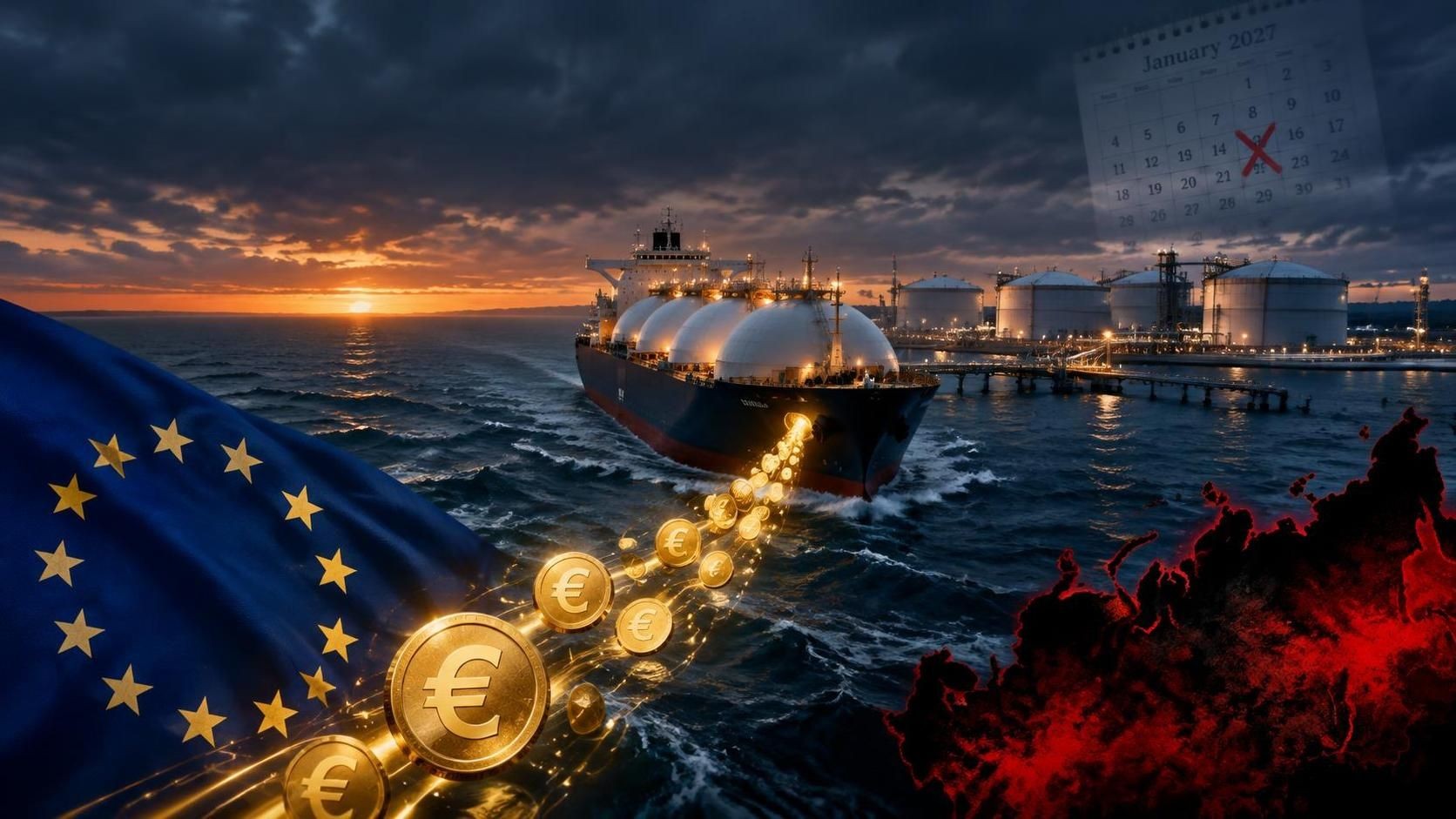
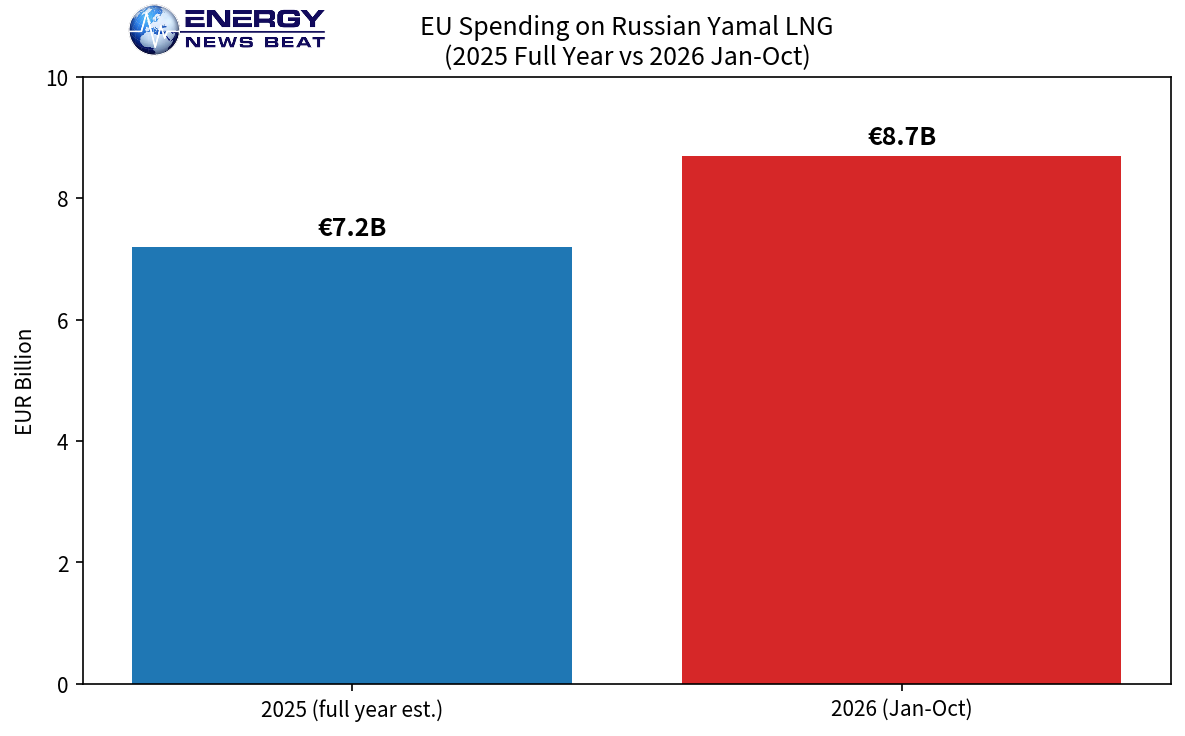
With roughly 50 days remaining until the European Union’s full ban on Russian LNG imports takes effect on January 1, 2027, the bloc has already spent more on Russian liquefied natural gas this year than it did in all of 2025. German campaign group Urgewald, analyzing Kpler vessel-tracking data, estimates that EU ports received 12.89 million tonnes of LNG from Russia’s Yamal project between January and October 2026 across 177 cargoes. The estimated bill: €8.7 billion ($9.6 billion)—about 21% higher than the €7.2 billion estimated for the full year of 2025.Oilprice
Volumes rose 6.3% year-on-year, and Europe absorbed roughly 81% of Yamal’s recorded deliveries. France has remained the largest buyer (historically around 41–42% of EU Yamal imports), followed by Belgium (especially Zeebrugge), Spain, and the Netherlands. Higher European gas prices—driven in part by disruptions to Qatari LNG supply linked to conflict involving Iran and the Strait of Hormuz—have pushed the value higher even when monthly volumes dipped. In October alone, 10 cargoes totaling about 706,000 tonnes were valued at an estimated €839 million as the TTF benchmark averaged near €87/MWh.Oilprice
The EU accounted for nearly half (47%) of Russia’s total LNG exports in October, according to the Centre for Research on Energy and Clean Air (CREA). Short-term contract bans have applied since late April 2026, but long-term contracts continue until the January 1, 2027 cutoff. Buyers have kept cargoes flowing—and in some periods increased volumes—while prices stayed elevated.
Five Years of Russian Energy Purchases: Gas, Oil Products, and Uranium
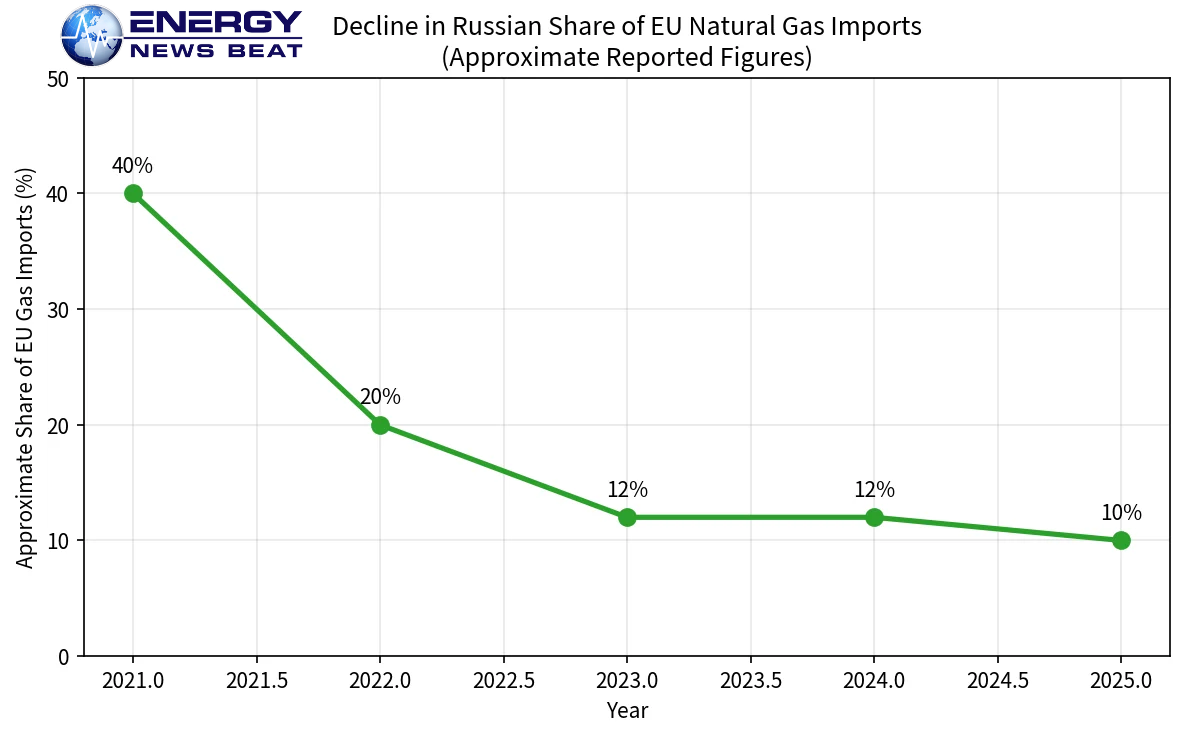
Before Russia’s full-scale invasion of Ukraine in February 2022, Russia supplied roughly 40–45% of the EU’s natural gas imports (around 155–160 bcm in 2021). Pipeline flows via Nord Stream, Ukraine transit, and the Yamal-Europe route largely collapsed. Ukraine transit ended on January 1, 2025. Residual pipeline gas continues mainly via TurkStream to southeastern Europe (notably Hungary and others under exemptions).
Russian LNG has filled part of the gap. Imports of Russian LNG were already rising before the war and remained substantial afterward. In 2025, the EU imported around 15 million tonnes from Yamal alone (roughly 76% of the project’s exports), generating an estimated €7.2 billion. Overall Russian gas’s share of EU imports has fallen sharply—from near 40% pre-war to roughly 8–15% in recent years depending on whether only directly reported Russian origin or transit-attributed volumes are counted—but LNG volumes have been far more resilient than pipeline gas.Brentandbeyond
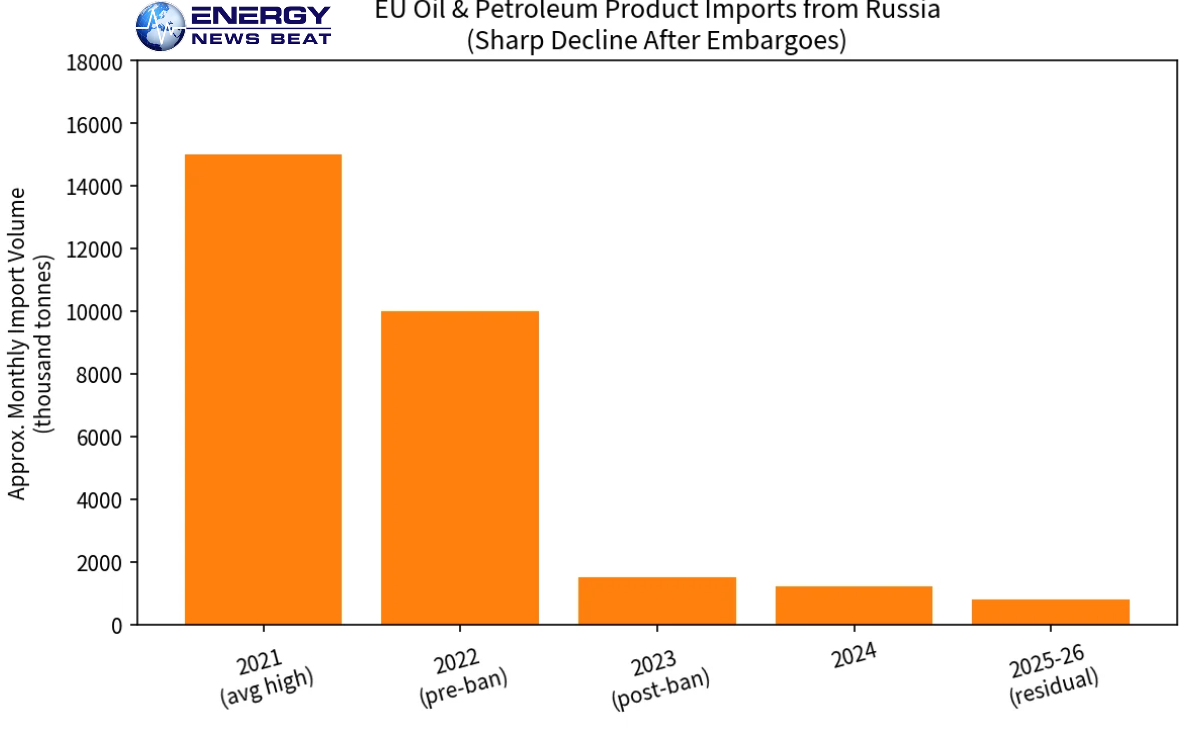
Oil, diesel, and gasoline tell a different story. The EU banned seaborne Russian crude oil in December 2022 and refined oil products in February 2023. Russia’s share of EU petroleum oil imports collapsed to around 1% by the second quarter of 2026, according to Eurostat. Residual crude flows continue via the Druzhba pipeline to Hungary and Slovakia under exemptions. Concerns persist about refined products (including diesel and gasoline) from third-country refineries that process Russian crude, with CREA noting shipments from such facilities still arriving at EU ports. Overall volumes of direct Russian oil products are a fraction of pre-war levels.
Uranium and nuclear fuel have seen less disruption. Russia remains a significant supplier of enriched uranium and fabricated fuel for certain reactor designs (notably VVER). In 2023, Russian material accounted for roughly 23% of natural uranium used in EU final nuclear products and about 38% of enriched uranium. The EU imported over €700 million in Russian uranium products in 2024. Early 2026 saw a sharp rise in the value of enriched uranium imports (Jan–Apr €163.5 million versus €20.7 million in the same period a year earlier), driven largely by France and described by analysts as largely reflecting contract timing rather than a fundamental reversal of diversification efforts. Nuclear fuel phase-out is slower due to technical constraints and inventory building.
The Dual Funding Reality
Cumulative EU payments for Russian fossil fuels since early 2022 are estimated in the range of roughly €197–213 billion through mid-to-late 2026 (European Commission and Commissioner figures for 2022–2025/mid-2026 periods; CREA tracking has shown even larger cumulative totals in some updates). Oil and gas revenues have historically formed a large share of Russia’s budget and military funding. At the same time, the EU has provided substantial financial, military, and humanitarian aid to Ukraine. Analyses from CREA and others have noted periods in which energy payments to Russia exceeded (or closely approached) certain categories of aid to Kyiv in given years.
The pattern is clearest with LNG: pipeline gas and most oil have been curtailed, yet European terminals continue to take the majority of Yamal’s output right up to the ban deadline, at elevated prices. France, Belgium, Spain, and the Netherlands have been the primary destinations. Companies such as TotalEnergies (a Yamal stakeholder) and others hold long-term contracts that remain valid until the January 2027 cutoff.
The upcoming ban will remove Europe as Yamal’s most convenient winter market. Whether Russia can fully reroute volumes to Asia, manage ice-class shipping constraints, and maintain revenues at similar levels remains an open question. For the EU, the final weeks of 2026 are producing a clear numerical outcome: more money transferred for Russian LNG in ten months than in the previous full year, while the political commitment to end the trade is already on the books.
Appendix: Sources and Links
- OilPrice.com – “EU Imports of Russian LNG Top 2025 Value Ahead of January Ban” (Nov 12, 2026): https://oilprice.com/Latest-Energy-News/World-News/EU-Imports-of-Russian-LNG-Top-2025-Value-Ahead-of-January-Ban.html
- TradeWinds – “EU Russian LNG imports bill climbs ahead of January ban” (Nov 12, 2026): https://www.tradewindsnews.com/gas/eu-russian-lng-imports-bill-climbs-ahead-of-january-ban/2-1-2072567
- Urgewald analyses and press releases (multiple 2026 reports based on Kpler data): https://www.urgewald.org/en/media/2025-eu-imports-kremlins-flagship-yamal-lng-project-hit-eu72-billion and related updates
- Centre for Research on Energy and Clean Air (CREA) – October 2026 monthly analysis: https://energyandcleanair.org/october-2026-monthly-analysis-of-russian-fossil-fuel-exports-and-sanctions/
- CREA Russia Fossil Tracker: https://www.russiafossiltracker.com/ and related project pages
- Euronews – “Europe paid Russia $209bn for energy since 2022…” (Oct 2026): https://www.euronews.com/2026/10/13/europe-paid-russia-209bn-for-energy-since-2022-far-below-moscows-320bn-claim
- High North News and related coverage of Urgewald/Kpler Yamal data (Jan 2026 and updates)
- Eurostat energy trade statistics (nrg_ti_gasm, nrg_ti_oilm, COMEXT)
- Bruegel – analyses on EU-Russia energy divorce and uranium: https://www.bruegel.org/
- IEEFA European LNG Tracker and analyst comments (Ana Maria Jaller-Makarewicz)
- S&P Global and other reporting on enriched uranium import spikes (2026)
- European Commission / Commissioner statements on cumulative payments (2026)
- ACER and other EU agency reports on Russian gas supplies
Data estimates (especially values) are based on vessel tracking, benchmark prices, and published analyses; actual contract prices can differ. Volumes and shares are drawn from Kpler, Eurostat, CREA, and Urgewald as cited.