

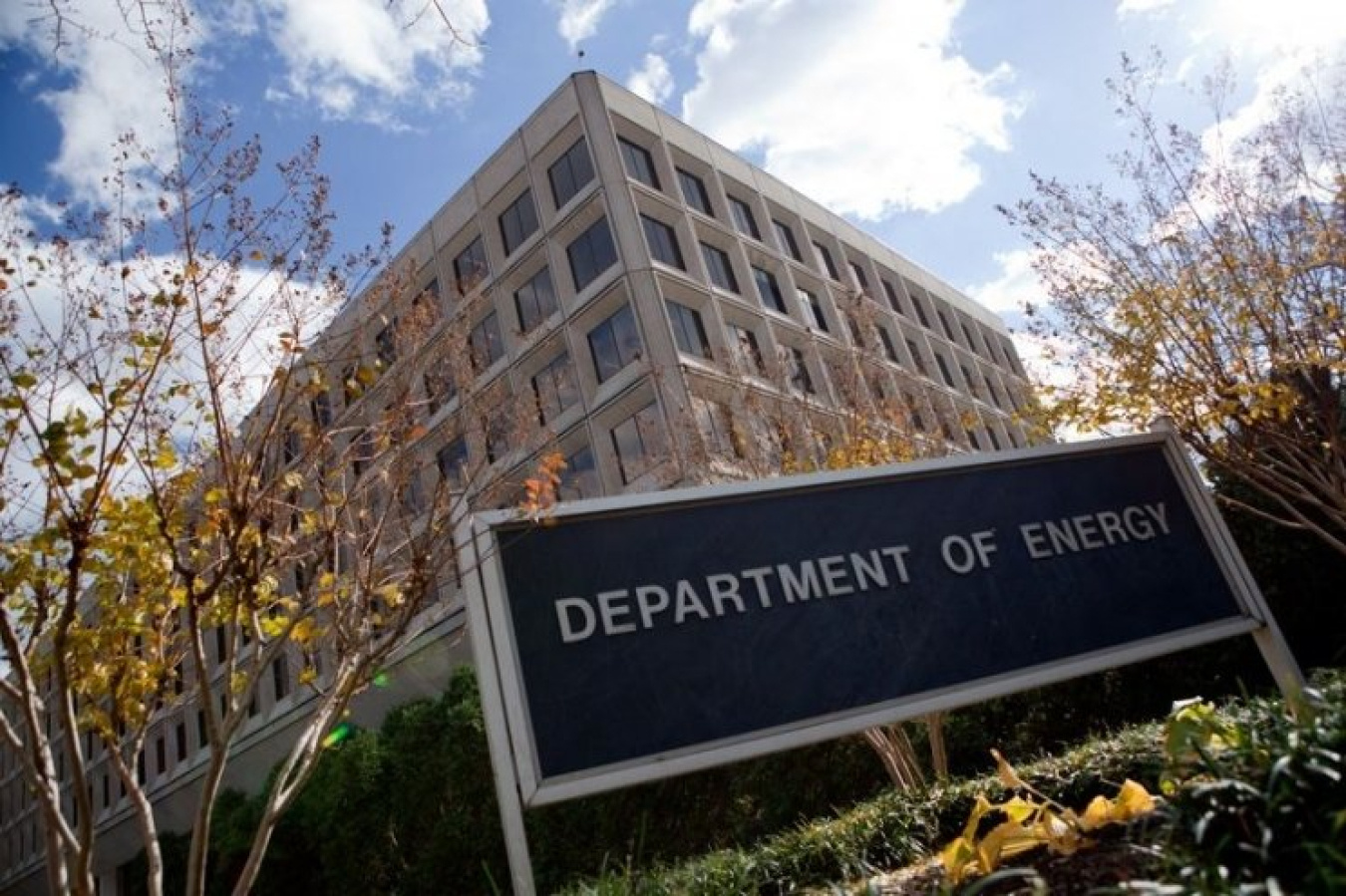
Wagner Unit 4, a 397-megawatt oil-fired machine at Talen’s H.A. Wagner station, had already used its 438 permitted hours for 2026. Energy Secretary Chris Wright’s emergency order lets PJM call on it through year-end when the mid-Atlantic grid is tight. DOE and PJM say that is to reduce outage risk. Neither published a bill impact.
U.S. Energy Secretary Chris Wright on Nov. 17 issued an emergency order under Federal Power Act section 202(c) that lets PJM Interconnection, working with Talen Energy, run Unit 4 at the H.A. Wagner Generating Station in Anne Arundel County, Maryland, beyond its annual operating limit through Dec. 31. The order, No. 202-26-25B, takes effect Nov. 18 and follows a PJM application filed Oct. 23. It is the fifth such order for the unit since DOE first issued Order No. 202-25-6 on July 28, 2025.
The Department of Energy release said Wright issued the order “to reduce the risk of power outages and strengthen grid reliability across the mid-Atlantic region.” A DOE subhead said the step is meant to “minimize the risk of energy shortfalls in 13 states and the District of Columbia.” Wright said, “Energy shortfalls for 65 million Americans are simply unacceptable.” PJM, in a July 2026 overview, says it serves “67+” million people as of February 2026 in all or parts of Delaware, Illinois, Indiana, Kentucky, Maryland, Michigan, New Jersey, North Carolina, Ohio, Pennsylvania, Tennessee, Virginia, West Virginia and D.C. The two figures differ.
Wagner Unit 4 is a 397-megawatt (summer rating) unit, the order says; PJM’s filing calls it oil-fired. By the Oct. 23 application, it had already used its yearly allotment: no more than 438 hours when burning fuel oil, a cap in a December 2019 Maryland consent order submitted to EPA on Jan. 31, 2020. PJM asked for 44 more days of authority this winter.
What the order is supposed to protect
DOE’s order finds a “risk of substantial energy supply shortfall” in PJM, and says “blackouts resulting from the shortfall are probable and could substantially harm public health and safety.” It directs PJM to dispatch the unit “only during the hours necessary to meet the emergency and to minimize costs to ratepayers,” and only when PJM declares or anticipates a Maximum Generation Alert and/or a Transmission Security Emergency, or otherwise runs the unit under a FERC-accepted reliability-must-run settlement.
PJM’s application says that without the order, “residences, hospitals, military facilities, water treatment plants, and other critical facilities may lose electric service.” PJM also said it has already had to rely on Wagner Unit 4 “during atypically high and low temperatures during this calendar year,” and needs it “particularly as PJM supports the grid through the 2026-2027 winter season.” Neither the order nor DOE’s release quantified a winter bill impact or an avoided-outage dollar figure.
What Wagner Unit 4 is
The unit sits in Pasadena, at the Fort Smallwood complex next to Talen’s Brandon Shores coal plant. This order covers only Wagner Unit 4, not Brandon Shores. Talen’s plant page describes H.A. Wagner as oil-fired, with 702 megawatts across two units. EIA’s preliminary inventory as of September 2026, released Oct. 23, lists Unit 4 at 414.7 megawatts nameplate and 397 megawatts net summer capacity.
Talen told PJM on Oct. 16, 2023, it intended to retire Units 1, 3, 4 and CT 1 on June 1, 2025. PJM replied on Jan. 4, 2024, that losing Units 3 and 4 would “adversely affect the reliability of the PJM Transmission System” without upgrades. A FERC-approved reliability-must-run settlement, which Talen said FERC accepted on May 1, 2025, kept Units 3 and 4 running through May 31, 2029. On Aug. 18, 2026, FERC extended that obligation through May 31, 2031, after delays on two 500-kilovolt lines now slated for December 2030. EIA’s September inventory still listed a June 2029 planned retirement, lagging that order. The plant is already paid to stay online; what ran out is Unit 4’s 438-hour oil cap.
The mix on the grid this order covers
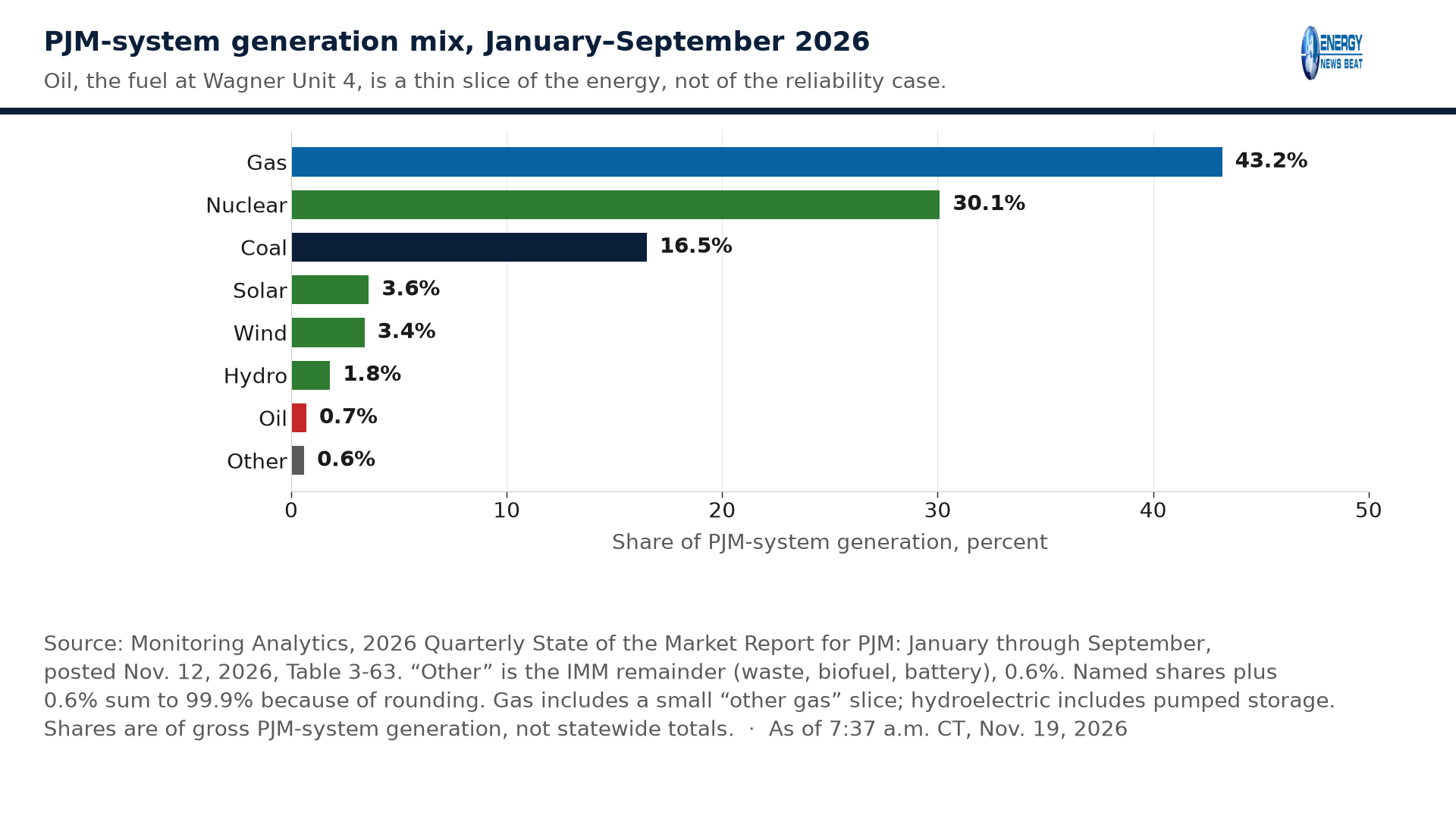
PJM’s Independent Market Monitor, in its quarterly report for January through September 2026, posted Nov. 12, said PJM-system generation was 43.2 percent gas, 30.1 percent nuclear, 16.5 percent coal, 3.6 percent solar, 3.4 percent wind, 1.8 percent hydroelectric and 0.7 percent oil.
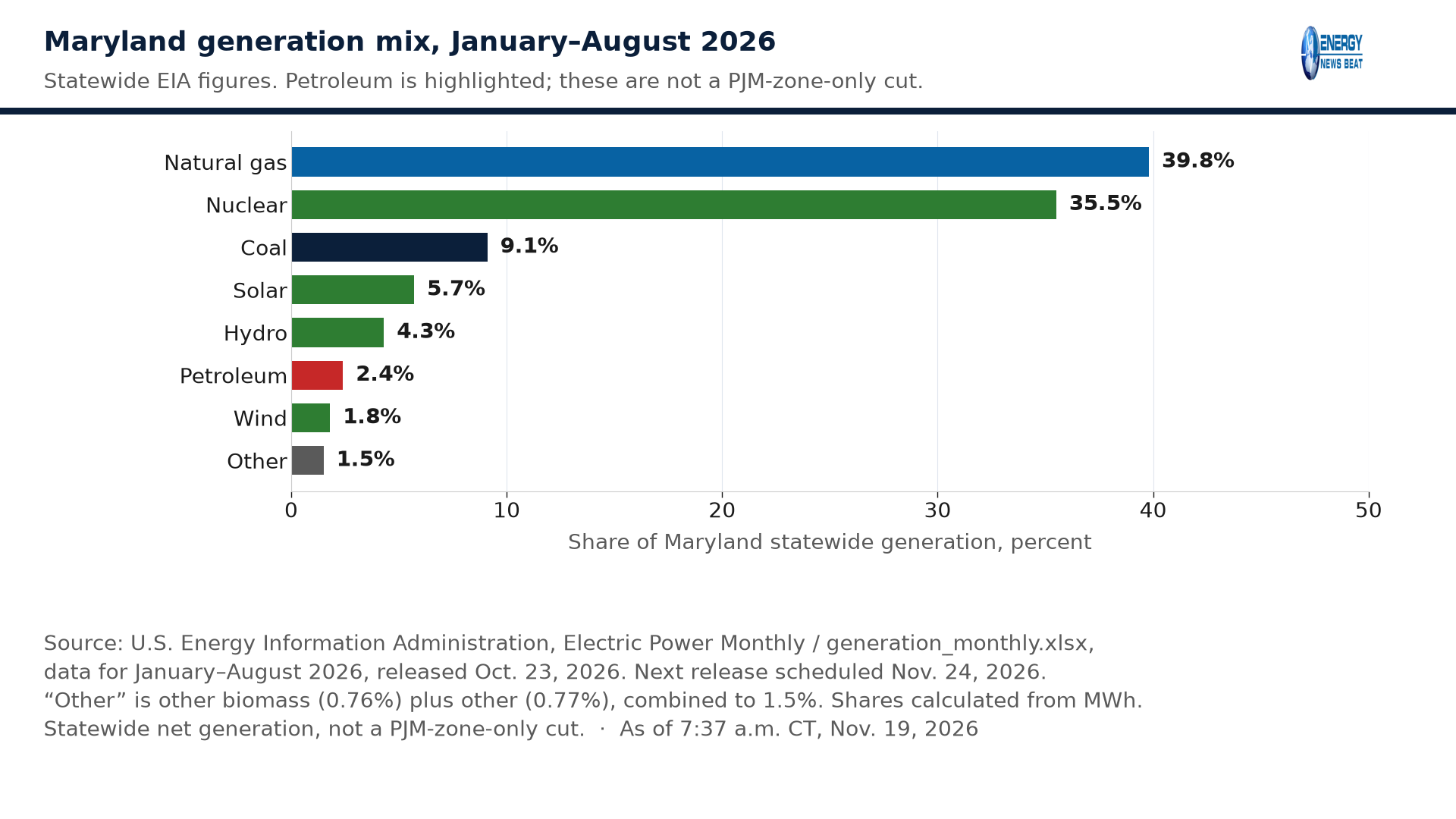
EIA’s Electric Power Monthly, data through August 2026, released Oct. 23, shows Maryland’s statewide generation was 39.8 percent natural gas, 35.5 percent nuclear, 9.1 percent coal, 5.7 percent solar, 4.3 percent conventional hydro, 2.4 percent petroleum and 1.8 percent wind. Petroleum is a small slice of the state’s generation, larger than oil’s share of the PJM system mix. Statewide figures for the other PJM states are in the appendix; several of those states are only partly inside PJM.
A capacity shortfall, a company that benefits, and the caveats
The Monitor says PJM has been short of its reliability objective in three straight capacity auctions: 208.7 megawatts in 2026/2027, 6,516.6 megawatts in 2027/2028, and 6,831.3 megawatts in 2028/2029. PJM’s July 14 report on the 2028/2029 auction said total RTO capacity cleared 6,831.3 megawatts UCAP below the reliability requirement after a 6,516-megawatt UCAP shortage in the prior auction.
Talen Energy (NASDAQ: TLN) owns the unit through H.A. Wagner LLC and, PJM said, “does not oppose” the request. A January 2025 settlement Talen announced, and that FERC later described, set Wagner’s maximum fixed-cost charge at $35 million a year, with fuel and variable costs reimbursed separately. Those figures are for the RMR, not this order. TLN closed at $360.18 on Nov. 18, per Yahoo Finance. The order warns that additional generation “may result in a conflict with environmental standards and requirements,” does not waive emissions fees or allowances, and says the unit must comply with applicable law after Dec. 31. Maryland’s Office of People’s Counsel protested the rates in Talen’s 2031 RMR extension filings in June; FERC accepted the extension in August. No separate criticism of this Nov. 17 emergency order was located this morning. Earlier orders in the chain drew published criticism, including an Aug. 19 mgrid.org analysis arguing that “Four consecutive orders across 13 months strain the word emergency.”
Consumer View
This is a 44-day insurance policy against mid-Atlantic load shed on the tightest days, aimed first at the Baltimore Gas and Electric zone. It is not a published finding that bills will be lower or higher.
Investor View
For Talen, the verified facts are ownership, a statement that it does not oppose the order, and an already-accepted Wagner RMR fixed charge of up to $35 million a year plus reimbursed fuel and variable costs.
Stu’s Take
A 397-megawatt oil unit in Anne Arundel County had already used its 438 allowed hours for 2026. DOE’s answer is to let PJM call on Wagner Unit 4 through Dec. 31 when the mid-Atlantic grid is in a declared or anticipated emergency. That is a reliability patch, not a new plant and not a rate case. Secretary Wright talked about shortfalls for 65 million Americans; PJM says it serves 67 million-plus. Neither the order nor DOE’s release put a number on winter bills, avoided outages, or what extra hours will pay Talen (NASDAQ: TLN), which already collects up to $35 million a year as a fixed RMR charge for Wagner and does not oppose the request. Oil is a sliver of the PJM mix, but the unit is still there because the region has been short in three straight capacity auctions. Keep it available if the alternative is load shed. Just do not pretend the cost, or the emissions, were priced in this order.
Taking care of the grid, and consumers is important. But the real question should be how do we get base load for cleaner natural gas to replace this unit long term? That is the Shakespearean question – “What base-load at What Cost?
Sources
Primary and official sources opened for this article, with access on Thursday, Nov. 19, 2026, unless a different date is noted. Direct quotation marks are used only where the named source set the words in quotes or an official English text was retrieved.
- U.S. Department of Energy, “Energy Secretary Acts to Protect Mid-Atlantic Grid,” news release, Nov. 18, 2026. Official announcement of the renewed 202(c) order. Subhead: “minimize the risk of energy shortfalls in 13 states and the District of Columbia.” Wright: “Energy shortfalls for 65 million Americans are simply unacceptable.” States the order permits PJM, in coordination with Talen, to run Wagner Unit 4; follows a PJM application submitted Oct. 23, 2026; effective Nov. 18 through Dec. 31, 2026. Does not quantify a bill impact https://www.energy.gov/articles/energy-secretary-acts-protect-mid-atlantic-grid-0
- U.S. Department of Energy, Order No. 202-26-25B, Talen Energy Corporation and PJM Interconnection, L.L.C., Regarding H.A. Wagner Generating Station Unit 4, issued in Washington, D.C., Nov. 17, 2026, effective Nov. 18 through Dec. 31, 2026. Official 8-page PDF retrieved from energy.gov/documents/202-26-25b-wagner (MD5 29809d15ca9b8e7b3abea32f713ec38a), identical to the copy posted by PJM. The order is the controlling primary record for the 397 MW summer rating, the 438-hour oil operating limit, the May 21, 2026 original application history, the zero remaining hours cited from the Aug. 4, 2026 application, the emergency findings, dispatch conditions, environmental caveats, and cost-to-ratepayers language https://www.energy.gov/documents/202-26-25b-wagner
- DOE Office of Cybersecurity, Energy Security, and Emergency Response, “Federal Power Act Section 202(c): PJM Interconnection L.L.C. (PJM) Order No. 202-26-25,” and “2026 DOE 202(c) Orders.” Official dockets confirming issuance of Order No. 202-26-25B on Nov. 17, 2026, and linking the renewal application and prior Order No. 202-26-25A https://www.energy.gov/ceser/federal-power-act-section-202c-pjm-interconnection-llc-pjm-order-no-202-26-25
- PJM Interconnection, L.L.C., letter from Michael E. Bryson, Senior Vice President, Operations, to Secretary Chris Wright, “Request for Renewal of Emergency Order Under Federal Power Act, Section 202(c),” Oct. 23, 2026. Official 8-page renewal application. States Wagner Unit 4 has zero hours remaining; Talen “does not oppose”; requests a 44-day renewal of Order No. 202-26-25A from Nov. 18 through Dec. 31, 2026; describes residences, hospitals, military facilities and water treatment plants at risk; cites the 2026-2027 winter season; recounts the Oct. 16, 2023 deactivation notice and PJM’s Jan. 4, 2024 reliability reply https://www.energy.gov/documents/pjms-202c-renewal-application-25b
- DOE, Order No. 202-26-25A, Aug. 19, 2026, the immediately prior 202(c) order for Wagner Unit 4, which expired Nov. 17, 2026 https://www.energy.gov/documents/doe-order-no-202-26-25a
- PJM, “PJM Overview,” Susan McGill, TEAC special session, July 16, 2026. Names the 13 states plus the District of Columbia and, on a slide marked “As of 2/2026,” lists “67+” million people served https://www.pjm.com/-/media/DotCom/committees-groups/committees/teac/2026/20260716-special/item-02—pjm-overview.pdf
- PJM, “PJM – At a Glance” fact sheet. States that PJM coordinates electricity in all or parts of 13 states and the District of Columbia and that its job is to ensure there is enough electricity for the 67 million people in the region. Used as a corroborating PJM description; the dated Overview is used for the as-of stamp and the state list https://www.pjm.com/-/media/DotCom/about-pjm/newsroom/fact-sheets/pjm-at-a-glance.pdf
- Monitoring Analytics, LLC, Independent Market Monitor for PJM, 2026 Quarterly State of the Market Report for PJM: January through September, dated 11.12.2026 and posted Nov. 12, 2026. Table 3-63 is the source for the PJM-system generation mix. Page 1 states that the capacity market was short of its reliability objective in the 2026/2027, 2027/2028 and 2028/2029 Base Residual Auctions, and that the shortfall grew from 208.7 MW to 6,516.6 MW to 6,831.3 MW https://www.monitoringanalytics.com/reports/PJM_State_of_the_Market/2026/2026q3-som-pjm.pdf
- PJM, 2028/2029 Base Residual Auction Report, July 14, 2026. States that procured capacity in the RTO, including RPM and FRR, is 149,181.6 MW UCAP, or 6,831.3 MW UCAP below the RTO Reliability Requirement, and that this is similar to the prior BRA, “where the shortage was 6,516 MW UCAP” https://www.pjm.com/-/media/DotCom/markets-ops/rpm/rpm-auction-info/2028-2029/2028-2029-bra-results-report.pdf
- U.S. Energy Information Administration, Electric Power Monthly, data for August 2026, release date Oct. 23, 2026, next release date Nov. 24, 2026. Companion file generation_monthly.xlsx, 2026_Preliminary sheet labeled “Months Through August 2026,” used to calculate statewide generation shares for Maryland and the other PJM-footprint states. 2025_Final sheet used only as a comparison reference in the data table https://www.eia.gov/electricity/monthly/
- EIA, Preliminary Monthly Electric Generator Inventory (Form EIA-860M), inventory of operating generators as of September 2026, released Oct. 23, 2026. Herbert A Wagner, Plant ID 1554, Generator ID 4: nameplate 414.7 MW, net summer 397 MW, technology Petroleum Liquids, energy source code DFO, operating August 1972, planned retirement June 2029, status Operating, entity H.A. Wagner LLC, Anne Arundel County, Maryland, balancing authority PJM https://www.eia.gov/electricity/data/eia860m/
- Talen Energy, H.A. Wagner Generating Station plant page. States the plant is in Pasadena, Maryland, fueled by oil, with 702 MW of owned generating capacity across two units, and that Units 3 and 4 will continue to operate until May 31, 2031, under a reliability-must-run agreement and subsequent extension https://www.talenenergy.com/plant/h-a-wagner-generating-station/
- Talen Energy, “FERC Approves Reliability Must Run Settlement Agreement for Units at Talen Energy’s Brandon Shores and H.A. Wagner Power Plants,” May 1, 2025. Announces FERC approval of terms to operate Brandon Shores Units 1 and 2 and H.A. Wagner Units 3 and 4 until May 31, 2029, beyond scheduled May 31, 2025 retirement dates. NASDAQ: TLN https://ir.talenenergy.com/news-releases/news-release-details/ferc-approves-reliability-must-run-settlement-agreement-units
- Talen Energy, GlobeNewswire, “Talen Energy, Other Parties Reach Reliability Must Run Settlement Agreement for Brandon Shores and H.A. Wagner Power Plants,” Jan. 27, 2025, 16:26 ET. States fixed payments of $312/MW-day ($145 million annually) for Brandon Shores and $137/MW-day ($35 million annually) for H.A. Wagner, including performance incentives, with fuel and variable O&M reimbursed separately https://www.globenewswire.com/news-release/2025/01/27/3015994/0/en/talen-energy-other-parties-reach-reliability-must-run-settlement-agreement-for-brandon-shores-and-h-a-wagner-power-plants.html
- Federal Energy Regulatory Commission, 196 FERC ¶ 61,140, Order Accepting Amended Reliability-Must-Run Rate Schedules, H.A. Wagner LLC and Brandon Shores LLC, Docket Nos. ER26-2739-002 and ER26-2740-002, issued Aug. 18, 2026. Accepts the extension of the RMR obligation until May 31, 2031. Recites the settlement-rate monthly fixed-cost charges of $12,083,333 for Brandon Shores and $2,916,667 for Wagner. Notes delays on the North Delta–High Ridge 500 kV and Peach Bottom–Conastone 500 kV lines, with revised completion dates of December 2030. Rejects Maryland OPC and Market Monitor objections to the extension as discussed in the order. Retrieved from the PDF posted on PJM’s deactivation-notices page https://www.pjm.com/-/media/DotCom/planning/gen-retire/deactivation-notices/brandon-shores-and-wagner-letters-as-ferc-amendment.pdf
- Maryland Office of People’s Counsel, protest of the Talen RMR extension filings, Docket Nos. ER26-2739 et al., June 25, 2026. Contests the proposed annual fixed revenue requirement for the two-year extension through May 31, 2031. Verbatim: “This protest asks the Commission to accept the Talen filings, subject to suspension for the period allowed by statute and set the matter for hearing to review the level and basis for the requested AFRR.” https://opc.maryland.gov/Portals/0/Files/Publications/Others/20260625-5224_Talen%20RMR%20Extension%20Filing%20ER26-2739%20et%20al%20Md%20OPC%20protest%20062526.pdf
- Maryland Department of the Environment and Raven Power Fort Smallwood LLC, Consent Order, Appendix B-1 to the Maryland State Implementation Plan sulfur dioxide documents. Paragraph 12: beginning Jan. 1, 2021, Unit W4 “shall not exceed 438 hours of operation per calendar year when burning fuel oil.” The DOE order states that this consent order, signed in December 2019, was submitted to EPA on Jan. 31, 2020 https://mde.maryland.gov/programs/Air/AirQualityPlanning/Documents/Current%20SIP/Sulfur%20Dioxide/Appendices%20B1%20to%20B2_ConsentOrders_wTOC.pdf
- Yahoo Finance, Talen Energy Corporation (TLN) daily historical prices. Nov. 18, 2026, regular-session close $360.18, retrieved Nov. 19, 2026, from the Yahoo Finance chart API and confirmed against the quote page https://finance.yahoo.com/quote/TLN/history/
- U.S. Department of Energy, “2025 DOE 202(c) Orders,” CESER listing page, last updated July 15, 2026, retrieved Nov. 19, 2026. Recites Order No. 202-25-6, issued July 28, 2025, directing PJM, in coordination with Talen, to operate Wagner Unit 4 beyond its environmental run-hour limitations through October 26, 2025, and Order No. 202-25-6A, issued October 24, 2025, in effect October 26 through December 31, 2025 https://www.energy.gov/ceser/2025-doe-202c-orders
- Marin Holt, “DOE Keeps 397-MW Wagner Oil Unit Running Past Permit Limits Through November 17,” mgrid.org, Aug. 19, 2026, retrieved Nov. 19, 2026. Published criticism of the earlier 202(c) orders for this unit, including Order No. 202-26-25A. Verbatim: “Four consecutive orders across 13 months strain the word emergency.” https://mgrid.org/2026/08/19/doe-keeps-397-mw-wagner-oil-unit-running-past-permit-limits-through-november-17/
Key Excerpts
DOE news release, Nov. 18, 2026, quoting Secretary Wright. “Energy shortfalls for 65 million Americans are simply unacceptable.”
DOE Order No. 202-26-25B, Nov. 17, 2026, on harm. “I also identify a risk of substantial harm from this inadequate electricity supply, as blackouts resulting from the shortfall are probable and could substantially harm public health and safety.”
DOE Order No. 202-26-25B, Ordering Paragraph A, on ratepayers and conditions. “I direct PJM to dispatch such unit and to order its operation only during the hours necessary to meet the emergency and to minimize costs to ratepayers.”
PJM renewal application, Oct. 23, 2026, on facilities at risk. “Absent such an order, in the limited circumstances when PJM is in emergency procedures as described herein, residences, hospitals, military facilities, water treatment plants, and other critical facilities may lose electric service to all or parts of their facilities due to the lack of adequate generation or transmission emergencies.”
Maryland consent order, Paragraph 12, Unit W4. “Beginning January 1, 2021, at all times when operating, Unit W4 at the H.A. Wagner generating station shall not exceed 438 hours of operation per calendar year when burning fuel oil.”
Independent Market Monitor, quarterly report posted Nov. 12, 2026, on capacity shortfalls. “The amount that PJM is short capacity grew from 208.7 MW in the 2026/2027 BRA, to 6,516.6 MW in the 2027/2028 BRA, and to 6,831.3 MW in the 2028/2029 BRA.”
Data tables
PJM-system generation by fuel, January–September 2026
| Fuel | GWh | Share |
| Gas | 293,682.3 | 43.2% |
| Nuclear | 204,703.7 | 30.1% |
| Coal | 111,816.4 | 16.5% |
| Solar | 24,480.3 | 3.6% |
| Wind | 23,419.8 | 3.4% |
| Hydroelectric | 12,388.8 | 1.8% |
| Oil | 4,704.8 | 0.7% |
| Other (remainder) | 4,035.1 | 0.6% |
Monitoring Analytics, 2026 Quarterly State of the Market Report for PJM: January through September, Table 3-63, posted Nov. 12, 2026. The IMM remainder (waste 2,944.6 + biofuel 937.5 + battery 153.0 = 4,035.1 GWh) is 0.6 percent. Named shares plus 0.6 percent sum to 99.9 percent because of rounding. The 43.2 percent gas share is IMM’s “Gas” row, which includes 0.1 percent “other gas.” Hydroelectric includes pumped storage (0.8 percent). Figures are gross generation.
Maryland statewide generation by fuel, January–August 2026
| Fuel | MWh | Share |
| Natural gas | 10,920,828 | 39.8% |
| Nuclear | 9,739,685 | 35.5% |
| Coal | 2,491,000 | 9.1% |
| Solar | 1,556,330 | 5.7% |
| Hydroelectric conventional | 1,178,818 | 4.3% |
| Petroleum | 658,052 | 2.4% |
| Wind | 496,862 | 1.8% |
| Other biomass | 208,255 | 0.8% |
| Other | 210,448 | 0.8% |
| Total | 27,460,278 | 100.0% |
EIA, generation_monthly.xlsx, 2026_Preliminary, Total Electric Power Industry, January–August 2026, released Oct. 23, 2026. Shares may not sum to 100.0 because of rounding. Wood is zero in this cut. Other biomass (0.76%) and other (0.77%) combine to 1.5% in Chart 2.
Statewide generation shares, January–August 2026, PJM-footprint states
| State | TWh | Top fuels |
| Delaware | 3.4 | Gas 87.0%, solar 5.1%, petroleum 4.3% |
| Illinois | 133.2 | Nuclear 48.9%, gas 17.2%, coal 14.5%, wind 13.3% |
| Indiana | 74.3 | Coal 41.5%, gas 37.0%, wind 9.9%, solar 9.3% |
| Kentucky | 49.7 | Coal 62.1%, gas 27.6%, hydro 6.0%, solar 3.6% |
| Maryland | 27.5 | Gas 39.8%, nuclear 35.5%, coal 9.1%, solar 5.7% |
| Michigan | 82.7 | Gas 46.1%, nuclear 20.8%, coal 17.4%, wind 7.9% |
| New Jersey | 41.5 | Gas 48.4%, nuclear 45.7%, solar 3.3% |
| North Carolina | 96.6 | Gas 42.5%, nuclear 29.0%, coal 14.5%, solar 9.5% |
| Ohio | 106.7 | Gas 57.4%, coal 21.3%, nuclear 11.0%, solar 6.7% |
| Pennsylvania | 167.9 | Gas 58.3%, nuclear 30.2%, coal 7.0% |
| Tennessee | 58.6 | Nuclear 44.5%, coal 21.6%, gas 21.1%, hydro 10.1% |
| Virginia | 72.7 | Gas 55.7%, nuclear 27.4%, solar 10.1% |
| West Virginia | 38.2 | Coal 87.5%, gas 6.5%, wind 2.9% |
| District of Columbia | 0.1 | Gas 50.3%, solar 26.8%, other biomass 21.9% |
EIA, generation_monthly.xlsx, 2026_Preliminary, Total Electric Power Industry, January–August 2026, released Oct. 23, 2026. Statewide figures, not PJM-zone-only. Several states are only partly inside PJM. Do not add the TWh column and call the sum “PJM.” The Monitor’s system mix is the PJM-footprint figure used in the body.
A Brief Timeline
Jan. 31, 2020. Maryland consent order for the Fort Smallwood complex, signed in December 2019, submitted to EPA, as recited in the DOE order. Paragraph 12 caps Wagner Unit 4 at 438 hours a year when burning fuel oil, beginning Jan. 1, 2021.
Oct. 16, 2023. Talen notifies PJM it intends to retire Wagner Units 1, 3, 4 and CT 1 effective June 1, 2025.
Jan. 4, 2024. PJM replies that deactivating Units 3 and 4 would adversely affect transmission reliability without upgrades.
Jan. 27, 2025. Talen announces an RMR settlement: up to $35 million a year fixed for Wagner, $145 million for Brandon Shores, plus reimbursed fuel and variable costs, through May 31, 2029.
May 1, 2025. FERC accepts the RMR settlement (Talen announcement). The DOE order cites H.A. Wagner LLC, 191 FERC ¶ 61,098 (2025).
June 1, 2025. Original planned retirement date for the Wagner units named in the deactivation notice.
July 28, 2025. DOE issues Order No. 202-25-6 for Wagner Unit 4.
Oct. 24, 2025. DOE issues Order No. 202-25-6A, effective through Dec. 31, 2025.
May 21, 2026. PJM files the 2026 202(c) application for Wagner Unit 4, as recited in Order No. 202-26-25B.
June 25, 2026. Maryland Office of People’s Counsel protests the rates in Talen’s request to extend the RMR through May 31, 2031, asking FERC to accept the filings, suspend them, and set a hearing.
July 14, 2026. PJM publishes the 2028/2029 Base Residual Auction report: 6,831.3 MW UCAP below the reliability requirement.
Aug. 18, 2026. FERC, 196 FERC ¶ 61,140, accepts the RMR extension through May 31, 2031.
Aug. 19, 2026. DOE issues Order No. 202-26-25A for Wagner Unit 4, effective Aug. 20 through Nov. 17, 2026. The same day, an mgrid.org analysis argued that “Four consecutive orders across 13 months strain the word emergency.”
Oct. 23, 2026. PJM files the 44-day renewal application. EIA releases Electric Power Monthly data through August 2026 and the EIA-860M inventory as of September 2026.
Nov. 12, 2026. The Independent Market Monitor posts its January–September 2026 quarterly report.
Nov. 17, 2026. Secretary Wright issues Order No. 202-26-25B.
Nov. 18, 2026. The order takes effect. DOE publishes the news release. TLN closes at $360.18.
Dec. 31, 2026. Scheduled expiration of Order No. 202-26-25B, except for specified compliance duties. A renewal, if needed, must be requested before the order expires.
Background Notes
The order and PJM’s application both give Wagner Unit 4 a 397 MW summer rating. EIA-860M as of September 2026 lists 414.7 MW nameplate and 397 MW net summer. Talen’s 702 MW plant figure matches the sum of EIA summer ratings for Units 3 and 4 (305 + 397). The application’s older “approximately 841 MW (summer rating)” description of the Wagner facility includes units that have since retired.
Brandon Shores is a separate coal-fired plant at the same Fort Smallwood complex. It is under a related RMR arrangement but is not authorized, or discussed as a dispatched unit, in Order No. 202-26-25B.
DOE’s Wright quote is “65 million Americans.” PJM’s dated July 2026 overview, with statistics as of February 2026, says “67+” million people. The article reports both and does not treat them as one figure. The order itself does not state a population number.
EIA-860M as of September 2026 still listed a planned retirement of June 2029 for Wagner Units 3 and 4, which lags FERC’s Aug. 18, 2026, acceptance of the extension through May 31, 2031. The article reports both dates and does not treat the EIA inventory as having been updated to 2031.
No incremental payment, avoided-outage value, or customer bill impact for this 202(c) order was published in the order or the DOE release. RMR fixed charges cited in the body are from the January 2025 settlement announcement and the August 2026 FERC order, not from Order No. 202-26-25B.
No separate, on-the-record criticism of the Nov. 17, 2026, emergency order was located on the morning of Nov. 19, 2026. Maryland OPC’s June protest, and the Market Monitor’s objections recited in the August FERC order, were directed at the 2031 RMR extension, not at this 202(c) renewal. Earlier orders in the chain did draw published criticism, including an Aug. 19, 2026, mgrid.org analysis of Order No. 202-26-25A.
