
The Crude Truth about the Pain at the Pump
ENB Pub Note: This article first ran on The Crude Truth Substack, and we recommend subscribing!
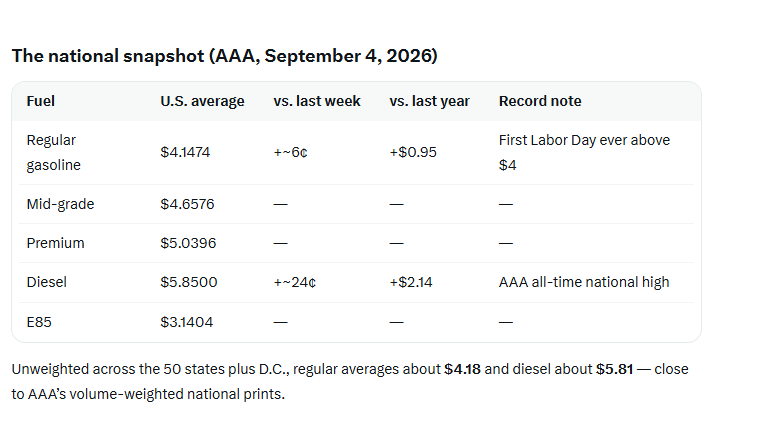
Americans heading out for Labor Day weekend are paying the highest holiday-weekend gasoline prices on record. AAA’s national regular average closed Friday at $4.1474 a gallon — the first Labor Day ever above $4, and about 95 cents above last year’s $3.20. Diesel is worse: AAA printed an all-time national high of $5.85 a gallon, up roughly $2.14 from a year ago.
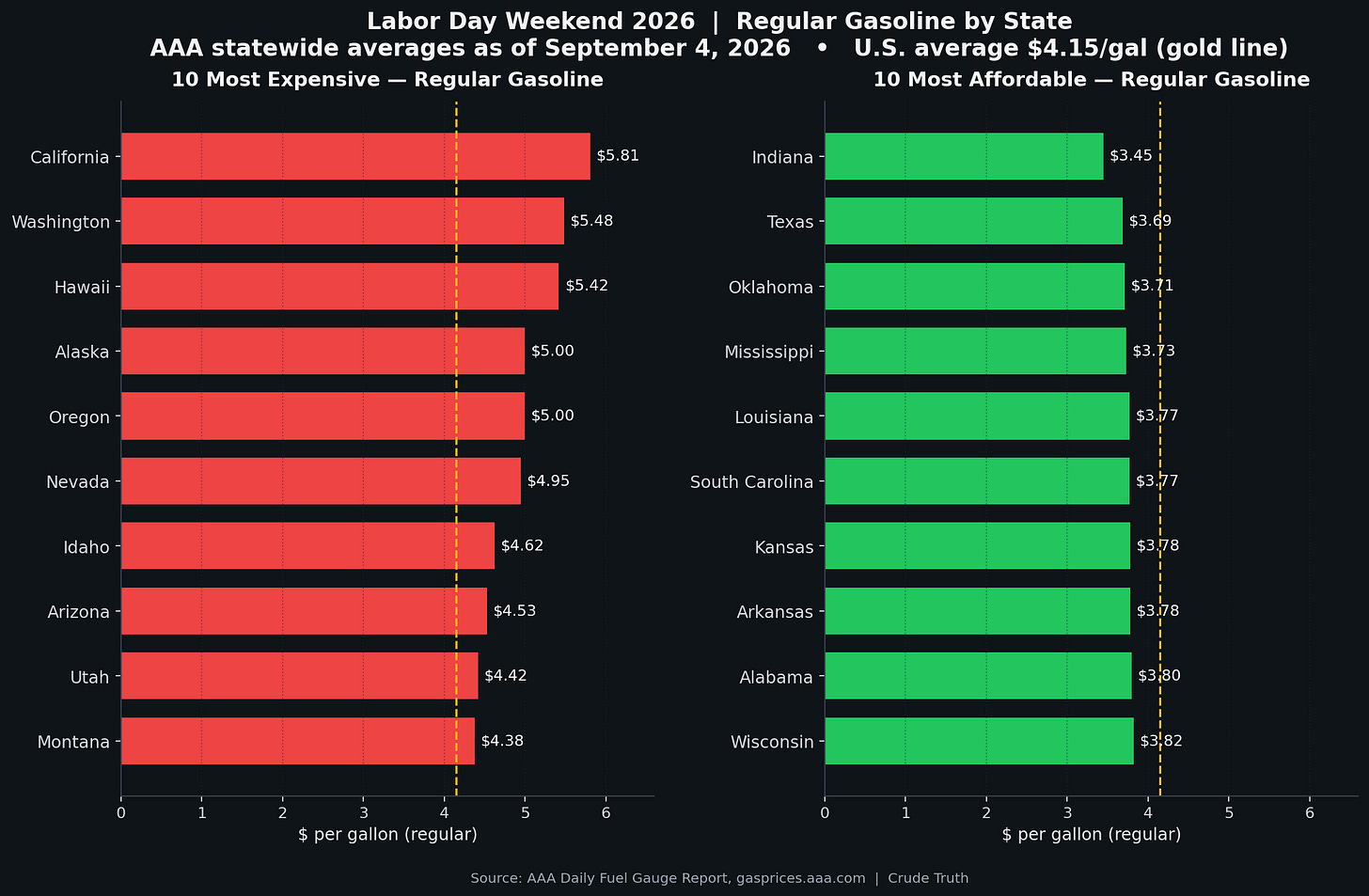
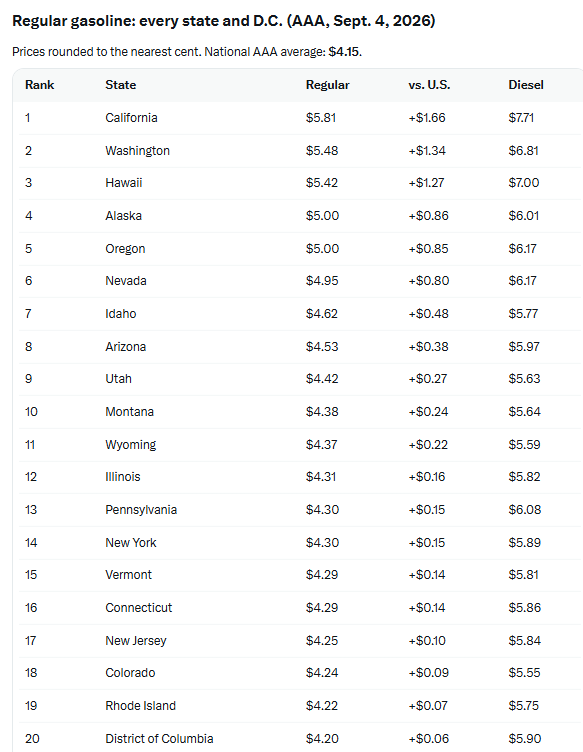
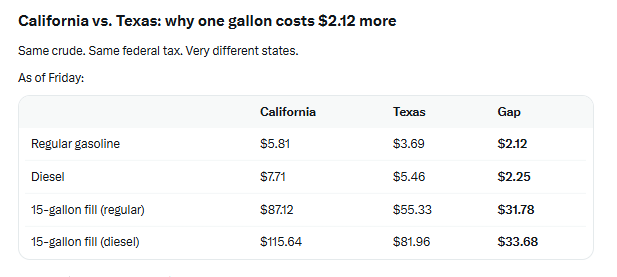
The crude backdrop is the same for every state. WTI has been hovering near $90 a barrel on Strait of Hormuz volatility. What is not the same is what each state layers on top of that barrel: excise taxes, sales taxes, carbon programs, boutique fuel specs, and the simple fact that the West Coast refining system is an island. That is why California is at $5.81 while Indiana is at $3.45 — a $2.36-a-gallon spread on the same holiday weekend.
GasBuddy, which compiles station-level reports rather than AAA’s statewide averages, ran a few cents cheaper in late August (national regular near $4.01 on August 31) but told the same story: West Coast isolation at the top, Gulf Coast and Midwest at the bottom, and Patrick De Haan warning that any post-holiday relief depends on crude and the shift to winter-blend gasoline.
Jet fuel: the third pump America rarely talks about
Retail gasoline and on-highway diesel are only two of the three refined products that move the country this weekend.FBO retail Jet-A (what general aviation and many regional operators actually pay at the airport) averaged $7.88 a gallon nationally as of September 4, 2026, per GlobalAir’s survey of more than 3,200 FBOs. 100LL avgas averaged $7.54; sustainable aviation fuel, where it is sold, averaged $10.09. The FAA Alaska region was the most expensive Jet-A market at $9.39; the Central region was cheapest at $7.23.
Wholesale Gulf Coast jet (EIA kerosene-type spot) was about $4.19 a gallon on September 1 — more than double year-ago levels — which is the price airlines hedge against before rack, into-plane, and airport fees.
Federal tax on commercial jet fuel used in domestic commercial aviation is generally 4.4¢/gal; other jet uses can face 21.9¢/gal. California still layers a 2.0¢ state jet excise plus sales-tax prepayment on aircraft jet fuel. Texas taxes aviation fuel at the same 20¢ state rate as motor gasoline.
High jet prices this weekend do not show up on the highway sign, but they show up in airfares, air-cargo rates, and the cost of flying parts, produce, and people over Labor Day.
Diesel: a different ranking, same West Coast problem
Diesel’s national average of $5.85 is a record. California diesel at $7.71 is in a league of its own — $2.25 above Texas and $2.33 above the cheapest state, Oklahoma.’
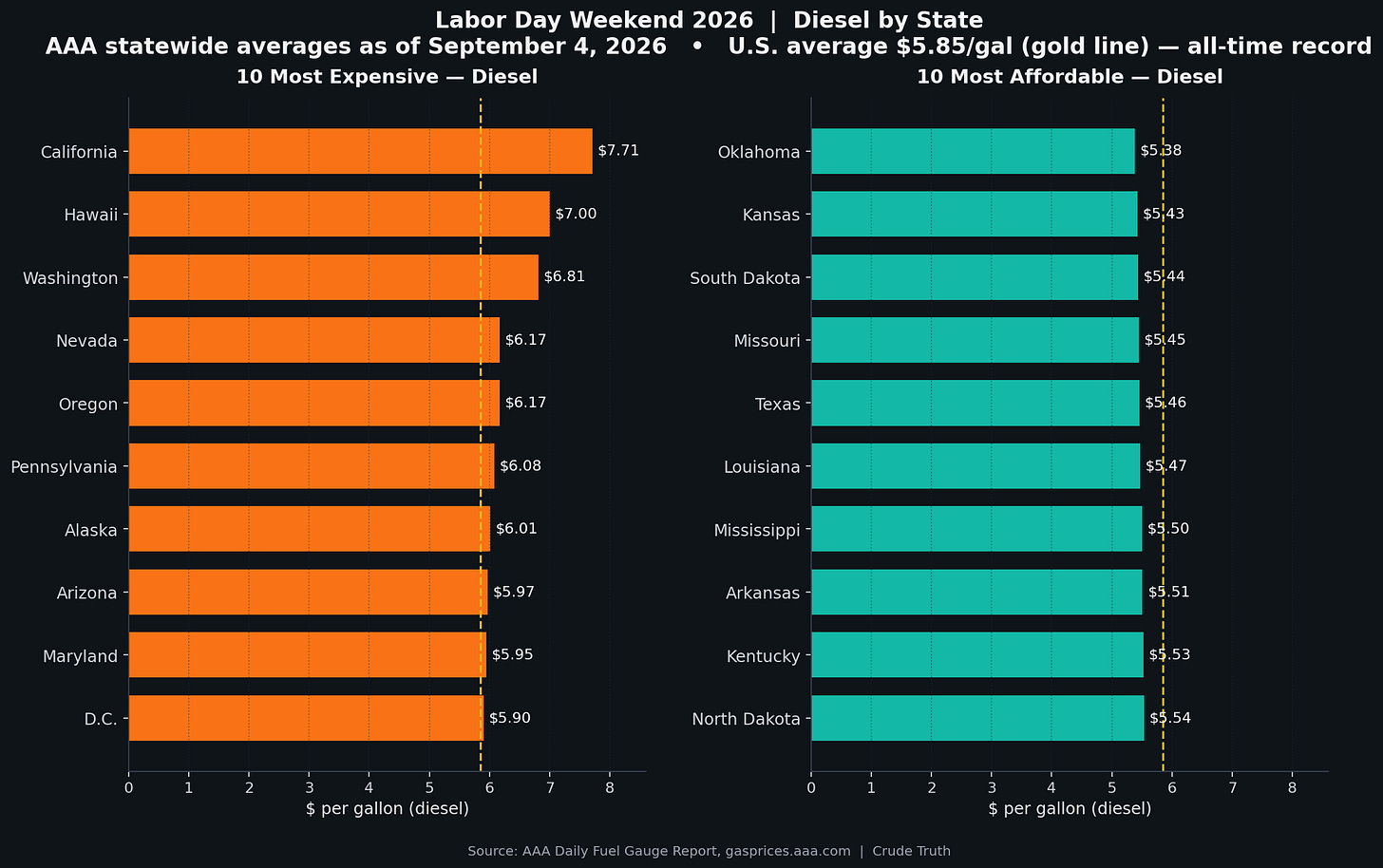
Most expensive diesel: California $7.71 · Hawaii $7.00 · Washington $6.81 · Nevada $6.17 · Oregon $6.17 · Pennsylvania $6.08 · Alaska $6.01 · Arizona $5.97 · Maryland $5.95 · D.C. $5.90Most affordable diesel: Oklahoma $5.38 · Kansas $5.43 · South Dakota $5.44 · Missouri $5.45 · Texas $5.46 · Louisiana $5.47 · Mississippi $5.50 · Arkansas $5.51 · Kentucky $5.53 · North Dakota $5.54Notice Indiana. It is the cheapest state for gasoline and nowhere near the cheapest for diesel ($5.85, right on the national average).
That is taxes: Indiana’s diesel and gasoline tax-and-fee stacks are both heavy; gasoline just happens to be oversupplied locally this week. California is #1 in both products because the policy stack and the isolated refining system hit gasoline and diesel.
For truckers, the Labor Day print is not a holiday story. At 6.5 mpg, $5.85 diesel is about 90 cents a mile in fuel alone. At California’s $7.71, it is about $1.19 a mile. That differential moves into grocery shelves, housing materials, and every other good that rides a trailer.
What Energy Policy adds to a gallon of gas
1. The statutory tax line
Federal (both states):
18.4¢/gal gasoline · 24.4¢/gal diesel. Unchanged since 1993.
California (effective July 1, 2026, CDTFA): Gasoline state excise: 63.4¢/gal (up from 61.2¢ on July 1; inflation-indexed under SB 1)
Diesel state excise: 48.2¢/gal (up from 46.6¢)
Sales tax still applies to gasoline at a reduced state rate of 2.25%, plus district add-ons that vary by county. The prepayment rate for gasoline is 8.0¢/gal effective July 1, 2026. Diesel is taxed at a much higher sales-tax rate (prepayment 42.5¢/gal).
Underground storage tank fee: 2.0¢/gal
Combined EIA/Tax Foundation “state taxes and fees” on gasoline: about 73.6¢/gal — highest in the country.
Texas (unchanged since 1991): Gasoline excise: 20.0¢/gal
Diesel excise: 20.0¢/gal
No local motor-fuel excise. No state sales tax on highway gasoline/diesel; the 20-cent motor-fuel tax is the consumption tax. Texas Comptroller: “LOCAL RATE: NONE.”
On statutory excise plus federal alone:
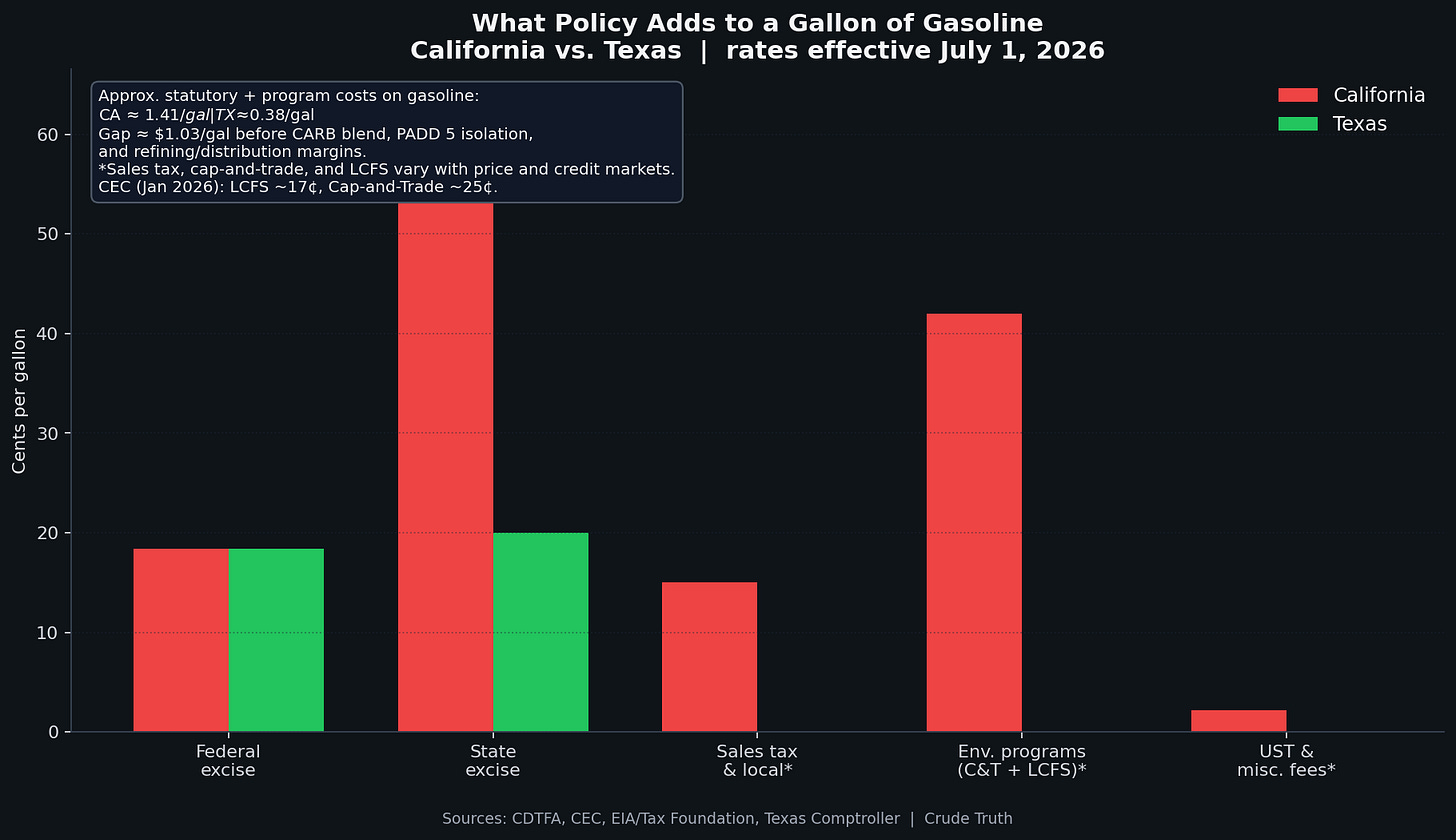
CA gasoline: 18.4 + 63.4 = 81.8¢
TX gasoline: 18.4 + 20.0 = 38.4¢
Statutory gap: 43.4¢/gal before sales tax and climate programs.
2. The programs that do not appear as a “gas tax” on the pump sticker
The California Energy Commission’s own price-breakdown page is blunt about two line items that Texas does not have:
- Cap-and-Trade pass-through: about 25¢/gal (CEC, January 2026 estimate, 6% of the then-retail price)
- Low Carbon Fuel Standard (LCFS) pass-through: about 17¢/gal (CEC, January 2026 estimate, 4%)
Those two programs alone are about 42¢ — more than Texas’s entire state gasoline tax, twice over. They move with allowance and credit markets, so they are not a fixed “tax,” but they are a state-imposed cost that refiners recover at the rack.
Add sales tax on a ~$5.80 gallon (2.25% state plus districts, commonly ~10–18¢ depending on city) and the UST/oil-spill nickels, and credible tallies put California policy adders around $1.20–$1.40 a gallon. Carscoops, citing the July 1, 2026 increase, put the combined state taxes, fees, and mandates at roughly $1.20/gal.
Texas policy adders: 38.4¢.
Policy gap: on the order of $1.00–$1.05/gal.
That still leaves about $1.00–$1.10 of the $2.12 California–Texas retail gap unexplained by the tax-and-program stack.
That remainder is market structure:
CARB gasoline. California requires a unique reformulated blend (CARBOB). It cannot be freely backfilled from Gulf Coast or Midcontinent barrels the way Texas regular can. When a West Coast refinery stumbles, the substitute molecule has to be imported by water.
PADD 5 isolation. There is no large-diameter products pipeline from Gulf Coast megarefineries into California. Washington, Oregon, Nevada, Arizona, and California live inside that isolated system — which is why they cluster at the top of every ranking, not just California.
Refining concentration and higher operating costs. Fewer, more tightly regulated plants, higher land/labor/compliance costs, and thinner spare capacity.
Distribution and retail margin. CEC regularly shows California distribution/marketing margins running richer than the national average.
Alaska and Hawaii are expensive for a simpler reason: they are islands. Their state gasoline taxes are among the lowest in America (Alaska 8.95¢, Hawaii 18.5¢). Geography, not Sacramento, is doing that work. California is the expensive-state problem that is mostly a policy-plus-spec problem.
3. Diesel makes the contrast even sharper
California diesel does not just carry the 48.2¢ state excise. It carries a 13% sales tax concept (prepay 42.5¢ from July 1), cap-and-trade, LCFS, and CARB diesel specs. IFTA’s California combined diesel rate has run near 97.9¢/gal (excise plus the “component b” add-on) for third-quarter 2026 interstate accounting. Texas IFTA diesel is 20¢. A truck crossing from El Paso to San Diego is not paying “a little more.” It is changing tax regimes.
What this weekend actually costs
A family putting 15 gallons in a sedan:Indiana: $51.70
Texas: $55.33
U.S. average: $62.21
California: $87.12
A contractor filling a 30-gallon diesel pickup:Oklahoma: $161.50
Texas: $163.92
U.S. average: $175.50
California: $231.28
That is Labor Day pain at the pump. It is not evenly distributed, and it is not mostly “oil companies.” Crude is the same molecule in Beaumont and Bakersfield. The $2.12 California–Texas gap is taxes, carbon programs, a boutique fuel spec, and a refining island. One of those four is geology.
Three of them are choices. And that is the Crude Truth
As the Knight in the Movie Indiana Jones and the Crusade, the Knight says, “You Must Choose Wisely.” Vote as if your pocketbook depends on it, as we are seeing what states cost more, and why.

Have a safe and happy Labor Day Weekend from Pecos Energy.
Our New Website: https://pecos.energy/

Appendix: sources and links
Pump prices
- AAA Daily Fuel Gauge Report — national averages and state table, prices as of September 4, 2026: https://gasprices.aaa.com/state-gas-price-averages/
- AAA Labor Day release, September 3, 2026, “Labor Day On Track to Set Record at the Pump”: https://gasprices.aaa.com/labor-day-on-track-to-set-record-at-the-pump/
- AAA national series (regular $4.1474, diesel $5.8500 record):
https://gasprices.aaa.com/
- GasBuddy weekly notes and late-August national average (~$4.01 on Aug. 31, 2026): https://www.gasbuddy.com/go/nationwide-gas-price-spike-continues-just-three-states-under-4
- GasBuddy analyst comments heading into Labor Day (Newsweek recap of Patrick De Haan): https://www.newsweek.com/gas-prices-surging-ahead-of-labor-day-as-midterms-loom-12403405
- Compiled AAA state series, September 4, 2026: https://energyfactbook.com/gas-prices/
- Keeping Up With Inflation, Labor Day 2026 state tracker: https://keepingupwithinflation.com/statistics/gas-prices-by-state/
- Keeping Up With Inflation, full ranking: https://keepingupwithinflation.com/gas-prices-by-state-ranked/
- Gasolytics live AAA mirror, September 4, 2026:
https://www.gasolytics.com/
- USA TODAY Labor Day recap: https://www.usatoday.com/story/travel/2026/09/03/labor-day-gas-prices-record-high-aaa/91600472007/
Diesel, wholesale, jet
11. AAA diesel by state (same table as #1).
12. EIA / FRED, U.S. Gulf Coast ULSD spot: https://fred.stlouisfed.org/series/DDFUELUSGULF
13. EIA / FRED, Gulf Coast kerosene-type jet fuel spot (~$4.19 on Sept. 1, 2026): https://fred.stlouisfed.org/series/MJFUELUSGULF
14. GlobalAir FBO survey, Jet-A / 100LL / SAF national and regional averages as of September 4, 2026: https://www.globalair.com/airport/region.aspx
15. EIA Weekly Petroleum Status Report / retail gasoline and on-highway diesel tables: https://www.eia.gov/petroleum/gasdiesel/Taxes and California vs. Texas
16. California Department of Tax and Fee Administration — fuel tax rates (gasoline excise $0.634, diesel $0.482, effective July 1, 2026): https://cdtfa.ca.gov/taxes-and-fees/special-taxes-and-fees-tax-rates/fuel-taxes.htm
17. CDTFA Tax Information Bulletin, June 2026 (July 1 rate changes and sales-tax prepayments): https://cdtfa.ca.gov/formspubs/jun26tib.pdf
18. CDTFA L-1028, sales-tax prepayment rates July 1, 2026–June 30, 2027: https://cdtfa.ca.gov/formspubs/l1028.pdf
19. California Energy Commission, Estimated Gasoline Price Breakdown and Margins (LCFS ~17¢, Cap-and-Trade ~25¢): https://www.energy.ca.gov/estimated-gasoline-price-breakdown-and-margins
20. EIA, “Many states slightly increased their taxes and fees on gasoline,” January 1, 2026 snapshot: https://www.eia.gov/todayinenergy/detail.php?id=67165
21. Nebraska DOT compilation of EIA total state motor-fuel taxes as of July 1, 2026: https://dot.nebraska.gov/media/qh5pifiq/gas-tax.pdf
22. Gasolytics / EIA statutory state gasoline taxes as of July 1, 2026 vs. AAA prices September 4: https://www.gasolytics.com/gas-tax-by-state
23. World Population Review, gas taxes by state 2026: https://worldpopulationreview.com/state-rankings/gas-taxes-by-state
24. Texas Comptroller, Source and Reliability of Revenue — motor fuel tax $0.20/gal gasoline and diesel, local rate none, last changed 1991: https://comptroller.texas.gov/transparency/revenue/docs/96-1774.pdf
25. Texas gasoline and diesel excise summary: https://www.salestaxhandbook.com/texas/gasoline-fuel
26. IRS Publication 510, federal fuel excise rates (gasoline 18.4¢, diesel 24.4¢, aviation gasoline 19.4¢, jet 21.9¢ / commercial 4.4¢): https://www.irs.gov/publications/p510
27. Federal Highway Administration, MF-121T historical motor-fuel tax rates: https://www.fhwa.dot.gov/policyinformation/statistics/2024/mf121t.cfm
28. July 1, 2026 California increase recap: https://www.carscoops.com/2026/06/california-gas-tax-increase/Context
29. KCRA / Get the Facts Data Team, Labor Day 2026 county-level increase analysis: https://www.kcra.com/article/labor-day-gas-prices/73605591
30. Institute for Energy Research, “The Pacific Premium” (PADD 5, CARB, tax pass-through): https://www.instituteforenergyresearch.org/fossil-fuels/gas-and-oil/the-pacific-premium/Figures: AAA statewide averages as of September 4, 2026. Jet-A FBO averages from GlobalAir the same day. Tax rates as enacted July 1, 2026. Cap-and-trade and LCFS cents-per-gallon are CEC pass-through estimates and move with credit markets. GasBuddy station-level averages typically print a few cents below AAA.