

An Energy News Beat Channel Analysis
Elon Musk’s two flagship companies have moved from informal collaboration into formal merger exploration. On October 20, 2026, during SpaceX’s Q3 earnings call, Musk confirmed that special committees of independent directors have been formed at both SpaceX and Tesla at the request of shareholders to evaluate a combination.Ars Technica
He described the idea as having “a lot of merit,” citing shared work on superintelligence software, chip design, the Terafab semiconductor project, robotics, mass-to-orbit capabilities (including the Starmind constellation of orbital data centers), and connectivity. At the same time, he stressed that no terms have been agreed, the committees have not concluded, and a deal is far from certain—particularly given the high bar of securing approval from 50% of all Tesla shares (not merely shares voted).The Verge
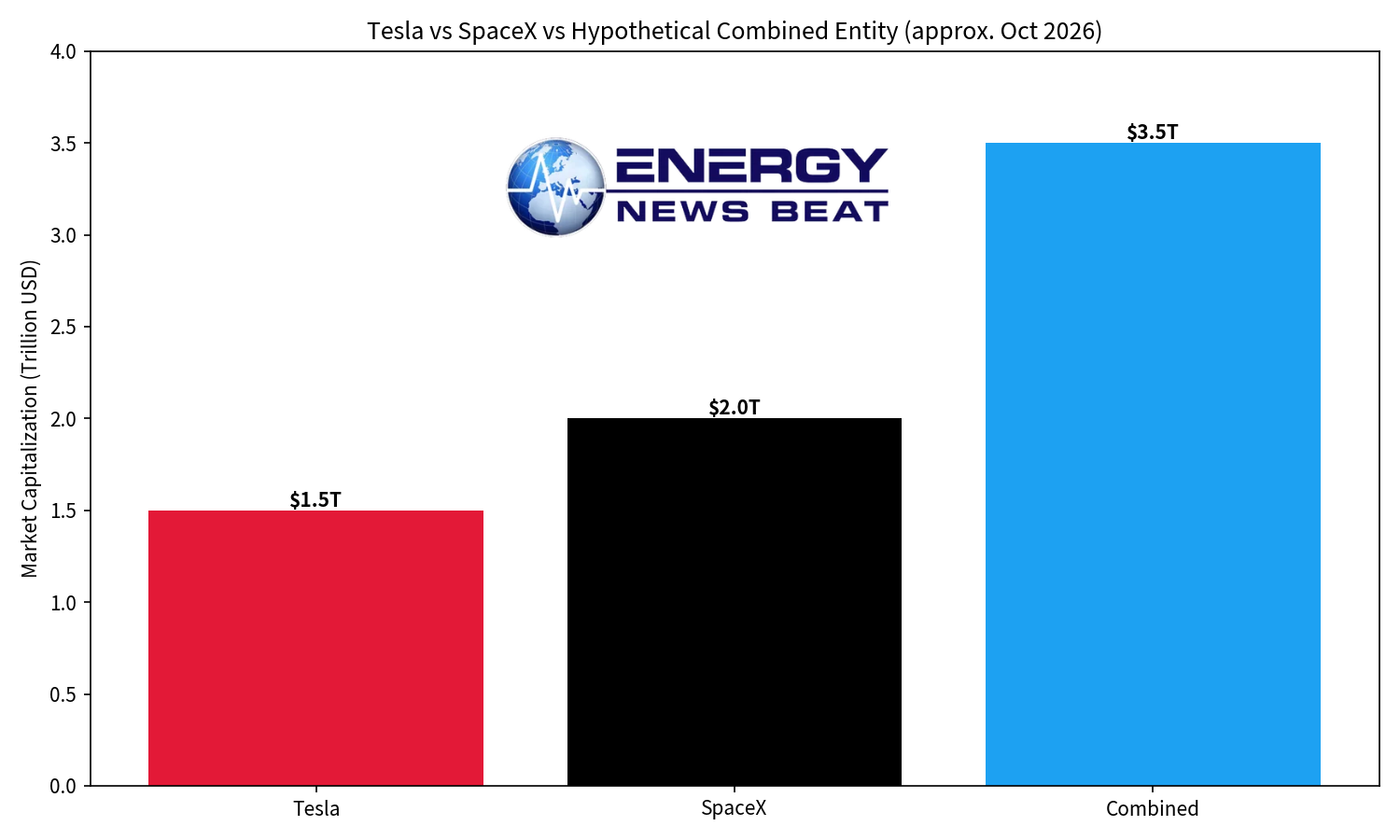
Combined valuations are in the $3.5 trillion range (Tesla ~$1.5 trillion, SpaceX ~$2 trillion), which would rank among the largest corporate combinations ever contemplated.NYTimes
Current Status and Timeline Outlook
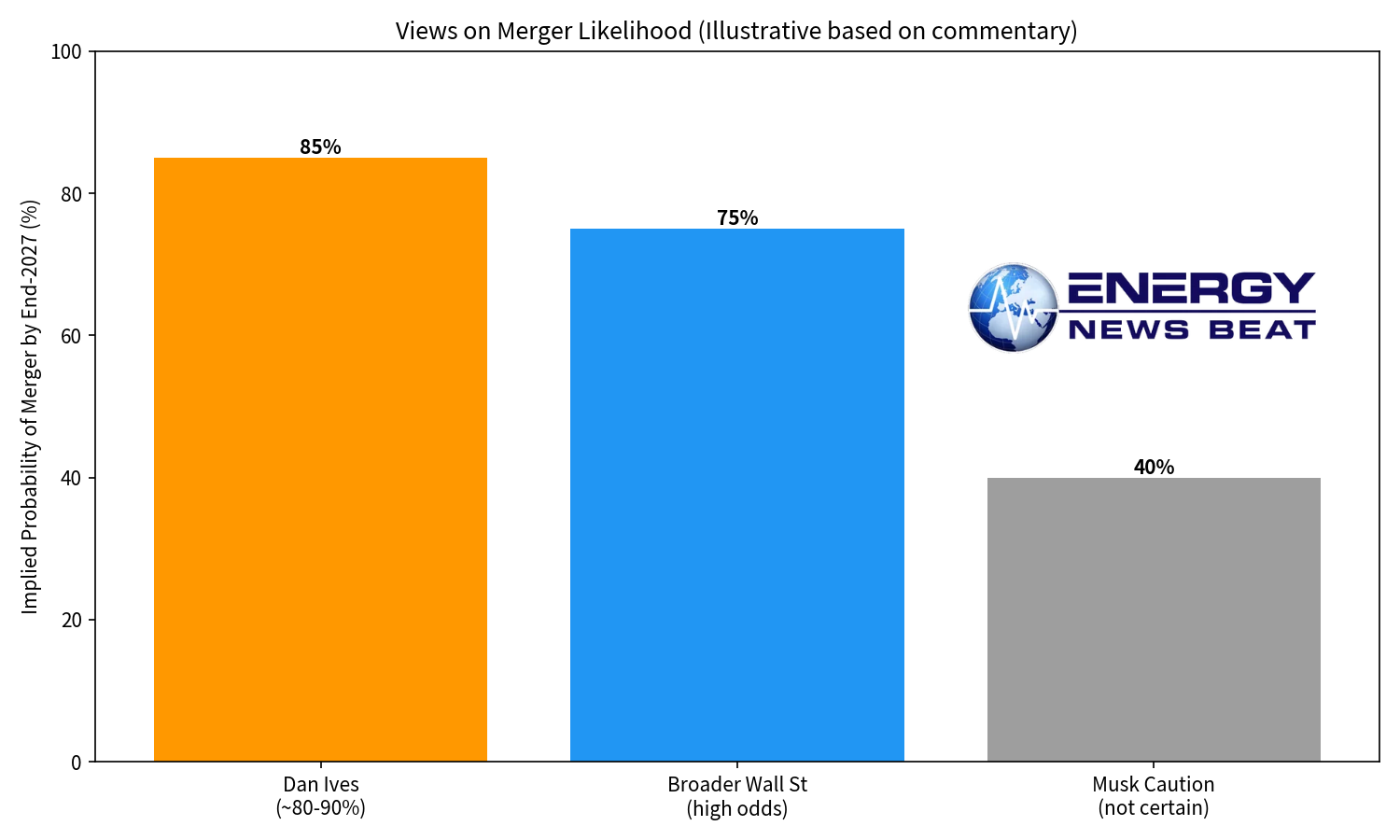
The process is still early. Musk has recused himself from the committees because he is a conflicted party as CEO and major shareholder of both companies. Wall Street analysts have assigned high probabilities—Dan Ives of Yorkville Ives has cited an 80–90% chance of a deal by the end of 2027—while Musk has cautioned against treating it as inevitable.CBS News
Barclays and others previously floated the possibility of an announcement in the second half of 2026 (potentially around Tesla’s annual meeting), but the formation of committees and the need for independent negotiation make near-term closure less likely than a 2027 timeline. Regulatory review (antitrust, national security given SpaceX’s government work, and foreign investment considerations) and shareholder votes remain substantial hurdles.
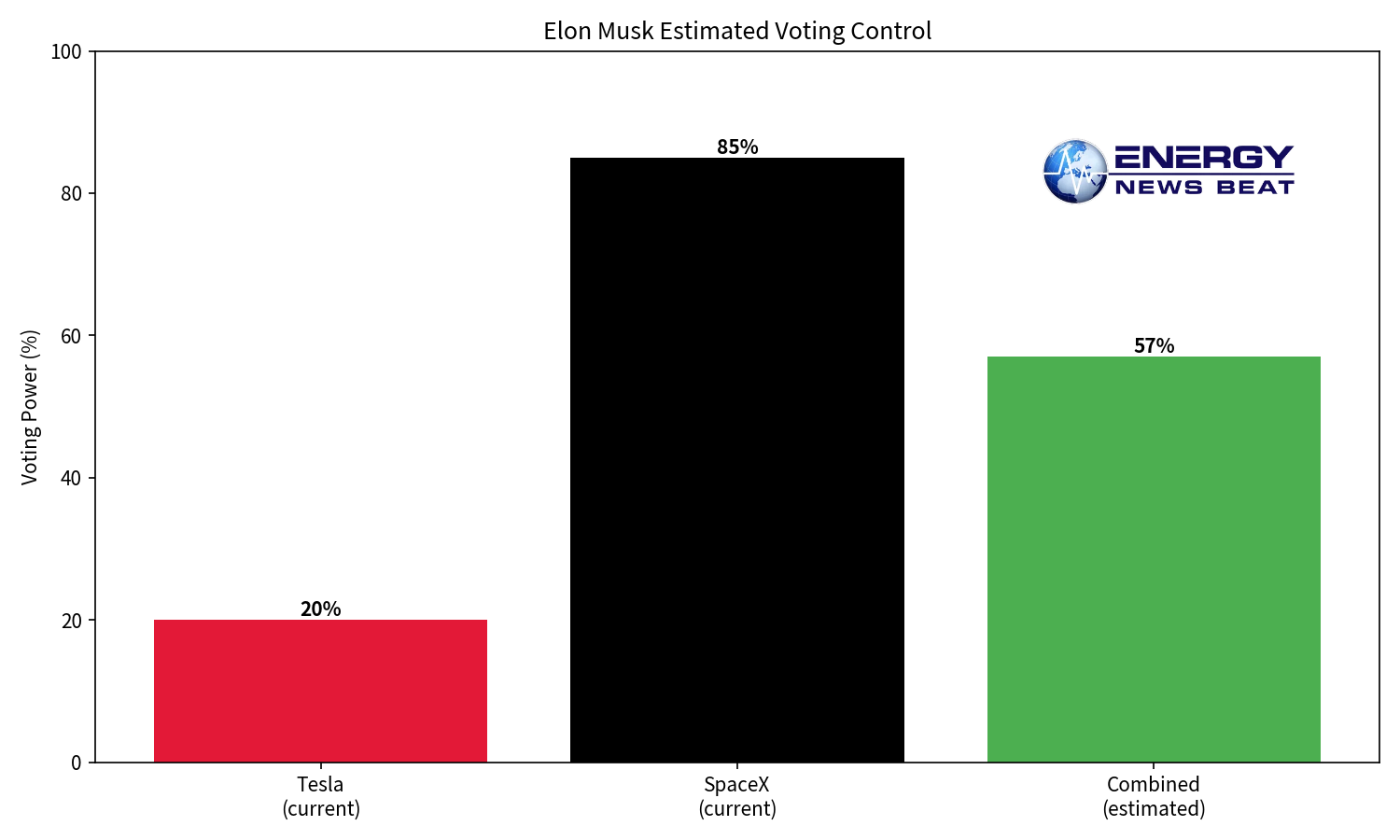
Musk currently holds roughly 20% of Tesla’s voting power versus more than 80% at SpaceX (via super-voting shares). Analysts estimate a merger could raise his control of the combined entity to the mid-to-high 50% range, depending on the exchange ratio.Reuters
Strategic Overlaps Already Underway
The companies are not starting from zero. Key collaborations include:
- Terafab: A joint AI semiconductor complex planned for Grimes County, Texas. First-phase investment is cited at approximately $16.8 billion, with ambitions for far larger scale (targeting volume production around Q3 2028 and ultimately massive compute capacity for Optimus robots, Cybercabs, and SpaceX orbital data centers). Intel is a technology partner; Tesla and SpaceX intend to build and operate the facility themselves.Electrek
- AI and software: Grok (now under SpaceX) is being integrated into Tesla vehicles and supports “Digital Optimus.” Starlink connectivity is planned for Cybercab and broader fleet use.
- Hardware cross-pollination: SpaceX thrusters are featured on the latest Tesla Roadster concept. SpaceX is a customer for Tesla energy products (including Megapacks) and vehicles.
- Framework agreements and investment: Tesla has made equity investments and entered collaboration frameworks with SpaceX.
These ties support Musk’s stated rationale that the companies are converging around “physical AI,” robotics, and energy-to-intelligence conversion.
Market Impacts
Electric Vehicles and Autonomy
Tesla’s core automotive business would gain access to Starlink’s low-latency connectivity and SpaceX’s AI infrastructure, potentially accelerating Full Self-Driving (FSD), robotaxi, and Cybercab deployment. Custom chips from Terafab could reduce reliance on external foundries and improve inference performance in vehicles and robots. Consumers could see tighter integration of connectivity, AI assistants, and over-the-air capabilities, though near-term vehicle hardware changes would likely remain limited. Risks include management distraction and the possibility that capital prioritizes space or orbital data centers over incremental EV improvements.
Robotics
Optimus humanoid robots stand to benefit from shared chip design, AI models, and manufacturing scale. Space applications (data collection, maintenance, or construction in orbit or on other worlds) become more plausible under a single entity. Tesla’s factory automation expertise could also help SpaceX scale Starship production. A merged company would control a larger portion of the “robot + connectivity + power + compute” stack than either firm alone.
Lithium, Batteries, and Energy Storage
Tesla’s Corpus Christi, Texas lithium refinery—the first large-scale North American spodumene-to-lithium-hydroxide facility—is operational and ramping toward capacity supporting roughly 1 million EVs (or ~50 GWh) per year. This provides supply-chain security and process advantages (including an acid-free approach).Electrek
A merger could deepen vertical integration: Tesla Energy’s Megapacks and related storage already serve SpaceX needs, while Terafab and future orbital data centers will require enormous, reliable power. Plans for on-site generation (including natural gas paired with large battery arrays) at Terafab illustrate the scale. Combined purchasing power, shared engineering, and Tesla’s energy-storage expertise could accelerate battery improvements useful for both terrestrial EVs/storage and space applications. Lithium and cathode material markets would face a more consolidated, vertically integrated buyer with both automotive and high-power AI demand.
Broader energy implications include greater demand for battery materials, potential acceleration of U.S. refining capacity, and hybrid power solutions (storage + generation) for data centers and launch infrastructure. Starlink’s ground infrastructure and future space-based computing could also drive new stationary storage deployments.
Other Key Industries
- Semiconductors and AI infrastructure: Terafab aims to address combined compute shortfalls far beyond current global supply.
- Satellite communications and launch: Starlink gains a large installed base of vehicles and robots; Tesla gains dedicated connectivity.
- Manufacturing and materials: Shared supply chains, automation, and Texas industrial footprint.
- Space economy: Closer linkage of Earth-based robotics/energy/AI with launch and orbital systems supports longer-term Mars or multi-planetary ambitions.
What Investors and Consumers Should Watch
Investors
- Formal terms and exchange ratio (all-stock deals are the expected structure; premiums for Tesla shareholders are widely debated).
- Shareholder vote mechanics, especially the 50% of all Tesla shares threshold and any special requirements for non-Musk shares.
- Regulatory outcomes and any conditions (divestitures, national-security reviews).
- Post-deal capital allocation between EV/robotics, energy storage, Starlink growth, Starship, and orbital data centers.
- Governance and control implications given Musk’s increased voting power.
- Financial performance: SpaceX’s recent profitability and AI revenue growth versus Tesla’s automotive and energy margins.
Consumers
- Near-term product continuity (vehicles and energy products are unlikely to change dramatically overnight).
- Potential longer-term benefits: better connectivity in vehicles and robots, faster software/AI iteration, improved energy products.
- Risks of reduced competition or shifted corporate priorities if one business line is de-emphasized.
- Pricing and availability of EVs, storage systems, and internet services as scale and integration evolve.
Conclusion
A SpaceX–Tesla combination is no longer pure speculation. Special committees are active, Musk sees substantial merit, and operational overlaps in AI chips, robotics, connectivity, and energy are already real. Timing remains uncertain—most likely measured in quarters to a couple of years rather than weeks—and success is not guaranteed. The strategic logic centers on building a vertically integrated physical-AI and energy platform spanning Earth and orbit. For energy markets in particular, the lithium refinery, battery storage franchise, and massive power needs of AI/data centers create concrete near-term linkages that a merger would formalize and potentially accelerate.
Whether or not the deal closes, the deepening collaboration already underway is reshaping competitive dynamics in EVs, robotics, semiconductors, and energy storage.
Appendix: Sources and Links
- Ars Technica (Oct 20, 2026) – Merging SpaceX and Tesla would be a “good idea,” Musk says
https://arstechnica.com/space/2026/10/spacex-and-tesla-into-a-single-company-has-a-lot-of-merit-musk-says/ - The New York Times (Oct 21, 2026) – SpaceX and Tesla Explore Merger to Create a De Facto Elon Inc.
https://www.nytimes.com/2026/10/21/business/elon-musk-spacex-tesla-merger.html - Reuters (Oct 21, 2026) – Explainer: Why would Musk merge SpaceX and Tesla?
https://www.reuters.com/legal/transactional/why-would-musk-merge-spacex-tesla-2026-10-21/ - Reuters (Oct 21, 2026) – Tesla-SpaceX deal: Wall St says inevitable but Musk says it’s not certain
https://www.reuters.com/legal/transactional/tesla-spacex-deal-wall-st-says-inevitable-musk-says-its-not-certain-2026-10-21/ - BBC News (Oct 20–21, 2026) – Tesla and SpaceX: Why does Elon Musk want to merge the companies?
https://www.bbc.co.uk/news/articles/cr93z1e87e0do - The Verge / multiple outlets (Oct 20, 2026) – Tesla and SpaceX are discussing a possible merger, Musk says
https://www.theverge.com/science/1014984/spacex-tesla-merger-elon-musk-special-committees - CBS News (Oct 21, 2026) – Elon Musk signals Tesla and SpaceX could merge
https://www.cbsnews.com/news/elon-musk-tesla-spacex-merger/ - Electrek (Aug 6, 2026) – Tesla, SpaceX confirm ‘Terafab’ chip fab site — $16.8B first phase
https://electrek.co/2026/08/06/tesla-spacex-terafab-grimes-county-16-8-billion/ - Reuters (Aug 6, 2026) – SpaceX, Tesla to initially spend $16.8 billion on Terafab chip plant in Texas
https://www.reuters.com/business/media-telecom/spacex-says-terafab-be-built-texas-with-initial-investment-168-billion-2026-08-06/ - Electrek / related (Jan 2026) – Tesla lithium refinery production start (Corpus Christi)
https://electrek.co/2026/01/15/tesla-rare-look-lithium-refinery-confirms-production-start/ - Additional reporting on synergies, Starlink integration, Roadster thrusters, and analyst notes from Bloomberg, Motley Fool, RBC, JPMorgan commentary, and company filings referenced in the above coverage.
All market-capitalization and ownership figures are approximate as of mid-to-late October 2026 reporting and subject to daily market movement. This article is for informational purposes and does not constitute investment advice.