
The grid operator wants one process for power plants, transmission and large loads, a ruling in 120 days, and clearer upgrade costs so states can bill big users. In an October letter, the Data Center Coalition and corporate energy buyers warned that missing an annual cutoff could still mean nearly two years.
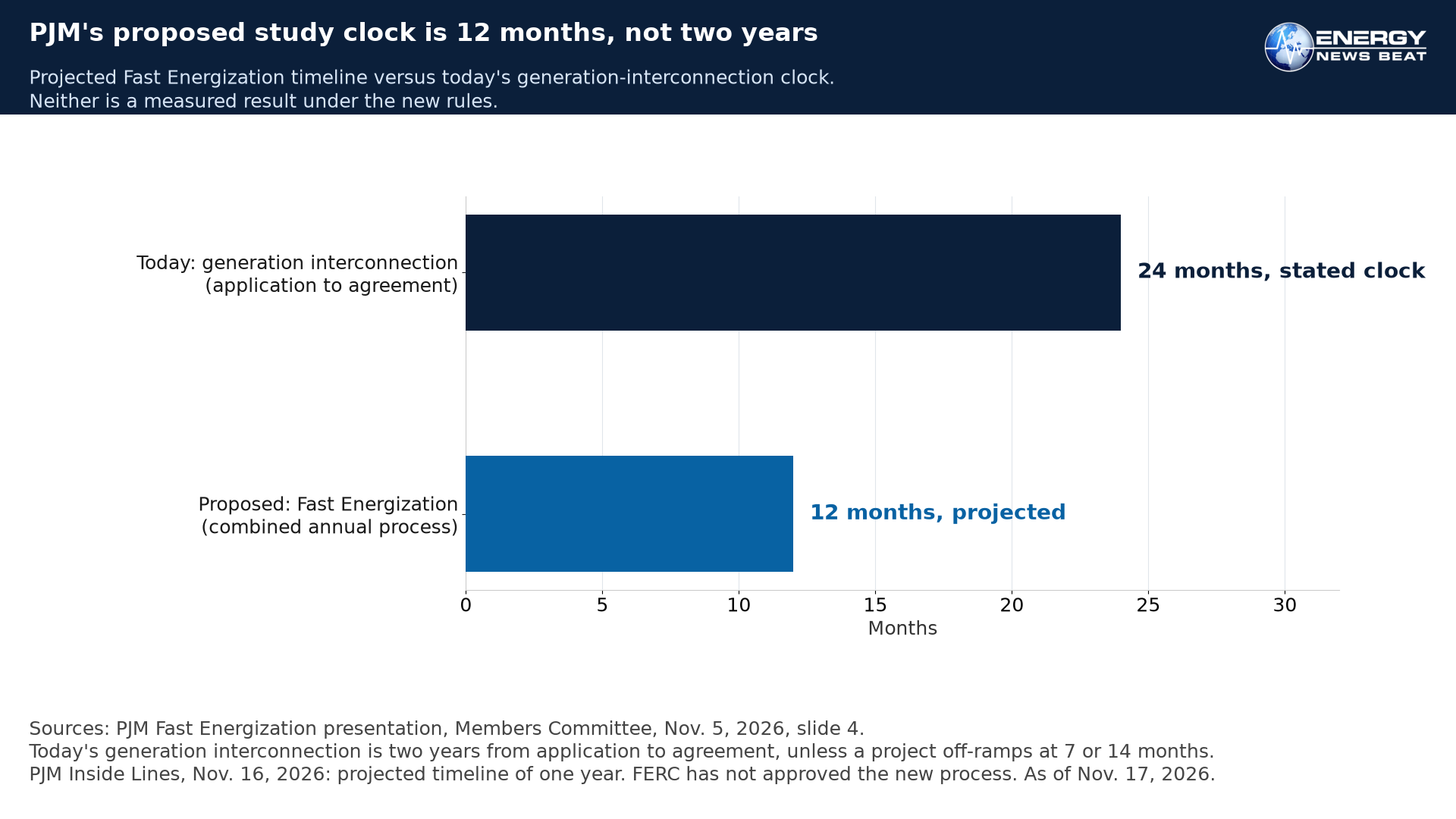
On Monday, Nov. 16, PJM Interconnection said it is asking the Federal Energy Regulatory Commission to approve a process it calls Fast Energization. The grid operator, which serves about 67 million people across 13 states and D.C., wants to fold separate studies of new power plants, transmission and large loads such as data centers into one annual, 12-month process. PJM says that would cut the projected study timeline from two years to one. It asked FERC for a 60-day comment period and “a Commission order on this filing within 120 days.” FERC’s eLibrary lists the filing, Proposed Tariff Revisions for Large Loads and Compliance with EL26-67, in Docket No. ER27-531-000.
PJM’s reason is blunt. “Neither generation nor transmission is coming online quickly enough to keep pace with new demand growth driven mainly by Large Loads like data centers.” Reuters, carried Tuesday by EnergyNow, attributed that line, and a second sentence about study speed that also appears in PJM’s announcement, to spokesman Jeff Shields. On July 14, PJM said its 2028/2029 capacity auction came up 6,831 megawatts — about 6.8 gigawatts — short of its reliability requirement. That is a gap against a planning standard for a future delivery year, not a count of plants offline today. PJM said the shortfall does not necessarily mean it will be unable to serve load, but it means slimmer reserves: 14.7%, versus a 20% target. Energy News Beat has already covered the separate capacity-market cost fight. This filing is about a different clock: the study timeline, and who can see what the wires will cost.
In a Nov. 5 presentation to PJM’s Members Committee, Donnie Bielak, director of interconnection planning, described a 12-month process with a four-month screening window, a system impact study, and a final-agreement step. PJM says the design keeps a first-ready, first-served rule, moves readiness requirements earlier, and would give states “transparent access to the costs of transmission improvements driven by data centers, as directed by FERC, empowering states to bill Large Loads for those costs.” That is cost visibility, not a federal invoice already landing on a data-center account. PJM says the design tracks FERC’s June 18, 2026, large-load show-cause and co-location orders, including new services for flexible loads and an interim service while upgrades are built.
Data-center and corporate buyers were already pushing back. In an Oct. 2 letter to PJM’s board, the Data Center Coalition and the Corporate Energy Buyers Association said they support faster interconnection, but warned that studying generation and load together “could have the opposite effect.” A large load, they wrote, first has to clear a transmission owner’s study to enter the new annual queue. A customer approved just after the cutoff “could wait nearly a year for the next cycle, followed by another year in PJM’s proposed study process,” or “nearly two years between Transmission Owner approval and completion of the PJM process.” They also warned that paired generation could be delayed, and they pointed to the show-cause order’s language that a large-load transmission-service study should take “no more than 60-90 calendar days.” PJM President and CEO David Mills replied on Nov. 5 that the proposal was still under development. PJM filed on Nov. 16.
None of this is in force. FERC has not accepted the 120-day request, has not set a comment schedule, and has not approved Fast Energization. The 12-month clock is a projected design, not a measured result. Even if approved, PJM’s filing says the first cycle would open in late November 2027 and finish in 2029. A same-day ride-through filing is a separate request.
Consumer and Investor Views
If you pay a power bill in PJM country, you will not see a “12-month study” line on next month’s statement. A faster study could, if it works, help plants and wires show up sooner. Clearer cost attribution could, if states use it, put more upgrade costs on the large loads that drive them, instead of on households. Neither is guaranteed. No sourced study puts a cents-per-kilowatt-hour figure on this filing, and we will not invent one.
For investors, the near-term watch is FERC, not a groundbreaking. The 120-day request is PJM’s ask, not a deadline the Commission has accepted. Watch the comments, and whether the annual cutoff becomes a waiting room. A requested reform is not a signed interconnection agreement.
A Fair Caveat
The filing is in FERC Docket No. ER27-531-000. The 12-month and two-year figures are PJM’s projected or stated timelines, not measured results. The 6,831-megawatt figure is a 2028/2029 auction shortfall against a reliability requirement, not a present-tense blackout forecast; reserves are 14.7%, below a 20% target. “Empowering states to bill” is cost transparency, not an automatic new charge. The “nearly two years” warning and PJM’s “two years to one” comparison start the clock at different points. FERC has not ruled.
Stu’s Take
PJM is asking FERC to study new power plants and data centers together, in a projected 12 months instead of two years, and to rule within 120 days. That is a request, not a reform already in force. The roughly 6.8-gigawatt figure is real, but it is July’s shortfall against a reliability standard for 2028/2029, not a proof that the lights go out tomorrow. The tension is also real. PJM says one combined year will be faster and will show states what data-center upgrades cost, so states can decide who pays. The Data Center Coalition and corporate energy buyers told the PJM board in October that missing an annual cutoff could still mean nearly two years, and they pointed to FERC language about a 60-to-90-day large-load study. Watch both clocks: how long the plants take, and who is asked to pay for the wires. Do not treat a filing as a finished fix.
Appendix A | What was asked, and what is not decided
These are the main requests and the main open items as of this as-of time. None of the requests is a FERC order. Status is as of 7:41 a.m. Central Time, November 17, 2026.
| Date or item | What was asked or recorded | Status | What it is not |
| Nov. 16, 2026 | PJM filed Fast Energization at FERC, end of day | Filed; Docket No. ER27-531-000 (accession 20261116-5340) | Not a FERC approval |
| Same filing | Combine generation, merchant transmission, firm service and large-load studies into one 12-month process | PJM request; projected timeline | Not a measured result |
| Same filing | 60-day comment period and a Commission order within 120 days | PJM request | Not a deadline FERC has accepted |
| Same filing | Give states transparent access to data-center-driven upgrade costs, “empowering states to bill Large Loads” | PJM description of cost visibility. Filing: states “pursuant to their retail rate authority may elect to cost allocate IRR among particular loads.” TO cost-allocation revisions filed separately, ER27-520-000 | Not an automatic new charge |
| Same filing | First Fast Energization cycle opens late Nov. 2027; finishes 2029; some other tariff revisions requested effective March 16, 2027; full Commission acceptance within 10 months of the date it is filed would likely be necessary to facilitate implementation in time for Cycle 02 | PJM projection in the Nov. 16 transmittal, pp. 5, 30–31 and 82 | Not a start date FERC has set. Fast Energization itself has an indefinite effective date until Cycle 01 Decision Point II |
| Oct. 2, 2026 | Data Center Coalition and Corporate Energy Buyers Association letter to the PJM board | Posted by PJM on Oct. 5 | A warning, not a FERC finding |
| Nov. 5, 2026 | David Mills reply: proposal still under development; keep engaging | Posted by PJM on Nov. 6 | Not a withdrawal of the Nov. 16 filing |
| July 14, 2026 | 2028/2029 capacity auction 6,831 MW short of the reliability requirement | PJM news release and auction report | Not a present-tense blackout forecast |
Sources: PJM Inside Lines, Nov. 16, 2026; PJM Fast Energization presentation, Nov. 5, 2026; CEBA/DCC letter, Oct. 2, 2026; Mills letter, Nov. 5, 2026; PJM 2028/2029 Base Residual Auction news release, July 14, 2026; PJM transmittal, FERC Docket No. ER27-531-000, Nov. 16, 2026.
Appendix B | Key figures (with as-of dates)
Figures below are taken from the cited primary documents. Auction totals are unforced capacity (UCAP). Process times are PJM’s stated or projected timelines. As-of dates are the document dates, except where noted as this article’s as-of stamp.
| Item | Figure | Source and as-of |
| Proposed combined study clock | 12 months (projected) | PJM Inside Lines, Nov. 16, 2026; Members Committee presentation, Nov. 5, 2026 |
| Current generation interconnection, application to agreement | 2 years, unless a project off-ramps at Decision Point I (7 months) or II (14 months) | Fast Energization presentation, slide 4, Nov. 5, 2026 |
| Fast Energization phases, simplified slide | Screening window 4 months; system impact study 7 months; agreement finalization 1 month | Same presentation, slide 7 |
| Fast Energization phases, detailed calendar in the same deck | Screening 4 months (16 weeks); system impact study 6.25 months (29 weeks); final agreement 5 weeks plus a 2-week buffer | Same presentation, slide 9 |
| Requested comment period | 60 days | PJM Inside Lines, Nov. 16, 2026 |
| Requested FERC order | Within 120 days of the filing | PJM Inside Lines, Nov. 16, 2026 |
| 2028/2029 BRA cleared UCAP | 138,318 MW in the news release; 138,317.8 MW in the auction report | PJM news release, July 14, 2026; 2028/2029 BRA Report |
| Fixed Resource Requirement (FRR) commitment | 10,864 MW in the news release; 10,863.8 MW in the report | Same |
| Total including FRR | 149,182 MW in the news release; 149,181.6 MW in the report | Same |
| Shortfall vs. RTO reliability requirement, 2028/2029 | 6,831 MW in the news release; 6,831.3 MW UCAP in the report (about 6.8 GW) | Same |
| Prior BRA shortfall, 2027/2028 | 6,516 MW UCAP in the report; “approximately 6,500 MW” in the news release | Same |
| Reserve margin cited for 2028/2029 | 14.7%; target 20%; 5.3 points lower (BRA Report) | PJM news release, July 14, 2026; 2028/2029 BRA Report |
| Capacity price, 2028/2029 BRA | $325/MW-day, at the FERC-approved cap, down 2.5% from $333.44 | Same |
| People and footprint cited by PJM | About 67 million people; 13 states and the District of Columbia | PJM news release, July 14, 2026, and Inside Lines, Nov. 16, 2026 |
| FERC large-load study language, June 18, 2026 | “timely study (i.e., within 60-90 days of receiving the request)”; “a study deadline of no more than 60-90 calendar days”; a study report “should take no more than 60-90 days calendar days” (FERC’s wording). The CEBA/DCC letter says “60–90 days or less.” | FERC, Docket No. EL26-67-000, June 18, 2026; CEBA/DCC letter, Oct. 2, 2026 |
| Show-cause response deadline after the abeyance | Section 205 filings by Nov. 16, 2026; answers due Dec. 16, 2026 | FERC, Docket No. EL26-67-000, Aug. 14, 2026 |
| FERC docket number for the Fast Energization Section 205 filing | ER27-531-000, filed and posted Nov. 16, 2026 (accession 20261116-5340) | FERC eLibrary |
| Requested effective dates in the Nov. 16 filing | March 16, 2027, for Parts I, III, VI, VII, IX, XI, Attachments F-3, F-3A and F-4, and some Part VIII co-location revisions; indefinite date for Fast Energization Part VIII, to take effect the business day after Cycle 01 Decision Point II (PJM anticipates late November 2027); first cycle would finish in 2029 | PJM transmittal, Docket No. ER27-531-000, pp. 5, 30–31 and 82, Nov. 16, 2026 |
The 4-month / 7-month / 1-month breakdown and the 4-month / 6.25-month / 5-week calendar appear in the same Nov. 5 presentation. The body describes a 12-month process with a four-month screening window, a system impact study, and agreement finalization, and does not treat 7 months as the only figure for the impact study. Release totals are rounded; the report gives the tenths.
Chart 2: Unforced capacity (UCAP) short of PJM’s reliability requirement in the last two base residual auctions. The 2028/2029 auction, announced July 14, 2026, was 6,831 megawatts short — about 6.8 gigawatts. The prior auction, for 2027/2028, was 6,516 megawatts short. These are gaps against a planning standard for a future delivery year, not a count of plants that are offline today. PJM said the latest shortfall does not necessarily mean the system will be unable to serve load reliably in that delivery year and said it means slimmer reserves: a 14.7% reserve margin against a 20% target. Sources: PJM news release, July 14, 2026, and 2028/2029 Base Residual Auction Report (target 20%). As of Nov. 17, 2026.
Appendix C | Key excerpts
PJM Inside Lines, Nov. 16, 2026. “The Fast Energization process reduces projected timelines from two years to one.” “PJM requests a Commission order on this filing within 120 days.” “A link to the filing will be provided when it is available.” “Give states transparent access to the costs of transmission improvements driven by data centers, as directed by FERC, empowering states to bill Large Loads for those costs.” “Neither generation nor transmission is coming online quickly enough to keep pace with new demand growth driven mainly by Large Loads like data centers. The factor that PJM Planning can influence is how quickly these new resources are studied for reliability.” https://insidelines.pjm.com/pjm-proposal-would-cut-interconnection-process-time-in-half/
Reuters, carried by EnergyNow, Nov. 17, 2026. Attribution to PJM spokesman Jeff Shields of the two sentences quoted above, with “large loads” and “planning” lowercased. The dispatch also reports a “roughly 6.8 gigawatt electricity supply shortfall” and that the Data Center Coalition told the PJM board in October the combined process “might complicate the grid interconnection process and ultimately lead to longer delays.” https://energynow.com/2026/11/biggest-us-power-grid-proposes-plan-to-regulators-to-cut-wait-times-for-data-center-power/
PJM, 2028/2029 Base Residual Auction news release, July 14, 2026. “The capacity of the resources procured in the auction, plus FRR resources, is short of PJM’s reliability requirement by 6,831 MW, meaning that the committed supply is less than what would be required to meet the one-event-in-10-year reliability standard.” “Such a shortage does not necessarily mean that the PJM system will be unable to serve load reliably in the delivery year; it means that PJM would have to operate with slimmer reserves and a greater level of risk. PJM continues to hold a reserve margin of 14.7% for the 2028/2029 Delivery Year.” https://www.pjm.com/-/media/DotCom/about-pjm/newsroom/2026-releases/20260714-pjm-capacity-auction-procures-138318-mw-of-generation-resources.pdf
CEBA and Data Center Coalition letter to the PJM Board, Oct. 2, 2026. “We remain deeply concerned that the proposed approach could have the opposite effect.” “Even if PJM meets its proposed annual schedule, that could mean nearly two years between Transmission Owner approval and completion of the PJM process.” The letter asks the Board to “explain why it is not directly complying with the Show Cause Order directives to establish an application and study process for the provision of transmission service for large loads that is 60–90 days or less,” or to “pursue a more targeted response.” Signed by John Miller, CEBA, and Morgan A. Sipple, Data Center Coalition. https://www.pjm.com/-/media/DotCom/about-pjm/who-we-are/public-disclosures/2026/20261005-ceba-dcc-letter-to-pjm-board-re-ll-show-cause-response.pdf
FERC, Docket No. EL26-67-000, June 18, 2026. Preliminary finding that PJM’s tariff “appears to be unjust and unreasonable because it lacks provisions that address, with sufficient clarity and consistency, how PJM and/or the Transmission Owners will timely study (i.e., within 60-90 days of receiving the request) the provision of transmission service to Eligible Customers on behalf of large loads.” The order also lists “(3) a study deadline of no more than 60-90 calendar days.” Later: such study processes, culminating in a report that includes necessary facilities and “a non-binding good-faith estimate of the cost and the time to construct such facilities, should take no more than 60-90 days calendar days.” The doubled “days” is in the Commission’s order. The Oct. 2 CEBA/DCC letter asks for a process “that is 60–90 days or less.” https://www.pjm.com/-/media/DotCom/documents/ferc/orders/2026/20260618-el26-67-000.pdf
David E. Mills, letter to CEBA, DCC, ACPA and ITI, Nov. 5, 2026 (posted Nov. 6). “I encourage you to continue to work with the PJM team as our proposal is still under development.” https://www.pjm.com/-/media/DotCom/about-pjm/who-we-are/public-disclosures/2026/20261106-pjm-board-response-to-ceba-acpa-dcc-and-iti-concerning-large-load-show-cause-issues.pdf
PJM transmittal, FERC Docket No. ER27-531-000, Nov. 16, 2026. “Opening the Submission Window in late November 2027 would result in a Soft Close Date in early May 2028.” “The first Fast Energization Cycle would therefore finish in 2029.” Some tariff revisions are requested effective March 16, 2027; Fast Energization revisions in Part VIII have an indefinite effective date until the business day after Cycle 01 Decision Point II. “The Commission’s full acceptance of this filing within 10 months of the date it is filed would likely be necessary to facilitate implementation in time for Cycle 02.” https://elibrary.ferc.gov/eLibrary/filelist?accession_num=20261116-5340
Appendix D | Sources
Primary pages and PDFs were opened for this article. Access dates below are November 17, 2026, Central Time, unless a document date is listed. Reuters’ EnergyNow copy was opened via a full-text fetch after a direct download returned 403. PJM Inside Lines was opened via a full-text fetch after a direct download was blocked. PJM’s Filings & Orders page is a JavaScript catalog and did not return a Fast Energization docket in the text retrieved. FERC eLibrary lists the Nov. 16 filing in Docket No. ER27-531-000.
- PJM Inside Lines, “PJM Plan Would Cut Interconnection Process Time in Half,” Nov. 16, 2026: Fast Energization announcement, two-years-to-one projected timeline, 60-day comment period, 120-day order request, cost-transparency wording, and the note that a filing link would follow. https://insidelines.pjm.com/pjm-proposal-would-cut-interconnection-process-time-in-half/
- EnergyNow, carrying Reuters (Laila Kearney, edited by Deepa Babington), “Biggest US Power Grid Proposes Plan to Regulators to Cut Wait Times for Data Center Power,” Nov. 17, 2026: Jeff Shields attribution, 6.8 GW shortfall wording, Data Center Coalition pushback, 60-day comment and 120-day ruling requests. https://energynow.com/2026/11/biggest-us-power-grid-proposes-plan-to-regulators-to-cut-wait-times-for-data-center-power/
- PJM, Fast Energization presentation, Special Members Committee, Donnie Bielak, Nov. 5, 2026: process principles, 12-month clock, phase times, existing generation-interconnection two-year clock, and transmission products. https://www.pjm.com/-/media/DotCom/committees-groups/committees/mc/2026/20261105-special/item-01—1-fast-energization—presentation.pdf
- PJM, “PJM’s Response Matrix to the Large Load Show Cause Order Opportunities,” Special Members Committee, Nov. 5, 2026: Section 205 filings planned on or about Nov. 16, including Fast Energization and a separate ride-through filing, in response to Docket No. EL26-67-000. https://www.pjm.com/-/media/DotCom/committees-groups/committees/mc/2026/20261105-special/item-01—2-large-load-compliance-matrix.pdf
- Corporate Energy Buyers Association and Data Center Coalition, letter to the PJM Board of Managers, Oct. 2, 2026, posted by PJM Oct. 5, 2026: combined-queue concerns, “nearly two years,” and the 60–90-day request. https://www.pjm.com/-/media/DotCom/about-pjm/who-we-are/public-disclosures/2026/20261005-ceba-dcc-letter-to-pjm-board-re-ll-show-cause-response.pdf
- David E. Mills, President and CEO, PJM, letter to CEBA, DCC, ACPA and ITI, Nov. 5, 2026, posted Nov. 6, 2026: proposal still under development. https://www.pjm.com/-/media/DotCom/about-pjm/who-we-are/public-disclosures/2026/20261106-pjm-board-response-to-ceba-acpa-dcc-and-iti-concerning-large-load-show-cause-issues.pdf
- American Clean Power Association, letter to the PJM Board regarding PJM’s combined queue process, Oct. 28, 2026, posted Oct. 29, 2026: additional stakeholder concern about the combined process; cited in the register, not quoted in the body. https://www.pjm.com/-/media/DotCom/about-pjm/who-we-are/public-disclosures/2026/20261029-acp-letter-to-the-pjm-board-re-pjms-combined-queue-process.pdf
- PJM, Board Communications / public disclosures index, opened Nov. 17, 2026: posting dates for the CEBA/DCC letter, the ACP letter, and the Mills reply. https://www.pjm.com/about-pjm/who-we-are/pjm-board/public-disclosures
- PJM, news release, “PJM Capacity Auction Procures 138,318 MW of Generation Resources as Work Continues To Address Growing Electricity Demand,” July 14, 2026: 6,831 MW shortfall, 14.7% reserve margin, 67 million people, price cap. https://www.pjm.com/-/media/DotCom/about-pjm/newsroom/2026-releases/20260714-pjm-capacity-auction-procures-138318-mw-of-generation-resources.pdf
- PJM, 2028/2029 Base Residual Auction Report: 138,317.8 MW cleared, 10,863.8 MW FRR, 149,181.6 MW total, 6,831.3 MW UCAP short, prior shortfall of 6,516 MW UCAP. https://www.pjm.com/-/media/DotCom/markets-ops/rpm/rpm-auction-info/2028-2029/2028-2029-bra-results-report.pdf
- PJM, Reliability Backstop Procurement fact sheet: initial target described as the 6,831 MW shortfall from the 2028/2029 auction, subject to offsets. Background only; the backstop is not this filing. https://www.pjm.com/-/media/DotCom/about-pjm/newsroom/fact-sheets/reliability-backstop-procurement-fact-sheet.pdf
- Federal Energy Regulatory Commission, Order to Show Cause, Docket No. EL26-67-000, June 18, 2026: 60-90-day large-load transmission-service study language and cost-transparency concerns. https://www.pjm.com/-/media/DotCom/documents/ferc/orders/2026/20260618-el26-67-000.pdf
- Federal Energy Regulatory Commission, order granting a 90-day abeyance, Docket No. EL26-67-000, Aug. 14, 2026: Section 205 filings due by Nov. 16, 2026; answers due Dec. 16, 2026. https://www.pjm.com/-/media/DotCom/documents/ferc/orders/2026/20260814-el26-67-000.pdf
- FERC eLibrary, PJM Interconnection, L.L.C., Proposed Tariff Revisions for Large Loads and Additional Compliance with Co-Location Order and Request for Extended 60-Day Comment Period, Docket No. ER27-531-000, accession 20261116-5340, Nov. 16, 2026. First Fast Energization cycle would open late November 2027 and finish in 2029; some other tariff revisions requested effective March 16, 2027. https://elibrary.ferc.gov/eLibrary/filelist?accession_num=20261116-5340
- FERC eLibrary docket sheet for ER27-531-000, opened Nov. 17, 2026. https://elibrary.ferc.gov/eLibrary/docketsheet?docket_number=ER27-531&sub_docket=000