

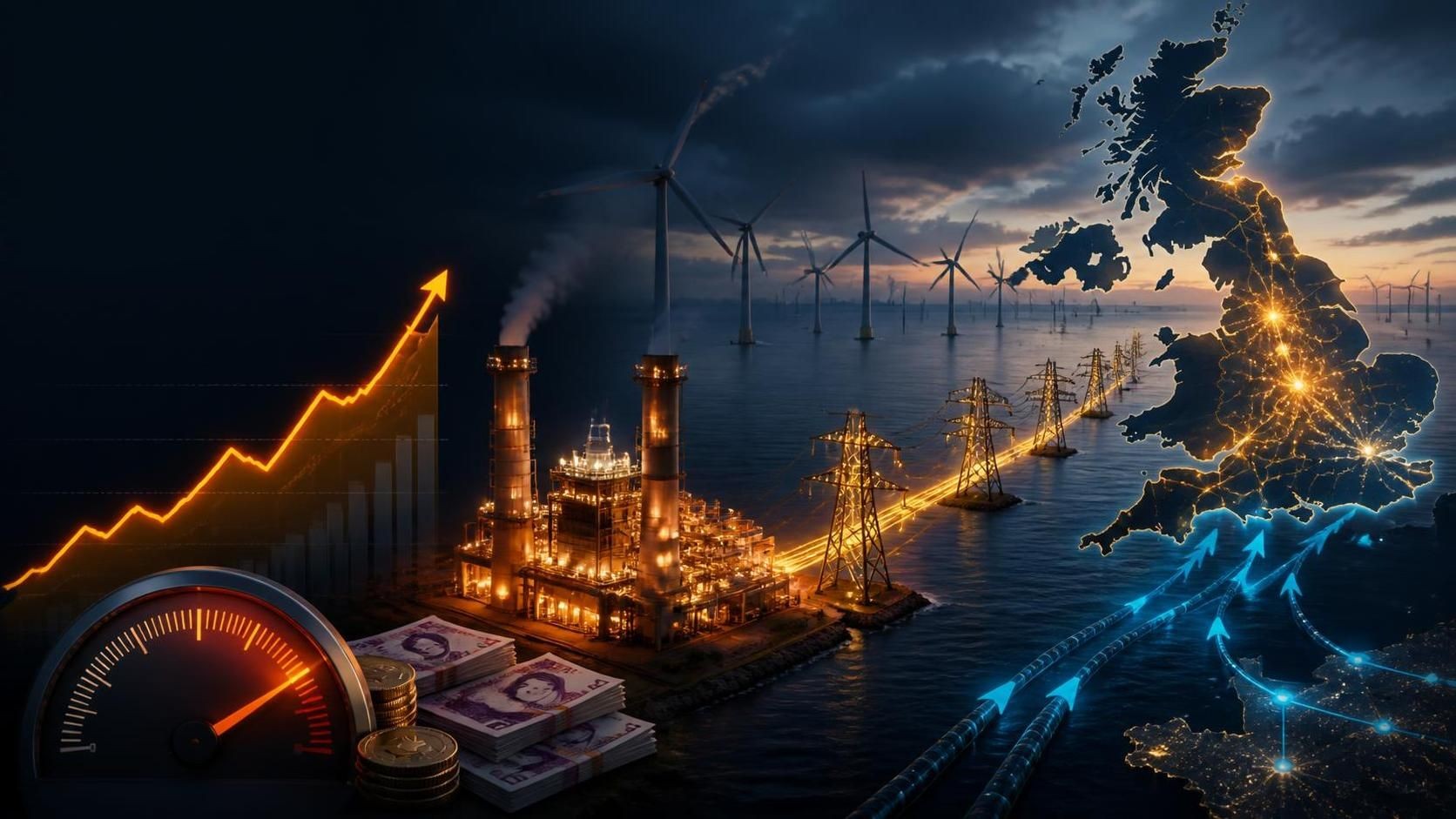
Britain’s electricity system is under growing strain. On the night of 8–9 November 2026, the National Energy System Operator (NESO) issued an Electricity Margin Notice (EMN) for the Monday morning peak (6am–11am). Low wind output across Britain and much of northern Europe had thinned the safety margin between supply and demand. NESO warned of a shortfall approaching 1,400 MW and asked the market to make extra generation available—primarily gas plants.The TelegraphThe Guardian
The morning notice was unusual; EMNs normally target the evening peak. Analyst Kathryn Porter noted that with thin margins and NESO’s forecast errors, any delay in wind recovery or higher-than-expected demand could create real trouble. Seven EMNs have already been issued in 2026, compared with just one for the whole of 2025.Yahoo Finance
Later the same day the costs became stark. NESO paid gas plants roughly £1,500 per megawatt-hour—about ten times the recent average—to cover the evening peak. Langage Power Station near Plymouth received the equivalent of £1.4 million an hour; Rye House and Seabank received similar sums. NESO described the morning notice as routine and precautionary, insisting there was no risk of power cuts. The numbers tell a different story about system stress.Yahoo Finance
Marginal Pricing: Gas Sets the Price for Almost Everything
The UK’s wholesale electricity market runs on short-run marginal pricing. Generators bid from lowest to highest cost until demand is met; every megawatt-hour in that half-hour period is then paid the price of the last (usually most expensive) unit accepted. In practice, gas-fired plants set the clearing price the vast majority of the time—around 97% of hours in recent data.EastangliabylinesTaxresearch
When wind and solar are producing, their near-zero marginal cost does not set the price. Gas still does. The result is that consumers pay gas-linked prices even while large volumes of cheaper renewable output are on the system. Low-marginal-cost generators (wind, solar, nuclear) capture large windfall revenues. This is not a competitive textbook market; it is a market of long-term contracts, capacity payments, and regulated network monopolies overlaid with a pricing rule that systematically transfers money from consumers to certain generators whenever gas is expensive.Eastangliabylines
Recent wholesale prices illustrate the problem. Day-ahead and system prices have regularly exceeded £200/MWh in late October and early November 2026, with live readings around £217/MWh on 10 November while gas supplied well over half of generation and wind was in single digits.Energy-review
Constraint Payments: Paying Wind to Stop and Gas to Start
A second structural cost arises because generation and transmission were not built in balance. Most new wind capacity is in Scotland and offshore, while the bulk of demand is in southern England. When the north-south transmission corridors are full, NESO pays wind farms to turn down and simultaneously pays gas plants farther south to turn up. Consumers fund both sides of the transaction.
Constraint costs reached roughly £1.5 billion in 2025 and have already exceeded that total in 2026. In some recent periods the majority of the money has gone to the replacement gas generation rather than the curtailed wind. Forecasts warn that without major grid upgrades these costs could rise toward several billion pounds a year by 2030. The underlying physics is simple: electrons cannot teleport, and building pylons takes years while turbines can be installed faster.Switch-pilotBmmagazine
Interconnectors and Dependence on Other Countries
Britain is connected to France (multiple cables), Norway, Belgium, the Netherlands, Denmark and Ireland, with roughly 10 GW of interconnector capacity. In 2025 imports accounted for about 14% of gross UK electricity supply. France was by far the largest source (net ~20 TWh over recent 12-month periods), followed by Norway.GlobalgridQuestions-statements.parliament
Interconnectors are valuable for sharing resources, but they do not eliminate weather risk. When low-wind conditions (“Dunkelflaute”) hit northern Europe simultaneously, neighbouring markets also lean on gas or other dispatchable plant. On some recent tight days NESO has paid extreme prices for imports—reports of £2,500/MWh via interconnectors and £1,000/MWh for domestic gas. National (rather than locational) pricing can also produce inefficient flows: power may be scheduled to export from constrained Scottish wind zones while southern England fires up gas, or interconnectors can flow in directions that worsen domestic bottlenecks.The GuardianCommittees.parliament
Domestic North Sea gas production continues its long-term decline. The UK is increasingly exposed to global LNG markets and to European gas storage levels and pipeline flows. Recent geopolitical tensions in the Middle East have already pushed European and UK gas prices higher, feeding directly into electricity prices via the marginal pricing mechanism.The IndependentOilprice
A System Built for Fragility
The combination of high renewable penetration without matching firm capacity or transmission, marginal pricing that lets gas dominate the wholesale price, multi-billion-pound constraint payments, and growing reliance on interconnectors and imported gas has produced an expensive and increasingly brittle system. Margin notices are becoming more common. Gas plants are being paid hundreds of pounds per megawatt-hour—and occasionally millions per hour—to fill gaps created by weather-dependent generation. Household and business bills reflect both the wholesale gas link and the balancing and network costs.
None of this is an argument against using wind or solar where they make economic sense. It is an argument that the current market design, planning approach and policy priorities have left Britain’s power system heavily exposed to weather, to gas prices, and to the generation and grid conditions of neighbouring countries. Until dispatchable capacity, transmission, and pricing signals are better aligned with physical reality, episodes like the November 2026 gas-plant cash-in will remain a recurring feature rather than an exception.
Appendix: Sources and Links
- Telegraph (via Yahoo Finance mirror) – “Gas power station paid £1.4m an hour to keep lights on as wind slumps” (9 Nov 2026): https://uk.finance.yahoo.com/news/gas-power-stations-alert-wind-050000711.html and related Telegraph coverage https://www.telegraph.co.uk/business/2026/11/09/gas-power-stations-to-fire-up-over-electricity-shortfall/
- The Guardian – “Rare call for more electricity supplies as wind power drops across Europe” (9 Nov 2026): https://www.theguardian.com/business/2026/nov/09/rare-call-more-electricity-supplies-windpower-drops-britain-energy-shortfall
- Live GB electricity data (Energy Review / similar trackers, 10 Nov 2026): https://www.energy-review.co.uk/energy-data/electricity and https://grid.iamkate.com/
- Global Grid – UK interconnectors overview and net import statistics: https://globalgrid.uk/uk-interconnectors
- UK Parliament written answer – Electricity imports share and fossil content of source countries (2025 data): https://questions-statements.parliament.uk/written-questions/detail/2026-05-18/hl176
- Carbon Brief / Nesta analysis – Gas driving the majority of electricity bill rises: https://www.carbonbrief.org/revealed-expensive-gas-behind-nearly-90-of-rise-in-uk-electricity-bills
- Constraint / curtailment cost trackers and reporting (Octopus Energy Wasted Wind, Utility Week, Telegraph 2025–2026 coverage, NESO data summaries): various reports showing ~£1.5 bn annual costs, e.g. https://bmmagazine.co.uk/news/wind-farm-constraint-costs-pass-2025-total/ and related NESO balancing cost pages.
- Energy UK and government papers on marginal pricing and market reform discussions: https://www.energy-uk.org.uk/publications/energy-uk-explains-why-marginal-pricing-is-the-cheapest-way-to-run-our-electricity-market/ and DESNZ Reformed National Pricing materials.
- Independent / Reuters winter outlook pieces on gas and power margins and overseas reliance (Oct 2026): https://www.independent.co.uk/news/business/great-britain-ofgem-iran-europe-north-sea-b3071883.html and https://www.reuters.com/business/energy/uk-gas-power-grids-ready-winter-despite-global-turmoil-operators-say-2026-10-23/
- Analyses of pricing distortions and locational issues (FT, CapX, Tax Research, parliamentary written evidence on REMA/constraints).
