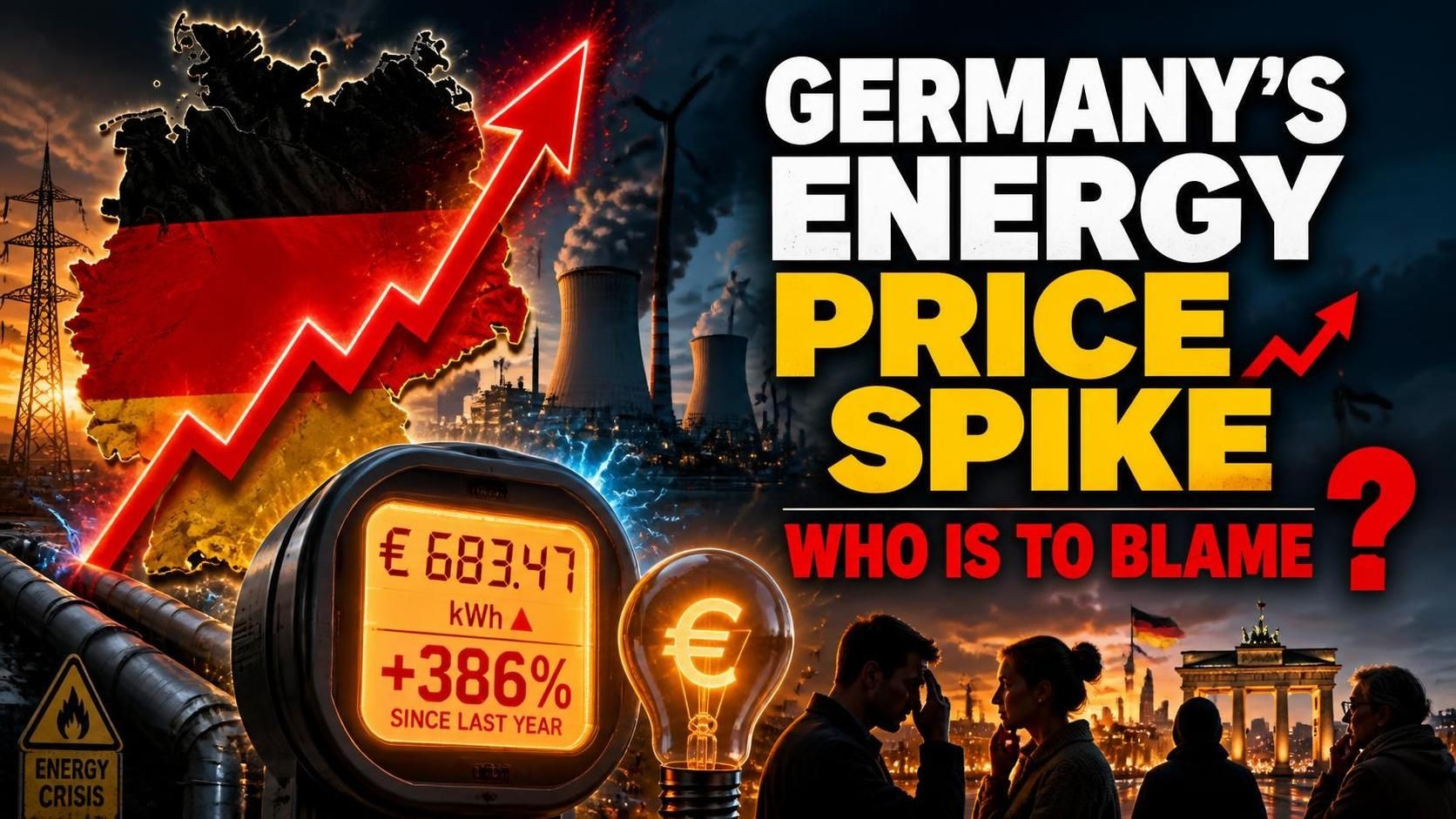
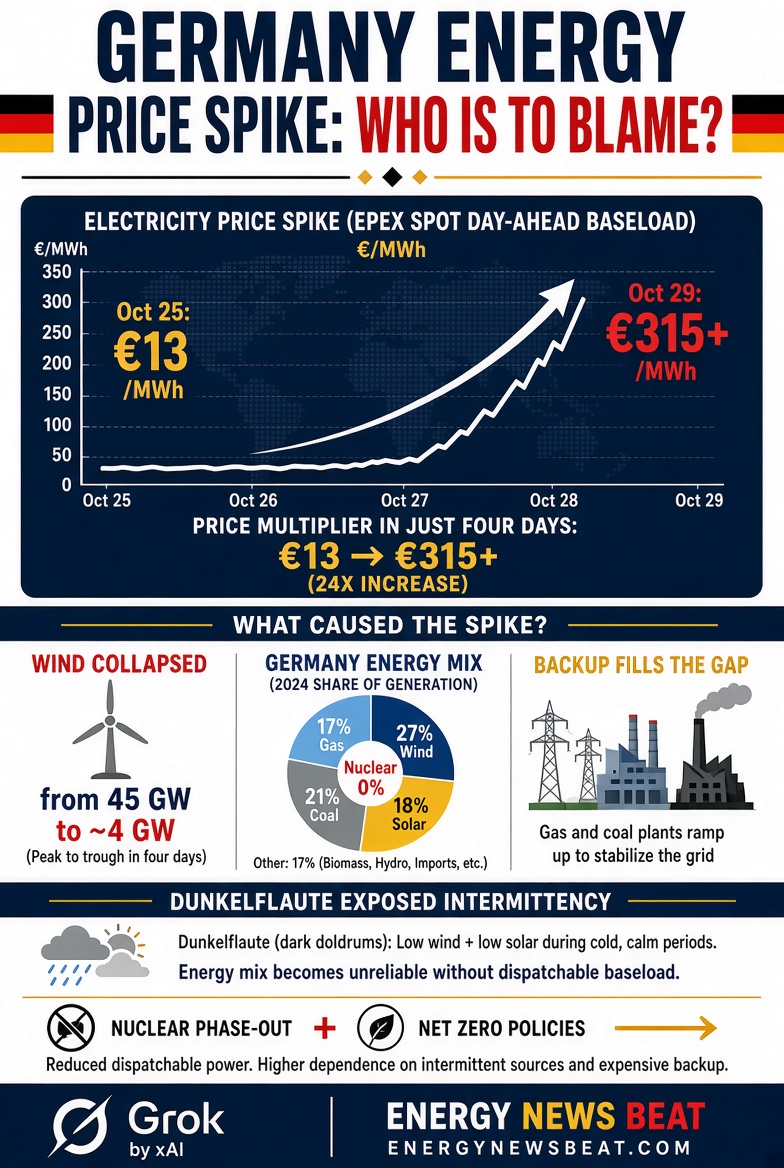
Germany’s wholesale electricity market delivered a textbook lesson in the limits of intermittent renewables in late October 2026. Day-ahead prices collapsed to an average of roughly €13 per megawatt-hour (MWh) on October 25 amid strong wind and solar output, with many 15-minute intervals clearing near zero. Four days later, on October 29, the average hit €314.85/MWh — the highest since 2024 — with evening slots exceeding €500–€574/MWh.Wattsupwiththat
This was the first major “Dunkelflaute” (dark doldrums) of the heating season: cool, cloudy, and nearly windless weather that simultaneously crushed wind and solar generation. Wind output fell from 44.5–46.5 GW on the high-output days to just 3.9–4.8 GW, well below half the 2026 year-to-date average of around 15 GW. Renewables’ share of load dropped from over 100% (with exports) to roughly 18–30%. Gas-fired plants ramped to around 12 GW and lignite to 12–13 GW to fill the gap, with hard coal adding more.Wattsupwiththat
The wind simply did not show up when it was “on deck.” Physics does not respond to policy targets.
Germany’s Energy Mix and the Dual System
In 2025, renewables supplied roughly 55–59% of Germany’s public net electricity generation or grid-fed power. Wind led at about 26–32%, solar 16–18%, with biomass and hydro making up most of the rest. Coal (lignite plus hard coal) still accounted for around 20–22%, and natural gas 14–17%. Nuclear was zero — the last three reactors (about 4.3 GW) shut down on April 15, 2023.Ember-energy
October 2026 as a whole still showed solid renewable output (around 61% of public net generation according to Energy-Charts), but the Dunkelflaute period reversed that instantly. Germany effectively runs two systems: one for high-wind/solar periods that can drive prices near zero or negative, and a fossil-backed system (increasingly gas, still significant lignite) that sets the marginal price whenever weather does not cooperate. The country pays for both the renewable buildout and the firm capacity that keeps the lights on.X
Battery storage remains tiny relative to multi-day lulls — on the order of tens of GWh, enough for minutes to a couple of hours of average demand, not days.
Net Zero Policies and the Shutdown of Dispatchable Power
The Energiewende and Net Zero pathway (climate neutrality by 2045, 80% renewables in electricity by 2030, coal exit by 2038) accelerated the nuclear phase-out and prioritized wind and solar. Nuclear once provided reliable, low-carbon baseload; its exit removed a source with low marginal costs and high capacity factors. Studies disagree on the precise price impact — some model analyses find limited short-term effects once renewables growth and demand changes are factored in, while others (including some PwC-linked work) argue that retaining the fleet would have lowered average prices and emissions substantially. What is not disputed is the increased reliance on gas and coal for firm power during low-renewable periods, and the fact that gas is often the price-setting marginal fuel in a Dunkelflaute.Foronuclear
Gas prices themselves spiked. The Dutch TTF front-month contract crossed €100/MWh around October 28 — the highest since the 2022 energy crisis — driven by Middle East conflict disrupting LNG flows through the Strait of Hormuz, low European storage levels (around 75% EU-wide, lower in Germany), and winter demand fears. A combined-cycle gas plant at typical efficiency faces fuel costs well over €150–190/MWh before carbon costs when gas is that expensive, which flows straight into electricity prices under the merit-order system.Energynews
Household bills layer on grid fees, levies, taxes, and VAT. Wholesale spikes of this magnitude push retail prices toward the 35–50+ euro cents per kWh range for many customers, depending on contract and state.
Who Is to Blame?
Weather is weather. Dunkelflaute events are a known feature of northern European winters; they are not a surprise. The vulnerability comes from policy choices that systematically reduced reliable, dispatchable, low-carbon capacity (nuclear) while scaling intermittent sources faster than firm backup, long-duration storage, or demand flexibility could compensate. The result is extreme price volatility, dual-system costs, and exposure to global gas markets.
Critics of rapid Net Zero timelines point to multi-trillion-euro estimates for the full transition (some KfW/Prognos and industry analyses put cumulative costs in the €5–6 trillion range through the mid-2040s when counting generation, grids, efficiency, and related investments). Supporters argue that renewables have driven long-term cost reductions and emissions declines on average, and that more wind, solar, batteries, and interconnectors will smooth the gaps. The late-October spike shows the gaps have not yet been closed.
The wind did not get the memo. Policymakers who treated intermittency as a minor engineering detail while shutting down plants that could run on demand bear the primary responsibility for the price shock households and industry are now facing. An expensive winter is underway.
Appendix: Sources and Links
- Watts Up With That / “Gone With the Wind” summary of the spike and Energy-Charts data: https://wattsupwiththat.com/2026/11/02/gone-with-the-wind-german-power-goes-from-e13-to-e315-a-megawatt-hour-in-four-days/
- Berliner Zeitung on the Dunkelflaute price jump: https://www.berliner-zeitung.de/article/dunkelflaute-rollt-ueber-deutschland-strompreis-springt-von-13-auf-ueber-300-euro-10543903
- Luxembourg Times / Bloomberg coverage: https://www.luxtimes.lu/businessandfinance/europes-first-winter-dunkelflaute-sends-power-prices-soaring/163754346.html
- Energy-Charts (Fraunhofer ISE) public generation, prices, and renewable shares: https://www.energy-charts.info/
- Bundesnetzagentur / SMARD electricity market data: https://www.smard.de/
- Ember Germany country profile (2025 mix): https://ember-energy.org/countries-and-regions/germany/
- Destatis / AGEB gross generation statistics: https://www.destatis.de/DE/Themen/Branchen-Unternehmen/Energie/Erzeugung/Tabellen/bruttostromerzeugung.html
- Fraunhofer ISE 2025 public generation summary: related releases via Energy-Charts and GlobNewswire coverage
- Nuclear phase-out official information (BASE): https://www.base.bund.de/en/nuclear-safety/nuclear-phase-out/nuclear-phase-out.html
- European gas price coverage (TTF ~€100/MWh, storage, Hormuz): energynews.pro, Strait Times, OilPrice, and related reports from late October 2026
- Energiewende cost estimates (DIHK, KfW/Prognos, FAZ): multi-trillion figures for 2025–2045/2049 pathways
- Additional price and mix reporting: StromAuskunft, Selectra, and Holger Zschaepitz commentary on X
All figures are drawn from contemporaneous market data (EPEX SPOT, ENTSO-E, SMARD, Energy-Charts) and official statistical releases available as of early November 2026.