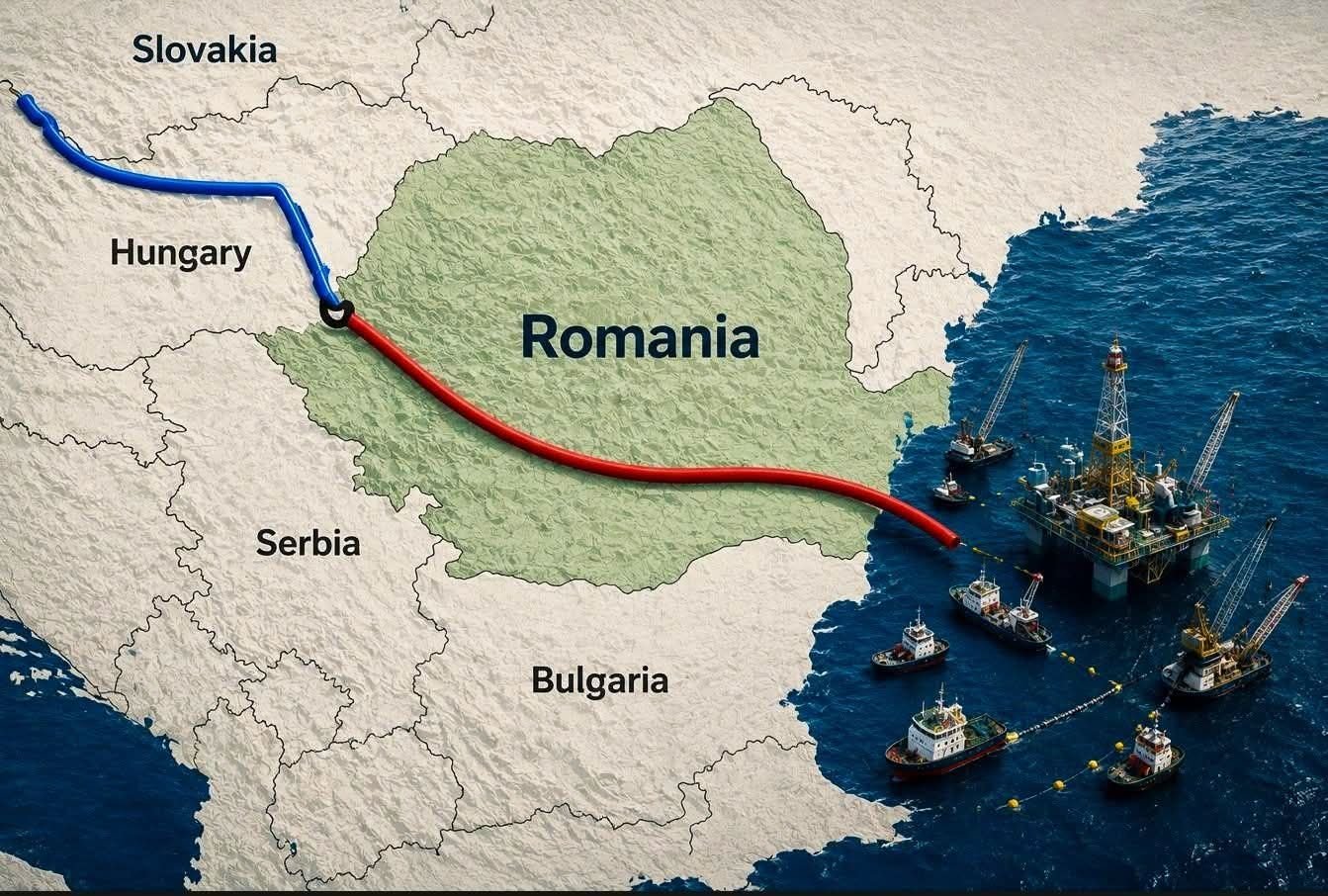
Europe’s largest new natural gas development is officially underway. In the Black Sea, 160 km off Romania’s coast, drilling has begun on the Neptun Deep project — a landmark initiative that promises to nearly double Romania’s domestic gas output, turn the country into a net exporter, and bolster energy security across Central and Eastern Europe.The project, operated by OMV Petrom (50%) in partnership with state-owned Romgaz (50%), targets two fields: Domino and Pelican South. It holds an estimated 100 billion cubic meters (bcm) of recoverable natural gas. First gas is targeted for 2027, with plateau production of approximately 8 bcm per year.
Project Scale and Progress
Development investment is up to €4 billion.
The concept includes:
10 production wells (4 in Pelican South, 6 in Domino).
A production platform (Neptun Alpha) is being fabricated in yards in Italy and Indonesia, with sail-away planned for 2026.
A 160 km, 30-inch subsea pipeline to bring gas ashore.
Construction is advancing on multiple fronts simultaneously. The first development well was spudded in March 2025 at Pelican South using the Transocean Barents rig. Pipelaying operations for the export pipeline kicked off in early May 2026, with Saipem executing the major EPCIC contract (valued around €1.6–1.8 billion / ~$1.75 billion). The platform installation and subsea tie-ins are scheduled to align for first gas in 2027.
Romania’s current domestic gas production stands at approximately 9.3 bcm per year (2025 data). Neptun Deep alone will add ~8 bcm at plateau, effectively doubling output and positioning Romania as the largest natural gas producer in the European Union.
Current Romanian consumption hovers around 9–10 bcm annually in recent years, meaning the project creates a substantial surplus for export or reduced import dependence.
Regional Impact: Supplying Central and Eastern Europe
With Groningen phased out and Russian pipeline supplies structurally reduced, indigenous European gas additions like Neptun Deep are critical this decade. Surplus volumes from Romania are expected to flow toward Moldova, Slovakia, Hungary, and potentially Germany via existing interconnectors and enhanced routes — no massive new long-haul pipelines are required immediately for market access.
Key country context (approximate recent figures):
Moldova (~2.5–3.2 bcm annual demand): Almost entirely import-dependent. Romania has already ramped up supplies via the Ungheni-Chisinau interconnector and is well-positioned to cover a growing share.
Slovakia (~4–5 bcm consumption): Very low domestic production (~0.04 bcm). Historically reliant on Russian imports; actively diversifying through reverse flows and alternative routes. Shows explicit interest in Romanian gas.
Hungary (~8.3–9.4 bcm consumption recently, down from peaks): Domestic production ~1.7 bcm. Significant importer with long-term Russian contracts but pursuing diversification. Enhanced Romania-Hungary links (part of BRUA corridor) facilitate flows.
Bulgaria (~2.5–3 bcm): No meaningful domestic production; benefits from regional interconnectors.
Germany: Large overall consumer but highly diversified (LNG, Norway, etc.). Romanian volumes could contribute indirectly through market integration or swaps.
These flows leverage and expand existing infrastructure like the BRUA pipeline (Bulgaria-Romania-Hungary-Austria), Romania-Moldova links, and Trans-Balkan pipeline in reverse flow. Initiatives such as the Vertical Gas Corridor further support northbound movements toward Slovakia, Hungary, and beyond.
Romania is already a net exporter or near-balanced in some periods and stands to become a key regional supplier, enhancing energy sovereignty for neighbors and reducing residual Russian influence in the region.
How Fast Can the Pipelines Be Built?
The critical new piece is the 160 km subsea pipeline (30-inch diameter). Subsea pipelaying is a mature, high-speed activity:
Modern vessels achieve typical lay rates of 4–9+ km per day (S-lay or J-lay methods), depending on water depth, weather, and seabed conditions. In favorable conditions, rates can exceed this.
For a 160 km line, active laying often takes weeks to a couple of months, with overall installation, testing, and commissioning spanning several months when including mobilization, surveys, and tie-ins.
In Neptun Deep’s case, the timeline is deliberately accelerated through parallel workstreams (drilling, platform fabrication, and pipelaying). Pipelaying began in May 2026; combined with 2026 platform installation and ongoing drilling, first gas in 2027 remains on track per operator statements.
Smaller onshore interconnectors or reinforcements (if needed for higher volumes) typically take 1–3 years from decision to operation, but much of the export pathway already exists or is being upgraded incrementally. The project’s offshore-to-shore infrastructure is the main bottleneck being cleared now.
Strategic Significance
Neptun Deep is more than a Romanian project — it is one of the EU’s most significant indigenous gas additions this decade. It strengthens Romania’s economy (revenues, jobs, taxes), enhances regional energy security, and supports the broader shift away from Russian pipeline dependence.
Challenges remain, including geopolitical risks in the Black Sea region and environmental considerations, but the project’s momentum is clear: approvals secured, contracts awarded, drilling and pipelaying underway, and first gas locked in for 2027.
As one of the few large-scale conventional gas projects advancing in Europe, Neptun Deep offers a tangible example of how targeted development can deliver both energy security and economic benefits in a transitioning market.
Energy News Beat will continue monitoring progress on this landmark Black Sea development. Energy Security Starts at home, and Energy dependency is displayed when you don’t listen to the Energy News Beat podcast. – Just saying.
Primary Project Sources:
- OMV Petrom official Neptun Deep page: https://www.omvpetrom.com/en/about-us/what-we-do/our-projects/neptun-deep
- Romgaz Neptun Deep info: https://www.romgaz.ro/en/about-neptun-deep-project
- OMV press release on first well spud (March 2025): https://www.omv.com/en/media/press-releases/2025/250325-omv-petrom-and-romgaz-spud-the-first-gas-production-well-of-neptun-deep-project
- Reuters coverage (pipeline work starts, May 2026): https://www.reuters.com/business/energy/pipeline-work-starts-romanias-biggest-black-sea-offshore-gas-project-2026-05-04/
Reserves, Production & Timeline:
- Offshore Technology: https://www.offshore-technology.com/projects/neptun-deep-gas-field-project-black-sea/
- GEM.wiki project page: https://www.gem.wiki/Neptun_Deep_Gas_Project_(Romania)
- Various consistent reports citing ~100 bcm recoverable and ~8 bcm/year plateau.
Romania Production Data:
- CEIC Data (Romania marketed production ~9.3 bcm in 2025): https://www.ceicdata.com/en/indicator/romania/natural-gas-production-opec-marketed-production
- Nine O’Clock / other reports on Romania leading EU production in quarters.
Regional Context & Interconnectors:
- Reuters mentions of exports to Moldova, Slovakia interest, Germany: See above Reuters article.
- Broader analyses on BRUA, Trans-Balkan reverse flow, Vertical Gas Corridor, and diversification (multiple IEA, OSW, Carnegie, etc. reports referenced in searches).
X Post (Original Reference):
- https://x.com/jackprandelli/status/2056653967572996156 (Jack Prandelli, May 19, 2026) — cross-checked and largely verified against operator statements and reputable reporting.
All figures are approximate and drawn from publicly available 2024–2026 data; actuals can vary with final investment decisions, operations, and market conditions. For the absolute latest updates, refer to OMV Petrom and Romgaz investor communications.