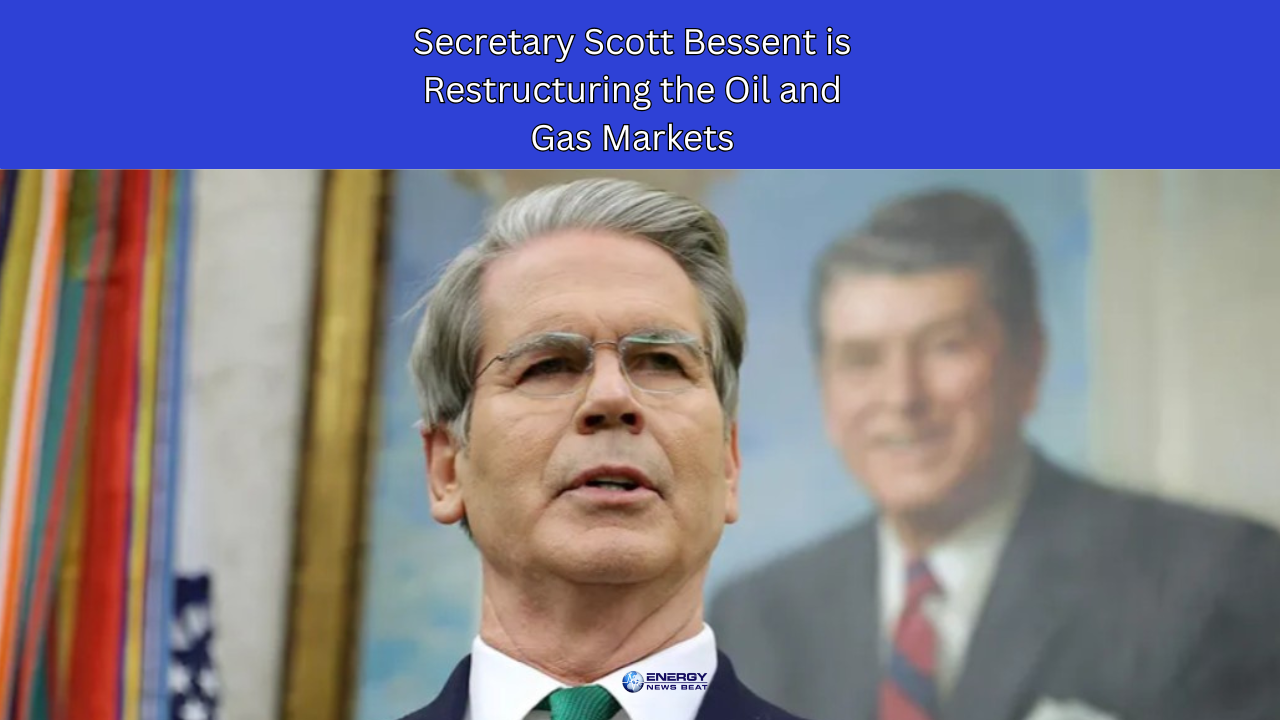
Secretary Scott Bessent is Restructuring the Oil and Gas Market

Reese Energy Consulting – Sponsor ENB Podcast

What a wild day on the Energy News Beat Stand Up. We have a special guest, David Blackmon, Forbes, Daily Caller, and Substack Author, and we have a blast.

Key points:

Secretary Scott Bessent: President Trump is talking about, and to be clear, he has focused on Karg Island since 1988, before the Shaw fell, that the U.S. Should be focused on that. He is laser focused on it. As I said, there was a bombing campaign last week. The military assets on Karg island were destroyed. And the other thing I can tell you, if you’re an oil worker, you don’t want to work there. So all the oil workers there are being coerced to stay there. And we will see what happens with whether that eventually becomes a U.S. Asset.” –

If the US takes control of Kharg Island, the Venezuelan-style controls will be placed on Iran, and this will help bring peace to the Middle East.

1. U.S. Energy Policy & Oil Price Stabilization

The transcript covers Energy Secretary Granholm’s efforts to manage oil prices through various policy tools, including sanctions enforcement, strategic energy reserves, and regulatory waivers on Russian and Iranian oil imports.

2. Middle East Energy Infrastructure Conflicts

A significant focus is on military actions affecting energy infrastructure:

  • Iran’s South Pars Gas Field: Discussion of drone attacks by U.S. and Israeli forces targeting Iran’s critical gas production facility
  • Qatar’s Pearl GTL Complex: Qatar’s retaliatory strike on this LNG export facility, leading to force majeure declarations on LNG contracts

3. Global LNG Supply Disruptions

The disruption to Qatar’s liquefied natural gas exports is presented as a major concern for global energy markets, with the U.S. unable to quickly fill the supply gap in the short term.

4. State-Level Energy Transitions

  • Hawaii’s LNG Initiative: Efforts to transition away from fuel oil for power generation by importing LNG from Japan
  • California Offshore Production: Discussion of restarting offshore oil production and the challenges posed by refinery closures

5. Domestic Oil Production

Coverage of new oil and gas lease bids in Alaska’s National Petroleum Reserve as a strategy to increase domestic oil production capacity.

6. Global Energy Market Dynamics

Overarching concerns about supply shortages, price volatility, and the geopolitical challenges of replacing disrupted Middle Eastern energy supplies.


1.Secretary Scott Bessent has levers he can still pull to keep oil prices stable for a few weeks – Key Points from his Interview on Fox

As the U.S.-Israel conflict with Iran roils global energy markets and pushes benchmark crude above $100 per barrel at times, Treasury Secretary Scott Bessent is wielding sanctions policy like a supply-side tool. With the Strait of Hormuz under pressure and Iranian exports partially disrupted, Bessent has already pulled several levers — temporary Russian oil sanctions waivers, coordinated Strategic Petroleum Reserve (SPR) releases, and allowances for Iranian tankers to transit — to inject supply and cap price spikes. This morning on Mornings with Maria, Secretary Scott Bessent has some great insights into how they are waging a financial war on Iran, and how they plan on keeping the markets stable. You had to listen quickly.

Bessent’s strategy is clear: use Treasury authorities to create near-term supply without new drilling or long-term policy shifts. He has signaled that more moves are possible, including broader unsanctioning of floating sanctioned crude and additional SPR taps. The goal? Keep prices stable for consumers and businesses “for a few weeks” while the administration addresses the Iranian threat.

Treasury’s Available Levers to Bolster Global Supply

Bessent’s primary tools sit in sanctions enforcement and emergency reserves:

Sanctions waivers on Russian (and potentially Iranian) oil: The U.S. issued a 30-day global waiver (through April 11) allowing purchases of Russian crude and products already loaded on tankers. This expanded an earlier India-specific license and targets “stranded” barrels — up to 215 million across 370+ vessels in some estimates. Bessent emphasized it provides “no significant financial benefit” to Moscow while flooding markets with existing supply. Similar logic applies to Iranian tankers: the U.S. is explicitly allowing them through the Strait of Hormuz to keep oil moving.

SPR releases: The Trump administration authorized a 172 million barrel U.S. draw (part of a record 400 million barrel coordinated IEA release). Sales occur via competitive bids managed by the Department of Energy but coordinated at the policy level by Treasury. More releases remain on the table, per Bessent’s recent comments.

Venezuelan-Style Price Controls (or Sanctions Framework) on Iran

This scenario envisions U.S. control of Kharg paired with Venezuela-style oversight: payments routed through special U.S.-controlled accounts, bans on sales to Russia/Iran/North Korea/China entities, and forced discounts or directed flows. In the new Venezuelan system that the United States controls, China was invited to buy Venezuelan oil at market prices rather than the usual discounts. The U.S. just eased sanctions on Venezuelan PDVSA precisely to boost supply amid the Iran crisis. They have not purchased through the new system, as they had found Russian and Iranian oil on the Dark Fleet tankers. At least we cannot verify they have purchased from Venezuela, and we will keep looking for that verification. That may dry up soon, so look for China to take as much as they have physical capacity to store.

This new financial control on oil will bring up foundational changes to the oil as well as the natural gas markets. Energy is now the main controlling lever tied to the monetary systems.

For Iran, the result would be regime revenue starvation (oil funds ~40%+ of budgets and proxies) while allowing managed exports to approved buyers. Markets could see discounted barrels hit shelves — but with distortions, black-market risks, and production drops mirroring Venezuela’s post-sanctions collapse. Long-term: potential redirection from China to the West, reshaping global flows.

If Iran’s Monetary System Is Already “Broken” (as Bessent Implicated), How Long Until Full Financial Collapse?

Bessent has been blunt: U.S. sanctions engineered a dollar shortage that triggered Iran’s December 2025 banking crisis — a major bank collapse, runs, money-printing, rial freefall (now exceeding 1.5 million per USD), and hyperinflation (food prices +70%+). Protests erupted nationwide. Elites are “wiring money out,” and the economy is “on the ropes.”The system is already in systemic breakdown — most banks are insolvent by central bank metrics, public finance is failing, and the rial is barely functioning as currency. Adding Kharg disruption, full Venezuelan-style controls, or sustained war pressure would accelerate the spiral. Expert consensus and Bessent’s own timeline point to full financial collapse (hyperinflation spiral, banking paralysis, mass unrest, or regime-threatening failure) in weeks to 1–3 months. The regime has survived crises before, but losing control of its currency and oil revenue simultaneously may prove fatal in 2026.

Bottom Line: Weeks of Stability Possible — But the Clock Is Ticking

Secretary Bessent has real, immediate levers — Russian waivers, SPR injections, and targeted Iranian allowances — to keep oil prices from spiraling out of control for the next few weeks. The floating sanctioned crude inventory and SPR barrels provide a tangible cushion. Yet the hypotheticals are stark: full unsanctioning delivers short-term relief; Kharg seizure or Venezuelan-style controls trigger supply shocks and regime collapse risks. Energy markets will remain hostage to how aggressively these levers are pulled versus how far military escalation goes.


2.South Pars Gas Field Strike: US-Israeli Drones Hit Iran’s Energy Lifeline – Production Hit, Markets Spike, and Tehran Targets Gulf Facilities in Retaliation

In a major escalation of the ongoing U.S.-Israeli war with Iran, strikes hit key processing facilities tied to the world’s largest natural gas field — Iran’s South Pars — today, knocking out critical infrastructure that supplies the bulk of the country’s energy needs. Iranian state media and multiple international reports confirm the attack targeted onshore gas treatment plants in the Assaluyeh Special Economic Energy Zone (Bushehr province), which process sour gas from offshore phases 3, 4, 5, and 6 of South Pars.

Who carried out the strikes?

Iranian officials and state television explicitly blamed “US-Israeli” drones and projectiles. Israeli media, citing unnamed sources, reported that the Israeli Air Force executed the operation in coordination with — and with approval from — the Trump administration. Qatar, which shares the giant reservoir (calling its portion the North Field), condemned the Israeli targeting as a “dangerous and irresponsible step.”

I am seeing that this was more Israel than the US, and there are some serious discussions on this. I do not think this was approved, and if it was not approved and Israel did it anyway, that is going to change our relationship. Not enough to put out there, just enough for speculation.

The retaliation from Iran to Qatar is one reason that I think this strike went too far and was not approved by the US. Once we get confirmation, we will let you know.


3.QatarEnergy’s Pearl GTL Complex Hit in Iranian Strike: Fires Rage at Ras Laffan – Critical Air Separation Units Likely Destroyed, Multi-Year Outage Expected

Equipment on Fire: The Critical Air Separation Units (ASUs)

The most likely target or hardest-hit area, per detailed analysis of the satellite data and process engineering knowledge, is Pearl GTL’s massive Air Separation Unit (ASU) complex. Pearl GTL relies on eight identical Linde-engineered ASUs, each capable of producing 3,800 tonnes per day (tpd) of oxygen — totaling ~30,000 tpd of pure O₂. These cryogenic plants supply the oxygen essential for autothermal reforming in the syngas production step of the Shell GTL process.

Each ASU features enormous cold boxes (470 tonnes each, standing 60 meters tall) manufactured primarily in Europe and China. The red boxes in the FIRMS imagery align precisely with the industrial footprint where these units and associated cryogenic infrastructure are clustered near the coastal process area of Ras Laffan.

Replacement Cost and Timeline: Years, Not Months

Rebuilding these specialized ASUs will be extraordinarily expensive and time-consuming. Original contract costs (awarded to Linde in 2006) were already massive; at today’s inflated prices for cryogenic equipment, specialized fabrication, and global supply-chain pressures, each unit is estimated at approximately $1 billion (versus ~$400 million at the time of original construction). For all eight units, that alone could exceed $8 billion — before installation, integration, civil works, and full plant recommissioning.

Manufacturing lead time for such mega-ASUs is 3–4 years per unit under normal conditions. Key components (cold boxes, heat exchangers, distillation columns) must be precision-fabricated by specialists like Linde or SIAD Macchine Impianti. Delivery, on-site erection, testing, and integration with the broader GTL facility push the full outage timeline to multiple years before Pearl GTL can return to even partial production. No official QatarEnergy or Shell damage assessment has been released yet, but the destruction of oxygen supply would render the entire syngas-to-liquids chain inoperable until replacement.

4.QatarEnergy Declares Force Majeure on LNG Contracts to Italy, Belgium, South Korea, and China: Shockwaves for Global Markets and a Major Boost for U.S. LNG Producers

In a dramatic escalation of the ongoing Middle East conflict, QatarEnergy — the world’s second-largest exporter of liquefied natural gas (LNG) — has confirmed it will likely invoke force majeure on long-term supply contracts with buyers in Italy, Belgium, South Korea, and China. The move stems from extensive damage to key production facilities at the Ras Laffan Industrial City, caused by Iranian missile strikes amid the broader U.S.-Israel war on Iran. QatarEnergy CEO and Qatar’s Energy Minister Saad al-Kaabi stated in an exclusive interview that two LNG trains (S4 and S6) were hit, taking approximately 17% of Qatar’s LNG export capacity — or roughly 12.8 million tonnes per annum (mtpa) — offline for three to five years. This could result in annual revenue losses of around $20 billion for Qatar. Kaabi noted that production cannot restart until hostilities cease, and the company “may have to declare force majeure on long-term contracts for up to 5 years.” He added that an earlier, shorter-term force majeure had already been declared, but the damage now requires a much longer suspension.

This builds on QatarEnergy’s initial force majeure declaration on March 4, 2026, following the initial production halt at its 77 mtpa Ras Laffan facility. Downstream traders such as Shell and TotalEnergies have already issued force majeure notices to their own customers worldwide.

Verification of the Force Majeure Statements

The claims are fully verified through multiple independent sources. QatarEnergy itself confirmed the facility damage and production halt in official statements. CEO Kaabi’s detailed comments were reported directly by Reuters on March 19, 2026, and corroborated by Bloomberg, S&P Global, Al Jazeera, and Yonhap News. Specific affected contracts include:

5.Hawaii’s Gas Bid Advances on Japan Plan for Power Plant, Imports – It’s about time

Japan rolls out an LNG to Power solution for Hawaii – this is huge.

6.National Petroleum Reserve–Alaska Has New Bids Opened

The Bureau of Land Management (BLM) opened bids yesterday for the first competitive oil and gas lease sale in the National Petroleum Reserve–Alaska (NPR-A) since 2019 — and the results are stunning. Industry submitted 430 bids on 187 tracts covering approximately 1.335 million acres out of the 5.5 million acres offered across more than 600 tracts. The total high bids reached a record $163.7 million — shattering the 2019 sale total of just $11.3 million and sending a clear signal that major oil companies are back in the Alaska game.

This is no ordinary lease sale. It is the first of at least five mandated NPR-A sales over the next decade under the 2025 “One Big Beautiful Bill Act.” The 2025 Record of Decision reopened roughly 82% of the 23-million-acre reserve (about 18.6 million acres) for leasing, reversing years of Biden-era restrictions and legal gridlock. Alaska’s congressional delegation and the Trump administration’s executive actions made it happen. As BLM Alaska State Director Kevin Pendergast put it, “The results of today’s sale are historic… It makes clear that for the NPR-A, despite all the successes to date, the best days are still ahead.”

7.Black gold gushes into California as offshore bill kicks into gear following Trump executive order – But what good will it do?

Oil is flowing again off the Santa Barbara coast for the first time in over a decade. On Monday, Sable Offshore Corp. restarted the Santa Ynez Pipeline System, sending “black gold” from its Dos Cuadras Field platforms through the onshore network that ends at Pentland Station in Kern County. The move follows President Donald Trump’s executive order last Friday, invoking the Defense Production Act (DPA) for national security reasons — a direct override of California state blocks that had kept the system idle since the 2015 Refugio oil spill.

Sable has 540,000 barrels of processed crude already in storage and plans to begin sales by April 1 at roughly 50,000 barrels per day. Full production across its three offshore platforms is expected by June, delivering what Sable Chairman and CEO Jim Flores called a roughly 17% boost in domestic crude supply for California consumers. “We look forward to working closely with the Department of Energy … to deliver the energy necessary for the security and defense of the country,” Flores said.

Gavin Newsom’s administration immediately threw up roadblocks.
Governor Newsom labeled the federal order “illegal,” claiming the pipeline’s operators face criminal charges and are barred by multiple court orders. He vowed to fight in court, while environmental groups like the Center for Biological Diversity warned of another “oil disaster.” State Attorney General Rob Bonta and the California State Fire Marshal have already sued the Trump administration over federal preemption of state oversight. Santa Barbara County prosecutors have filed criminal charges against Sable for alleged water-protection violations.

Secretary Wright and President Trump need to take control of the entire state’s refinery system. David and I cover that today.


8.Gasoline and Diesel Prices Are Going Up — What Are Trump’s Options to Lower Prices?

Gasoline prices have surged to a national average of around $3.79 per gallon as of mid-March 2026, with some regions seeing diesel climb toward $4.86 and isolated spots hitting over $6. That’s a roughly 25% jump in just 17 days, driven largely by supply disruptions tied to the ongoing U.S.-Iran conflict and tensions in the Strait of Hormuz.

Economist Peter St. Onge (@profstonge) nailed the frustration in his latest video post: “Gas prices just hit $3.70 — up 25% in 17 days.

The Bottom Line:

Buckle up, it is going to be a crazy few weeks. Until the Marines can take Kharg Island and implement controls on Iran’s oil, we will see peace very quickly.

In the meantime, hug an oil field worker, a lineman, or someone who brings low-cost energy to your home. The United States is not in the same place as the UK, the EU, Turkey, or the Middle East right now because of our great energy policies.

I am extremely grateful for Secretary Scott Bessent and Secretary Chris Wright, who I feel are the absolute best men for the job that we could have asked for. They are setting the bar extremely high for their replacements.

Check out The Energy News Beat Substack:

Energy News Beat

At The Intersection of Energy and Finance – By Sandstone Asset Management
By Stu Turley

Check out David Blackmon on

David Blackmon’s Energy Additions

There is no ‘Energy Transition’ taking place. Instead, what is taking place is the most massive addition of energy in all its forms in the history of mankind. Learn all about this energy addition and the public policies that drive it here.

If you are looking for a data center spot, give them a call.


A shout-out to our sponsor, Reese Energy Consulting:

https://reeseenergyconsulting.com/

What We Are Reading – and Dan Doyle is Scheduled

Be the first to comment

Leave a Reply

Your email address will not be published.


*