Energy News Beat Exclusive Analysis
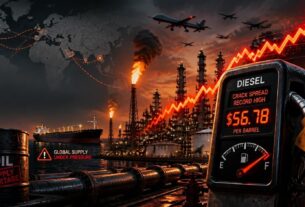
The International Energy Agency (IEA) released its “Sheltering from Oil Shocks” report on March 20, 2026, and it reads like a blueprint for managed energy rationing. Amid the Middle East conflict that has choked off roughly 20% of global oil supply through the Strait of Hormuz, the IEA outlined a 10-point menu of demand-side measures. These include working from home three additional days per week (cutting national car oil use by 2-6%), reducing highway speeds by at least 10 km/h (saving 1-6% nationally), promoting carpooling and odd-even license-plate days, efficient trucking, slashing non-essential air travel by up to 40%, and shifting LPG from transport to other uses. Widespread adoption could slash global oil demand by 2.7 million barrels per day within four months.
The IEA also coordinated the largest-ever release of 400 million barrels from emergency reserves. Some are already dubbing this the “Global Energy Lockdown” — echoes of the pandemic playbook: restrict movement, limit choice, and hope prices stabilize. But while governments scramble to ration demand, the real question remains: Why is the world this fragile to begin with?
Energy Security Starts at Home — Saudi Arabia Gets It
Saudi Arabia isn’t waiting for rationing memos. The Kingdom has ramped its East-West Pipeline (Petroline) to full capacity of 7 million barrels per day, fully bypassing the Strait of Hormuz and delivering crude to the Red Sea port of Yanbu. Of that volume, roughly 2 million bpd stays domestic for refining; the rest heads straight to export markets. Flow rates jumped from an average 1.7 million bpd in 2025 to 5.9 million bpd by early March 2026.
That’s energy security in action: decades of investment in pipelines, refineries, and production resilience — not ideology.
Coal Is Back — Except Where Europe Burned the Bridge
Reality is forcing a global coal revival. In Germany, Chancellor Friedrich Merz stated this week that if the crisis drags on, existing coal-fired plants may need to run longer than planned. The government is reviewing reactivation of up to 8.8 GW of reserve coal capacity (three-quarters hard coal) and even some decommissioned lignite plants — plants that can ramp in as little as 12 hours. Germany’s 2023 nuclear phase-out is now widely blamed for spiking prices and emissions.
Spain faces similar fallout. The April 28, 2025, Iberian Peninsula blackout — which cut power for hours across Spain and Portugal — has reignited debate over the 2035 nuclear phase-out. The outage was triggered by voltage instability, insufficient synchronous generation, and a fragile grid overloaded by high renewable penetration. Nuclear lobbyists are now urging a full review, noting that four reactors were offline during the event.
Meanwhile, the rest of the world — Asia, Eastern Europe, and beyond — is simply keeping reliable baseload plants online. The contrast is stark: countries that ignored the green ideology are far less vulnerable.
The Real Cost of Energy: Why “Cheap” Renewables Make Electricity the Most Expensive
If wind and solar are so cheap, why do Germany and Spain — with some of the world’s highest renewable penetration — consistently post among Europe’s highest electricity prices?
Household electricity in Germany averaged around €0.38/kWh in early 2026 — among the highest in the EU and roughly double U.S. levels. EU wholesale prices averaged ~USD 95/MWh in 2025, twice the U.S. figure. France, which kept its nuclear fleet, runs far cheaper at wholesale levels projected around €58/MWh for 2026 delivery.
Standard Levelized Cost of Energy (LCOE) from Lazard’s June 2025 report makes renewables look unbeatable on a plant-level basis: utility-scale solar $38–78/MWh, onshore wind among the lowest-cost new-build options, unsubsidized.
By contrast, new combined-cycle gas has climbed to a 10-year high, coal and nuclear higher still. Capacity factors tell part of the story: nuclear runs ~92%, modern gas combined-cycle ~85%, but onshore wind averages ~34% and solar ~23–25%.LCOE vs. Levelized Full System Cost of Electricity (LFSCE / LFSCOE):
The Gap That Changes Everything
LCOE was never designed to compare apples-to-oranges technologies. It ignores intermittency, the need for massive overbuild, backup generation, grid upgrades, curtailment, and storage to make weather-dependent sources dispatchable 24/7. Enter Levelized Full System Cost of Electricity (LFSCOE) — a peer-reviewed metric developed by researcher Robert Idel (2022, with later market-specific updates). It calculates the true cost of supplying 100% of market demand using only one technology plus storage.
Here’s the dramatic real-world comparison (USD/MWh, mean values):
|
Technology
|
LCOE (approx., Lazard 2025 baseline)
|
LFSCOE Germany
|
LFSCOE Texas
|
|---|---|---|---|
|
Solar PV
|
$36–78
|
1,548
|
413
|
|
Onshore Wind
|
$27–60
|
504
|
291
|
|
Wind + Solar Combo
|
—
|
454
|
225
|
|
Nuclear
|
$141–220 (older fleets lower)
|
106
|
122
|
|
Coal (USC)
|
$71–173
|
78
|
90
|
|
Natural Gas CC
|
$48–109
|
35
|
40
|
Key takeaways from the LFSCOE analysis:In Germany, solar’s full-system cost explodes to $1,548/MWh — 40×+ its plant-level LCOE — because of the need for enormous storage to cover multi-day lulls and seasonal mismatches.
Wind fares better but still $504/MWh in Germany, $291/MWh in windier Texas.
Dispatchables (nuclear, coal, gas) barely change because they are already reliable; their LFSCOE is essentially their LCOE plus minimal system adjustments.
Even a sensitivity case (LFSCOE-95, allowing 5% of hours unmet by storage) slashes renewable costs by over 50% — solar drops to ~$849/MWh in Germany, wind to ~$279/MWh — yet they remain multiples higher than nuclear or gas.
These numbers hold even if battery storage costs fall 90%. Real-world validation is everywhere: Europe spent $105 billion on grid upgrades in 2025 alone (roughly 60 cents per renewable dollar invested), with another €1.2 trillion projected by 2040 just to keep pace. Congestion management costs hit €8.9 billion in 2024. The highest-penetration renewable grids are also the most expensive and fragile — exactly as LFSCOE predicts.
It’s Time for a New Definition of Levelized Cost
LCOE was a useful shorthand for dispatchable plants. For an intermittent-dominated future, it is dangerously misleading. Policymakers and the IEA must adopt a standardized Levelized Full System Cost of Energy (LFSCE) framework that accounts for:
Reliability & Dispatchability — Required backup/storage hours and costs.
Grid Integration — Transmission upgrades, curtailment, and stability services (Europe’s €70+ billion annual grid spend is just the start).
Land Use & Lifecycle — Acres per TWh, mining, recycling, decommissioning.
Subsidies & Externalities — Full taxpayer burden removed.
Energy Poverty & Competitiveness — Impact on household bills and industry (Germany’s prices vs. France’s nuclear advantage).
Until full-system accounting becomes the global standard, we’re subsidizing fragility while pretending it’s cheap.
The Path Forward: Energy Dominance Starts at Home
High prices aren’t caused by Middle East headlines alone — they’re the predictable result of decades of policy that demonized reliable baseload power while subsidizing intermittency.
Energy security starts at home. That means:
Unleashing domestic oil, gas, clean coal, and nuclear, where environmentally responsible.
Building more nuclear — the only proven, scalable, zero-carbon dispatchable source (92% capacity factor).
Stopping the premature closure of paid-for plants.
Demanding full-system cost transparency before another subsidy flows.
Investing in infrastructure like Saudi Arabia’s 7 million bpd pipeline.
The IEA can publish demand-rationing playbooks. The rest of us should be building supply-side dominance. Because the next crisis is coming — and the countries that chose reality over virtue-signaling will be the ones with the lights on.
Energy News Beat will keep holding the line. Energy security isn’t a slogan. It’s a strategy. And it starts right here at home.
Check out the Energy News Beat Substack: https://theenergynewsbeat.substack.com/