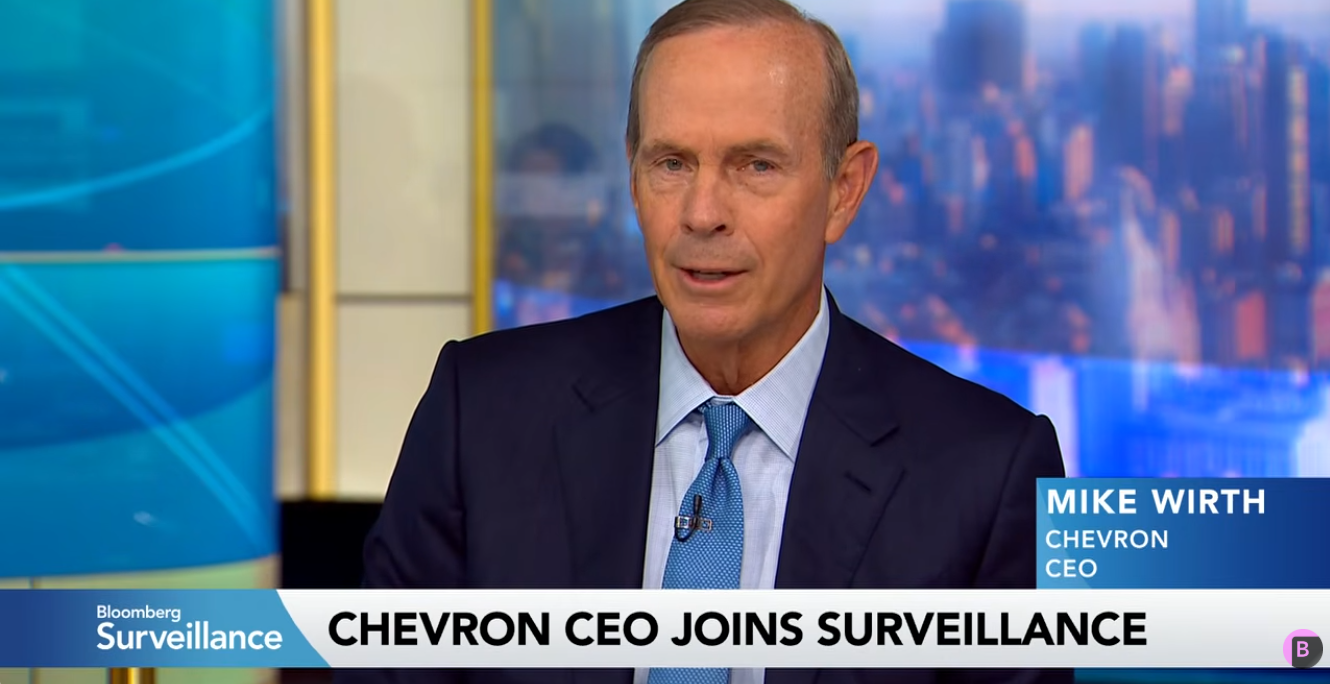
In a wide-ranging Bloomberg Surveillance interview aired today, Chevron Chairman and CEO Mike Wirth painted a sobering picture of ongoing disruptions in the Strait of Hormuz while signaling that the industry is accelerating plans for alternative infrastructure to reduce reliance on the critical chokepoint.
Wirth confirmed that multiple vessels transiting the Strait of Hormuz have suffered attacks this week, some previously unreported, underscoring the persistent security risks even amid fragile U.S.-Iran ceasefire talks. Chevron has six vessels under charter in the Persian Gulf, but the company is taking a firm stance: it will not pay any tolls or fees demanded by Iran for safe passage. “We believe in freedom of navigation,” Wirth emphasized, aligning with U.S. warnings against complying with what Washington calls illegal levies.
Traffic through the Strait—normally responsible for roughly 20% of global petroleum flows—has plunged to about 10-20% of pre-conflict levels, with hundreds of ships and tens of thousands of crew members effectively stranded. Wirth noted that even if a longer-term peace agreement is reached soon, restoring normal operations will take months as shipowners, insurers, and operators rebuild confidence.

Pipeline Bypass Momentum Building
One of the most forward-looking elements of Wirth’s remarks was his explicit reference to expanding pipeline infrastructure as a strategic workaround. He highlighted ongoing investments in Saudi Arabia and the UAE, including the Fujairah project that is already 50% complete, which would allow oil to bypass the Strait entirely via overland routes to ports on the Gulf of Oman or Red Sea. For producers in Iraq and Kuwait, northern pipelines to the Mediterranean are also under consideration.
“New investments in infrastructure to avoid Hormuz transits are expected in the coming years,” Wirth stated. This aligns with broader Gulf cooperation already underway: Saudi Arabia’s East-West pipeline is reportedly operating at full capacity of around 7 million barrels per day, rerouting crude from eastern fields to Yanbu on the Red Sea.
The CEO’s comments reflect a growing industry consensus that the current crisis is accelerating decades-old plans for Hormuz bypass capacity. With Iran exerting de facto control over the waterway during the recent conflict, major producers are now prioritizing redundancy to protect global supply chains.
Wirth’s Outlook on Oil Prices: Tightness, Volatility, and Short-Term Pressure
Wirth offered a nuanced view on oil markets amid the disruptions. Despite the severity of the supply shock, crude prices have not spiked as dramatically as some expected. He attributed this to “market psychology” that continues to price in a relatively quick resolution to the conflict. However, the underlying physical realities tell a different story: global inventories of crude and refined products are steadily drawing down, and June and July will be “critical months.” Physical shortages are already appearing in parts of Asia, where some economies have imposed rationing and shortened workweeks. In the United States, record exports to allies have tightened domestic supplies—distillate inventories are at their lowest since 2003—while refineries run at maximum utilization.
Wirth warned of upward pressure on physical prices for gasoline and diesel in the coming weeks, with risks of broader supply outages if the situation drags on. At the same time, he cautioned that a rapid reopening of the Strait could eventually lead to gluts as production ramps up and delayed cargoes flood the market. Chevron itself expects its production to grow 7-10% this year against roughly 1% global demand growth.
Overall, the CEO sees a volatile, uncertain environment where buffers have been eroded, and the market’s ability to absorb shocks is diminished compared to pre-crisis levels. High prices “with us for some time” appears to be the operative theme until confidence and logistics fully recover.
Cross-Check with OilPrice.com Reporting
The Bloomberg interview dovetails closely with today’s OilPrice.com report titled “Chevron CEO: Multiple Ships Attacked In Strait of Hormuz.” Both sources quote Wirth on the unreported attacks, Chevron’s six chartered vessels, refusal to pay tolls, and the slow path back to normal trade flows, even after any peace deal. The OilPrice piece notes traffic at roughly 10% of pre-war levels and highlights the same diplomatic context of a potential 60-day ceasefire extension. No contradictions were found; the Bloomberg discussion simply provides deeper color on pipeline strategies and price dynamics.
What This Means for Energy Markets
Wirth’s remarks underscore a pivotal shift: the Strait of Hormuz, long a vulnerability, is now driving serious capital allocation toward bypass infrastructure. For energy consumers and policymakers, the message is clear—near-term tightness and price volatility remain risks, but longer-term resilience is being built through pipelines and diversified routes. Chevron’s own growth trajectory and refusal to yield on navigation principles also signal confidence that U.S. producers can help bridge global gaps in the interim. As the industry watches ceasefire negotiations unfold, Wirth’s analysis suggests markets should prepare for a bumpy ride through the summer, with pipeline projects offering the most credible path to lasting stability.
We recommend subscribing to Bloomberg.
- Bloomberg Television Interview with Chevron CEO Mike Wirth – “Chevron CEO Wirth on Oil Prices, Strait of Hormuz, Venezuela” (full video and transcript basis): https://youtu.be/6iJSfeqr-TQ (uploaded May 29, 2026). Primary source for direct quotes, pipeline references, and oil price analysis.
youtube.com
- OilPrice.com – “Chevron CEO: Multiple Ships Attacked In Strait of Hormuz” by Alex Kimani (May 29, 2026): https://oilprice.com/Latest-Energy-News/World-News/Chevron-CEO-Multiple-Ships-Attacked-In-Strait-of-Hormuz.html. Cross-checked for consistency on attacks, vessels, and toll refusal.
oilprice.com
- Supporting context on pipeline bypasses and market impacts drawn from contemporaneous reporting referenced in search results (e.g., Saudi East-West pipeline capacity, Gulf rerouting efforts).
All analysis is based on the publicly available Bloomberg interview and the referenced OilPrice.com article. No other external documents were required for this piece. Energy News Beat will continue monitoring developments in the Persian Gulf and global oil markets.