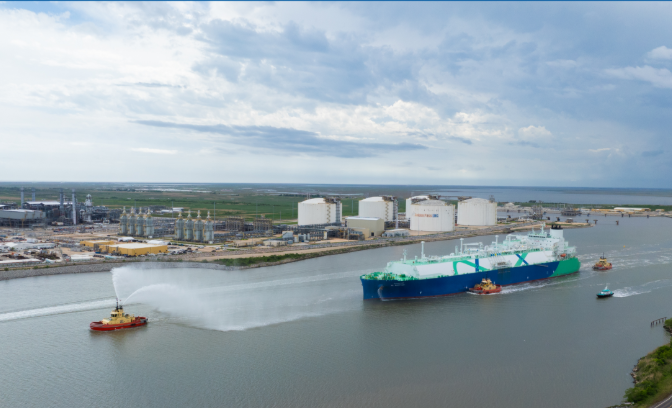
Golden Pass LNG, a major joint venture between QatarEnergy (70%) and ExxonMobil (30%), has reached a historic milestone. On April 22, 2026, the company announced that its first liquefied natural gas (LNG) export cargo has departed from its Sabine Pass terminal in Texas. The 174,000-cubic-meter QatarEnergy-owned carrier Al Qaiyyah loaded the inaugural cargo at the facility and has now sailed. Reuters previously reported the destination as Italy, aligning with QatarEnergy’s offtake contracts.
This marks the culmination of years of development for one of North America’s largest new LNG export projects. First LNG production from Train 1 was achieved on March 30, 2026, setting the stage for sustained operations. The terminal is now transitioning from commissioning to commercial exports, with feedgas intake recently hitting record levels around 400–434 million cubic feet per day (MMcf/d) as the first train ramps up.
Project Details and Capacity
Golden Pass LNG features three liquefaction trains with a total nameplate capacity of approximately 18 million metric tons per annum (mtpa), equivalent to roughly 2.4–2.5 billion cubic feet per day (Bcf/d) of feedgas once fully operational. Train 1 alone is expected to contribute around 800 MMcf/d (~5–6 mtpa) initially, with Trains 2 and 3 following in 2027. The $10+ billion project includes five 155,000-cubic-meter storage tanks and two marine berths. Located in Sabine Pass (Port Arthur area), Texas, it leverages existing infrastructure originally built for imports before the U.S. shale boom turned the country into a net exporter.
What This Means for U.S. Investors, ExxonMobil, and Qatar
EnergyFor U.S. investors and the energy sector: The startup adds incremental U.S. LNG export capacity at a time of strong global demand. It boosts demand for domestic natural gas from key basins like the Haynesville and Permian, supporting producers, midstream companies, and jobs in Texas. With U.S. LNG now a cornerstone of global energy security—especially for Europe and Asia—this project reinforces America’s position as the world’s top LNG exporter and provides a hedge against international supply disruptions.
For ExxonMobil (30% stake): The milestone strengthens Exxon’s growing LNG portfolio and delivers new revenue streams from U.S.-sourced gas. As a low-cost, flexible supplier, Golden Pass enhances Exxon’s global competitiveness and long-term cash flow potential for shareholders.
For QatarEnergy (70% stake): This represents QatarEnergy’s largest investment in the United States and a key pillar of its international LNG expansion strategy. The project diversifies Qatar’s supply beyond its home base, secures long-term offtake (including to Europe), and solidifies its role as a global LNG leader.
How Much Will This Add to U.S. LNG Exports?
The first cargo is a symbolic start, but the full ramp-up of Train 1 alone will add meaningful volume in the coming months. When all three trains are online, Golden Pass will contribute ~2.4 Bcf/d—roughly 20% of current U.S. daily LNG export levels. This comes as U.S. exports continue their explosive growth. U.S. LNG Export Trends (2020–2025)U.S. LNG exports have surged thanks to new terminals and rising global demand:2020: 2,190 Bcf (6 Bcf/d average)
2021: 3,661 Bcf (10 Bcf/d)
2022: 3,966 Bcf (10.9 Bcf/d)
2023: 4,242 Bcf (11.6 Bcf/d)
2024: 4,283 Bcf (11.7–12 Bcf/d)
2025: 5,108 Bcf (14 Bcf/d)
Exports have more than doubled since 2020, with the U.S. overtaking Australia and Qatar to become the world’s largest LNG exporter. Growth is driven by European demand post-2022 energy crisis and Asia’s long-term needs.
Other Projects Coming Online
Golden Pass is part of a broader wave:
Corpus Christi LNG Stage 3 (Cheniere): Already producing first cargoes in early 2025; adding ~10+ mtpa.
Plaquemines LNG Phases 1 & 2 (Venture Global): Phase 1 online late 2024; Phase 2 ramping in 2025–2026.
Future additions (2026–2027): Port Arthur LNG, Rio Grande LNG Trains 1–3, and more Gulf Coast projects expected to push total U.S. capacity toward 20+ Bcf/d by 2027.
Analysts forecast U.S. LNG exports averaging 14–17 Bcf/d in 2026, with near-full utilization of new capacity.
Looking Ahead
The departure of Golden Pass LNG’s first cargo underscores the United States’ rising dominance in global LNG markets. For investors, it signals continued momentum in the U.S. energy export story—delivering jobs, revenue, and energy security at home while powering allies abroad. As additional trains and projects come online, expect further acceleration in U.S. LNG volumes through the end of the decade.
All information drawn from public announcements and official data as of April 23, 2026.
- Reuters: “Golden Pass says first LNG export cargo has departed…” (April 22, 2026) – https://www.reuters.com/business/energy/golden-pass-says-first-lng-export-cargo-has-departed-sabine-pass-terminal-2026-04-22/
- Golden Pass LNG Official Site & Press Releases – https://www.goldenpasslng.com/newsroom/golden-pass-lng-marks-historic-milestone-with-first-lng-production
- EIA: Liquefied U.S. Natural Gas Exports (monthly data) – https://www.eia.gov/dnav/ng/hist/n9133us2m.htm
- Additional reporting: Natural Gas Intelligence, LNG Prime, TradeWinds, Bloomberg, and Energy Intelligence (April 2026 coverage).
Energy News Beat will continue monitoring ramp-up at Golden Pass and broader U.S. LNG developments.