Satellite observations from the Payne Institute for Public Policy at the Colorado School of Mines reveal a notable divergence in upstream gas flaring trends across the Middle East in early 2026. While countries like Iraq, the UAE, Qatar, and Saudi Arabia showed sharp declines in flaring activity amid regional conflict, Iran registered a net increase of 84 MW in summed pass-normalized radiative heat—a direct proxy for flared gas volume—across its changed upstream flares.
Why the increase? Avoiding shut-ins in low-pressure reservoirs
Iran’s oil fields, particularly the mature, low-pressure basins in Khuzestan and elsewhere, present unique operational challenges. Many rely on associated natural gas reinjection to maintain reservoir pressure. Shutting in wells—even temporarily—carries significant risks: water migration into the formation, pressure collapse, paraffin or asphalt buildup, and corrosion of equipment. Restarting can be slow, costly, or in some cases, result in permanent production losses estimated at hundreds of thousands of barrels per day if wells are capped for extended periods.
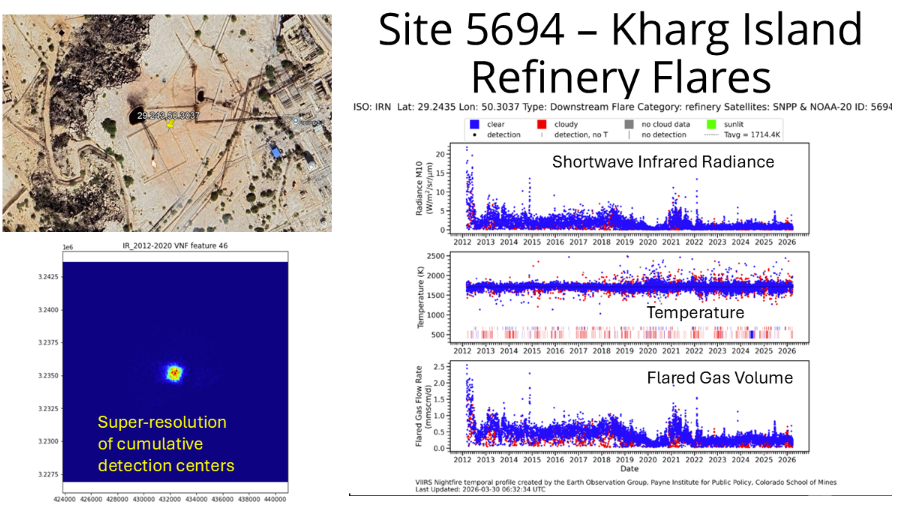
The flaring increase is not occurring in a vacuum. Multiple independent sources in April 2026 highlighted Iran’s storage crunch:
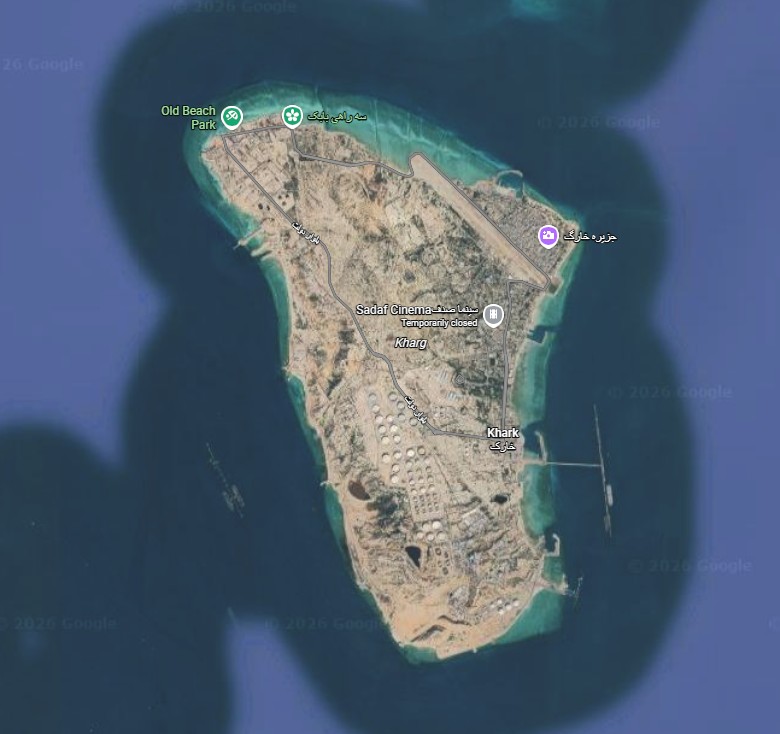
- Kharg Island storage is nearing capacity, forcing operators to either flare, reduce flows gradually, or risk permanent well damage.
- Estimates of surplus production overwhelm available tanks within days to weeks under the export blackout.
- Reactivation of older tankers as emergency floating storage, underscoring the desperation to keep oil moving (or at least not shutting in upstream).
Source: The Payne Institute for Public Policy at the Colorado School of Mines
This pattern strongly suggests that Iran’s storage infrastructure is at or near full capacity due to the effective halt in exports. Flaring serves as a pressure-relief valve to sustain field output without immediate reservoir harm.
Iran has historically been one of the world’s top gas flarers (second only to Russia in many recent years), with volumes around 17-20 billion cubic meters (bcm) annually in the mid-2020s, often rising in tandem with oil production. Pre-conflict data from the World Bank and EDF already showed Iran increasing flaring by about 12% in 2024 alongside higher output, due in part to limited associated-gas capture infrastructure. The 2026 satellite-detected step-up adds to this baseline amid wartime constraints.
Appendix: Sources and Links
- Payne Institute for Public Policy: “Recent War-Time Changes in Upstream Gas Flaring Across the Middle East Observed by VIIRS Nightfire” (March 24, 2026) – https://payneinstitute.mines.edu/recent-war-time-changes-in-upstream-gas-flaring-across-the-middle-east-observed-by-viirs-nightfire/
- Payne Institute Kharg Island Refinery analysis (April 1, 2026) – https://payneinstitute.mines.edu/kharg-island-refinery-viirs-nightfire-temporal-profiles/
- Bloomberg: “Middle East War Spurs Emissions From Oil and Gas Sites, Satellites Show” (March 23, 2026) – https://www.bloomberg.com/news/articles/2026-03-23/iran-war-missile-attack-on-ras-laffan-spurs-increased-flaring-satellites-show
- India Today / Crypto Briefing / WSJ reports on Iran storage limits and low-pressure well risks (April 2026) – e.g., https://www.indiatoday.in/science/story/iran-oil-tanks-on-cusp-of-being-full-why-tehran-cant-just-turn-it-off-2899869-2026-04-22 and related coverage.
- World Bank Global Gas Flaring Data (historical context) – https://www.worldbank.org/en/programs/gasflaringreduction/global-flaring-data
- Recent X posts and videos of Khuzestan flaring (April 27, 2026) – e.g.,
@IranIntl_En
report.
All data and analysis drawn from publicly available satellite observations, industry reports, and contemporaneous news as of April 27, 2026. Flaring volumes are estimates based on VIIRS radiative heat proxies; absolute bcm figures for Q1-Q2 2026 are not yet finalized in public datasets.