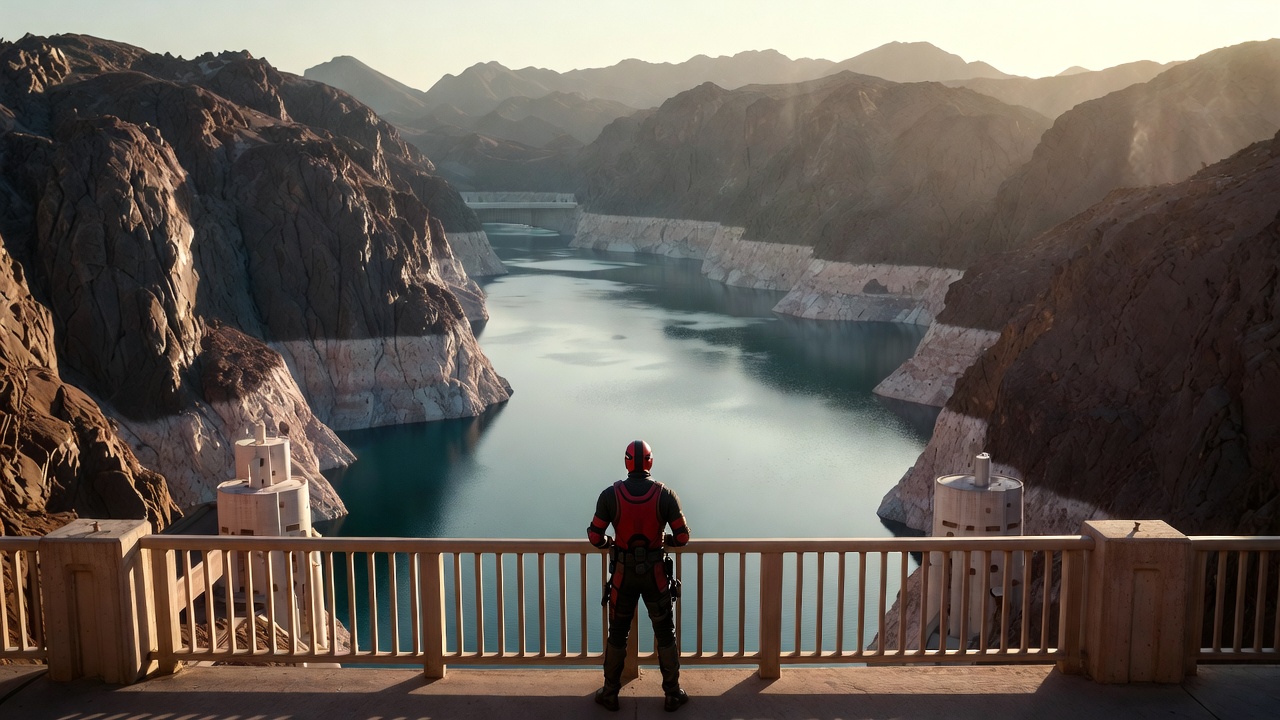
A viral video circulating on X (formerly Twitter) from user @lily95075891 highlights the alarming state of Hoover Dam and the Colorado River system, warning of a potential “dead pool” scenario that could endanger water and power for millions of Americans while crippling agriculture. The post, shared amid growing concerns over the Southwest’s megadrought—the worst in at least 1,200 years—underscores a real and escalating crisis for hydroelectric generation in the US West.
While the video uses dramatic imagery of receding shorelines, dry lakebeds, power infrastructure, and agricultural statistics (noting the region supplies roughly one-third of US vegetables and two-thirds of its fruits and nuts), the underlying data from federal agencies confirms the severity. The Colorado River Basin, which feeds the nation’s two largest reservoirs—Lake Powell (behind Glen Canyon Dam) and Lake Mead (behind Hoover Dam)—is at the epicenter. These dams are critical for hydroelectric power, but plunging water levels are threatening output and raising the specter of operational failure.
Current Water Levels and Immediate Risks (as of Late April 2026)Lake Powell (Glen Canyon Dam): As of April 26–28, 2026, the reservoir sits at approximately 3,526–3,527 feet elevation, holding about 5.62–5.64 million acre-feet (maf) of water—roughly 24% of capacity. This is 172 feet below full pool.
Lake Mead (Hoover Dam): Currently around 1,057 feet elevation, or 31% of capacity.
Key thresholds:
Minimum power pool (Glen Canyon Dam): 3,490 feet. Below this, the eight turbines cannot operate safely due to risks like cavitation (air bubbles damaging equipment). Hydropower generation stops.
Dead pool (Glen Canyon): ~3,370 feet. Water can no longer flow downstream through the dam except during rare high-flow events exceeding evaporation losses. The Colorado River effectively stops flowing below the dam.
Hoover Dam equivalents: Similar risks arise below ~1,025–1,050 feet for full operations, with dead pool at 895 feet.
Without intervention, the Bureau of Reclamation’s April 2026 24-Month Study (Most Probable scenario) projected Lake Powell dropping below the 3,490-foot minimum power pool by August–September 2026, with a low around 3,456 feet by March 2027. Lake Mead would also decline further.
Hydroelectric Generation Impact: How Bad Is It?
The Colorado River’s two major dams provide significant carbon-free power, but drought has already curtailed output:
Glen Canyon Dam (Lake Powell): Nominal capacity ~1,300 MW, historically supplying electricity to hundreds of thousands of homes across the region (estimates vary; some sources cite impacts on up to 5.8 million customers when combined with broader system effects). Generation has declined sharply with water levels; a full shutdown looms if the minimum power pool is breached.
Hoover Dam (Lake Mead): Nominal capacity ~2,080 MW, powering millions in Arizona, California, and Nevada (including Las Vegas and parts of Los Angeles). Drought has already reduced output; new plans could cut it by up to 40% as early as fall 2026 due to reduced inflows from Powell.
Broader Western hydropower (Northwest, Rockies, California) is faring better overall. The U.S. Energy Information Administration (EIA) forecasts total U.S. hydropower generation rising 5% in 2026 to 259 billion kWh (still ~1.8% below the 10-year average), with Northwest/Rockies output up 17% despite snow drought conditions in some areas. California is projected down 6% but above its 10-year average. However, the Colorado River system represents a critical vulnerability in the Southwest, where hydro supports grid stability and low-cost power.
Broader effects: The crisis threatens power reliability for over 40 million people reliant on the Colorado River for water and the downstream ripple effects on regional grids if these dams go offline or severely curtail output. Agriculture, municipal supplies, and recreation are also at risk.
Timeline to “Dead Pool” and Interventions
Federal officials are acting aggressively to avert catastrophe under the Drought Response Operations Agreement:
Supplemental releases of 660,000–1 million acre-feet from Flaming Gorge Reservoir (upstream on the Green River) through April 2027.
Reduced annual releases from Lake Powell to Lake Mead by ~1.48 million acre-feet.
These measures are projected to raise Lake Powell by ~54 feet, keeping it above 3,500 feet (and minimum power pool) through at least April 2027.
Without these steps, the minimum power pool at Glen Canyon will be available as soon as this fall (2026); there is a dead pool risk within 1–2 years if the megadrought persists. Even with interventions, Lake Mead will drop faster, accelerating Hoover Dam’s power reductions.
Longer-term outlook remains grim. The megadrought, exacerbated by climate change, overuse, and overallocation under the 1922 Colorado River Compact, shows no quick end. Snowpack and inflows for Water Year 2026 are among the lowest on record (e.g., Powell unregulated inflow forecast as low as 35% of normal).
What This Means for Energy
This is not just a water crisis—it is an energy security issue. Hydropower provides flexible, renewable baseload and peaking power. Losing Glen Canyon and Hoover output would increase reliance on natural gas or other sources, raising costs and emissions while straining Western grids already facing growing demand (e.g., data centers, electrification).
The viral X post and video capture public anxiety, but the data show a managed (for now) emergency. Sustained conservation, better interstate agreements, and long-term solutions (e.g., demand reduction, infrastructure upgrades) are essential to prevent the worst-case “dead pool” scenario from becoming reality. Keep watching to see if progress is made, and whether this is a man-made crisis is a really good question.
All data drawn from official and recent reporting as of April 2026:
- U.S. Bureau of Reclamation Lower Colorado Weekly Hydrologic Update (April 27, 2026): https://www.usbr.gov/lc/region/g4000/weekly.pdf
- USBR Most Probable 24-Month Study (April 2026): https://www.usbr.gov/lc/region/g4000/24mo.pdf
- Lake Powell Water Database (real-time levels): https://lakepowell.water-data.com/
- USBR News Release on Drought Response (April 17, 2026): https://www.usbr.gov/newsroom/news-release/5326
- EIA Short-Term Energy Outlook (April 2026 hydropower forecasts): https://www.eia.gov/todayinenergy/detail.php?id=67444
- Arizona Central / Reclamation projections on hydropower risks: https://www.azcentral.com/story/news/local/2026/04/17/colorado-river-outlook-bleak-new-risks-for-hydropower/89591809007/
- Additional context from Circle of Blue, KUER, and The Independent on dam operations and impacts.
- Original X post/video: https://x.com/lily95075891/status/2049714162914492684 (TikTok-sourced content highlighting Hoover Dam risks).
For the latest updates, monitor the Bureau of Reclamation’s 24-Month Studies and Colorado River Basin dashboards. The situation evolves monthly with snowpack and inflows.