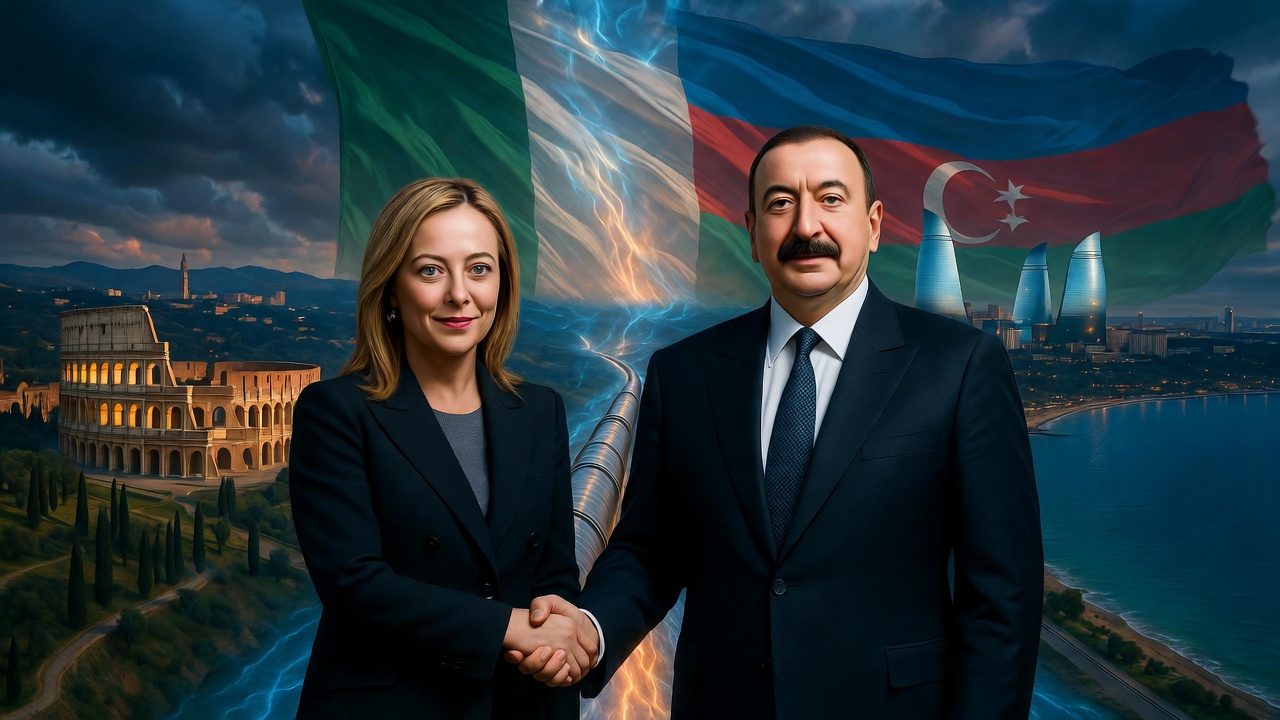
Italian Prime Minister Giorgia Meloni met Azerbaijani President Ilham Aliyev in Baku on May 4, 2026, and vowed to deepen energy cooperation with Azerbaijan as part of Italy’s broader strategy to secure supplies amid ongoing global disruptions.
Meloni described Azerbaijani gas and oil — which currently account for 16% of Italy’s gas imports and 17% of its oil imports — as “crucial” for the country’s energy security since Russia’s full-scale invasion of Ukraine in 2022. She pledged to “deepen this partnership” to address the latest supply squeeze triggered by the Iran war.
The visit underscores Italy’s aggressive energy diplomacy to diversify away from volatile sources while maintaining reliable imports as it transitions toward renewables.
Italy’s Energy Landscape: High Import Dependence and a Gas-Heavy Mix
Italy remains one of the European Union’s most energy-import-dependent nations, with roughly 75–80% of its total energy needs met through imports (down slightly from pre-COVID levels but still well above the EU average). Domestic production covers only a modest share of demand.
Primary energy mix (approximate latest figures): Oil and petroleum products: ~38%
Natural gas: ~35%
Renewables: ~20%
Coal and other solid fuels: ~3.4%
Imported electricity and non-renewable waste: ~4%
In the electricity sector, 2025 data from Italian grid operator Terna shows: Total electricity consumption: 311 TWh (stable year-over-year).
Renewables covered 41% of consumption (slightly down from 42% in 2024), led by record solar output (14.5% share, +25% growth to 44 TWh) and hydro (~13.5%).
Wind contributed ~7%, and geothermal is stable.
Natural gas-fired generation remained the single largest source at roughly 38–44% of the mix, acting as a critical flexible backup for intermittent renewables.
Domestic production met 85% of demand; the rest came from net imports (15%). Coal continued its sharp decline (-13.5%).
Italy imported approximately 59–60 bcm of natural gas in 2025, with Azerbaijan supplying 9.5 bcm via the Trans Adriatic Pipeline (TAP) — equating to the stated 16% share. Algeria remains the top supplier, but Azerbaijan has become a strategic pillar of the Southern Gas Corridor.
Energy Prices: Among Europe’s Highest
Italy’s heavy reliance on imported gas for power generation keeps electricity and gas prices elevated and volatile. In the first half of 2025, Household electricity prices averaged €0.3291 per kWh (fourth-highest in the EU, behind Germany, Belgium, and Denmark).
Non-household/industrial prices were also among the highest on the continent.
Gas prices for households ranked high as well. The government has rolled out support measures (such as the February 2025 “Decree on Bills”) to ease the burden on vulnerable families, but prices remain sensitive to international events like the Iran conflict.
How a Stronger Relationship with Azerbaijan Helps Italy
A deepened partnership with Azerbaijan offers multiple strategic advantages:
Diversification and Supply Security — Post-2022, Italy slashed Russian pipeline gas to near zero, pivoting to Algeria, Azerbaijan, and LNG. Azerbaijani gas via the TAP pipeline (which landed its first volumes in Italy in 2020 and has already delivered over 42–47 bcm cumulatively) provides a stable, non-LNG route that is less exposed to spot-market volatility or shipping disruptions.
Mitigating Current Crises — The Iran war has created new supply squeezes in global energy markets. Pipeline gas from the Caspian is a reliable alternative to LNG or Middle East routes, helping stabilize flows amid geopolitical turbulence.
Economic and Infrastructure Benefits — Italy is Azerbaijan’s largest European customer for both oil and gas and its top overall trading partner (~$11.9 billion in 2025 trade). Italian companies are also active in Azerbaijani infrastructure projects. Expanding TAP capacity (already increased in recent years) could unlock additional volumes, supporting Italy’s goal of becoming a European energy hub.
Bridge to the Energy Transition — While Italy targets 65% renewables in electricity by 2030 and net-zero by 2050, natural gas serves as a flexible bridge fuel. Reliable, lower-carbon pipeline gas from Azerbaijan helps balance the grid as solar and wind grow, reduces coal use, and supports industrial competitiveness without immediate spikes in LNG imports.
Meloni’s pledge signals that energy ties are now a cornerstone of broader Italy-Azerbaijan relations, extending beyond commodities to long-term strategic cooperation.
- Bloomberg original article (May 4, 2026): https://www.bloomberg.com/news/articles/2026-05-04/italy-s-meloni-vows-closer-ties-with-azerbaijan-in-energy-push?srnd=phx-industries
- Terna (Italian TSO) – Electricity Consumption 2025: https://www.terna.it/en/media/press-releases/detail/electricity-consumption-2025
- Enerdata / Terna data on renewables: https://www.enerdata.net/publications/daily-energy-news/italy-records-41-share-renewables-energy-consumption-during-2025.html
- Eurostat Electricity Price Statistics (H1 2025): https://ec.europa.eu/eurostat/statistics-explained/index.php?title=Electricity_price_statistics
- IEA Italy Country Profile: https://www.iea.org/countries/italy
- Trade.gov Italy Natural Gas & Renewables Guide: https://www.trade.gov/country-commercial-guides/italy-natural-gas-renewable-energy
- Additional Azerbaijan gas flow data: Decode39, Azernews, Trend.az (2025–2026 reports)
All data reflects the most recent publicly available 2025 figures as of May 2026. Energy News Beat will continue monitoring developments from Baku and Rome.