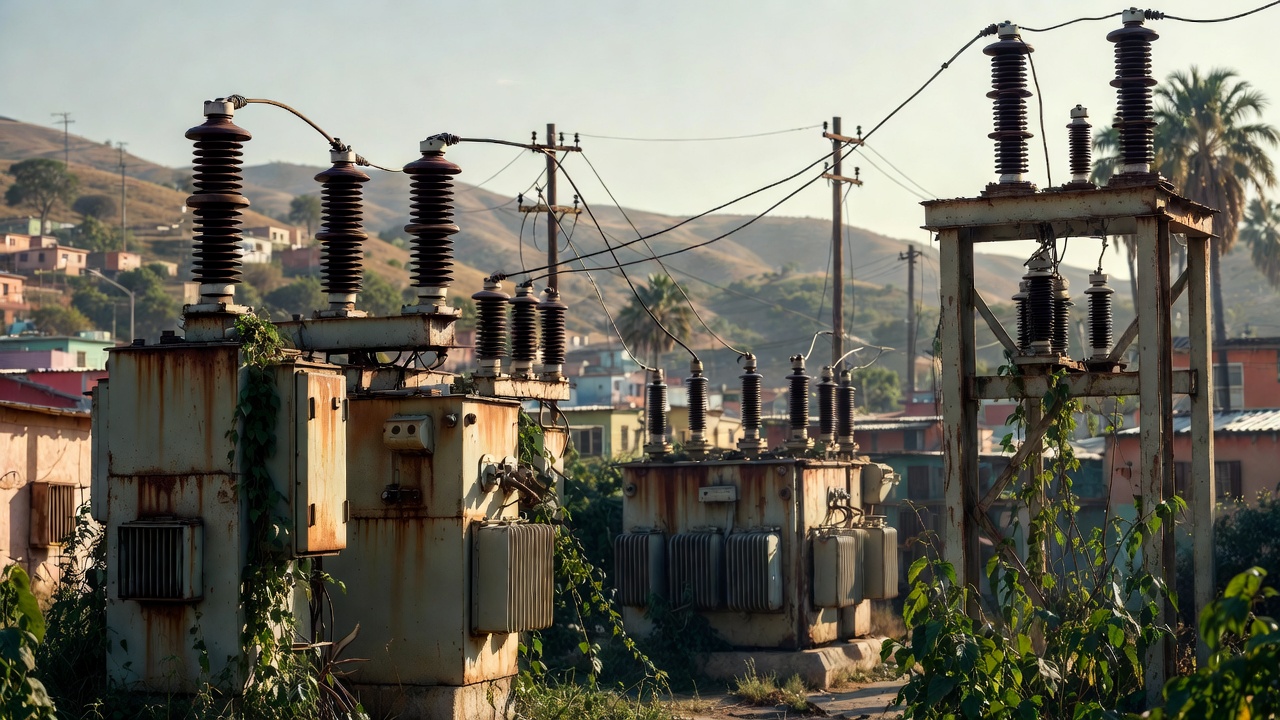
Venezuela’s long-suffering electricity system is once again flashing red warning lights. According to Bloomberg, the country has announced emergency measures after power consumption reached a nine-year high, raising the specter of widespread blackouts that could derail the nascent economic recovery following the dramatic political changes earlier this year.
Oil refineries operate at just 15-20% capacity. Petrochemical plants are at 43% or lower. Mining and manufacturing projects that could drive GDP growth are stalled by the saturated distribution network and chronic supply-demand gap of 500–3,000 MW. Without reliable electricity, the “incalculable boom” anticipated by the Venezuelan Chamber of Construction risks remaining on paper.
Major international players approached by Caracas—including Siemens Energy, GE Vernova, and Mitsubishi Power—have left recent meetings in Caracas without firm commitments. The primary roadblock: payment risk. Many contractors still carry scars from earlier unpaid bills and lengthy legal battles. Without credible guarantees, even generous contracts look too risky.
- Payment and Financing Guarantees
Establish escrow mechanisms backed by future oil export revenues or U.S.-controlled accounts (as already used in some oil deals). Multilateral support from the World Bank, Inter-American Development Bank (IDB), and CAF—Development Bank of Latin America—could provide concessional financing and political-risk insurance. U.S. agencies such as the Export-Import Bank (EXIM) and Development Finance Corporation (DFC) could play a catalytic role once sanctions frameworks are fully aligned. - Public-Private Partnerships (PPPs) and BOT/BOOT Contracts
Extend the production-sharing and build-operate-transfer (BOT) models already approved for the oil sector to power generation, transmission, and distribution. Independent power producers (IPPs) could build, own, and operate new thermal, hydro, or renewable plants with clear offtake agreements tied to dollar-denominated tariffs. - Regulatory reforms should allow competitive bidding, third-party access to the grid, and transparent pricing that reflects actual costs.
- Legal and Regulatory Overhaul
Guarantee international arbitration (ICSID or similar), profit repatriation, and protection against future expropriation. Anti-corruption safeguards and an independent regulator would boost confidence. The recent hydrocarbons law changes provide a blueprint; the power sector needs an equivalent “Electricity Opening” law. - Phased, Prioritized Investments Tied to Oil Recovery
Prioritize quick-win projects: rehabilitating key thermal plants, completing stalled hydro facilities (e.g., Tocoma), and deploying modular gas-fired generation using associated gas from oil fields. U.S. companies could supply turbines, smart-grid technology, and diluent while earning early revenue from increased oil output. Self-generation allowances for industrial users should be expanded as a bridge solution. - Security and Workforce Measures
Provide on-the-ground security assurances for personnel and assets. Training and retention programs for Venezuelan engineers (many of whom emigrated) would reduce reliance on foreign expertise over time.
U.S. officials have already signaled willingness. Secretary Wright’s February 2026 visit emphasized that American private-sector involvement is “essential to modernize the electric grid.” President Trump’s energy fact sheet explicitly listed grid improvement as a priority alongside oil rehabilitation.
Venezuela sits on the world’s largest proven oil reserves and possesses vast gas and mineral wealth. The political opening of 2026 has created a rare window for recovery. But as Bloomberg rightly warns, a faulty power grid could slam that window shut.
Appendix: All Sources and Links
- Bloomberg (May 8, 2026): “Venezuela’s Faulty Power Grid Risks Derailing Economic Comeback” – https://www.bloomberg.com/news/articles/2026-05-08/venezuela-s-faulty-power-grid-risks-derailing-economic-comeback?srnd=phx-industries-energy [web:0]
- Reuters / MSN (May 2026): “Venezuela’s power fix stalls as investors balk at payment risks” – https://www.msn.com/en-us/news/world/venezuela-s-power-fix-stalls-as-investors-balk-at-payment-risks/ar-AA22l44M [web:1]
- BNamericas (Mar 26, 2026): “No power, no oil: Venezuela crisis threatens investor return” – https://www.bnamericas.com/en/analysis/no-power-no-oil-venezuela-crisis-threatens-investor-return [web:14] / detailed summary [web:37]
- Reuters videos on Maracaibo blackouts (May 2026) – https://www.reuters.com/video/watch/idRW821106052026RP1/ [web:39]
- U.S. Department of Energy Fact Sheet (Jan 2026) – https://www.energy.gov/articles/fact-sheet-president-trump-restoring-prosperity-safety-and-security-united-states-and [web:55]
- Additional context from Reuters, Seeking Alpha, Columbia Energy Policy, and industry analyses (Jan–May 2026) as referenced in search results.
Energy News Beat – Independent coverage of global energy markets and policy.