The Washington Examiner was right on target in its May 16, 2026, editorial: the “data center doomers” — the coalition of socialists, Democrats, and foreign-funded activists pushing moratoriums and fear-mongering — must be defeated.
Data centers are the backbone of the AI revolution, national security, economic growth, and America’s edge over China. Blocking their hands gives Beijing a decisive advantage in warfare, cyber defense, drug discovery, and manufacturing.
But defeating the doomers cannot come at the expense of America’s family farms or our water resources. Rural communities, especially in the South and Midwest, are already seeing prime agricultural land rezoned for server farms and local water supplies strained by massive cooling demands. The solution isn’t to stop building — it’s to build smarter: co-locate data centers next to power sources, embrace hybrid geothermal-natural gas systems in abundant-gas regions, deploy water-saving cooling technologies, and protect farmland through smarter zoning. Growth and stewardship are not mutually exclusive.
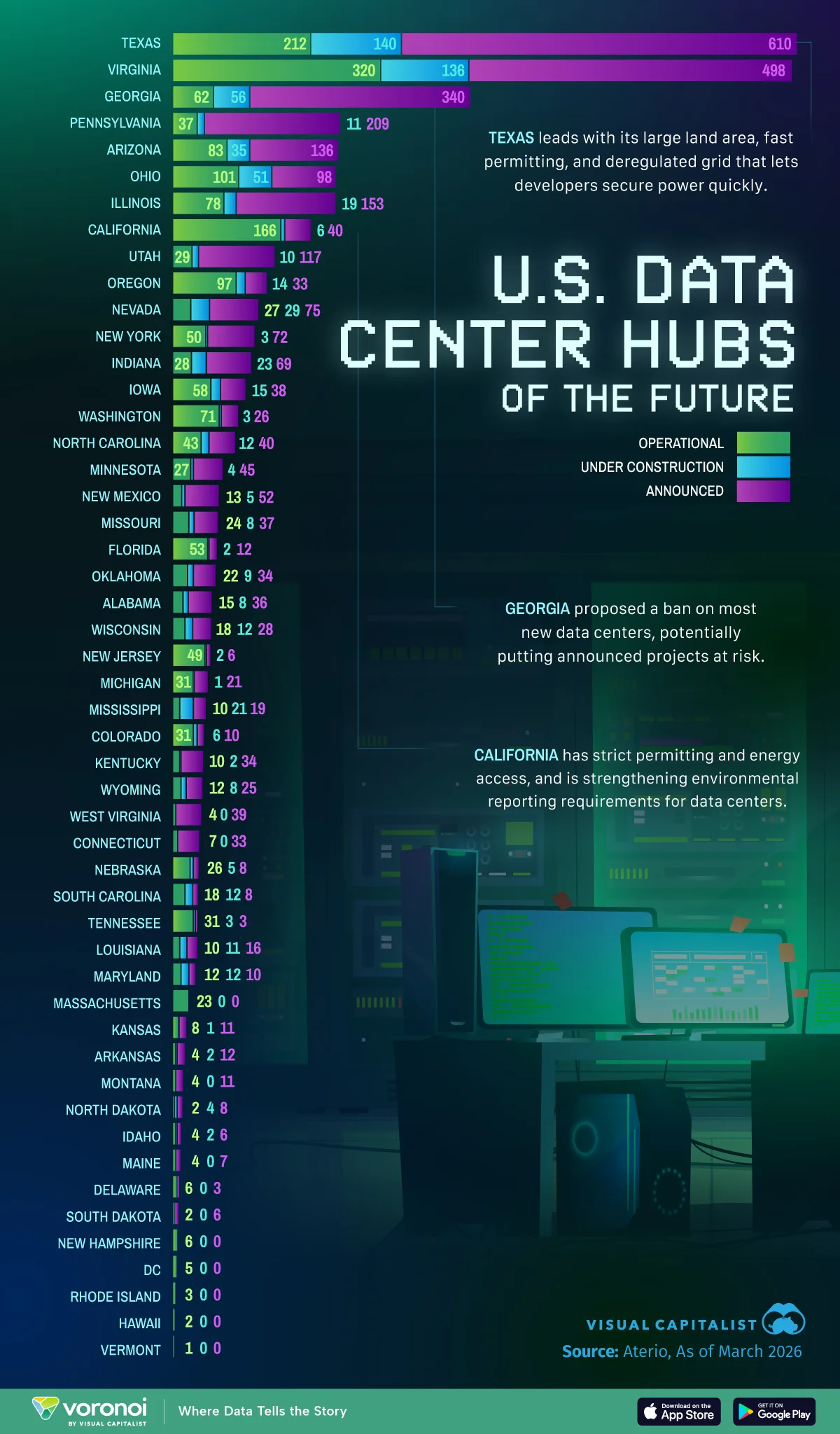
The Data Center Boom: Numbers by State
America is in the midst of an unprecedented data center expansion driven by AI. As of early 2026:
Virginia leads with roughly 320–665 operational facilities and hundreds more under construction or planned (total sites approaching 950+). It remains “Data Center Alley.”
Texas is close behind or poised to surpass Virginia, with 212–413 operational and 400+ planned, for nearly 1,000 total sites.
Georgia (62–162 operational, 285+ planned), Pennsylvania (37–98 operational, 184+ planned), Arizona, Ohio, Illinois, and others follow, with massive capacity additions.
Nationally, the U.S. has over 3,000–5,000 operational data centers, with 1,500+ new ones in development, adding ~150 GW or more of power capacity and 295,000+ MW projected. Many are landing in rural areas — exactly where family farms operate.
Real Impacts on Communities, Farms, and Water
Opponents aren’t entirely wrong about the scale. A mid-sized data center can consume 300,000–500,000 gallons of water per day for cooling; large hyperscale facilities can hit 5 million gallons daily — equivalent to a small town’s usage. AI-driven demand could reach 32 billion gallons annually by 2028 nationally, with two-thirds of recent projects in water-stressed regions like Arizona, Texas, and the Colorado River Basin.
In Georgia, Meta’s facility uses 500,000 gallons daily (10% of Newton County’s total). Texas projections show data centers using 49 billion gallons in 2025 and up to 399 billion by 2030. Northern Virginia’s centers consumed nearly 2 billion gallons in 2023.
Land use hits farms hardest. Large projects can cover hundreds of acres of former cropland with impermeable surfaces, disrupting agriculture, stormwater, and rural character. Proposals in Ohio, Indiana, and Wisconsin have sparked farmer backlash, with some rezoning applications withdrawn after opposition.
Electricity demand is real too, though the Examiner correctly noted that prices in heavy data-center states aren’t dramatically higher — the bigger drivers are policy-driven fossil retirements and permitting delays, not the centers themselves. Still, local grids feel the strain, and rural ratepayers worry about costs.
These impacts are why communities are pushing back. But moratoriums like the Sanders-AOC AI Data Center Moratorium Act would kneecap American innovation. We need a better path.
A Smarter Way: Co-Locate Next to Power Sources, Not Prime Farmland
The winning strategy is simple: bring the data center to the power instead of forcing power to the data center. Grid interconnection queues now stretch 7–10 years. Co-locating at or adjacent to existing or new generation bypasses that, cuts transmission losses, boosts reliability, and frees up farmland.
Gas-powered examples: In Texas’ Permian Basin, developers are building massive on-site gas plants (up to 7.65 GW) dedicated to data centers. Chevron, Fermi America, and Pacifico Energy are leading the charge.
Nuclear restarts and adjacency: Microsoft’s deal to restart Three Mile Island Unit 1, Talen Energy’s campus next to Susquehanna, and Amazon’s use of former plant sites show the model works for carbon-free baseload.
Brownfield redevelopment: Retired power plant sites already have grid ties, water access, and industrial zoning — perfect for data centers without touching active farmland. Google did this at Alabama’s Widows Creek site.
This approach keeps development off prime agricultural land and on industrial or marginal sites.
Geothermal + Abundant Natural Gas: The Perfect Hybrid
Where natural gas is plentiful — think Pennsylvania’s Marcellus Shale, Texas, or New Mexico — geothermal offers game-changing potential for both power and cooling.
Pennsylvania’s subsurface geology is ideal for geothermal cooling systems paired with on-site natural gas generation. Waste heat from combined-cycle gas turbines can integrate with geothermal loops, slashing overall energy and water use while providing 24/7 firm power.
Meta just signed for 150 MW of geothermal in New Mexico. Enhanced Geothermal Systems (EGS) can be sited near load, delivering clean, dispatchable power cheaper than clustered approaches in some regions. Rhodium Group analysis shows geothermal could meet 55–64% of hyperscale growth with behind-the-meter setups — or all of it if siting follows resource availability.
These hybrids reduce water demand (geothermal cooling is highly efficient), stabilize costs, and keep development away from farms.
Practical Suggestions to Protect Family Farms and Water
Prioritize non-farmland siting: Strengthen agricultural zoning. Require performance standards for buffering, noise, traffic, and long-term reclamation. Steer projects to brownfields, industrial parks, or power-adjacent land.
Water-smart tech: Mandate or incentivize closed-loop systems (70%+ water reduction), immersion cooling (zero water), dry/air cooling, and reclaimed/non-potable water. Companies like Microsoft and Amazon are already moving toward water-positive operations by 2030.
Community and transparency rules: Require full disclosure of water and power usage. Engage locals early. Tie tax incentives to farmland preservation and water recycling targets.
Integrated energy planning: Co-locate with renewables, nuclear, or gas where appropriate. Use geothermal where geology allows. Support policies that pair new load with new generation instead of straining existing grids.
Federal and state leadership: Defeat blanket moratoriums but enact smart standards that protect rural America. The DOE and states should fast-track permits for co-located, low-impact projects.
Conclusion: Defeat the Doomers — Build Responsibly
The data center doomers exploit legitimate local concerns to push decline. We must reject their moratoriums and NIMBYism. But conservatives, energy advocates, and rural leaders must also champion solutions that safeguard family farms and water. Co-location, geothermal hybrids in gas-rich states, advanced cooling, and smart zoning let us have both: AI-powered prosperity and preserved agricultural heartlands.
Stu Turley just recently interviewed Jon Brewton, CEO of Data2, and they are working on game-changing ways to build data centers. You can see the full podcast and article here:
America became the world’s superpower by building steam power, railroads, electricity, highways, and yes, data centers. Let’s build them right this time.
Appendix: Sources and Links
- Washington Examiner editorial (May 16, 2026): https://www.washingtonexaminer.com/opinion/4569459/the-data-center-doomers-must-be-defeated/
washingtonexaminer.com
- American Edge Project / Axios data center map (Dec 2025): https://www.axios.com/2025/12/18/data-center-growth-map-states
- Reuters charting data center roadmap (Jan 2026): https://www.reuters.com/business/energy/charting-data-center-development-roadmap-key-us-states-2026-01-22/
- Visual Capitalist ranked states (Apr 2026): https://www.visualcapitalist.com/ranked-us-states-data-center-hotspots/
- Cleanview US Data Center Map (May 2026): https://cleanview.co/public/data-centers/us
- Pew Research on rural data centers (Apr 2026): https://www.pewresearch.org/short-reads/2026/04/13/most-new-data-centers-in-the-us-are-coming-to-rural-areas/
- World Resources Institute: 7 Ways Data Centers Affect Communities (Feb 2026): https://www.wri.org/insights/us-data-center-growth-impacts
- BBC on Georgia water impacts: https://www.bbc.com/news/articles/cy8gy7lv448o
- Lincoln Institute on land/water impacts: https://www.lincolninst.edu/publications/land-lines-magazine/articles/land-water-impacts-data-centers/
- Texas Tribune on Permian gas plants for data centers (Feb 2026): https://www.texastribune.org/2026/02/02/texas-permian-basin-power-plant-project-data-centers/
- LandGate on power plant proximity: https://www.landgate.com/news/why-power-plant-proximity-is-the-new-competitive-advantage-for-data-centers
- Penn State CELP on geothermal cooling + natural gas in PA: https://celp.psu.edu/wp-content/uploads/2025/02/Pennsylvania-Report_Supplement.pdf
- DOE Geothermal and Data Centers: https://www.energy.gov/hgeo/geothermal/geothermal-and-data-centers
- Rhodium Group on geothermal potential (Mar 2025): https://rhg.com/wp-content/uploads/2025/03/The-Potential-for-Geothermal-Energy-to-Meet-Growing-Data-Center-Electricity-Demand.pdf
- Additional reports from Enverus, Data Center Knowledge, Farm Progress, and others as cited.
Energy News Beat will continue tracking this balance — because America needs both AI leadership and thriving family farms.