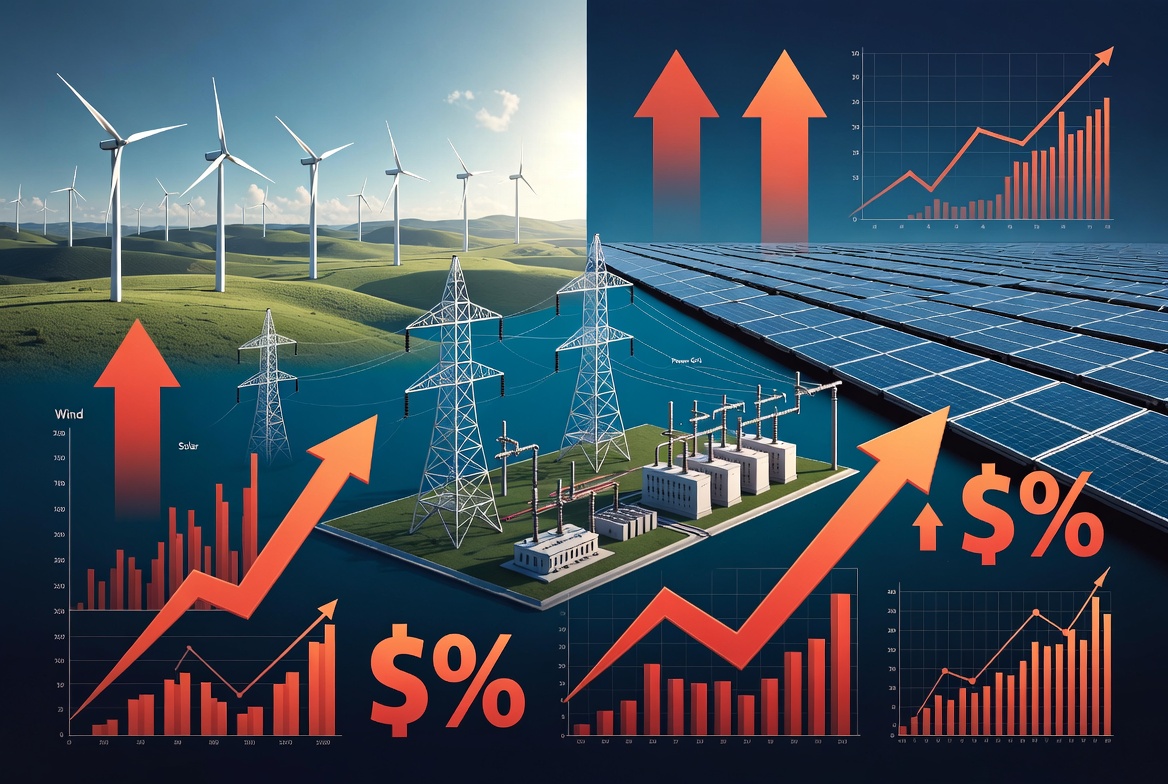
Lars Schernikau, Author and prior guest on the Energy News Beat nails it.
Europe’s electricity grid may be the most complex machine humanity has ever built. Yet energy debates too often reduce the conversation to installed capacity, solar additions, or wind megawatts. This narrow focus misses the real engineering and economic reality.
Europe’s electricity grid may be the most complex machine humanity has ever built. Yet energy debates too often reduce the conversation to installed capacity, solar additions, or wind megawatts. This narrow focus misses the real engineering and economic reality.
That observation comes from energy economist Lars Schernikau in a recent LinkedIn post. He points out that keeping the lights on for over 400 million people across more than 20 countries requires maintaining five critical physical conditions every millisecond: voltage, current, frequency (50 Hz in Europe), phase synchronization, and short-circuit strength. Conventional synchronous generators (coal, gas, nuclear, hydro) naturally provide inertia, voltage support, frequency control, and fault resilience. Wind and solar — what Schernikau calls “digital power” connected through inverters — do not.
Replacing conventional generation with wind and solar is not a simple one-for-one swap. It requires additional infrastructure, greater complexity, and real costs to replicate the stabilizing services that are being displaced.
This is the core of Schernikau’s framework on Full Cost of Electricity (FCOE) versus the misleading Levelized Cost of Electricity (LCOE). The same principles explain why grids with high shares of wind and solar are becoming more expensive to operate reliably — in both Europe and the United States.
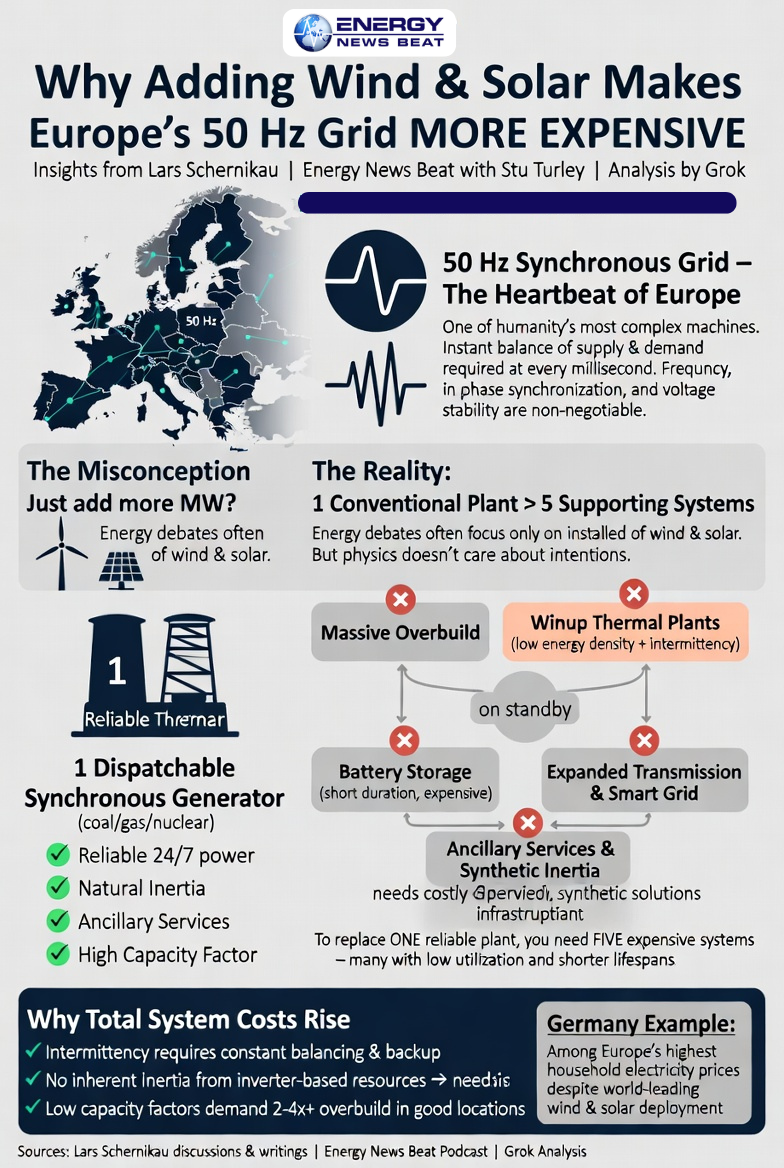
The European 50 Hz Grid RealityEurope operates one of the world’s largest synchronous grids at a precise 50 Hz. As detailed in the infographic “Why Adding Wind & Solar Makes Europe’s 50 Hz Grid MORE EXPENSIVE,” adding large amounts of intermittent generation does not simply displace conventional plants. It multiplies the systems required.
To replace the services of one reliable dispatchable plant, the system typically needs:
Massive overbuild of wind and solar (due to low capacity factors and intermittency)
Backup thermal plants kept on standby
Battery storage (expensive and short-duration)
Vastly expanded transmission and smart grid infrastructure
Additional equipment for synthetic inertia and ancillary services
Germany’s Energiewende provides the clearest real-world example. Despite enormous investment in wind and solar, German households face some of the highest electricity prices in Europe.
The rapid buildout has driven up total system costs through the very mechanisms Schernikau describes.
The U.S. 60 Hz Grids — Same Physics, Different Structure
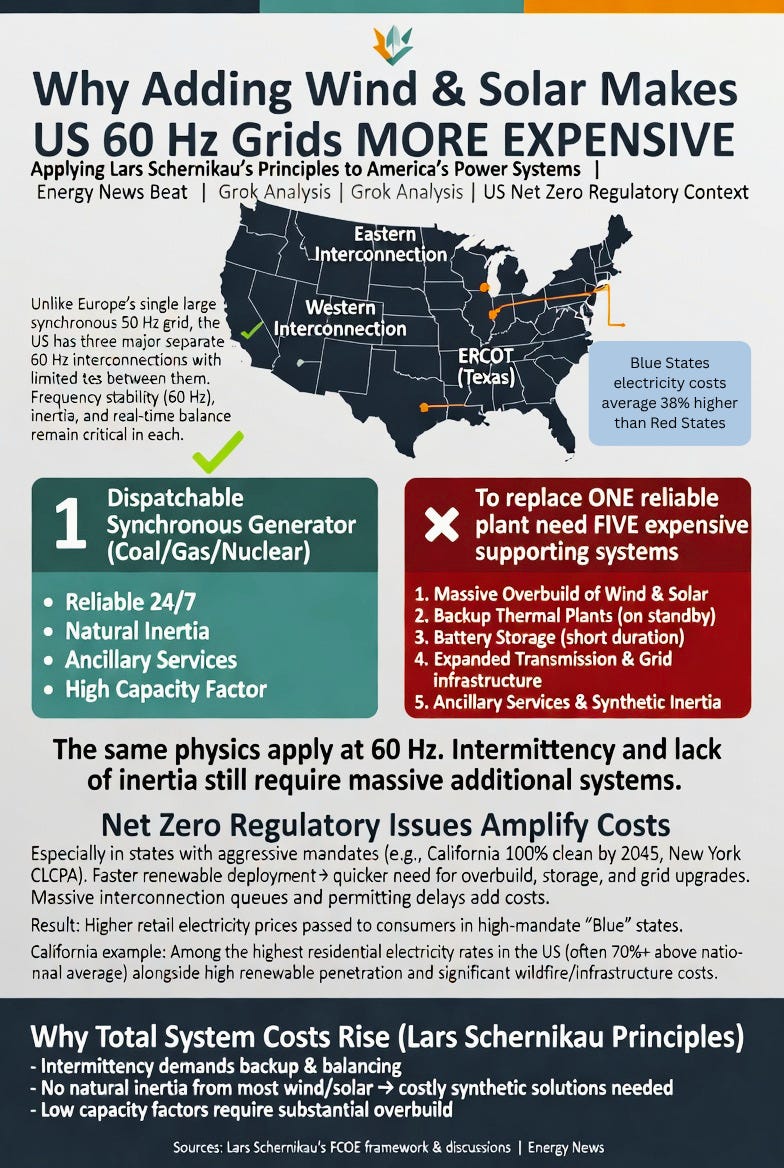
The United States operates at 60 Hz across three major, largely separate interconnections: the Eastern Interconnection, the Western Interconnection, and ERCOT in Texas. Unlike Europe’s tightly synchronized continental grid, these are connected only by limited DC ties.
The physics, however, remain identical. As shown in the companion infographic “Why Adding Wind & Solar Makes US 60 Hz Grids MORE EXPENSIVE,” the same requirement for five supporting systems applies when displacing synchronous generation. Frequency stability, inertia, and real-time balance are non-negotiable in every interconnection.
Why Blue States Are Paying More
Recent data shows a clear pattern: states with the most aggressive Net Zero and renewable energy mandates — predominantly Democrat-led “Blue” states — consistently have higher retail electricity prices than many Republican-led “Red” states.
California and New York routinely rank among the highest in the nation (often 70%+ above the U.S. average in recent data).
States like Texas and Florida generally deliver power at significantly lower average rates.
This is not a coincidence. Aggressive state-level policies — renewable portfolio standards, 100% clean energy targets (California by 2045, New York’s CLCPA), and heavy subsidization of wind and solar — accelerate deployment. This faster pace forces utilities and ratepayers to fund the supporting systems (overbuild, storage, transmission upgrades, and synthetic inertia) more quickly and at a greater scale.In contrast, states with more balanced or market-driven approaches have generally seen slower cost escalation from these integration challenges. While other factors (wildfire mitigation in California, regulatory structure, population density) also play roles, the policy-driven speed of the renewable transition amplifies the very system costs Lars Schernikau has long highlighted.
The Uncomfortable Truth
Wind and solar can be valuable parts of a diverse energy mix. But when policymakers treat them as a near-complete replacement for dispatchable synchronous generation without honestly accounting for the full system requirements, costs rise. The grid does not care about political narratives or good intentions — it cares about physics, inertia, and instantaneous balance.
Schernikau’s message is consistent across both continents: focus on total system cost and reliability, not just nameplate capacity or marginal generation costs. The infographics created for this discussion make that visual: one reliable plant is effectively replaced by five expensive systems, many of which have low utilization rates and shorter economic lives.
The Path Forward
Honest energy policy requires acknowledging these realities. Europe’s experience and diverging U.S. state outcomes both demonstrate that rapid, mandate-driven renewable buildouts increase complexity and expense when the supporting infrastructure and backup systems are not properly planned and costed.
A redefinition of the Levelized Cost of Energy is warranted. We are well past the experiment stage of wind and solar. Make no mistakes, on my personal grid system, I have wind and solar, and it is expensive. But I use them for off-grid backup systems, not as the primary source of electricity in the synchronized grid system in use today.
This discussion is about physics, not emotions. The UN has admitted that it lied about the fear-mongering of climate change and the damage inflicted on us as consumers, which we will be seeing in our energy bills for decades.
Consumers ultimately pay the bill — whether through higher rates in high-mandate states or through the broader economic drag of less reliable and more expensive power.
The conversation needs to move beyond counting turbines and panels to a serious discussion of what it actually takes to keep the grid stable and affordable for everyone.
Working on the next Energy News Beat Stand Up, and my interview with Wasif Lafit, CEO of Sarmaya Partners. Next week, I have Todd Royal, an author and nuclear advocate, stopping by the podcast. He has some great insights.
Also working on other projects with our sponsors on AI and Data Centers.
Thanks again for all of your great support as subscribers, patrons, and readers.
Appendix: Sources and ReferencesPrimary Sources
- Lars Schernikau LinkedIn Post: “Europe’s electricity grid may be the most complex machine humanity has ever built.” (May 2026) — https://www.linkedin.com/posts/larsschernikau_europes-electricity-grid-may-be-the-most-ugcPost-7462565003573903360-9v-D
- Schernikau’s broader work on Full Cost of Electricity (FCOE) and eROI, including discussions on the Energy News Beat podcast with Stu Turley.
- You can buy his book here: https://unpopular-truth.com/
- The Unpopular Truth episode
Infographics Referenced
- “Why Adding Wind & Solar Makes Europe’s 50 Hz Grid MORE EXPENSIVE” (Grok Imagine, May 2026)
- “Why Adding Wind & Solar Makes US 60 Hz Grids MORE EXPENSIVE” (Grok Imagine, May 2026)
U.S. Electricity Price Data
- U.S. Energy Information Administration (EIA) Electric Power Monthly data (2025–2026)
- ElectricChoice.com and ChooseEnergy.com state-by-state residential rate comparisons (May 2026)
- Studies from American Energy Alliance and Institute for Energy Research on blue vs. red state electricity prices and rate increases (2014–2024)
Energy News Beat is committed to clear-eyed analysis of energy realities. The principles discussed here — rooted in grid physics and full system costing — apply regardless of political affiliation.
Shout out to our great sponsors:
A shout-out to Steve Reese and the Reese Energy Consulting group for sponsoring the Podcast https://reeseenergyconsulting.com/.
Data2 if you have any business systems, can you trust A? Well, they have the patent on validation. . https://data2.zoholandingpage.com/energy
And we have WellDatabase rolling in as a new sponsor.