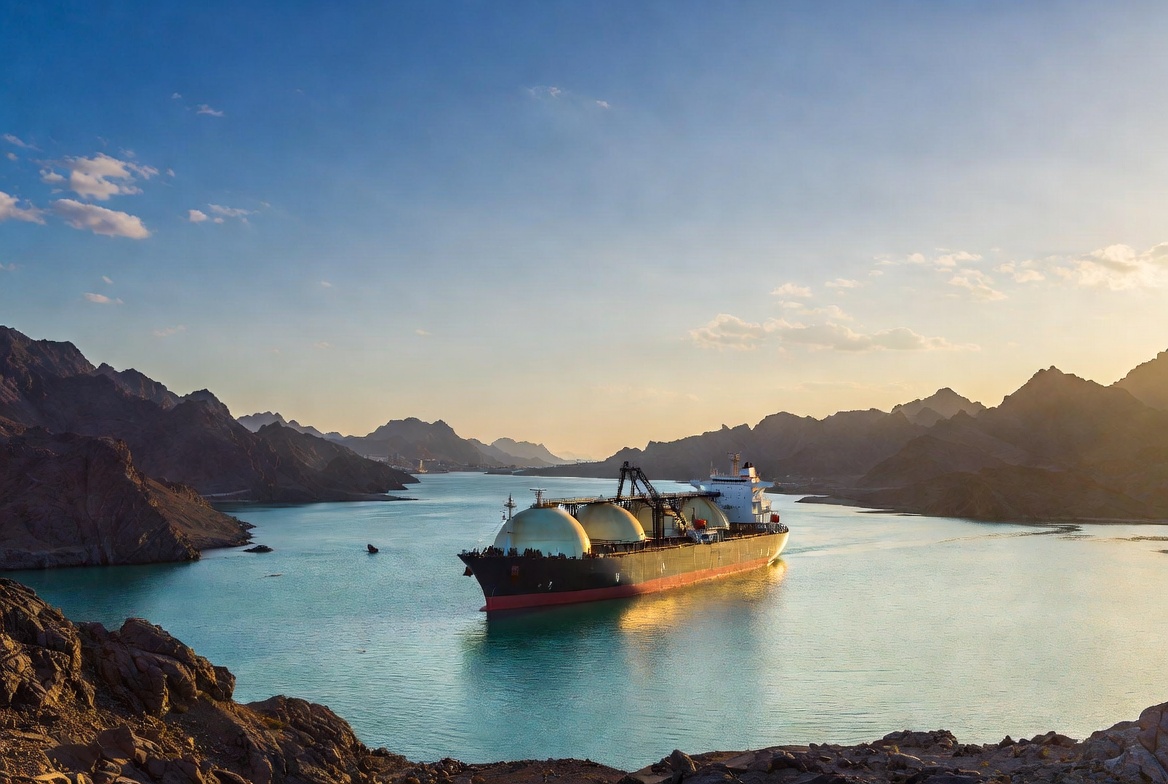
In a notable development signaling cautious thawing in one of the world’s most critical energy chokepoints, the Qatari LNG tanker Al Sahla is transiting the Strait of Hormuz today, heading directly to China’s Tianjin LNG terminal. Expected to arrive around June 14 with a cargo capacity of approximately 211,842 cubic meters, this marks the third Qatari LNG tanker to successfully navigate the strait since the outbreak of the Iran war in late February 2026.
This transit stands out as the first purely commercial cargo to China, unlike the previous two shipments to Pakistan, which were structured under government-to-government (G2G) deals quietly approved by Iran to build confidence in ongoing peace talks.
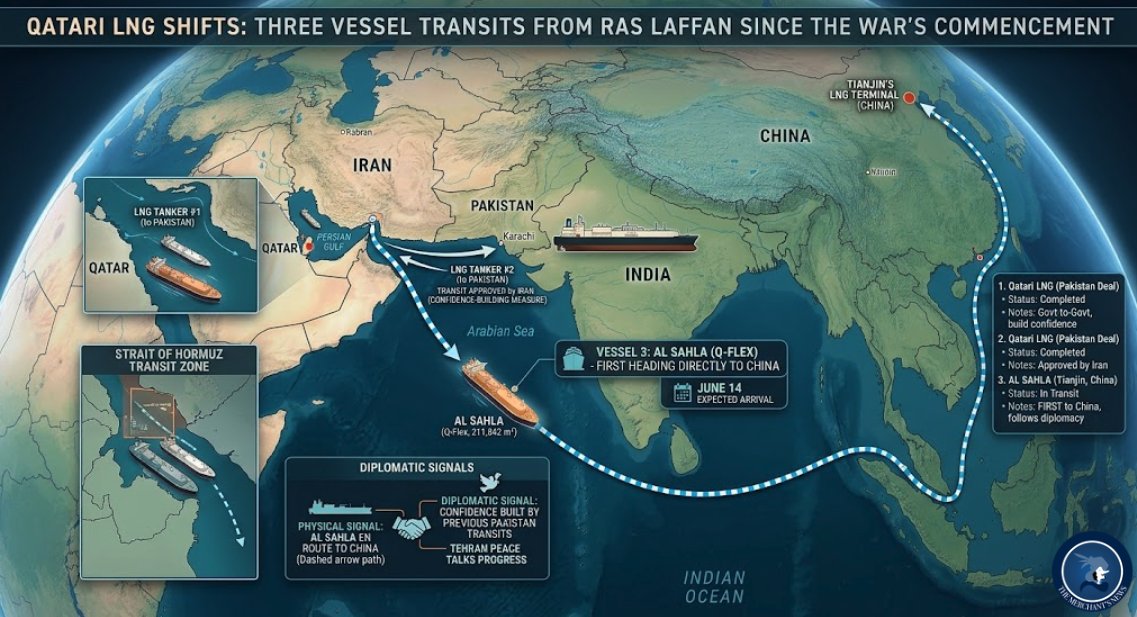
Background: From Near-Total Closure to Selective, Managed Transits
The Strait of Hormuz — through which roughly 20% of global oil and a significant share of LNG trade normally flows — has operated under severe constraints since late February 2026. Following U.S.-Israeli strikes on Iran and subsequent Iranian retaliation (including attacks on Qatari facilities), the Islamic Revolutionary Guard Corps (IRGC) declared effective control, issued warnings, conducted attacks on vessels, and laid mines. Traffic plummeted from a normal average of ~50–60 vessels per day to a trickle, with many days seeing single-digit or low double-digit transits.
Iran has since established the Persian Gulf Strait Authority (PGSA) and published maps asserting a broad “controlled maritime zone,” requiring prior authorization, designated routes (often closer to Iranian shores), and, in some cases, fees reportedly up to $2 million per vessel (payable in cryptocurrency or yuan). The IRGC has claimed coordination of 26–35 vessels in recent 24-hour periods, positioning itself as the de facto manager of traffic despite the ongoing U.S. naval blockade of Iranian ports.
Independent shipping data from LSEG, Kpler, and other trackers shows overall volumes remain suppressed and volatile — far below pre-war norms — with a preference for eastbound cargoes to Asia (China, Pakistan, India, etc.) and selective approvals. Recent examples include Chinese VLCCs exiting with millions of barrels of crude after long waits, and Japan’s first post-blockade managed tanker transit.
Qatar’s LNG Challenge: Significant Capacity Loss
The stakes for Qatar are particularly high. In March 2026, Iranian attacks struck the Ras Laffan Industrial City complex, damaging two LNG trains and one gas-to-liquids (GTL) facility. QatarEnergy CEO and State Minister for Energy Affairs Saad al-Kaabi confirmed that this wiped out roughly 17% of Qatar’s LNG export capacity — about 12.8 million tonnes per annum (mtpa) — with repairs expected to take 3 to 5 years.
The company declared force majeure on affected long-term contracts. Additional impacts hit condensate, LPG, helium, and other byproducts. QatarEnergy has described the strikes as shocking, noting they undermine the region’s image as a safe energy hub and could delay the massive North Field expansion.
Despite this, Qatar is actively testing routes and engaging diplomatically. The Al Sahla’s commercial voyage to China — without the explicit G2G diplomatic cover of the Pakistan shipments — represents a step toward normalizing commercial flows.Diplomacy in Parallel:
Qatari Team in Tehran
Timing is not coincidental. A Qatari negotiating team arrived in Tehran on May 22, coordinating with the United States to resolve outstanding issues toward a ceasefire. Pakistan has played a mediating role in earlier confidence-building measures.
Social media and news reports today highlight the linkage: ships moving through Hormuz and diplomats moving through Tehran as part of the same process. Broader talks appear focused on ending hostilities and addressing Strait of Hormuz management rather than immediate nuclear issues.
This Week’s Tanker Traffic and Weekend Outlook
This week has seen continued low but incrementally visible activity:
Selective LNG and crude transits, primarily eastbound.
IRGC-reported coordination of dozens of vessels on some days.
Persistent gaps between official Iranian claims and independent AIS/tracker data.
Preference for non-Western or pre-cleared cargoes.
For the weekend ahead (May 23–25, 2026): Expect continued selective, low-volume transits under Iranian coordination rather than a full reopening. The presence of the Qatari team in Tehran and positive diplomatic signals could facilitate a few additional approved movements — especially to China and other Asian buyers — but Western-flagged or U.S.-allied vessels are likely to remain heavily restricted or rerouted.
Risks remain elevated: potential incidents involving vessels that skip fees/routes, sudden IRGC announcements, or escalation if talks stall. Shipping companies and insurers continue to exercise extreme caution. Overall throughput is unlikely to approach pre-war levels without a broader political settlement.
Qatar’s reduced domestic capacity adds to global LNG market tightness, though offsets like increased U.S. exports (including from facilities with Qatari stakes, such as Golden Pass) are helping balance supplies.
Key Takeaways for Energy Markets
Symbolic but limited progress: Three Qatari LNG transits in ~3 months is a “trickle,” but each successful passage builds operational confidence.
De facto Iranian management: The strait is not fully “closed” nor fully “open” — it operates under a managed, permission-based regime.
Diplomatic window: Parallel ship movements and high-level talks suggest both sides are testing pathways to de-escalation.
Longer-term Qatar impact: 17% capacity loss for years will keep upward pressure on global LNG prices and accelerate diversification efforts.
Energy News Beat will continue monitoring shipping data, IRGC statements, and diplomatic developments closely.
- Jack Prandelli X post (May 22, 2026): https://x.com/jackprandelli/status/2057860713406750906
- Reuters: “Third Qatari LNG tanker heads through Hormuz to China, data shows” (May 22, 2026) — https://www.reuters.com/world/china/third-qatari-lng-tanker-heads-through-hormuz-china-data-shows-2026-05-22/
- Reuters: “Exclusive: Iran attacks wipe out 17% of Qatar’s LNG capacity…” (March 19/20, 2026) — https://www.reuters.com/business/energy/iran-attack-damage-wipes-out-17-qatars-lng-capacity-three-five-years-qatarenergy-2026-03-19/
- Reuters: Second Qatari LNG tanker (Mihzem) to Pakistan (May 11, 2026) — https://www.reuters.com/world/middle-east/second-qatari-lng-tanker-heads-through-hormuz-pakistan-iran-war-continues-data-2026-05-11/
- Al Jazeera, Jerusalem Post, Baird Maritime, and multiple X reports confirming Al Sahla transit and diplomacy (May 22, 2026).
- Broader context: Wikipedia “2026 Strait of Hormuz crisis”; Al Jazeera on IRGC coordination claims; ABC News and others on PGSA and new transit regime (May 2026).
- Shipping data references: LSEG, Kpler, MarineTraffic trackers (as cited in Reuters and industry reports).
All information is current as of May 22, 2026. Maritime and geopolitical situations can change rapidly — always cross-reference the latest AIS data and official statements.