

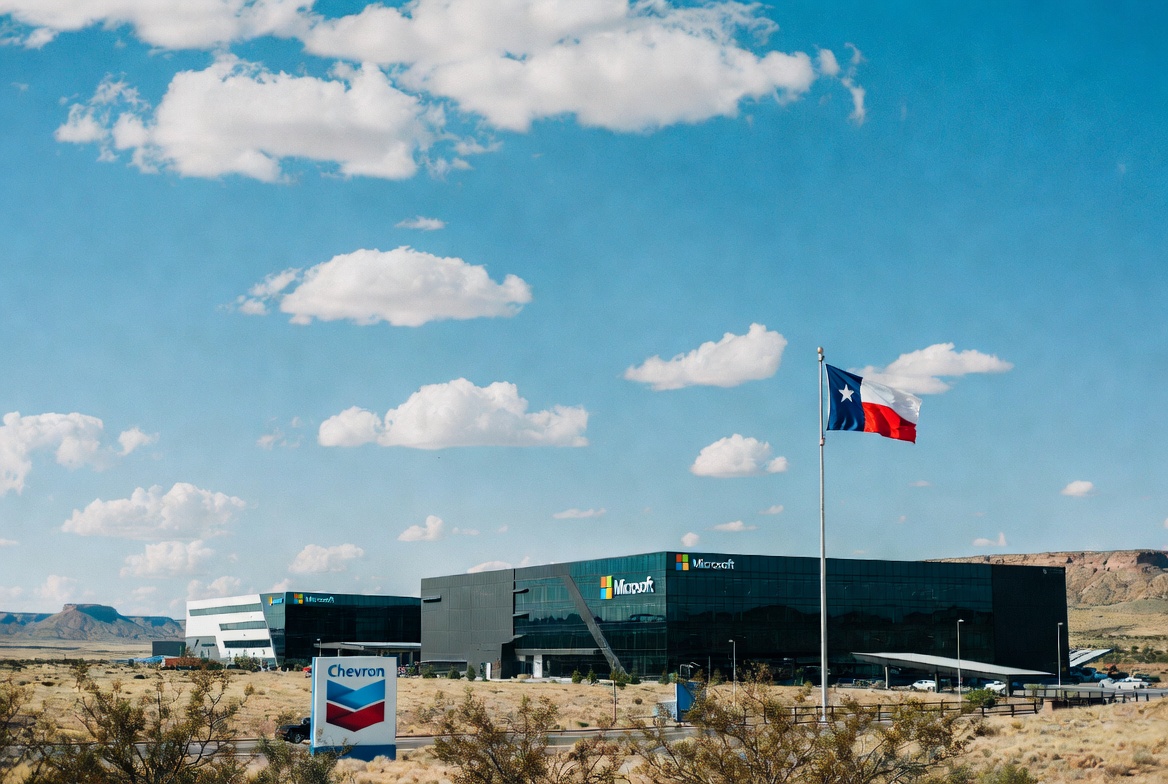
Chevron Corporation and Microsoft have signed a landmark 20-year power purchase agreement to supply electricity to a major data center campus in West Texas. The deal centers on a large natural gas-fired power plant being developed in partnership with investment firm Engine No. 1, marking one of the largest collaborations to date between a U.S. oil major and a hyperscaler.
The project, located near Pecos in the Permian Basin, involves a natural gas-fired generation facility expected to deliver an initial capacity of approximately 2.5 GW, ramping up toward 2.67 GW and potentially scaling to 5 GW in later phases. It is designed as a behind-the-meter installation—co-located directly with Microsoft’s data center campus on a large site—bypassing the public ERCOT grid. First power is targeted for 2028, with a final investment decision expected later this year. The initial phase carries an estimated cost of around $7 billion.
This agreement builds directly on the exclusivity deal announced in late March 2026 between Chevron, Microsoft, and Engine No. 1.
Monetizing Stranded Gas in West Texas: An Environmental Win
West Texas, particularly the Permian Basin, produces vast quantities of associated natural gas as a byproduct of oil extraction. Historically, limited pipeline takeaway capacity has left significant volumes “stranded,” leading to routine flaring. Flaring wastes valuable resources and releases methane and CO₂ into the atmosphere.By siting gas-fired generation close to production and consumption, the Chevron-Microsoft project enables direct utilization of this local gas supply. It converts what would otherwise be flared gas into reliable baseload electricity for AI-driven computing. Industry analyses highlight how such behind-the-meter and co-located developments in the Permian are turning stranded gas into a high-value resource while substantially reducing flaring volumes and associated emissions.
This represents a practical environmental improvement: lower methane releases compared to flaring, while providing the dispatchable, 24/7 power that hyperscalers require—something intermittent renewables alone cannot fully deliver at this scale and reliability.
Impacts on Investors
For Chevron shareholders, the 20-year offtake agreement with Microsoft (a high-credit counterparty) significantly de-risks the multi-billion-dollar investment. It provides long-term, contracted revenue visibility in a new growth area—power generation for AI infrastructure—while leveraging Chevron’s existing Permian gas production and operational expertise.In its Q1 2026 earnings (reported early May 2026), Chevron explicitly highlighted the exclusivity agreement (now formalized) as a key step in addressing surging AI power demand. The company reported adjusted earnings of $2.8 billion and returned $6.0 billion to shareholders, underscoring its financial strength to pursue such projects.
Broader sector implications are positive. Oil and gas majors are increasingly viewed as essential partners in powering the AI economy rather than being sidelined by the energy transition. This enhances the investment case for companies with strong upstream gas positions and infrastructure capabilities.ExxonMobil (Q1 2026 earnings: $4.2 billion reported / higher on an adjusted basis) has discussed opportunities in low-carbon and reliable power solutions for data centers during earnings discussions, signaling similar strategic interest.
EQT, a leading Appalachian natural gas producer, highlighted in its Q1 2026 results the accelerating U.S. power demand from data centers and positioned itself to benefit through gas supply to power generation. Management noted a potential “bull case” of 10 Bcf/d in incremental power-sector gas demand.
Liberty Energy, an oilfield services leader, is actively expanding into distributed and on-site power solutions for hyperscalers. In its Q1 2026 earnings, the company emphasized grid constraints driving demand for self-generation and outlined plans to deploy up to 3 GW of power projects by 2029, backed by secured long-term agreements with data center developers.
Collectively, these moves show traditional energy players stepping into the hyperscaler space with gas-fired, distributed, and behind-the-meter solutions—creating new revenue streams and diversifying business models.
Impacts on Consumers
Residential and commercial electricity consumers stand to benefit indirectly but meaningfully:
Grid stability and cost avoidance: Massive data center loads threaten to strain regional grids like ERCOT. Behind-the-meter generation keeps this demand off the public system, reducing the risk of capacity shortfalls, emergency curtailments, or broad-based price spikes passed on to all ratepayers.
Potential rate moderation: Historical data shows data center growth can sometimes spread fixed grid costs across more consumption, contributing to modestly lower residential rates in high-growth markets. While future AI-driven demand could pressure prices without adequate supply additions, dedicated generation projects like this help balance the equation.
Environmental and local benefits: Reduced flaring improves air quality in West Texas communities. The project brings construction and operational jobs, tax revenue, and economic activity to the region without relying on strained transmission infrastructure.
Trade-offs exist: gas-fired plants emit CO₂ (though far preferable to flaring or coal in many analyses), and long-term gas price exposure remains a factor. Overall, however, the model supports energy abundance and affordability while advancing practical decarbonization through reduced waste.
A New Era of Energy-Tech Partnerships
The Chevron-Microsoft agreement exemplifies how surging AI electricity demand—projected to drive data centers toward 9% or more of U.S. power consumption by 2030—is reshaping the energy landscape. Oil and gas companies are not merely suppliers of fuel; they are becoming critical developers of reliable power infrastructure tailored to hyperscale needs.
By pairing abundant domestic natural gas resources with co-located generation, these projects deliver the reliability, speed of deployment, and economics that AI infrastructure demands—while unlocking value from assets that were previously underutilized or wasted.
This is a pragmatic win for energy security, technological progress, investors seeking growth, and communities looking for cleaner utilization of local resources.
- Bloomberg: “Microsoft and Chevron Sign 20-Year Power Deal For Texas Data Center” (June 22, 2026) — https://www.bloomberg.com/news/articles/2026-06-22/microsoft-chevron-sign-20-year-power-deal-for-texas-data-center
- Energy Capital HTX / Bloomberg reporting on $7B project and 2.5 GW capacity (April 2026) — https://energycapitalhtx.com/chevron-microsoft-power-plant
- Chevron Official Statement on Exclusivity Agreement (March 31, 2026) — https://www.chevron.com/newsroom/2026/q1/chevron-statement-regarding-exclusivity-agreement-with-microsoft-and-engine-no-1
- Chevron Q1 2026 Earnings Release — https://chevroncorp.gcs-web.com/news-releases/news-release-details/chevron-reports-first-quarter-2026-results
- ExxonMobil Q1 2026 Earnings — https://investor.exxonmobil.com/company-information/press-releases/detail/1204/exxonmobil-announces-first-quarter-2026-results
- EQT Q1 2026 Earnings — https://ir.eqt.com/investor-relations/news/news-release-details/2026/EQT-Reports-First-Quarter-2026-Results/default.aspx
- Liberty Energy Q1 2026 Earnings — https://investors.libertyenergy.com/news-and-events/press-releases/2026/04-22-2026-223408592
- Additional context on Permian stranded gas, flaring reduction, and data center power deals: Multiple reports from Natural Gas Intelligence, Enverus, Bracewell LLP, and industry analyses (2025–2026).