

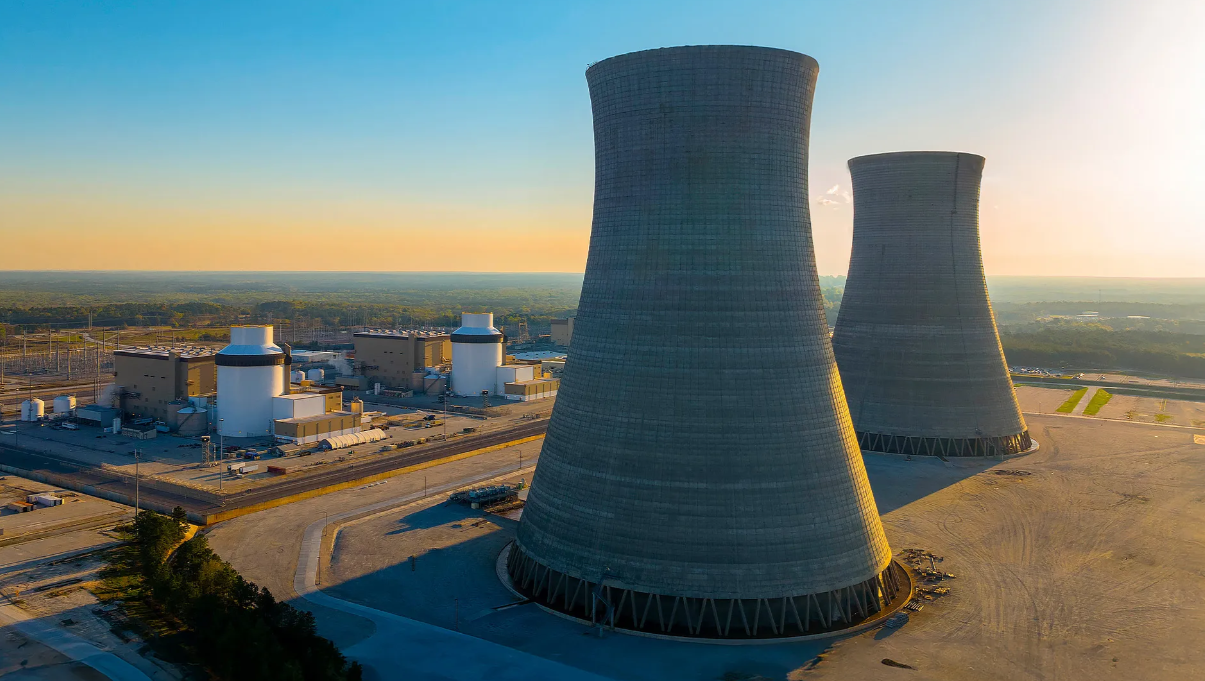
In a world rocked by geopolitical tensions around the Strait of Hormuz — a critical chokepoint for global oil supplies — and an explosive surge in electricity demand from AI data centers, nuclear power is experiencing a powerful resurgence. Reliable, low-carbon baseload energy is no longer a niche option; it is becoming central to energy security, economic growth, and climate goals.
A June 26, 2026, analysis from OilPrice.com captures this shift perfectly: AI-driven power hunger, conflicts (including the war in Iran), and climate pressure are pushing the world back to nuclear after decades of stagnation following Chernobyl, Three Mile Island, and Fukushima.
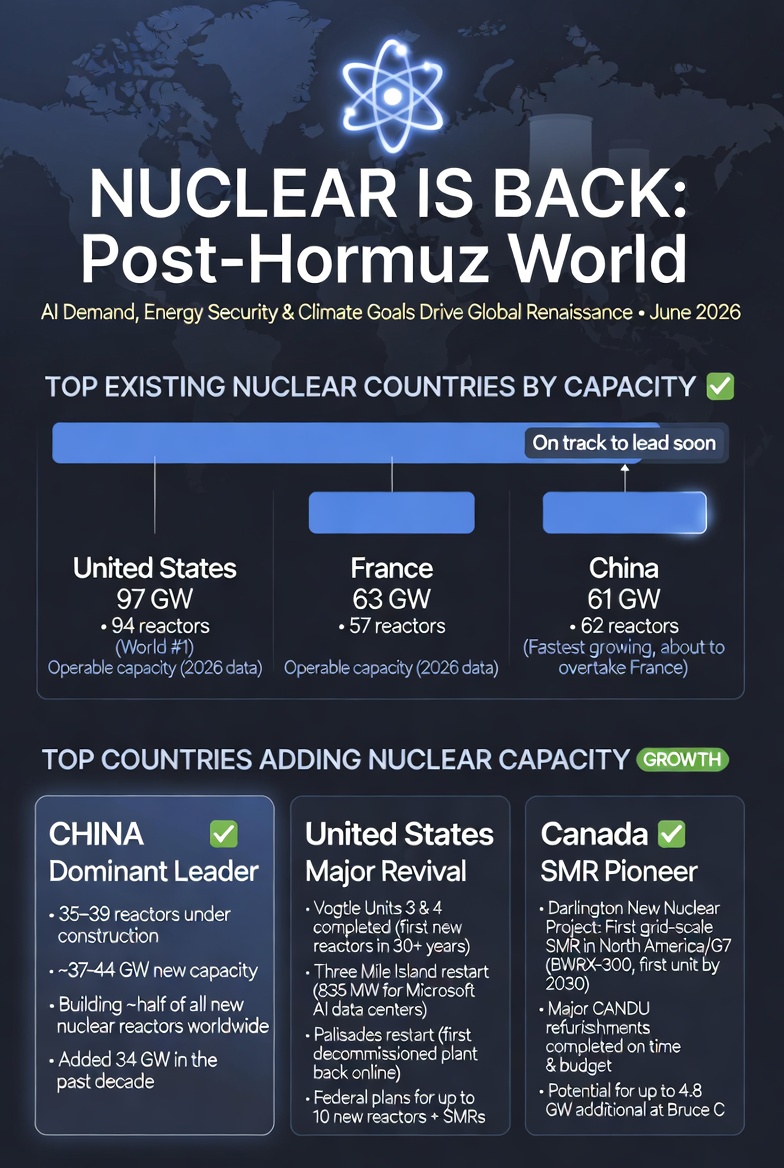
China added 34 GW of nuclear capacity over the past decade, while the United States managed only one new plant in ten years (years late and billions over budget). China is now firmly on track to overtake both the United States and France as the world’s largest nuclear energy producer within the next decade.
US Nuclear Renaissance: Restarts, New Builds, and Federal Backing
The United States is accelerating its nuclear revival through a combination of restarts of shuttered plants and support for advanced technologies.
Plant Vogtle in Georgia stands as a landmark achievement. Units 3 and 4 (AP1000 Generation III+ reactors with advanced passive safety systems) entered commercial operation in 2023 and 2024, respectively. These are the first new nuclear reactors built from scratch in the US in over 30 years. The expanded plant is now America’s largest generator of carbon-free electricity.
Three Mile Island Unit 1 (now the Crane Clean Energy Center) is being restarted by Constellation Energy under a landmark 20-year power purchase agreement with Microsoft to supply carbon-free power for AI data centers. The ~835 MW restart, backed by a $1 billion US Department of Energy loan, is targeting operation as early as 2027 — ahead of the original schedule.
Palisades Nuclear Plant in Michigan, the first decommissioned US commercial reactor to restart, is on track for early 2026 operation under Holtec International, supported by a $1.52 billion DOE loan guarantee. Plans also include new small modular reactors (SMRs) on the same site.
Broader momentum includes federal support under the Trump administration for new reactor construction (plans for up to ten new units), billions in DOE loans, and rapid progress on SMRs such as Kairos Power’s Hermes test reactor and Holtec’s SMR-300 fleet. Executive orders have further energized the sector.
Canada: Refurbishment Success and North American SMR Leadership
Canada is demonstrating world-class project delivery while pioneering next-generation technology.Major CANDU reactor refurbishments at Darlington and Bruce Power have been completed on time and on (or under) budget, extending plant life by 30+ years and securing reliable baseload power. The Darlington refurbishment program wrapped up in early 2026.Even more exciting is the Darlington New Nuclear Project — North America’s first grid-scale SMR. Ontario Power Generation received a construction license in April 2025 for the first GE Hitachi BWRX-300 (300 MW). Construction is advancing, with key regulatory hold points cleared in March 2026. The first unit is targeted for operation before the end of 2030, with up to three more to follow. Canada is also exploring large-scale new builds, including the Bruce C project (up to 4.8 GW potential).ans.org
Canadian officials have emphasized nuclear’s role in doubling the national grid by 2050 and establishing the country as an “energy superpower” with clean, reliable power.
China: The Fastest-Growing Nuclear Powerhouse
China continues its breakneck expansion. As of early to mid-2026, it operates approximately 62 reactors with roughly 60–62 GW of capacity. Another 35–39 reactors totaling around 37–38 GW are under construction — representing roughly half of all nuclear builds worldwide.
Standardized designs like the Hualong One (HPR1000) and CAP1000 (AP1000 derivative) enable faster, more cost-effective construction than many Western projects. Projections show China overtaking France’s ~63–66 GW fleet by late 2026 or shortly thereafter and challenging the US lead (currently ~94–102 GW) within the coming decade.
Why This Matters: Benefits for Consumers, Investors, and the Environment
For consumers: Nuclear delivers stable, predictable electricity prices insulated from volatile fossil fuel markets — especially critical in a post-Hormuz world where oil supply disruptions remain a real risk. It provides 24/7 baseload power that complements intermittent renewables without relying on expensive gas peakers. Long fuel cycles and domestic uranium resources enhance energy security.
For investors: The sector offers compelling growth. Corporate PPAs from tech giants (Microsoft, Amazon, Google, etc.) for data centers are de-risking projects. Government loans, tax incentives, and policy support are flowing. Companies involved in restarts, SMRs, uranium supply, and utilities are positioned for strong returns as capacity expands rapidly.For the environment: Nuclear has one of the lowest lifecycle greenhouse gas emissions of any energy source — comparable to wind and lower than solar when full supply chains are considered. It avoids massive CO₂ emissions while using minimal land and providing high energy density. It is essential for meeting net-zero targets without sacrificing reliability.As the IEA and other analysts note, nuclear complements renewables perfectly by providing dispatchable, low-carbon power at scale.
Conclusion: A New Era for Nuclear
The combination of geopolitical risks to oil supply chains, AI-driven electricity demand, and the urgent need for decarbonization has placed nuclear firmly back at the center stage. The US and Canada are showing renewed leadership through restarts, refurbishments, and SMR innovation, while China’s scale and speed are reshaping global rankings.
In the post-Hormuz world, nations that embrace nuclear will enjoy greater energy security, economic opportunity, and environmental progress. The Renaissance is not just beginning — it is accelerating.
- OilPrice.com article (primary reference): https://oilprice.com/Alternative-Energy/Nuclear-Power/AI-Demand-War-and-Climate-Pressure-Push-World-Back-To-Nuclear.html (Haley Zaremba, June 26, 2026)
- US Vogtle plant status and details: Multiple sources including EIA and Georgia Power reports (Units 3 & 4 commercial operation 2023–2024)
- Three Mile Island / Crane Clean Energy Center restart: Constellation Energy announcements and DOE loan news (2024–2026)
- Palisades restart: Holtec International and DOE loan guarantee details (2024–2026)
- Canada Darlington SMR and refurbishments: Ontario Power Generation, Canadian Nuclear Safety Commission, World Nuclear Association (2025–2026 updates)
- China nuclear capacity and construction: World Nuclear Association, Global Energy Monitor, IAEA PRIS data, Wikipedia summary of official figures (2026 data points)
- Broader benefits and IEA analysis: IEA reports on nuclear energy and secure transitions; World Nuclear Association sustainability pages
Additional supporting sources include Reuters, Utility Dive, NucNet, and various 2025–2026 industry updates referenced in the research above.This article is written for the Energy News Beat Channel and draws on the latest available data as of June 2026.