Hat Tip to NBC4 Washington and the LinkedIn post by Bethany Boo, which highlighted the story. We covered this on the Energy News Beat Substack.
Just before 8 a.m. on Wednesday, July 22, 2026, electricity flickered on and off for roughly 10 minutes across a vast stretch of the eastern United States—from Chicago to Boston and down to Miami. Millions of homes and businesses experienced brief drops and spikes in power. An engineer’s monitoring data from devices in residences across the region captured the event clearly: voltage and current swinging repeatedly before stabilizing.
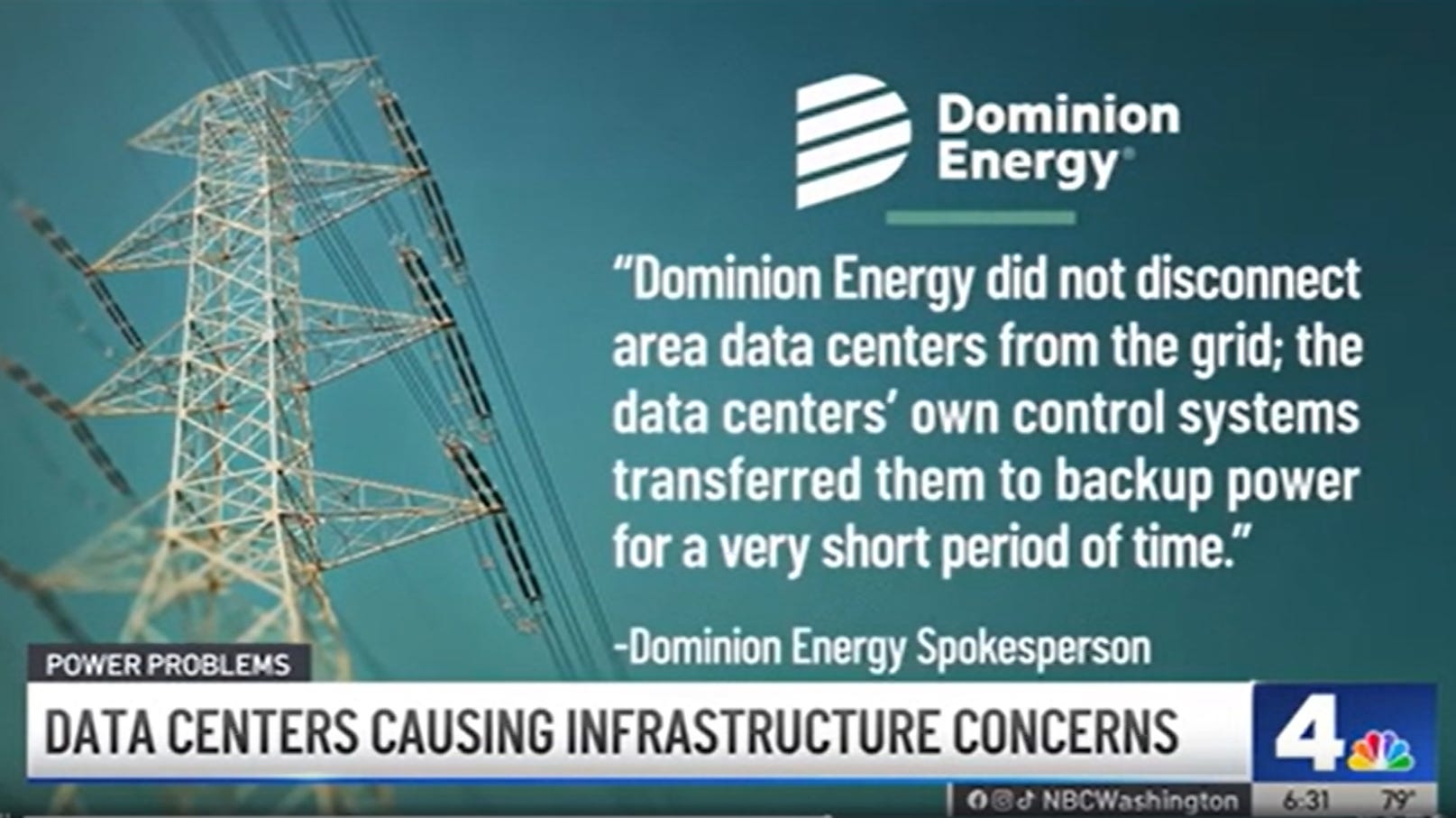
The epicenter was Data Center Alley in Ashburn, Loudoun County, Virginia—the world’s densest concentration of data centers, with more than 200 facilities in the county alone. According to Dominion Energy, a piece of equipment failed on one of its high-voltage transmission lines serving the area. The line went out of service. Data centers’ own protective control systems detected the disturbance and automatically transferred their massive loads to on-site backup power (typically diesel generators or other reserves) for a short period.

Bob Marshall of Ting Labs, whose wall-plug monitoring devices (taking 30 million measurements per second) first flagged the widespread anomaly, put it bluntly: “This is what experts are worried about… The data centers are such a big load on the grid that they can have a detrimental impact on the surrounding grid.” Loudoun County Supervisor Michael Turner noted the industry is confronting unprecedented challenges and working on preemptive measures.
The immediate crisis was averted. But the event is a stark warning about the growing strain on America’s electric grid.
What received less attention in the initial coverage is a deeper structural issue: the challenge of maintaining the precise 60 Hz alternating-current (AC) frequency of the North American grid as inverter-based resources (primarily wind and solar) displace traditional synchronous generation, while enormous new loads like data centers proliferate.
Traditional power plants—coal, natural gas, nuclear, and large hydro—use massive spinning turbines and generators. These rotating masses provide inertia: kinetic energy that naturally resists sudden changes in frequency.
When supply and demand briefly mismatch, inertia slows the rate of frequency change (RoCoF—rate of change of frequency), giving operators precious seconds to respond with generation adjustments or load shedding.
Drew Wilder, NBC Reporter
“That real big problem could be a blackout.”
What is not talked about is the Spain incident, or even the Texas ERCOT failure several years ago where lives were lost. The great utilities did their jobs, and the systems worked. But the changes we are seeing to the grid have no precedent in our history.
Wind turbines and solar panels produce direct current (DC) that is converted to AC via power electronics (inverters). These inverter-based resources lack physical rotating mass connected to the grid. They contribute little or no natural inertia. As their share of generation rises, overall system inertia falls. The grid becomes more brittle—frequency can swing faster and farther after a disturbance.
Data centers compound the problem. They are enormous, concentrated, and highly sensitive loads. Many are programmed to protect their sensitive IT equipment by rapidly transferring to backup power on voltage or frequency anomalies. When 3 GW drops offline in roughly 30 seconds—as happened on July 22—the grid experiences a sudden surplus of generation relative to load. Frequency rises. In a low-inertia system, that rise (or a corresponding drop if generation is lost) happens more abruptly, increasing the risk that protective relays trip other resources or loads, potentially cascading into larger outages.
This is not theoretical.
What This Means for Consumers and Investors
For investors: The warning is also an opportunity map. Utilities serving data-center corridors (Dominion Energy, for example) face both capital-intensive growth and regulatory scrutiny; those that successfully expand transmission and secure firm power (natural gas, nuclear including small modular reactors, or long-duration storage) stand to benefit. Transmission and grid-equipment providers, battery storage developers, and companies offering synthetic inertia or advanced inverter controls are positioned for demand. Pure-play intermittent renewable developers without firming resources face higher risk of curtailment or instability-related costs. Hyperscale cloud and AI companies themselves must increasingly invest in on-site generation, long-term power purchase agreements with reliable sources, or co-located power solutions—creating secondary investment themes in energy infrastructure tied to tech.
Capacity markets (such as PJM’s) have already shown sharp price spikes linked to data-center forecasts. Investors should watch load-growth accuracy, interconnection queues, and policy responses closely.
How People Should Prepare Their Homes for Blackout Risks
Core emergency kit (minimum 3 days, ideally 7–14): 1 gallon of water per person per day; non-perishable food; manual can opener; battery-powered or hand-crank radio and flashlights/headlamps with extra batteries; first-aid kit and prescription medications; cash; important documents in a waterproof container; sanitation supplies.
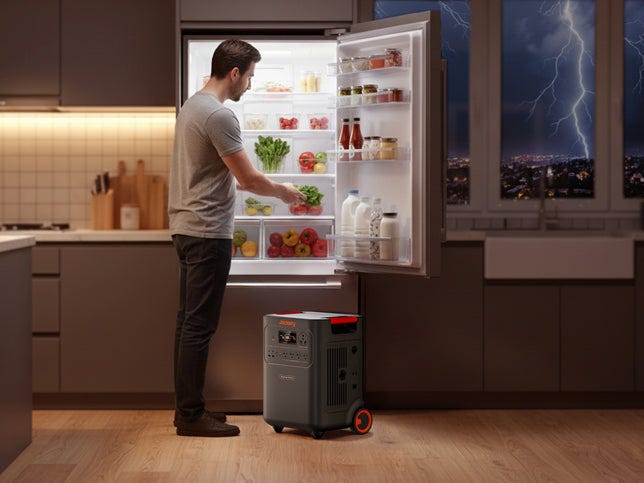
Power and communications: Portable power banks and solar chargers for phones; a portable power station sized for critical loads (router, CPAP, medical devices, lights); car charger adapters. Consider a whole-house or portable generator (use only outdoors, far from windows/doors, with carbon monoxide detectors on every level). Battery systems such as home energy storage can provide seamless backup for essential circuits.
Home readiness: Keep refrigerators and freezers closed as much as possible. Know how to manually open garage doors. Have a plan for medically dependent household members. Install surge protectors and consider uninterruptible power supplies (UPS) for computers and networking gear. Test detectors and generators periodically.
Information: Sign up for utility outage alerts; know how to report problems. Keep a printed list of emergency contacts.
These steps turn a potential multi-hour inconvenience into a manageable disruption.
The July 22 event in Data Center Alley was contained because protections worked and operators responded swiftly. It nevertheless revealed the scale of concentrated modern loads interacting with a grid in transition. As AI-driven demand accelerates and renewable penetration deepens, maintaining the delicate 60 Hz balance will require deliberate investment in inertia, flexibility, transmission, and operational coordination. Consumers, investors, and policymakers who treat this as an early warning—rather than an isolated glitch—will be better positioned for the energy system of the next decade.
Make no mistake, the folks at Dominion, PJM, ERCOT, and other utilities are doing great things keeping the power on.
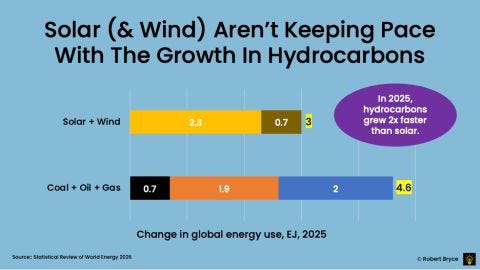
Hat Tip also to Robert Bryce on his newest article. Wind and Solar aren’t keeping pace with the Growth in Hydrocarbons. Energy Security matters more than virtual signaling.
But do not plan on power being like it was in the past.
Get battery generators, and have ways to charge them like solar, gas, propane, or natural gas. As I said above, this is new territory. This is not Democrat vs. Republican; this is Consumer vs. Government. I, for one, am glad that we have Secretary Chris Wright helping get ready for these changes.
Let me know what systems you already have, or are looking at. The CEO of Jackery has confirmed, and we will be filming in a couple of weeks.
Doomberg is scheduled for the 11th live at 9;00 Central; here is the link.

Thanks again to all of our great subscribers, patrons, and sponsors. We could not do this without you and your feedback and comments.