ENB Pub Note: This article ran on The Energy News Beat Substack – to comment, head over there.
Blue States and Rinos Should Be a Warning For Consumers and Voters
Stu Turley (Me) has been saying it on the Energy News Beat channel for years: energy security starts at home, and energy dominance is displayed through your exports. New York is running the opposite playbook. The state shut its own nuclear plant in the city, bet the downstate grid on a $6 billion Canadian hydro cable, and then discovered that politics, winter weather, and physics do not care what Albany wrote into the Climate Leadership and Community Protection Act.
This week, New York got a live drill.
On August 26, at the 3 p.m. peak, the Hydro-Québec ties were delivering zero megawatts. That includes the brand-new 1,250 MW Champlain Hudson Power Express under the Hudson — the line Albany has been selling as up to 20 percent of New York City’s power. CHPE sat idle at the peak hour and averaged just 260 MW all day, about 21 percent of its nameplate. The only Canadian power on the wire at 3 p.m. was roughly 200 MW from Ontario, under 1 percent of load.
So what filled the “imports” band on the chart? Not Canada. PJM — Pennsylvania gas country. About 2,500 MW came up from the south, with three of the four cables into the city and Long Island pinned at their limits. At the same hour, New York was exporting 1,000 MW to New England. Over the full day, New York sent more energy to Québec on the older tie than CHPE delivered from Québec.
New York Energy Alliance put the day in one sentence: losing Canada on a mild August afternoon costs almost nothing. The backup for Canadian hydro is not more hydro. It is combustion — PJM’s gas fleet first, New York’s second.
That is the physical grid. The political grid is something else. Ontario Premier Doug Ford is again putting electricity exports “on the table” in the U.S.–Canada trade fight, after already slapping a 25 percent surcharge on power to New York, Michigan, and Minnesota in 2025 — a surcharge that lasted a day before it was pulled. He has said he would cut the power “with a smile.” New York City’s new Canadian hydro link is expensive, already unreliable in its first summer, and now sits inside a trade war. Gov. Kathy Hochul needs to hear this before January, not after.
The $6 Billion Cable That Was Sold as “Clean Baseload”
Then reality showed up.
The line reached commercial operation in May 2026. It tripped. It was taken offline again on July 4 for cable repairs and spent much of its first summer dark. NYISO itself said planning studies did not assume CHPE would be available this summer — which is why the July heat wave did not break the grid. On paper, CHPE still counts toward the city’s reliability math. On the wire, it is optional.
Ratepayers are already on the hook. Statewide bills were projected to rise about $1.65 a month in the first full year for the project’s renewable-energy credits. LIPA trustees approved $810 million over 25 years for Long Island’s share of those Tier 4 RECs — for a line that terminates in Queens and “will almost exclusively benefit New York City.” That is the policy grid: upstate and Long Island households subsidizing a cable Albany can put in a press release.
How Much Power Does New York Actually Buy From Canada?
Less than the speeches imply — until the day it matters.
EIA data show Canadian imports used to cover about 11 percent of NYISO electricity from 2016 to 2022. That fell to 5 percent in 2023, 3 percent in 2024, and about 2 percent through August 2025. Drought, higher Canadian winter demand, and more U.S. generation flipped the old relationship.
In 2025 New York was a daily net exporter to Canada 86 times through August. Ontario still sent New York 7,461 GWh in 2025; New York sent Ontario 811 GWh the other way.
Then CHPE opened, and the July 3, 2026 heat wave produced the highest Canada-to-New York day since January 2025: 52 GWh, about 9 percent of NYISO demand, with CHPE running at full 1,250 MW. NYSERDA still markets the line as up to a fifth of the city’s power. A North Country report this week put Canada at about 22 percent of New York’s electric imports — imports, not total load. Those two numbers get mashed together in Albany talking points. They are not the same thing.
The honest answer to “what if Canada shuts it off?” is therefore two answers:
On a mild August day like August 26: almost nothing, if PJM and in-state gas stay online. Hydro-Québec was at zero. CHPE averaged 260 MW. Ontario was a rounding error. Pennsylvania carried the imports band.
On a January morning: that is the day the question gets expensive. Québec heats with electricity. When Québec is cold, it keeps the water behind the dam. The ties thin out exactly when New York is tightest. CHPE’s 1,250 MW can still be counted in a PowerPoint. It cannot be counted as winter capacity you own.
Ontario is the province making the cutoff threat. Québec is the province on the other end of CHPE. Ford cannot flip Québec’s switch by himself — he has already said he “can’t do it alone” and wants a “Team Canada” approach. That is not comfort. That is a reminder that New York outsourced a slice of New York City’s reliability to a foreign government in a trade war.
The Mix Albany Does Not Put on the Podium
New York used 471 GWh. Demand peaked at 23.5 GW at 3 p.m. At that hour:
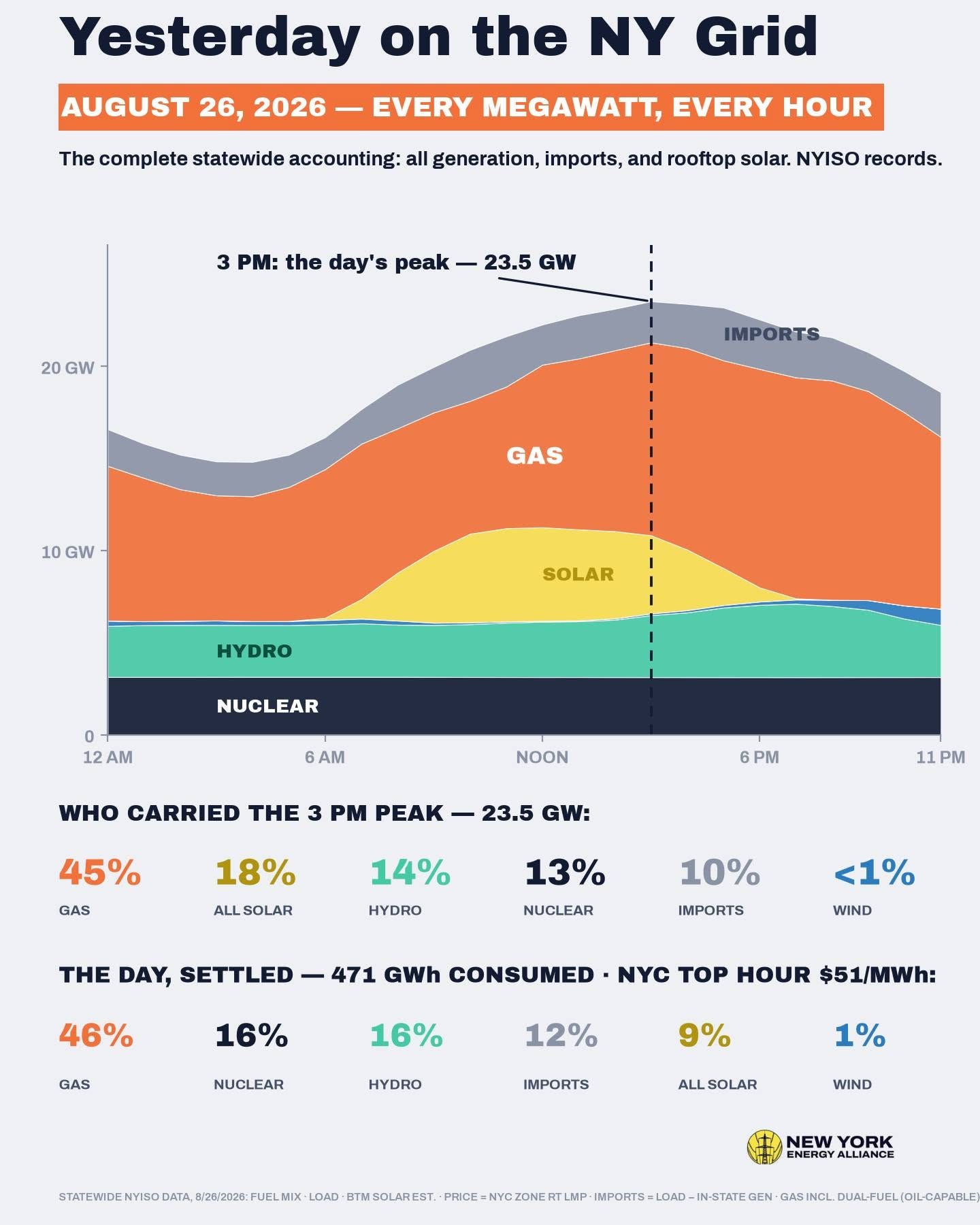
Over the full day: gas 46%, nuclear 16%, hydro 16%, imports 12%, all solar 9%, wind 1%. Solar’s best hour covered 23 percent of the state’s power. Solar was done by 8 p.m. NYC wholesale prices topped out around $51/MWh. Wind, after years of ratepayer money, was a rounding error when the system was heaviest.
This is a huge hat tip for @NYEnergyAllies on X
Zoom out to the year. NYISO’s 2026 Power Trends book shows 2025 energy production still dominated by dual-fuel and gas plants — on the order of half the megawatt-hours — with nuclear about 21 percent, in-state hydro about 18 percent, land-based wind about 5 percent, and grid solar under 1 percent.
Summer capability is even more gas-and-oil heavy: dual-fuel plus gas plus oil is most of the installed fleet that can be dispatched when the wind dies. Downstate — New York City and Long Island — is still a gas island with a nuclear hole where Indian Point used to be.
That is Meredith Angwin’s “two grids.” There is the grid outside the window: gas, nuclear, hydro, and PJM cables. And there is the grid written in Albany: 70 percent renewable by 2030, zero-emission electricity by 2040, and a Canadian line that “counts” whether it is flowing or not.
About 30 people drove to a church in Hurley this week to hear her explain the difference after a school district canceled the venue.
Energy News Beat has called Angwin ( The Electric Grandma ) a national treasure for a reason. The physical grid does not read statutes. We love her and all of her FANTASTIC work.
New Yorkers Are Already Paying Net-Zero Prices
EIA’s latest state table, for June 2026, puts New York residential electricity at 29.49 cents per kWh against a U.S. average of 18.34 cents. Commercial power is 23.56 cents against 14.19 cents nationally.
The Empire Center, using May 2026 EIA data, had New York third-highest in the country at 29.93 cents, 62 percent above the U.S. average, behind only Hawaii and California. Residential prices are up 12.1 percent year over year versus 6.2 percent nationally, and 72.5 percent since 2019 versus 38.5 percent for the country.
Those are not “wholesale volatility” numbers. Those are household and storefront numbers.
The Climate Leadership and Community Protection Act is not a footnote on that bill.
A Department of Public Service informational report projects CLCPA-related charges rising toward the mid-teens of dollars per month on a typical residential bill by the end of the decade. Newsday’s math for a more realistic Long Island user — 725 kWh a month — was about $14.40 in 2026 and $19.85 by 2029, before two offshore wind farms still under construction. A NYSERDA analysis of full cap-and-invest compliance put gross annual hits above $4,000 for some upstate oil-and-gas households and about $2,300 for NYC gas households, with gasoline up more than $2 a gallon under high allowance prices. Governor Hochul herself floated figures in the $3,500 range while arguing the law had to be slowed.
The FY27 budget pushed implementing regulations to 2028 and swapped the old path for a 60 percent emissions cut by 2040 — an admission that the original timetable collides with bills people can see.
Net-zero policy does not show up as a single line item called “climate.” It shows up as closed nuclear, delayed gas, subsidized cables, offshore-wind RECs, delivery-system upgrades for electrification, and a city that now treats a foreign hydro line as if it were a power plant in Queens.
What Actually Happens If Canada Pulls the Plug
First, prices move before lights go out. ISO-New England has already said a Canadian cut would be “largely financial” in the form of higher wholesale prices. New York is the same machine. Lose 1,000–2,000 MW of Canadian energy on a tight day and the next megawatt is a dual-fuel unit in the city or a PJM import already near its limit. That is a price event. Stretch it across a cold week, and it is a reliability event.
Second, downstate is tighter than the statewide average. Upstate still has Niagara, the nukes, and the wind belt. New York City closed Indian Point and imported the politics of Québec. CHPE was supposed to be the replacement “clean baseload.” A line that averaged 260 MW on August 26 and spent weeks offline in July is not baseload. It is a weather-and-politics option.
Third, the backup is gas whether Albany likes it or not. New York Energy Alliance said it without blinking: the backup for Canadian hydro is combustion. Keep permitting, maintaining, and fueling those plants, or do not run a winter peak. There is no third choice that fits inside a statute.
Fourth, exports are the tell. On August 26, New York was a supplier to New England and, on the old Québec tie, a net sender the other way. That is the Turley test. Energy dominance shows up as electrons leaving your system because you have surplus, not as a ribbon-cutting for a cable you do not control. New York is trying to buy the appearance of dominance with someone else’s dams.
The Message for Albany
Energy security starts at home. That means keep the gas fleet that actually carried 45 to 46 percent of August 26. It means stop treating in-state nuclear as a problem to be managed and start treating it as the zero-carbon capacity that does not care about Canadian politics. It means count winter capacity you can dispatch, not summer capacity you can announce.
It means admitting that net-zero timelines written in 2019 are already landing on 2026 bills at nearly 30 cents a kilowatt-hour.
New York does not need another Canadian press release. It needs electrons it owns.
If Canada ever does shut the tap — for a week, a winter, or a negotiation — the chart from August 26 is the instruction manual. The imports band will turn Pennsylvania-colored.
The city cables will pin. Wind will still be a rounding error after dark. And the only question left will be whether Albany kept enough combustion and nuclear standing to fill the hole it paid $6 billion to pretend was gone.
Make no mistake. The Midterms will be about who will control your power bills for the next multi-year cycle. Blue States and Rinos will end up costing United States Consumers millions, if not billions. This will show up in your power bills and soon – wait for it – rolling blackouts.
Prepare now. The UK posted warnings about food shortages yesterday. On the Stand Up with Rey Revnion, we covered the JP Morgan warning; stock up gradually.
The Warning Signs are going off. Take notes, and let me know what you are seeing.
Thanks again to our great sponsors, subscribers, and patrons. For our great subscribers like Ann’s group – buckle up and get motivated to vote for people who are not Consumer and Constituent First politicians.
I love President Trump’s move yesterday to allow farmers to butcher and produce their own food. I am going to be buying local! This is how we protect our food supply.

Looking forward to visiting with Meredeth again – her book sits on my desk, and it is a great discussion point for learning why Net Zero will never work.
Appendix: Links and Sources
New York Energy Alliance / primary posts
- NY Energy Alliance, “What if New York lost Canadian imports completely?” Aug. 27, 2026:

- NY Energy Alliance, Hurley event with Meredith Angwin, Aug. 27, 2026:

- NY Energy Alliance write-up of the Hurley event: https://nyenergyalliance.org/meredith-angwin-and-the-two-grids-in-hurley/
- NY Energy Alliance home:
Stu Turley / Energy News Beat
- “Energy security starts at home, and energy dominance is through your exports,” US Energy Dominance VS EU Net Zero, Energy News Beat, Feb. 24, 2026: https://energynewsbeat.co/us-energy-dominance-vs-eu-net-zero/
- “Key Takeaway: Energy Security Starts at Home,” Energy News Beat standup recap, July 31, 2026: https://energynewsbeat.co/enb-podcast/oil-ignores-prices-ignore-physical-costs-10-big-stories-on-the-energy-news-beat-standup/
- Prior ENB on CHPE and Canadian cutoff risk, June 8, 2026: https://energynewsbeat.co/electrical-generation/new-york-just-got-a-huge-influx-of-clean-power-from-canada-it-still-needs-more-and-will-canada-cut-the-power-if-they-dont-agree-with-trump/
- Stu Turley on Meredith Angwin, reply to NY Energy Alliance, Aug. 28, 2026:
CHPE project, operations, outages
- EIA, “New York imports more electricity from Canada after high-voltage transmission line opens,” July 20, 2026: https://www.eia.gov/todayinenergy/detail.php?id= (see EIA Today in Energy, July 20, 2026 post on CHPE / 52 GWh day)
- Utility Dive, “New 339-mile transmission line brings Canadian hydropower to NYC,” June 17, 2026: https://www.utilitydive.com/news/Champlain-Hudson-transmission-hydro-nyc/823115/
- Utility Dive, “FERC approves market rules for Champlain Hudson,” April 14, 2026: https://www.utilitydive.com/news/ferc-approves-market-rules-for-champlain-hudson-transmission-project/817409/
- Gothamist, “Repairs complete on new $6 billion power line,” July 24, 2026: https://gothamist.com/news/repairs-complete-on-new-6-billion-power-line-bringing-nyc-energy-from-canada
- Energies Media, CHPE first-summer outages, Aug. 1, 2026: https://energiesmedia.com/champlain-hudson-power-express-new-york/
- Newsday, LIPA $810 million REC obligation, Nov. 13, 2025: https://www.newsday.com/long-island/politics/lipa-trustees-champlain-hudson-power-line-feav4jvw
- Meredith Angwin, “A Tale of Two Transmission Lines,” July 24, 2026:

Canadian import volumes and trade-war cutoff risk
- EIA, “U.S. Northeast is relying less on electricity imports from Canada,” Sept. 19, 2025: https://www.eia.gov/todayinenergy/detail.php?id=66144
- EIA Electric Power Monthly, U.S. electricity trade with Canada: https://www.eia.gov/electricity/monthly/epm_table_grapher.php?t=table_7_01
- National Post, “The one problem with Canada threatening to cut off U.S. electricity,” Aug. 27, 2026: https://nationalpost.com/opinion/the-one-problem-with-canada-threatening-to-cut-off-u-s-electricity
- Times Union, Ontario export threat and 2025 NY–Ontario volumes, Aug. 24, 2026: https://www.timesunion.com/business/article/ontario-threatens-halt-power-exports-ny-22401189.php
- The Hill, Ford cutoff threat and price risk, Aug. 27, 2026: https://thehill.com/policy/energy-environment/6053492-canada-trade-war-trump-tariffs-ontario-power/
- WCAX, North Country import-share figures, Aug. 26, 2026: https://www.wcax.com/2026/08/26/us-canada-trade-fight-sparks-energy-cost-fears-north-country/
- Utility Dive, U.S.–Canada trade war and electricity, Aug. 20, 2026: https://www.utilitydive.com/news/us-canada-trade-war-threatens-electricity-imports-prices/828689/
- The Narwhal, Ford threat explainer, Aug. 25, 2026: https://thenarwhal.ca/ontario-ford-trump-trade-war-electricity/
- CTV News, Ford “I can’t do it alone,” Aug. 26, 2026: https://www.ctvnews.ca/toronto/article/i-cant-do-it-alone-ford-suggests-ontario-wouldnt-act-unilaterally-in-cutting-off-electricity-to-us/
New York prices
- EIA Electric Power Monthly Table 5.6.A, June 2026 prices (NY residential 29.49¢, commercial 23.56¢): https://www.eia.gov/electricity/monthly/epm_table_grapher.php?t=epmt_5_6_a
- Empire Center Energy Data Bulletin, August 2026 (May 2026: 29.93¢ residential): https://www.empirecenter.org/energydata/
- NYSERDA commercial monthly averages: https://www.nyserda.ny.gov/Energy-Prices/Electricity/Monthly-Avg-Electricity-Commercial
- Con Edison 2026 bill outlook: https://www.coned.com/en/accounts-billing/your-bill/about-con-edisons-rates
Energy mix
- NYISO 2026 Gold Book / Load and Capacity Data: https://www.nyiso.com/documents/20142/2226333/2026-Gold-Book-Public.pdf
- NYISO 2026 Power Trends (2025 energy production by fuel):
https://www.nyiso.com
- (2026 Power Trends report)
- NYISO real-time dashboard: https://www.nyiso.com/single-chart-page
- Choose Energy, May 2026 state generation shares: https://www.chooseenergy.com/data-center/electricity-sources-by-state/
- EIA Hourly Electric Grid Monitor: https://www.eia.gov/electricity/gridmonitor/
CLCPA / net-zero consumer impacts
- NYSERDA analysis of CLCPA compliance costs (cap-and-invest household hits): https://s3.documentcloud.org/documents/27420088/nyserda-analysis-of-cost-to-comply-with-clcpa.pdf
- City & State New York, “Climate law mandates could cost New Yorkers $4,000,” Feb. 26, 2026: https://www.cityandstateny.com/policy/2026/02/climate-law-mandates-could-cost-new-yorkers-4000-higher-energy-bills-state-analysis-shows/411735/
- Newsday, climate-law charges on Long Island bills, March 9, 2026: https://www.newsday.com/long-island/politics/climate-law-impact-electric-bills-rmpw1e6c
- Governor Hochul, FY27 budget / CLCPA timeline changes, May 28, 2026: https://www.governor.ny.gov/news/governor-hochul-announces-energy-affordability-package-help-new-yorkers-struggling-high
- NY DPS CLCPA informational report (bill-impact tables): New York Department of Public Service CLCPA Second Informational Report filings at
https://documents.dps.ny.gov
Meredith Angwin / two-grids framing
- Hudson Valley One coverage of the Hurley talk, Aug. 24, 2026: https://hudsonvalleyone.com/2026/08/24/why-are-energy-prices-high-and-rising-in-ulster-county-electric-grandma-gives-technical-insight-at-hurley-event/
- Angwin, Shorting the Grid (physical grid vs. policy grid), referenced in her Substack and Hurley remarks.