ENB Pub Note: This is an outstanding article from Dr. Tammy Nemeth on the Nemeth Report Substack. We highly recommend subscribing!
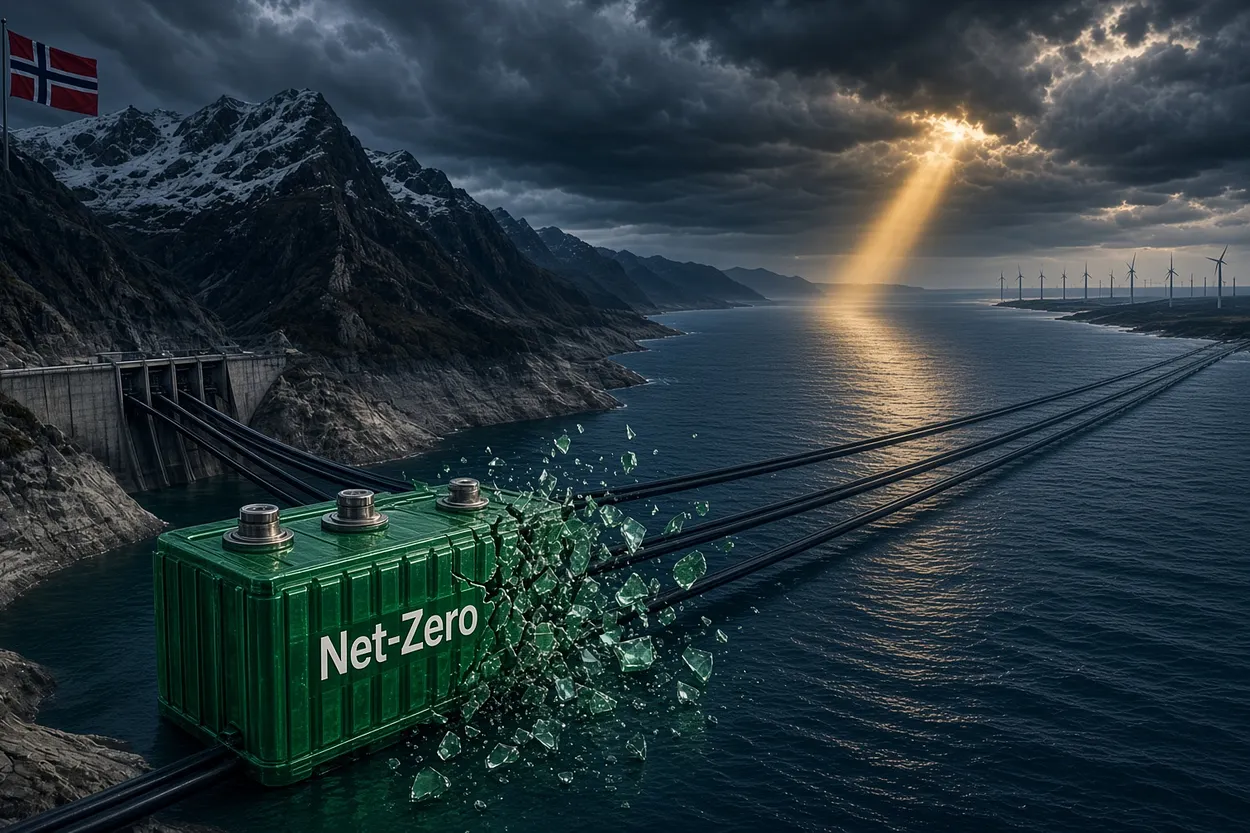
Norway has punctured the illusion that Europe’s net-zero transition is attainable. At the end of August, Energy Minister Terje Aasland not only declared that Norway as Europe’s “green battery” was “a flawed idea”, but also made clear that Norway will develop Arctic oil and gas whether or not Brussels approves. The Norwegian government is also asking the Supreme Court to overturn environmental activist challenges to new oil developments. These are not isolated developments; they are the first honest admission from within Europe that net-zero’s contradictions can no longer be reconciled with energy security and reliability.
Norway is not a member of the European Union (EU). It is, however, bound to European power markets and the legal and political orbit of EU climate rules through its membership in the European Economic Area. Norway bought into the “green battery” idea when the UK, Germany, and other EU neighbours still looked likely to keep reliable generation as baseload power. They did not. Net-zero policy has not only demonized hydrocarbons, and treated gas like a temporary embarrassment, it also crushed investment and confidence in nuclear. In the UK, coal plants were demolished and not replaced. In Germany, all nuclear power stations closed. Weather-dependent wind and solar are prioritized, with Norwegian reservoirs treated as an on-call battery after connected countries dismantled their own firm generation.
These are not isolated developments; they are the first honest admission from within Europe that net-zero’s contradictions can no longer be reconciled with energy security and reliability.
Aasland put it bluntly: Norway can no longer balance the European power market on its own. The “green battery”, once used to justify interconnections to Britain and Germany, has backfired. In good years, surplus hydro was meant to be exported so Norwegians paid less. In drought, the links were supposed to protect the reservoirs. As energy analyst Kathryn Porter notes, “Despite promises that the UK would export cheap surplus wind power to its neighbour, this rarely happens in practice.” The UK, Porter says, must realise that import capacity is not generation capacity. In other words, the North Sea Link is not a British power station. This is a clear warning and lesson for those advocating for more interconnections in North America and beyond.
Hydropower still supplies almost 90 percent of Norway’s electricity, but like wind and solar it depends on the weather. Successive dry winters and thin snowpack have left reservoirs depleted. Yet exports continue. Norwegian commentators warn that drawing reservoirs too hard and too often can damage the hydro resource itself. Instead of providing security, interconnections imported Europe’s electricity price spikes into Norway.
Oslo is finished with new interconnectors—for now. Norway’s grid operator has been instructed not to plan new subsea links before 2029. NorthConnect to Scotland is dead. The old Skagerrak cables to Denmark are reaching end-of-life and likely won’t be replaced. In fact, surveys put public opposition to new cables around 60 percent. Norway’s governing coalition is mindful of the grim public mood.
The contradictions are sharper in oil and gas. Petroleum accounts for more than half of Norway’s goods exports and underwrites its welfare state, EV programme, and sovereign wealth fund. Norway is Europe’s indispensable gas supplier, a role that has only grown since Russia fell out of favour and the Middle East became more unstable. Europe claims it is decarbonising, but hydrocarbons are about 70 percent of its energy mix. Instead of increasing domestic supply, it has policies banning new hydrocarbon development in the Arctic. After months of lobbying to lift the ban, Norway stated it will develop the Barents Sea anyway, and the EU can decide whether to buy that gas. “In today’s geopolitical and security environment,” Aasland said, “continued activity in the Barents Sea serves both Norwegian and European interests.” Norway insists its licensed acreage is largely ice-free. Greenpeace and other NGOs warn that Arctic projects are slow, risky, and likely stranded assets. The government disagrees and is prioritizing firm supply.
That choice is now in court. Alignment with EU climate rules and the Paris Agreement is being used to argue that developing new fields is illegal because of Scope 3 emissions, the combustion of the product. Greenpeace Nordic and Youth Friends of the Earth (Natur og Ungdom) sued over the Breidablikk, Tyrving, and Yggdrasil fields, arguing the permits should be voided because of those emissions. Lower courts agreed. Now the government is asking the Supreme Court to overturn that ruling. Norway cannot accept the net-zero logic that new barrels are unlawful because someone will use them.
Why the open break now? Official forecasts show oil and gas output falling after 2030 without new projects; Europe’s climate rhetoric and gas purchases are in contradiction; export-driven electricity prices have poisoned the “solidarity” bargain at home; geopolitics has reminded leaders about energy security, reliability, and affordability. The honest reading is that net-zero’s contradictions, not a sudden ideological shift, have forced Oslo into the open. Norway is the first to admit that pretending the circle would square was a fantasy. Governments have a duty to provide energy that is secure, reliable, and affordable. Net-zero as practised in the UK, Germany, and Europe has failed that duty. The question is: Can Canada learn that lesson before it’s too late?