What Musk’s companies have actually put on the record
- SpaceX and Tesla are each building 100 GW/year of solar production capacity as quickly as possible, but natural gas will still be needed to supplement and bootstrap solar for several years.
- The limiting factor for nat gas turbine production is casting the blades & vanes.
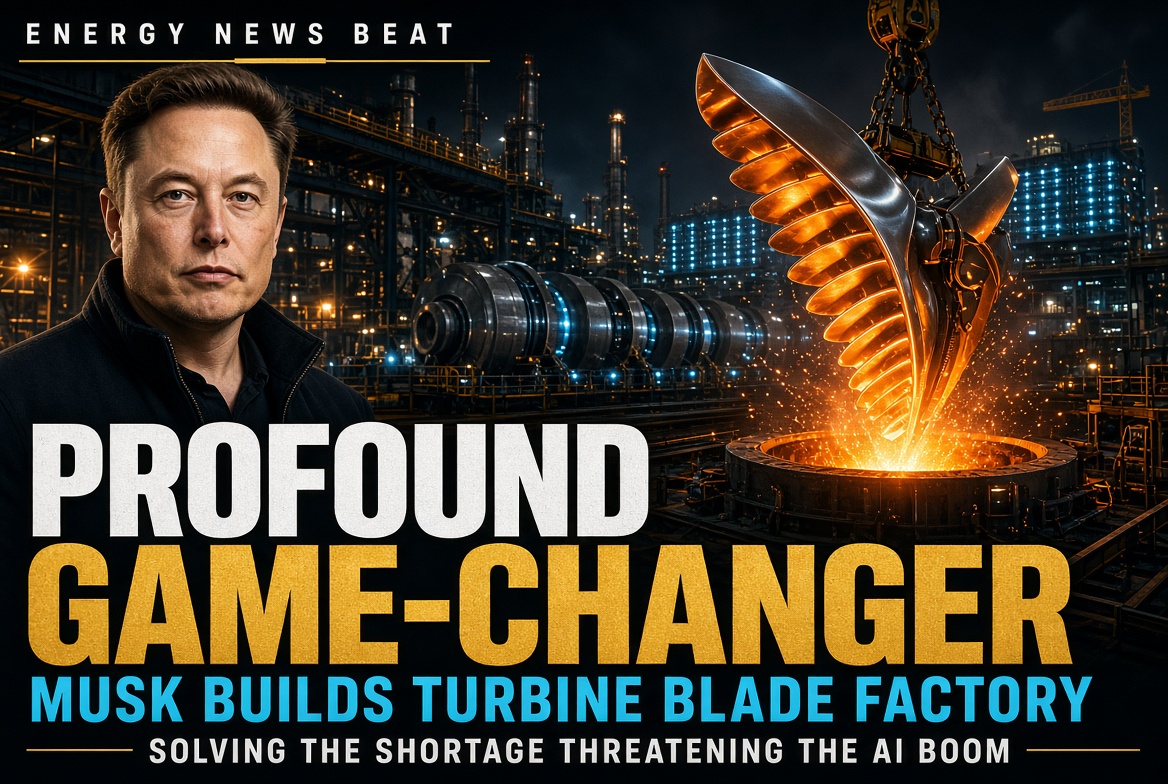
- By doing in-house casting at SpaceX, we can accelerate nat gas turbines coming online by up to 18 months, which is a profound game-changer.
That post landed after The Information reported that SpaceX was laying groundwork for a blades-and-vanes foundry in Bastrop. Musk treated the report as confirmation, not a leak to deny.
- Sr. Operations Engineer, Blades and Vanes Foundry — “extreme owner” of construction, buildout, and operational ramp-up of a new foundry
- Sr. Materials Engineer, Blades and Vanes Foundry — nickel-superalloy castings for power generation; single-crystal (SX), directionally solidified (DS), and equiaxed (EQ) components
- Automation Engineer / Sr. Automation Engineer, Blades and Vanes Foundry — wax injectors, ceramic shells, preheat, melt, and controlled-solidification furnaces
- CNC Programmer, NX CAM (IGT Blades & Vanes) for a new industrial gas turbine manufacturing line in Bastrop
Those descriptions are not exploratory. They describe a plant being stood up.
Bastrop, Texas—about 30 miles from Austin, next to SpaceX’s existing Starlink manufacturing campus.
Between March and June 2026, SpaceX acquired roughly 830 acres near that plant, according to reporting that cited due-diligence specialist Corey Trinetti. Satellite imagery reviewed for The Information showed two new buildings standing by July, where nothing stood a year earlier. Bastrop is already “Elon Land”: Starlink production, related industrial buildings, and a growing workforce. The foundry is an expansion of that hub, not a greenfield in an empty county.
Who the customers are
First customer is Musk’s own stack.
- xAI / SpaceX terrestrial data centers — Colossus and follow-on sites. Musk has talked about at least 10 GW of terrestrial data-center capacity by the end of 2027. Bridge power is gas; longer-term baseload is supposed to shift toward the 100 GW/year solar build at SpaceX and Tesla, plus batteries.
- SpaceX’s own turbine fleet — APR Energy mobiles, Doosan heavy frames, and the dozens of units already running. The fastest path to qualify a new caster is often spare and replacement parts on machines you already own and can take the warranty risk on.
- Raptor engine turbopumps — aerospace demand that does not wait for AI interconnect queues.
- Tesla’s energy and future compute load — Musk grouped Tesla with SpaceX when he first said the companies would likely have to make blades internally. Tesla is also tied to the Terafab chip effort, which filings have described as gas-powered in its first phase.
External customers are not promised. If SpaceX can cast at industrial quality and volume, every other AI builder fighting the same 2030 turbine queue—Amazon, Google, Meta, Microsoft, OpenAI and the rest now standing up behind-the-meter gas plants—would theoretically be a buyer. That is optionality, not a signed offtake book. The immediate strategy is captive: get their turbines online up to 18 months sooner than the oligopoly will allow.
Musk’s number is up to 18 months faster turbine commercial operation, not “foundry pouring qualified blades next quarter.”
What is already done:
- Strategy flagged publicly in February 2026
- Foundry jobs posted by April 2026
- ~830 acres acquired March–June 2026
- New buildings visible by July 2026
- Confirmation and 18-month claim on August 29, 2026
What still has to happen is the hard metallurgy. A typical greenfield path for qualified hot-section blades is often cited at about two years to first acceptable parts and three or more years to meaningful run-rate. Vacuum furnaces, ceramic shells, single-crystal growth, coatings, and OEM qualification are not software sprints. One blade campaign can already take 60–90 weeks at existing specialists.
Realistic base case: first useful castings for captive spares and Raptor in a 12–24 month window from the current buildout; material pull-forward of new large IGT deliveries if qualification and yield cooperate. Stretch case is Musk’s 18-month claim on full turbines coming online. The risk case is that single-crystal yield, coating life, or OEM acceptance take the traditional three-plus years and the AI power queue barely moves.
Market implications
Power timing, not ideology. Solar at 100 GW per year from each of Tesla and SpaceX is the destination Musk keeps repeating. Natural gas is the bridge and the bootstrap. The foundry is an attempt to own the toll booth on that bridge.
Vertical integration as a competitive weapon. If SpaceX can cast what only three or four shops can cast today, Musk-controlled data centers get electrons while competitors wait. That is an advantage that is expensive and slow to copy. It also puts pressure on Howmet, PCC, and the turbine OEMs: a new captive source changes pricing and allocation power even if SpaceX never sells a blade outside the family.
Gas demand stays bid. IEA-type forecasts still have data-center electricity roughly doubling by 2030. Hyperscalers have already pivoted toward on-site or near-site gas because grid interconnection is measured in years. More blades mean more turbines that can actually be assembled. That supports U.S. gas-plant construction already jumping in 2026 project trackers—and it keeps methane, NOx, and formaldehyde fights in the same zip codes as the data halls. Memphis and Southaven have already produced NAACP and environmental litigation over unpermitted or lightly controlled turbines. Faster gas is not free of political or health costs.
Texas industrial gravity. Bastrop becomes more than a Starlink town. Superalloy foundry work is high-skill, high-capex, and sticky. Combined with Tesla’s separate solar factory plans in Fort Bend County, Musk’s energy manufacturing footprint in Texas is no longer just batteries and cars.
The AI boom is no longer limited by GPUs alone. It is limited by transformers, interconnection, water, and—now visibly—a few vacuum furnaces that grow metal as a single crystal. Musk is building one of those furnaces next to a satellite factory and calling the time saved a game-changer. The market will find out whether 18 months was a forecast or a slogan. The land, the job reqs, the $2.8 billion turbine budget, and the APR fleet say he is already spending as if the slogan has to become schedule.
Appendix: Sources and links
Example job text, Sr. Materials Engineer, Blades and Vanes Foundry: https://haystackapp.io/jobs/2a968c43-8575-4ab1-a453-9f0012eed902
Sawyer Merritt compilation of foundry job listings: https://x.com/SawyerMerritt/status/2093849896122012129
Original reporting that triggered confirmation The Information exclusive (paywalled; widely cited August 29, 2026): https://www.theinformation.com/briefings/musk-responds-informations-report-spacex-setting-turbine-blade-factory
Dealroom summary of that exclusive: https://dealroom.co/news/info-x6qh1f-exclusive-spacex-lays-groundwork-for-turbine-blade-factory-to-solve-data/
Confirmation and analysis TechCrunch, “Musk’s faster path to more gas turbines comes with pollution problem,” August 30, 2026: https://techcrunch.com/2026/08/30/musks-faster-path-to-more-gas-turbines-comes-with-pollution-problem/
Tom’s Hardware, August 30, 2026: https://www.tomshardware.com/tech-industry/data-centers/spacex-starts-in-house-turbine-blade-manufacturing-to-boost-gas-powered-generator-output-for-elons-ai-data-centers-new-manufacturing-strategy-cuts-generator-delays-by-18-months
AI Weekly alert on Bastrop foundry: https://aiweekly.co/alerts/spacex-lays-groundwork-for-bastrop-gas-turbine-blade-foundry
Christopher Gannatti, “The Blade Problem” (February podcast context and metallurgy): https://christophergannatti.substack.com/p/the-blade-problem
CryptoBriefing on in-house components and $2.8B turbine spend: https://cryptobriefing.com/musk-in-house-gas-turbine-components/
Turbine purchases, APR Energy, Colossus WIRED, SpaceX $2.8 billion gas-turbine commitment: https://www.wired.com/story/elon-musk-spacex-spending-gas-turbines-grok/
Electrek, Musk APR Energy acquisition: https://electrek.co/2026/07/14/musk-buys-gas-turbine-company-apr-energy-grok/
Data Center Dynamics on APR: https://www.datacenterdynamics.com/en/news/elon-musk-quietly-acquires-mobile-gas-generation-firm-apr-energy-report/
Latitude Media on the APR deal: https://www.latitudemedia.com/news/what-to-know-about-elon-musks-billion-dollar-turbine-deal/
Solar counterpart (Tesla / SpaceX 100 GW) pv magazine USA, Musk at WEF on 100 GW each: https://pv-magazine-usa.com/2026/01/26/elon-musk-at-wef-spacex-and-tesla-to-produce-100-gw-each-of-pv-per-year-in-the-u-s-this-decade/
Business Insider on Tesla Texas solar factory filing: https://www.businessinsider.com/tesla-texas-solar-factory-elon-musk-100gw-manufacturing-plans-2026-8
Reuters on Tesla hiring for the solar build: https://www.reuters.com/sustainability/climate-energy/tesla-executives-say-hiring-is-ramping-up-support-musks-expanded-solar-strategy-2026-02-06/
Industry context GE Vernova sold-out-through-2030 coverage (widely cited; example): https://www.benzinga.com/trading-ideas/long-ideas/26/07/60618792/ge-vernova-says-its-mostly-sold-out-through-2030
Note: SpaceX and Tesla have not issued a standalone corporate press release on the Bastrop blades-and-vanes foundry as of August 30, 2026. The record above is the public one—Musk’s confirmation, SpaceX hiring language, land and imagery reporting, and related energy-procurement filings.