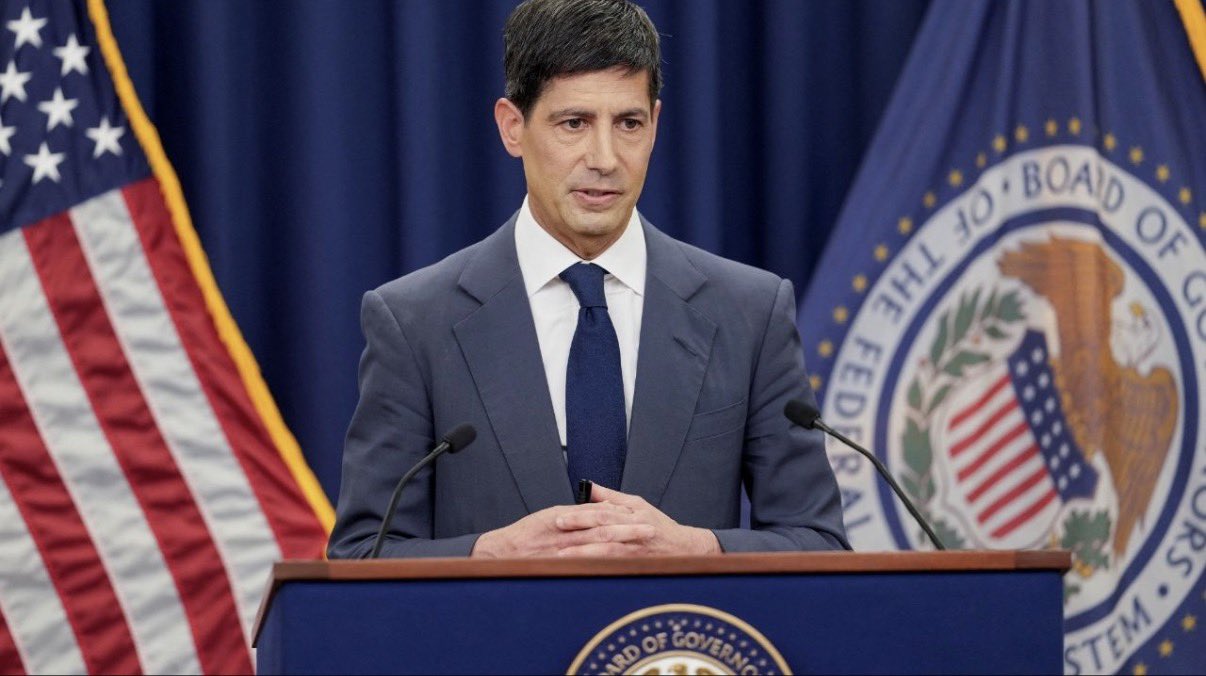
On September 16, 2026, the Federal Reserve raised the federal funds target range by 25 basis points to 3.75–4.00 percent, its first hike since July 2023. The decision was unanimous. Chair Kevin Warsh and the FOMC cited elevated inflation and said the move would support a “timelier return” to the 2 percent goal. Economic activity was described as expanding at a solid pace, with resilient domestic spending, strong productivity, robust capital investment, and a stable labor market—despite “elevated uncertainty owing, in part, to geopolitical developments.”
Those geopolitical developments are not abstract. An Iran-related conflict has disrupted the Strait of Hormuz. Brent crude broke $100, and U.S. diesel hit a record around $6 per gallon. Higher rates do not reopen a shipping lane, restore refining capacity, or produce a single additional barrel. They act on demand, with a lag. That is the core of the critique now circulating among energy-focused analysts and market commentators: the Fed is repeating a 50-year-old error by treating a supply shock as if it were primarily a demand problem.
What the Fed Said Versus What It Can Control
The official statement is short. Inflation “remains elevated.” Policy will deliver price stability. Officials revised up their 2026 PCE inflation forecast to 3.7 percent (core 3.4 percent) and signaled at least one more hike this year in the Summary of Economic Projections.
Monetary policy cannot fix a physical shortage of oil and refined products. It can only slow the rest of the economy until households and businesses spend less. In an energy-intensive system, that means higher borrowing costs layered on top of already-record diesel costs that feed through trucking, food distribution, manufacturing, and construction. Analysts have noted that diesel’s pass-through is broader and stickier than gasoline’s; businesses, not just commuters, feel it first.
Other Central Banks Are Watching the Same Shock
The Bank of England has held Bank Rate at 3.75 percent through its 2026 meetings so far, including a 6–3 vote in July. Three members preferred a hike then. The next decision is due September 17. Markets and economists still lean toward a hold, but energy prices have pushed some toward expecting a November move if the shock persists. The BoE itself has stated that monetary policy cannot influence global energy prices; its job is to prevent second-round effects from becoming embedded.
The Bank of Canada held at 2.25 percent on September 2. Minutes released September 16 show governors saw inflation remaining elevated in the near term because of high gasoline and diesel prices tied to the Middle East conflict and damaged refining capacity. They saw little evidence yet of broad pass-through, but they agreed that if energy costs spilled into other goods and services, a policy response would be needed. They also flagged trade tensions as an added cost pressure. In short, Ottawa is prepared to follow a similar logic if the data worsen.
Neither bank has hiked in lockstep with the Fed this week, but both are operating from the same playbook: look through a temporary supply shock until it starts looking persistent, then tighten demand.
The 1973 Parallel
Matt Allen’s post on X laid out the historical comparison that many energy-market observers are making. In 1973 the Fed tightened into an oil shock after the embargo. The result was not a clean victory over inflation. It was recession stacked on double-digit inflation. “Nobody in Washington has figured out the difference between a supply problem and a demand problem in 50 years,” he wrote. A quarter-point hike does not refine fuel or end the disruption; it only beats demand down over subsequent months.
The 1973–75 recession followed the first oil shock. The late-1970s/early-1980s episode under Volcker combined a second oil shock with aggressive tightening that produced deep recession even as it eventually broke inflation. Historians and Fed researchers still debate how much of the downturn was the oil itself versus the monetary response. The practical lesson for energy markets is that rate hikes do not increase barrels; they reduce activity. When the constraint is physical supply, the policy lag can turn one problem into two.
Trump’s Position and the Independence Question
Hours after the announcement, President Trump posted on Truth Social that U.S. rates “should be 1%, or less” because the country has “the Best Credit in the World — BY FAR” and is “BOOMING with new Investment.” He argued that stopping trade with deficit countries would generate large savings and that high rates put America at an unfair disadvantage. “LOWER THE INTEREST RATES FOR THE UNITED STATES OF AMERICA, AND FAST!” he wrote.
Warsh, a Trump appointee, has publicly emphasized the Fed’s independence. When asked about the president’s views after the meeting, he declined to engage. The tension is real: the White House wants cheaper money to support growth and investment; the central bank sees sticky inflation—partly energy-driven—and is raising the cost of money anyway.The question the energy community is asking is simpler than the independence debate: should policy rely on an institution that has repeatedly applied demand tools to supply problems? Ending the disruption that closed a chokepoint, expanding domestic refining and production, or both would address the price of diesel more directly than another 25 basis points.
What Analysts Expect: Recession Risk or a Speed Bump?
Views split along familiar lines.
Some see the hike as a necessary signal that the Fed will not let energy inflation become generalized. Officials want a faster return to 2 percent. Markets had largely priced the move. A hold, some argued, would have looked like a loss of nerve. Goldman Sachs has put 12-month U.S. recession odds around 15 percent, down from earlier in the year, while warning that another major energy shock would raise that number.
Others call the hike a mistake that risks a 2027 demand slump without fixing the shortage. Record diesel already functions as a tax on freight. Higher short-term rates hit small and mid-sized businesses that cannot easily refinance. The combination can produce “stagflation light”: weaker activity alongside still-elevated energy and transport costs. One analysis framed a series of hikes as turning a 2026 supply problem into a homemade demand recession once policy lags hit. Diesel’s 24 percent monthly surge in August PPI data was cited as evidence that the shock is already working through producer prices.
In energy terms, a single 25-basis-point move is more speed bump than crash—unless it is the start of a campaign while Hormuz remains constrained and refining remains tight. The diesel market will keep scoring the outcome: if pump and rack prices stay elevated because molecules are scarce, the Fed will have raised the cost of everything else without adding supply.
The Fed’s statement did not mention oil, diesel, or the Strait. It mentioned inflation and a timelier return to target. That gap—between the physical constraint and the policy instrument—is why critics say the institution still does not distinguish supply from demand. History suggests the cost of getting that distinction wrong is paid later, in both growth and prices.
Side note: Any time I see the Bank of Canada, Bank of London, and the Fed doing the same thing, I get worried they are working in concert and don’t trust them. Just saying. At least Canada held, but expressed willingness to increase rates.
Making Appendices Great Again
Appendix: Sources and links
- FOMC statement, September 16, 2026: https://www.federalreserve.gov/newsevents/pressreleases/monetary20260916a.htm
Unanimous 25 bp hike to 3.75–4.00%; inflation elevated; action to support timelier return to 2%. - Implementation note: https://www.federalreserve.gov/newsevents/pressreleases/monetary20260916a1.htm
- Economic projections release: https://www.federalreserve.gov/newsevents/pressreleases/monetary20260916b.htm
Coverage of the decision
- New York Times summary: https://www.nytimes.com/2026/09/16/business/economy/federal-reserve-interest-rates-warsh.html
- CNBC: https://www.cnbc.com/2026/09/16/fed-rate-decision-september-2026.html
- Fox Business: https://www.foxbusiness.com/economy/federal-reserve-interest-rate-decision-september-16-2026
Bank of England
- July 2026 Monetary Policy Summary (hold at 3.75%, 6–3): https://www.bankofengland.co.uk/monetary-policy-summary-and-minutes/2026/july-2026
- Current rate explainer and energy shock language: https://www.bankofengland.co.uk/explainers/current-interest-rate
- September 17 decision expected hold, energy risks noted: Reuters and market pricing summaries.
Bank of Canada
- September 2 hold at 2.25% and September 16 minutes: https://www.bankofcanada.ca/2026/09/summary-of-governing-council-deliberations-fixed-announcement-date-of-september-2-2026/
- Reuters on minutes: https://www.reuters.com/business/bank-canada-saw-inflation-staying-high-near-term-say-minutes-2026-09-16/
X posts referenced
- Matt Allen on 1973 parallel and supply vs. demand: https://x.com/investmattallen/status/2100053820805972401
- Debo_tx sharing Trump Truth Social post: https://x.com/Debo_tx/status/2100324212745310255
Trump Truth Social / reaction coverage
- Bloomberg: https://www.bloomberg.com/news/articles/2026-09-16/trump-says-interest-rates-should-be-1-or-less-after-fed-hike
- CNBC: https://www.cnbc.com/2026/09/16/trump-fed-interest-rate-warsh.html
Historical oil-shock / Fed episodes
- Federal Reserve History, 1978–79 oil shock: https://www.federalreservehistory.org/essays/oil-shock-of-1978-79
- Interest rates and recession history: https://americandeposits.com/insights/interest-rates-recession-history-united-states/
- Analysis of Fed response to oil shocks: https://finance.yahoo.com/news/how-the-fed-has–and-hasnt–responded-to-previous-oil-price-shocks-090035039.html
Analyst commentary on recession vs. inflation containment and diesel
- OilPrice.com on oil spikes and recession fears (Goldman 15% recession odds): https://oilprice.com/Energy/Oil-Prices/Further-Oil-Price-Spikes-Could-Rekindle-Recession-Fears.html
- Nowflation on hiking into an oil shortage and 2027 demand risk: https://nowflation.com/articles/fed-cannot-hike-its-way-out-of-an-oil-shortage
- InvestingLive on why a hike cannot fix oil/diesel: https://investinglive.com/education/why-a-fed-rate-hike-can-t-fix-oil-and-diesel-prices-but-may-still-curb-inflation/
- Seeking Alpha pieces on hike as potential mistake / stagflation-light risk.
Energy News Beat readers will judge the outcome in the diesel market and freight costs, not in the FOMC statement. Supply constraints are not solved by raising the price of money.