

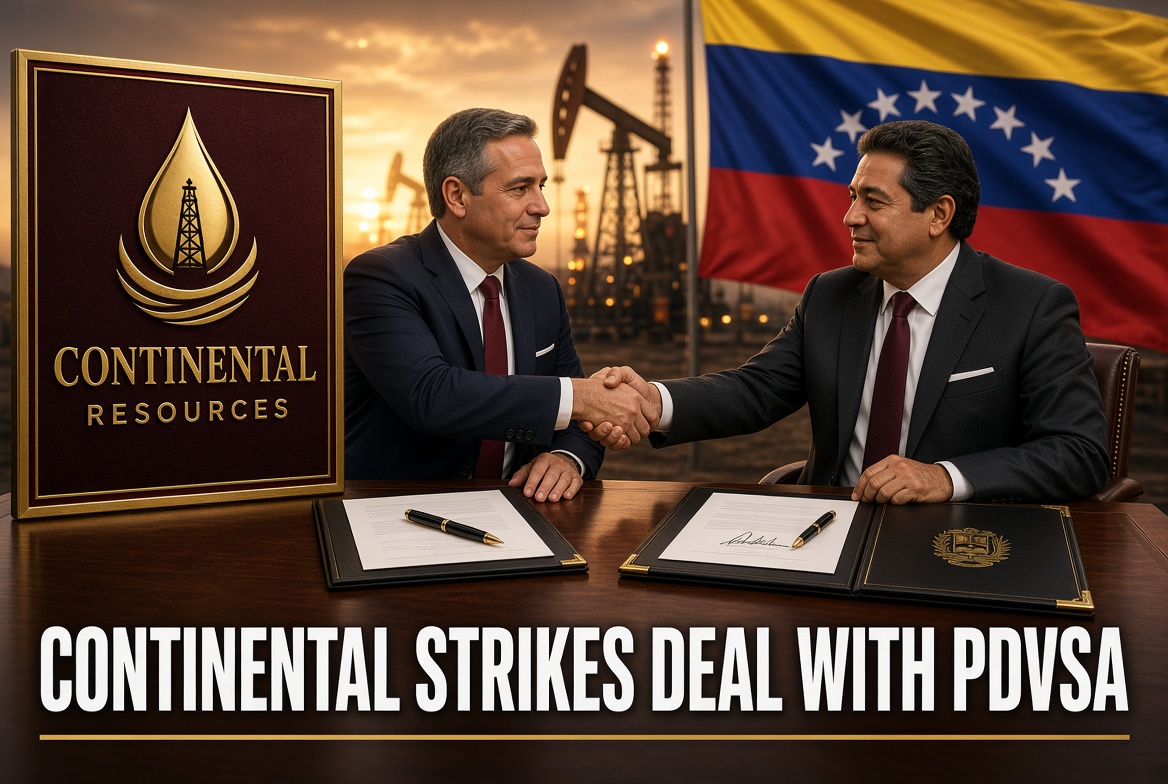
The MOU is not a final development contract. Continental and PDVSA said they intend to convert it into a long-term Contrato de Participación Productiva (CPP) in the coming weeks. Once that agreement is signed, Continental would operate the block with a 100% working interest.
The announcement was made in Houston during the G20 energy ministers meeting and follows Washington’s push for American companies to help rebuild Venezuelan output after years of underinvestment, sanctions, and operational collapse.
The Block: Ayacucho 2
Ayacucho 2 sits north of the Orinoco River in Anzoátegui state. Continental estimates the tract covers about 126,000 acres and holds roughly 30 billion barrels of resource in place. That figure is oil in the ground, not proved reserves and not a production forecast.
The wider Ayacucho area is one of the four classic Orinoco Belt divisions, historically known as Hamaca. Neighboring Ayacucho acreage already hosts heavy-oil operations such as the Petropiar joint venture, but Continental described Ayacucho 2 as a greenfield project. That means the first work program will be seismic, appraisal, and exploration rather than a simple restart of existing wells.
CEO Doug Lawler called the block “one of the most significant resource opportunities in Continental’s nearly 60-year history.” Founder and Chairman Emeritus Harold Hamm said the agreement “takes Continental to an entirely new level.” Continental said it began screening Venezuelan opportunities after the Trump administration urged U.S. producers to participate and after Caracas revised its hydrocarbon framework. The company also said it will keep evaluating other Venezuelan assets.
Orinoco crude is extra-heavy. It needs diluent, upgrading capacity, power, water handling, and export logistics. Those constraints, more than geology, are why a 30-billion-barrel resource number does not automatically translate into barrels at the wellhead.
How Soon Could Production Arrive?
Two timelines are on the record, and they are not the same thing.
Lawler told Reuters first output could start in as little as 18 months. He also said Continental is evaluating possible partnerships while planning to keep 100% working interest.
The New York Times reported Lawler saying operations could begin six months after a final contract is signed, while warning that the path to production is highly uncertain because the site is undeveloped.
A practical reading is this: field work could start within months of a CPP. First oil is more likely late 2027 or 2028 if the contract closes on the company’s stated schedule, seismic and permitting move quickly, and diluent/export capacity is available. That is faster than a typical greenfield mega-project, but slower than a brownfield workover program of the kind Chevron can run on existing Orinoco infrastructure.
Continental has not published a plateau rate, capex budget, or well count. Until those numbers appear in a definitive contract, Ayacucho 2 should be treated as a large inventory addition, not as barrels already in the 2026 supply balance.
Venezuela’s Last 10 Years of Oil Production
Venezuela still holds the world’s largest proved crude reserves, on the order of 303 billion barrels. Production has not matched that resource base.
Sources disagree on exact annual averages because OPEC official submissions, OPEC secondary sources, EIA crude-only series, and Energy Institute totals (which can include NGLs) are not identical. The direction of the story is not in dispute.
Approximate crude / liquids production, thousand barrels per day
|
Year
|
EIA-style crude series
|
OPEC / official-linked series
|
Broader liquids series
|
|---|---|---|---|
|
2016
|
2,254
|
~2,370
|
~2,570
|
|
2017
|
1,997
|
~2,030
|
~2,210
|
|
2018
|
1,486
|
~1,510
|
~1,640
|
|
2019
|
878
|
~1,010
|
~1,015
|
|
2020
|
527
|
~570
|
~650
|
|
2021
|
595
|
~640
|
~640
|
|
2022
|
724
|
~720
|
~780
|
|
2023
|
771
|
~780
|
~865
|
|
2024
|
863
|
~920
|
~975
|
|
2025
|
~970
|
~1,080
|
~1,100
|
Sources compiled from countryeconomy/Datosmacro, OPEC Statistical Bulletin figures cited in 2026 industry reviews, and Energy Institute/YCharts annual series.
The collapse from more than 2 million barrels a day in the mid-2010s to a 2020 trough near 500,000–650,000 bpd was the product of underinvestment, lost technical staff, failing upgraders, diluent shortages, and sanctions. Recovery since 2021 has been real but incomplete. By mid-to-late 2026, official and secondary estimates clustered around 1.0–1.25 million bpd, still roughly 60–70% below 2013 levels near 2.5 million bpd.
Active rigs and new-well counts tell the same story. API has noted that Venezuela completed only 190 new wells from 2020 through 2024, versus 1,560 in 2007 alone, while active rigs fell from 221 in 2014 to a handful in 2024.
That is the hole Continental, Chevron, Eni, and other new operators are being asked to fill.
The Rest of the Deal Flow: Chevron, Eni, NABEP — and Exxon Still on the Sideline
Continental is not the first mover. It is the latest.
Chevron, September 2, 2026. Chevron committed more than $7 billion over five years through its Venezuelan joint ventures and said it intends to more than double its Venezuelan output to about 600,000 bpd. The expansion adds two adjacent Carabobo-area blocks in the Orinoco Belt — Carabobo 1 and Carabobo-2-South-A — next to the existing Petroindependencia venture. Chevron also operates Petropiar in the Orinoco and Petroboscan in Zulia. CEO Mike Wirth said total production costs are expected to stay below $20 per barrel, in part because the new acreage can use existing roads, power, water, and pipelines rather than a full greenfield build.
Eni. At the same Caracas signing wave, Eni took a larger position in Junín-5, another Orinoco extra-heavy block. Reporting put oil in place as high as 35 billion barrels, current output around 12,000 bpd, and a development concept that could involve about $1.5 billion a year and a long-term target near 400,000 bpd if executed.
The U.S.–Venezuela 17-field package. Separate from Continental, Washington and Caracas announced a long-term arrangement covering 17 fields with roughly 65 billion barrels of proved potential and a stated long-term target of 1.5 million bpd. Venezuelan officials have cited more than $200 billion in possible fiscal take; U.S. officials have put near-term private investment in the broader rebuild near $100 billion. The private operator identified in subsequent reporting is North American Blue Energy Partners (NABEP), with a U.S. government equity stake reported at 35%. Those terms remain politically contentious and less transparent than a conventional IOC joint-venture release.
Other signed or advancing pacts
Repsol signed a mid-2026 crude and gas agreement tied to Petroquiriquire and the eastern shore of Lake Maracaibo, with officials discussing about 20,000 bpd of additional light crude.
SLB signed a June 2026 MOU with PDVSA on digitalization, AI workflows, and field modernization.
Turkey’s Minerosol Group (Çan2 Termik) signed a 20-year deal for the CEMA area in Anzoátegui, with a $381.7 million plan, remaining reserves cited at 104.2 million barrels of oil and 499.3 Bcf of gas, and a target lift from about 400 bpd to 9,865 bpd.
ExxonMobil. There is still no announced Exxon operating contract. President Trump has said Exxon will invest. Exxon CEO Darren Woods said earlier in 2026 that Venezuela was “uninvestable” under the old legal framework and that durable investment protections were required. May 2026 reporting said Exxon was in talks for as many as six fields and had sent technical teams to Caracas. As of this week’s Continental announcement, Exxon and ConocoPhillips remain the two large U.S. independents most scarred by the 2007 expropriations of Cerro Negro, La Ceiba, and related projects. A U.S. court last year recognized an Exxon compensation award of about $984.5 million. Their return would be strategically important. It is not yet a signed barrel.
What This Could Mean for Future Growth
If even a portion of the announced programs is executed, Venezuela’s production path changes from a slow crawl above 1 million bpd to a multi-year rebuild.
U.S. Energy Secretary Chris Wright has used several related targets: a more-than-doubling of output over the next few years, 1.5 million bpd by around the end of 2027 in some remarks, and 2 million bpd by the end of the decade. Those figures are political and operational stretch goals, not independent audits.
A sober stack-up looks like this:
Near term (2026–2027): most incremental barrels come from Chevron brownfield growth, existing NABEP/partner fields already producing around 200,000 bpd, diluent restoration, and workovers. Continental does not move the 2026 average.
Medium term (2028–2030): Ayacucho 2, Carabobo step-outs, Junín-5, and the 17-field package can start to matter if contracts hold, upgraders and pipelines are repaired, and heavy-oil netbacks stay investable.
Ceiling: getting back to 2 million bpd would be a major recovery. Getting back to the late-1990s peak near 3.2–3.5 million bpd would require tens of billions of dollars, years of drilling, rebuilt refining and upgrading, and political durability that Venezuela has not yet demonstrated.
Continental’s contribution is inventory and operating capability, not an overnight national supply shock. The company’s shale-era strength — speed, capital discipline, and pad-scale development — is useful in the Orinoco only after the subsurface is appraised and the midstream exists. That is why Lawler’s 18-month first-oil comment is the number to watch, and why it should be treated as a best case.
Why It Can Help Venezuela — and U.S. Consumers
For Venezuela, oil is still the fiscal engine. Higher output and legally clearer private-operator contracts can bring hard-currency investment, royalties and taxes, field jobs, and a path to repair power systems, upgraders, and export terminals that have been decaying for a decade. Acting Venezuelan officials have framed the broader deal wave as a reconstruction program measured in the hundreds of billions of dollars over a generation. Whether that money reaches institutions rather than intermediaries will decide if the recovery sticks.
For U.S. consumers, the transmission mechanism is not a Continental well in Anzoátegui next quarter. It is the Gulf Coast refining system.
U.S. complex refiners were built to run Venezuelan extra-heavy and other sour grades. When those barrels disappeared, plants substituted Canadian heavy, Mexican Maya, and other crudes, often at a cost. Venezuelan barrels have already been returning to the Gulf. EIA data cited in September 2026 reporting showed U.S. imports of Venezuelan crude rising through the first half of the year to 630,000 bpd in June. Chevron’s Pascagoula, Mississippi, refinery has increased coker runs on Venezuelan feedstock and can take more if supply is reliable.
Wright has argued that more available crude puts downward pressure on oil prices, while noting that refining capacity, not crude availability, is often the tighter constraint on gasoline and diesel. Additional heavy barrels still help on two fronts: they improve utilization at coking refineries designed for them, and they diversify Western Hemisphere supply at a time when officials want less dependence on longer-haul barrels. That can dampen crack-spread spikes when a particular heavy grade is scarce. It does not guarantee cheaper pump prices if global crude is tight or if U.S. refining remains the bottleneck.
The consumer case is strongest if several conditions hold at once: contracts are honored, extra-heavy barrels actually reach the water, Gulf Coast plants keep running at high utilization, and the incremental supply is large enough to matter in a 100-million-bpd world. A single 126,000-acre MOU does not do that. A Chevron doubling plus a functioning 17-field program plus later Ayacucho 2 volumes could.
The Fine Print
This remains an MOU. Resource-in-place is not reserves. First oil is not booked. Extra-heavy projects fail when diluent, electricity, or export docks fail. Venezuela’s legal reset is new, and Exxon’s hesitation reminds us that contract sanctity is still being tested. The political backdrop — a U.S.-backed opening after the January 2026 removal of Nicolás Maduro and the elevation of Delcy Rodríguez — is itself a risk factor as well as the reason the door opened.
For Energy News Beat readers, the clean takeaway is narrower. Continental has secured a flagship Orinoco position at Ayacucho 2, wants a 100% operatorship CPP within weeks, and says first barrels are possible in about 18 months. That deal sits inside a larger 2026 reopening that already includes Chevron’s $7 billion Carabobo expansion, Eni’s Junín-5 push, and a U.S.-backed 17-field package. Venezuela’s production is no longer collapsing. It is also not yet rebuilt. Ayacucho 2 will tell us whether private U.S. independents, not just the majors already on the ground, can turn Orinoco resource headlines into measurable supply.
Making Appendices Great Again
Appendix: Sources and links
Continental / Ayacucho 2
- Continental Resources press release, Sept. 16, 2026 — https://www.prnewswire.com/news-releases/continental-resources-signs-memorandum-of-understanding-with-petroleos-de-venezuela-sa-pdvsa-to-operate-and-develop-the-ayacucho-2-block-in-venezuelas-orinoco-belt-302880911.html
- Reuters, “US firm Heeney Capital to operate Venezuela gold mine, Continental seeks to enter oil project,” Sept. 16, 2026 — https://www.reuters.com/business/energy/us-energy-producer-unveil-venezuela-investment-energy-secretary-says-2026-09-16/
- Reuters, “Continental signs Venezuela oil block deal with PDVSA,” Sept. 16, 2026 — https://www.reuters.com/business/energy/continental-signs-venezuela-oil-block-deal-with-pdvsa-2026-09-16/
- OilPrice.com, “Continental Strikes Venezuela Oil Deal with PDVSA,” Sept. 16, 2026 — https://oilprice.com/Latest-Energy-News/World-News/Continental-Strikes-Venezuela-Oil-Deal-with-PDVSA.html
- The New York Times, “Trump Ally Harold Hamm Strikes Venezuela Oil Deal,” Sept. 16, 2026 — https://www.nytimes.com/2026/09/16/business/energy-environment/harold-hamm-trump-venezuela-oil.html
- World Oil, “Continental Resources targets 30-Bbbl Venezuela oil block in PDVSA deal,” Sept. 16, 2026 — https://worldoil.com/news/2026/9/16/continental-resources-targets-30-bbbl-venezuela-oil-block-in-pdvsa-deal/
- Fox Business, “Continental Resources to develop Venezuela’s Orinoco Belt oil block,” Sept. 16, 2026 — https://www.foxbusiness.com/markets/continental-resources-strikes-venezuela-oil-development-deal
- CNBC, “Continental Resources to develop massive oil patch in Venezuela,” Sept. 16, 2026 — https://www.cnbc.com/2026/09/16/continental-resources-to-develop-massive-oil-patch-in-venezuela-.html
- Bloomberg / Yahoo Finance, “Billionaire Harold Hamm Makes Deal to Explore for Venezuela Oil,” Sept. 16, 2026 — https://finance.yahoo.com/energy/articles/billionaire-harold-hamm-makes-deal-171809886.html
- Infobae / EFE, “Continental Resources firma un memorando con PDVSA…,” Sept. 16, 2026 — https://www.infobae.com/america/agencias/2026/09/16/continental-resources-firma-un-memorandum-con-pdvsa-para-operar-un-bloque-petrolero
Chevron, Eni, and the broader 2026 deal wave