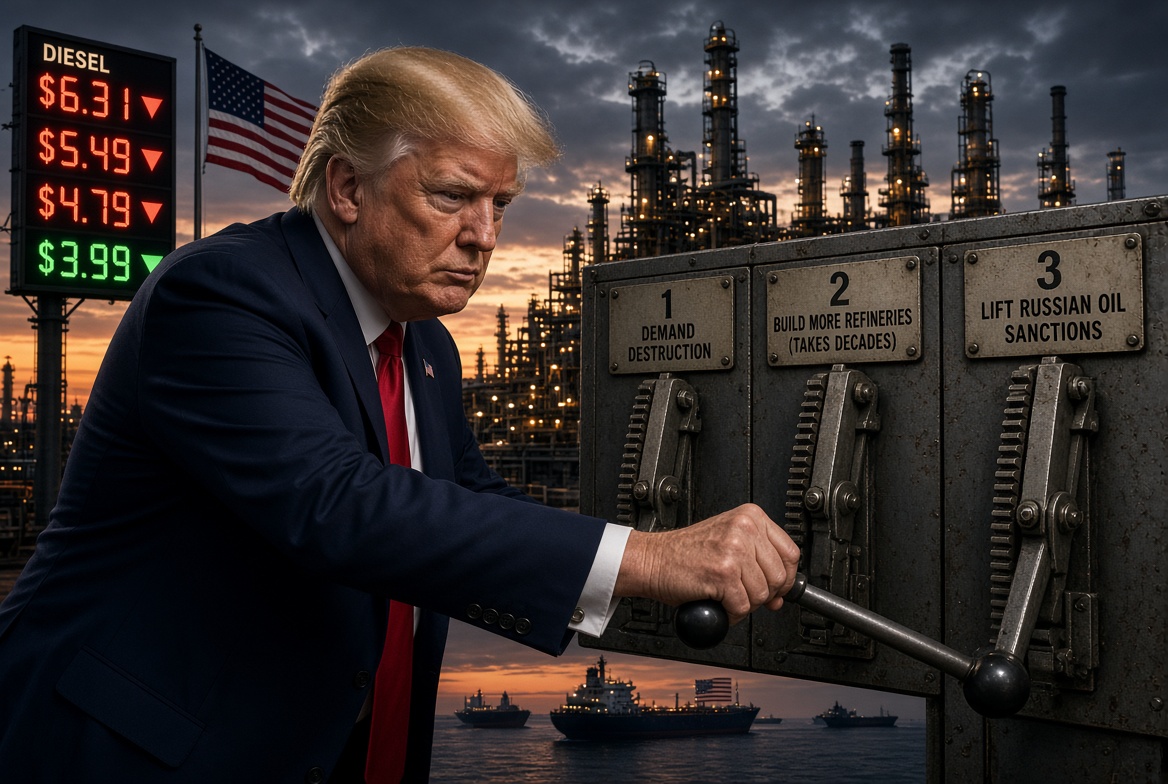
Diesel prices in the United States have smashed through records, topping $6.31 a gallon nationally as of September 16, 2026. Truckers, farmers, and households feel it immediately. Heating oil, chemically similar to diesel, is following the same path. With midterms weeks away, the political pressure is intense.
Senate Majority Leader John Thune said he is “open to exploring” a diesel export ban, arguing that if the United States has the supply and is exporting it, that “might be one way of getting at it.” Other lawmakers are floating similar ideas. The impulse is understandable. It is also based on a misunderstanding of how oil and refined-product markets actually work.
As Stu Turley has said repeatedly on the Energy News Beat Podcast: “Energy Security Starts at home, but your Energy Dominance is displayed through your Exports.” Banning diesel exports would not meaningfully change crack spreads or deliver lasting price relief at the pump. It would only undercut the political and strategic message of American Energy Dominance.
The Numbers Do Not Support a Ban
The United States is the world’s largest exporter of diesel and distillate. Recent weekly exports have run 1.5–1.9 million barrels per day, hitting records this summer as Europe and other buyers scrambled for barrels after Russian and Middle Eastern disruptions. Refineries have been running at 96–98 percent utilization—near practical maximums. There is almost no spare capacity left to simply “make more diesel” for the domestic market.
A barrel of crude produces a slate of products—gasoline, diesel, jet fuel, and others. You cannot throttle diesel output without also cutting gasoline and other fuels. Flooding the Gulf Coast with unsellable diesel would compress margins, prompt run cuts, and ultimately reduce total refined-product supply. That is the opposite of what consumers need. Distillate inventories sit about 13 percent below the five-year average even after a recent modest build; East Coast stocks have been especially tight. Prices are set in a global market. Keeping extra barrels at home does not magically decouple U.S. pump prices from worldwide tightness.
Interior Secretary Doug Burgum has already stated the obvious: an export ban is unlikely to lower prices and could invite retaliation that hurts import-dependent regions such as California. Analysts have called the idea “chilling.” After the 2015 lifting of the crude-export ban, presidential authority over refined-product exports was also constrained. Any new restriction would almost certainly require an act of Congress.
The Global Picture Is the Real Driver
The current squeeze is not primarily a U.S. production problem. It is a global refined-product shortage.Russia, normally the world’s second-largest diesel exporter, has banned diesel exports through at least October 31 and has seen multiple refineries damaged by Ukrainian strikes. Russian diesel loadings have collapsed. Urals crude has surged past $110 a barrel despite sanctions, showing that demand for Russian barrels remains strong.
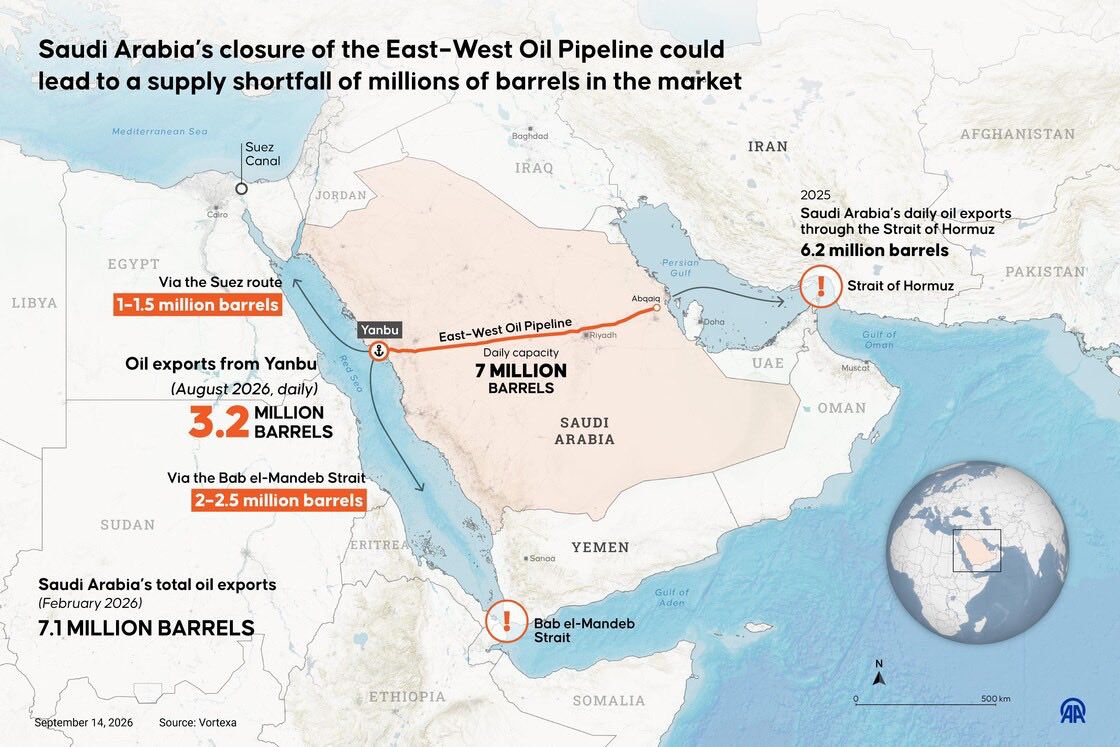
Saudi Arabia’s East-West pipeline—the 7-million-barrel-per-day route that moves crude from Abqaiq to the Red Sea port of Yanbu, bypassing the Strait of Hormuz—was shut after drone attacks in mid-September. Yanbu was already exporting about 3.2 million barrels per day in August, against earlier total Saudi exports near 7.1 million. Alternative routes (Suez 1–1.5 million bpd, Bab el-Mandeb 2–2.5 million bpd, plus remaining Hormuz volumes) cannot close the gap. Oil is still moving via tankers that go dark and through remaining corridors, but not at the volumes needed to ease prices.
The dark fleet continues to move Russian and other sanctioned oil. Pretending otherwise does not change the physics of tankers and cargoes.
The Levers Actually Available
President Trump has a limited set of realistic options to influence prices in the near term.
Demand destruction. High prices are already doing some of this work. It is painful, inflationary, and politically toxic heading into midterms. It is not a strategy; it is a symptom.
More refining capacity. Building or expanding refineries takes years, often a decade or more. The United States lost capacity through closures (Houston, Los Angeles, and others) driven by regulations, ESG pressure, and prior policy choices. New projects, such as the Permian-focused facility in Brownsville, Texas, are welcome but will not solve a 2026 winter shortage. We arrived here because of years of discouraging domestic refining investment.
Easing sanctions on Russian oil. This is the lever that can actually increase global refined-product supply in a timeframe that matters. Russian refineries, when running, produce large volumes of diesel. The dark fleet will move the oil anyway. Making the trade more transparent and efficient would put more barrels into the market rather than forcing them through inefficient, higher-cost channels. Trump already issued temporary waivers earlier in 2026 for oil already at sea and has publicly urged Ukraine to stop striking Russian energy infrastructure because those attacks raise U.S. pump prices. Further targeted relief focused on refined products could help more than an export ban ever would.
Reopening the Strait of Hormuz and restoring Saudi pipeline capacity remain the highest-impact geopolitical moves, but those are not fully under Washington’s control.
Banning U.S. diesel exports would signal that America is retreating from the very markets it has spent years building. It would squeeze allies in Europe that now rely on American barrels, invite tit-for-tat measures, and do nothing to fix the structural shortage of global refining capacity. Energy security starts at home. Energy dominance is proven by reliable exports. The data and the market mechanics both say the same thing: an export ban is the wrong tool for this problem.
President Trump would be wise to pull the third lever first and get in front of the story. China is already buying the market, not in US dollars through dark fleet tankers, so why not help the narrative and get in front of politicians who don’t understand the oil and gas markets? If he waits for demand destruction to kick in, the economy and political narratives change for the worse.
- Bloomberg: Thune open to diesel export ban – https://www.bloomberg.com/news/articles/2026-09-15/thune-says-he-s-open-to-diesel-export-ban-as-prices-surge
- OilPrice.com: Russia extends diesel export ban – https://oilprice.com/Latest-Energy-News/World-News/Russia-Extends-Diesel-Export-Ban-Through-October.html
- Benzinga: Analyst warns export ban would be “chilling” – https://www.benzinga.com/news/politics/26/09/61810522/record-diesel-prices-have-john-thune-considering-export-ban-but-analyst-warns-move-would-be-chilling-calls-for-extreme-caution
- Reuters: Burgum says export ban unlikely to lower prices – https://www.reuters.com/legal/litigation/us-oil-export-ban-unlikely-lower-energy-prices-interior-secretary-says-2026-09-14/
- EIA Weekly Petroleum Status Report and distillate data – https://www.eia.gov/petroleum/supply/weekly/ and related tables
- S&P Global Energy / Business Today: Winter coming for diesel – https://www.businesstoday.in/latest/economy/story/winter-is-coming-for-diesel-warns-sp-global-energy-555966-2026-09-16
- AFPM analysis of product export bans – https://www.afpm.org/print/pdf/node/40395
- X post by
@Alex_Oloyede2
on Urals crude >$110 – https://x.com/Alex_Oloyede2/status/2100260785960128788
- X post by
@jackprandelli
on Saudi East-West pipeline – https://x.com/jackprandelli/status/2100252554651459640
- Reuters / CNBC / OilPrice on Saudi pipeline shutdown – https://www.reuters.com/business/energy/us-energy-chief-says-saudi-arabia-oil-pipeline-should-be-back-within-days-2026-09-15/ and https://oilprice.com/Latest-Energy-News/World-News/Saudi-Aramco-Cancels-European-Crude-Cargoes-as-Key-Pipeline-Stays-Shut.html
- NYT / WaPo on earlier Russian oil sanctions waivers and Trump comments on Ukrainian strikes – https://www.nytimes.com/2026/03/12/us/politics/trump-russia-oil-sanctions.html and https://www.washingtonpost.com/world/2026/09/13/trump-calls-zelensky-stop-attacking-russian-energy-targets/
- Energy News Beat / Stu Turley references – https://theenergynewsbeat.substack.com/p/natural-gas-powering-the-future and https://energynewsbeat.co/us-energy-dominance-vs-eu-net-zero/
- Additional market analyses: RBN Energy, IER, Atlantic Council, CSIS, Columbia CGEP, Dallas Fed (historical but still relevant mechanics).