

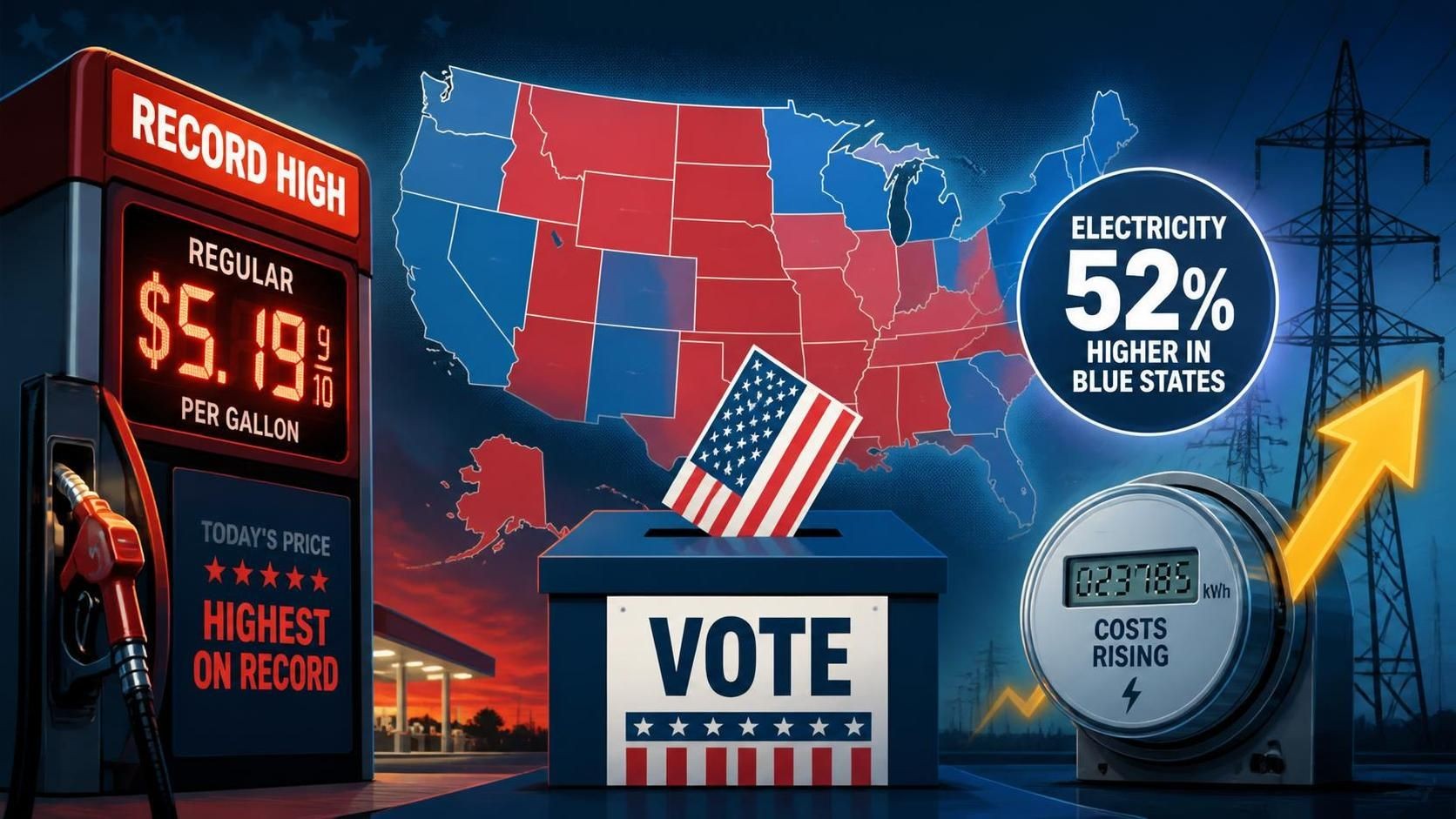
Regular averaged $4.149 on Tuesday morning, the highest Election Day price on record in nominal dollars. Diesel was $6.288, and heating oil has started the winter above $6 a gallon. Ukraine is hitting Russian refineries again, and nine states are electing the people who set utility rates. Here is what each of those numbers does and does not tell you about your bills.
By Energy News Beat | Nov. 3, 2026
If you filled up on the way to vote this morning, you paid more than any American voter has on an Election Day, at least in the dollars printed on the sign. AAA put the national average for regular at $4.149 a gallon on Tuesday, Nov. 3. That is two cents lower than Monday and 12 cents lower than a week ago, but $1.11 more than the $3.036 drivers paid a year ago. Diesel averaged $6.288, up $2.61 from $3.680 a year ago.
Three energy stories meet at the ballot box today. Gasoline is the one voters can see. Diesel and heating oil are being pushed around by a war a long way from any American polling place. And in nine states, the people who approve electricity and gas utility rates are themselves on the ballot. This piece walks through all three, with the numbers checked this morning and the gaps marked plainly.
One market note sets the scene, with a time stamp because it is moving fast. Reuters, carried by Euronext, reported Brent crude up $1.36 at $106.13 a barrel and West Texas Intermediate up $1.45 at $97.91 as of 10:43 GMT on Tuesday, which is 4:43 a.m. Central. That followed a fall of more than 7 percent on Monday, when Brent settled at $104.77. The bounce came after Iran said a deal to end the war remained distant and a U.S. official said U.S. forces had struck Iran’s Qeshm Island, Reuters reported. Those prices will be stale by the time you read this.
A record, with one important asterisk
The Washington Post reported Monday that gas was set to be the highest for any Election Day in U.S. history. It put Monday’s AAA average at $4.17, “roughly 37 cents higher” than the $3.80 average before the 2022 midterms, the previous Election Day high. The $3.80 is the Energy Information Administration’s weekly survey reading of $3.796 for Nov. 7, 2022. Today’s AAA figure is 35.3 cents above it. Measured against AAA’s own Election Day 2022 average of $3.804, as reported at the time by Fox Business, the gap is 34.5 cents.
We checked the comparison against EIA’s weekly survey for every federal Election Day since 2000, shown in Chart 1. No Election Day reading comes close to today’s in nominal terms. The 2012 election week was $3.492 and 2024 was $3.069.
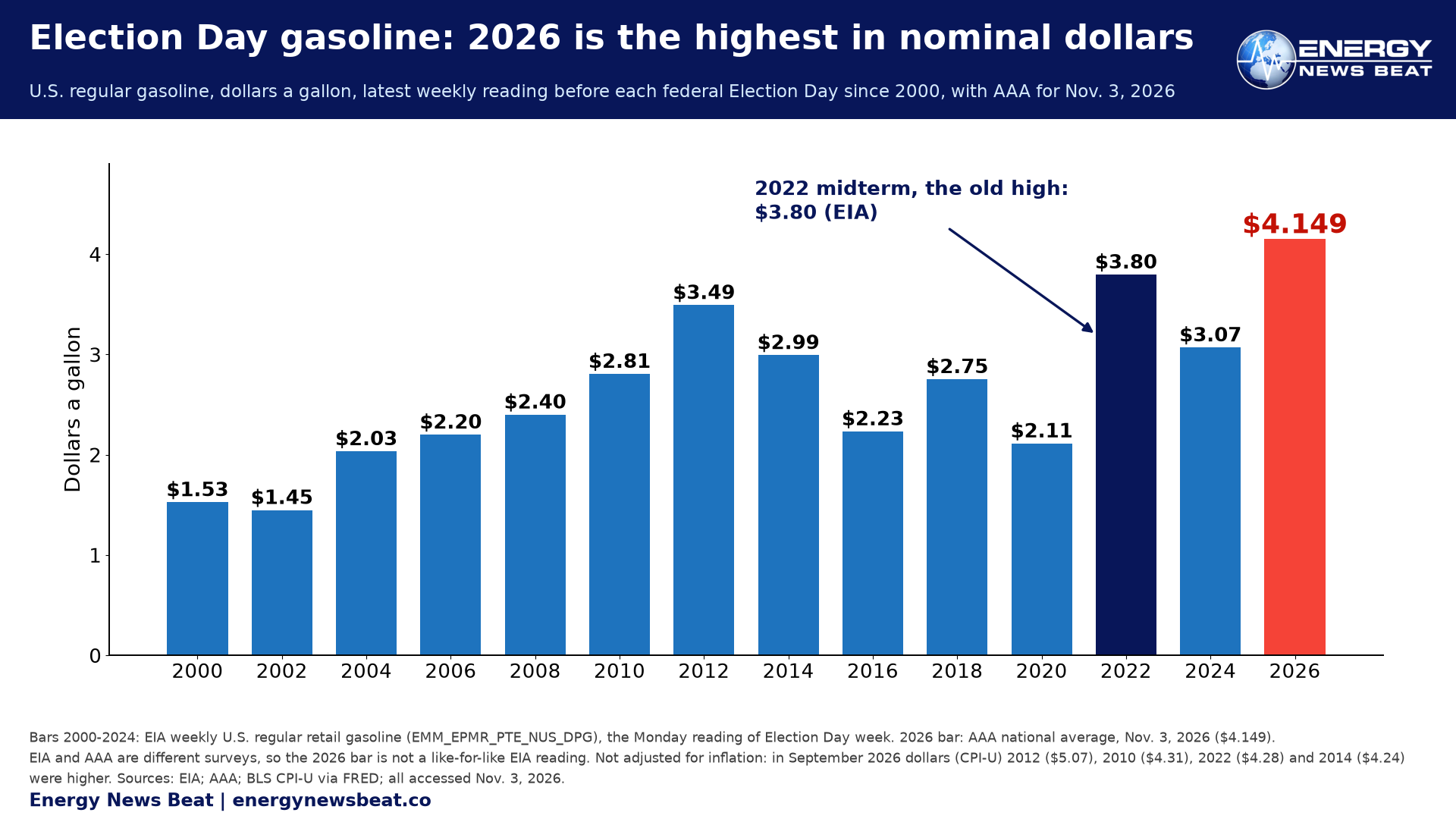
Here is the asterisk. These are not inflation-adjusted. Using the government’s consumer price index (CPI-U via FRED) to put each year in September 2026 dollars, 2012’s $3.492 is worth about $5.07, 2010’s $2.806 about $4.31, 2022’s $3.796 about $4.28, and 2014’s $2.993 about $4.24, all above today’s $4.149. So the honest version is this: today is the highest Election Day pump price on record in dollars, but not the most expensive Election Day relative to everything else people buy. Both statements are true, and voters feel the first one at the pump.
There is a second, smaller caveat. AAA and EIA run different surveys. The Post compares a daily AAA number with a weekly EIA number. Our own chart does the same for the 2026 bar, and it is labelled that way. EIA’s latest weekly reading, for Oct. 26, was $4.269. The 2026 weekly peak was $4.500 on May 11, and the all-time weekly record is still $5.006 from June 13, 2022.
The direction this week is down. Al Jazeera reported regular 12 cents lower on the week and 23 cents lower on the month, against $2.98 on Feb. 28, the day the strikes on Iran began. GasBuddy’s Patrick De Haan, in a post quoted by Al Jazeera, said “the national average could fall under $4 a gallon in the next week barring a course change.” That is a forecast, made before Tuesday’s crude bounce, and it is labelled as one here.
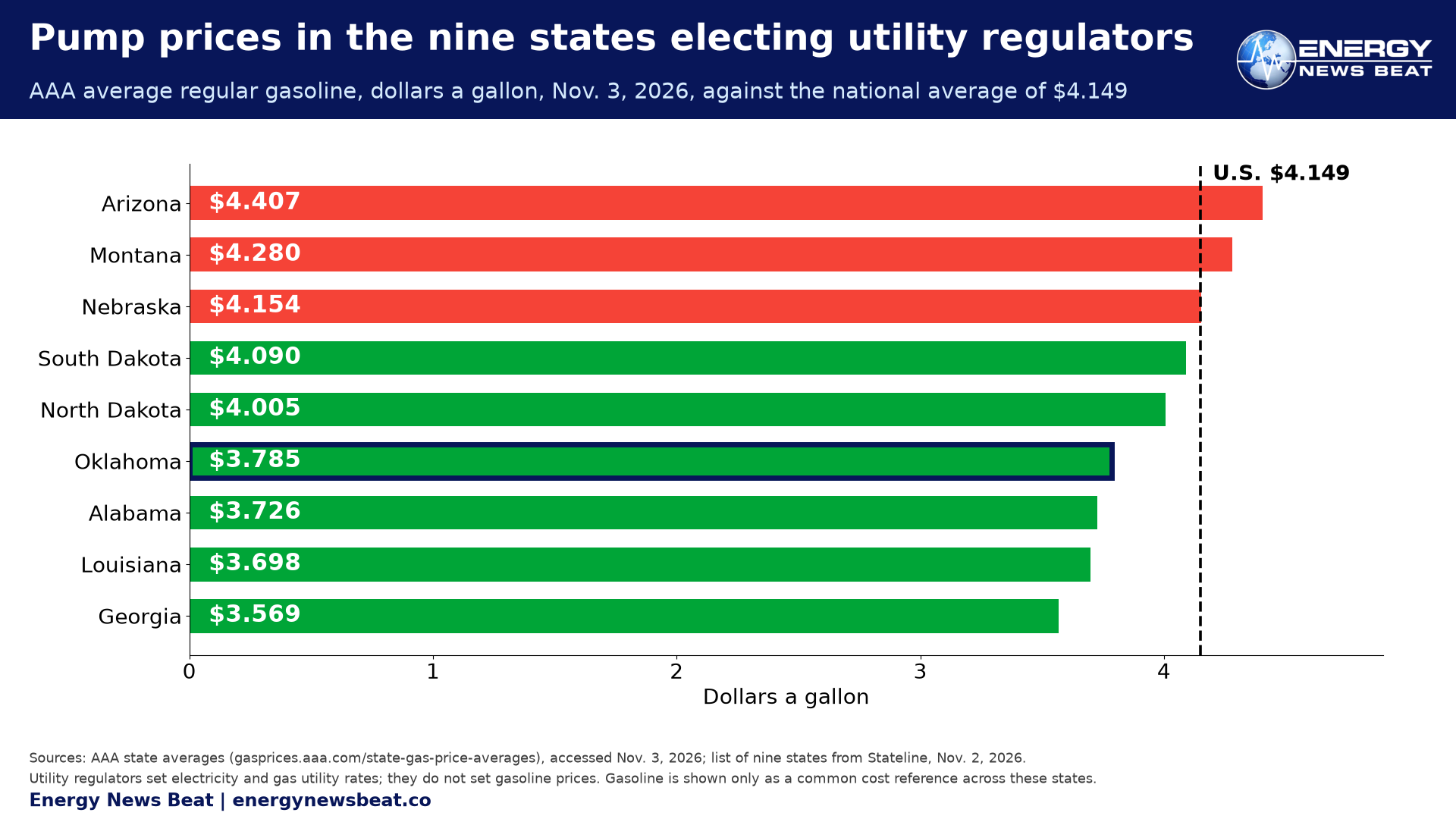
The national number hides a wide spread. AAA’s state table has California at $5.889 and North Carolina at $3.383, a gap of $2.51. Here in Oklahoma regular is $3.785, about 36 cents below the national average, and Texas is $3.627.
Diesel and heating oil: the war you pay for in gallons
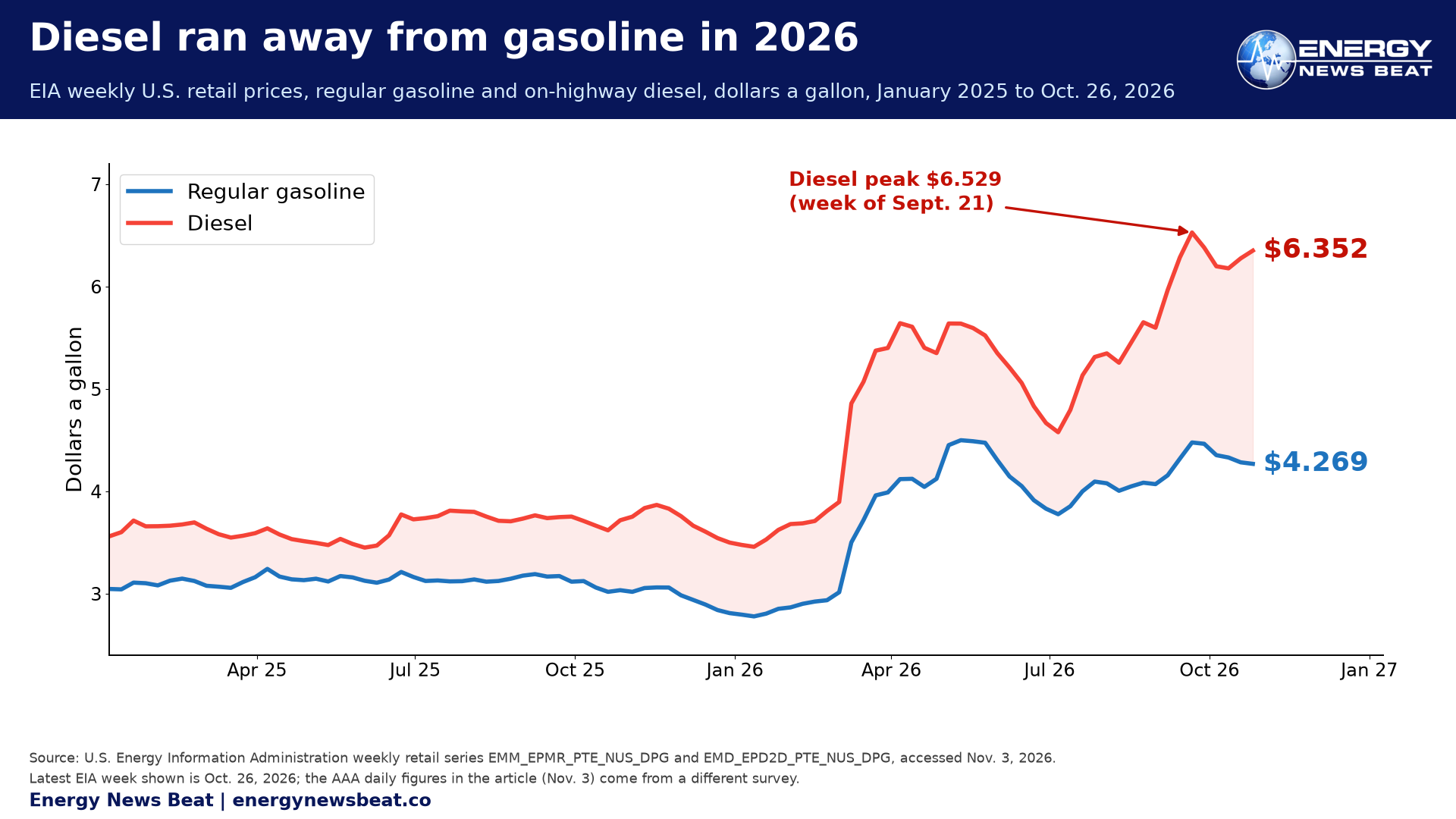
Diesel is the bigger story for the household budget, even for people who never buy it. It moves freight, farm equipment and, in the Northeast, the furnace. EIA’s weekly retail diesel survey set its record at $6.529 on Sept. 21 and was $6.352 on Oct. 26. In the 2022 election week it was $5.333.
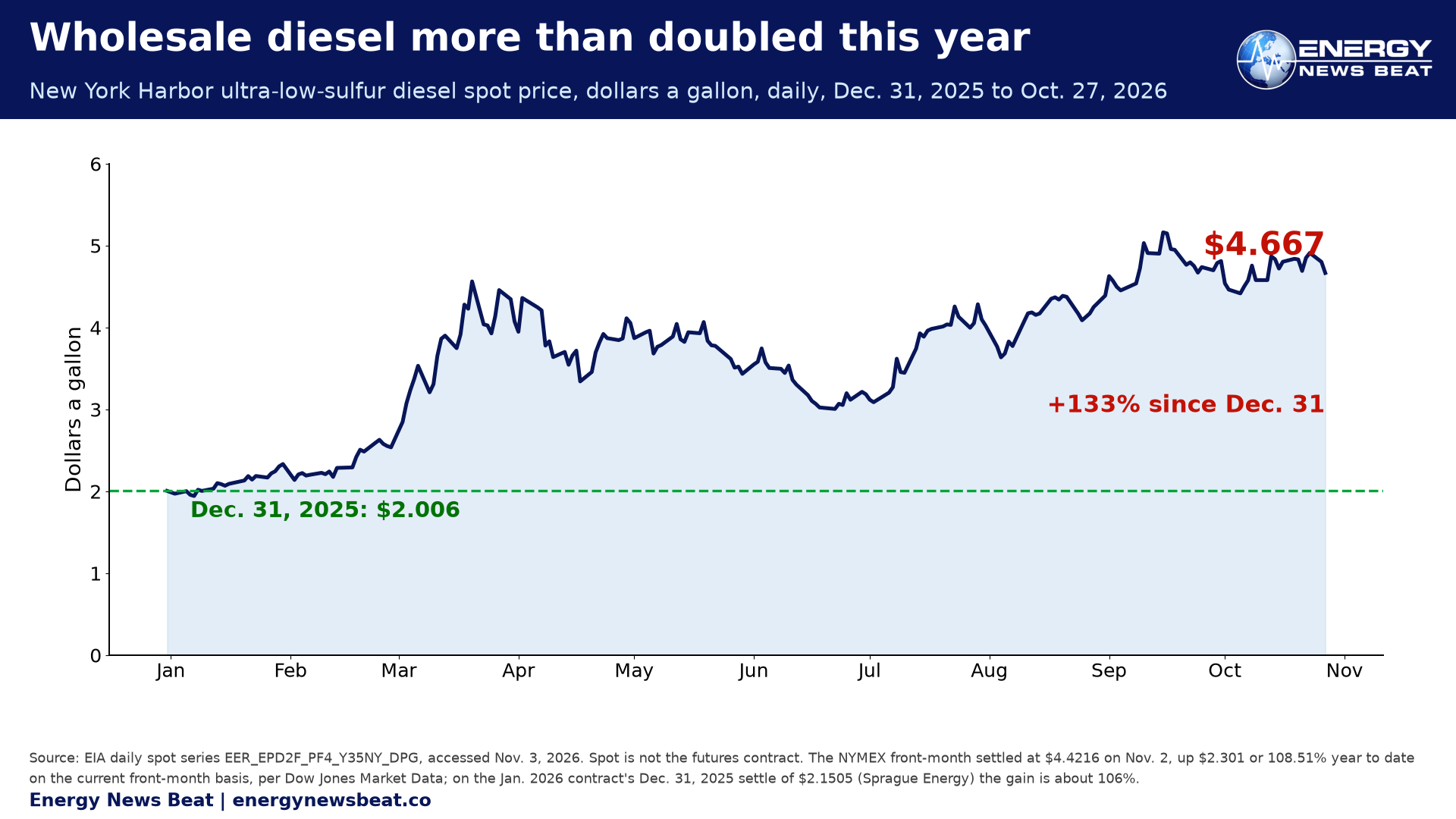
Wholesale moved first. The front-month NYMEX ultra-low-sulfur diesel contract settled at $4.4216 a gallon on Monday, down 5.44 percent on the day. Dow Jones Market Data put Monday’s settle up $2.301, or 108.51 percent, year to date, based on the current front-month contract. Measured against the January 2026 contract’s Dec. 31, 2025 settle of $2.1505, the gain is about 106 percent. A week earlier, on Oct. 26, Dow Jones put the year-to-date gain at 131.63 percent. The New York Harbor spot price EIA publishes tells the same story, from $2.006 on Dec. 31 to $4.667 on Oct. 27.
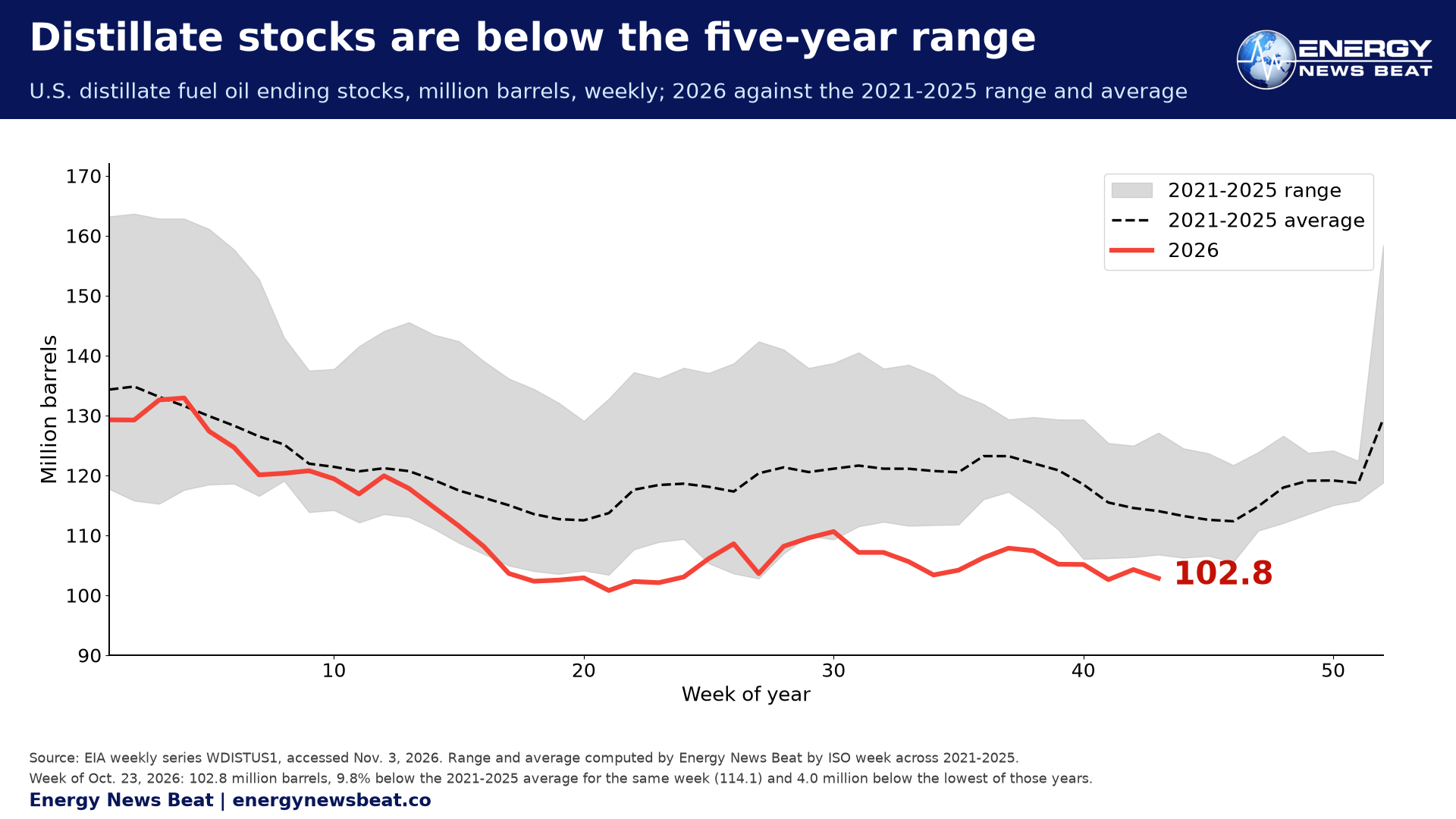
Why so high? Part of it is crude, which is up because of the Iran war. Part of it is the barrels themselves. U.S. distillate stocks were 102.8 million barrels in the week to Oct. 23. That is 9.8 percent below the 2021-2025 average for the same week and below the lowest of those five years, our calculation from EIA data.
Then there is Russia, normally one of the world’s biggest diesel exporters. Ukraine has resumed drone strikes on Russian refineries. Oilprice.com reported that Rosneft’s Novokuibyshevsk refinery was hit on Friday, the first strike on a Russian refinery since Oct. 15. Over the weekend drones hit a Rosneft refinery in Bashkortostan and Lukoil’s plant at Kstovo. The Kyiv Post describes Kstovo as a refinery of roughly 17 million metric tons a year, about 340,000 barrels a day. It reported “multiple large fires”, based on open-source monitors. How much capacity is actually offline has not been independently confirmed, and this article does not estimate it. Oilprice also reported that President Trump had pressed Ukraine to halt refinery strikes ahead of the midterms.
At the same time, Moscow has extended its diesel export ban to the end of January 2027, the Kyiv Post reported, with exemptions for designated suppliers under the arrangement with Washington. TASS carried Deputy Prime Minister Alexander Novak’s announcement of the extension. The Kyiv Post, citing Bloomberg, reported planned November exports of about 2.15 million tons, up from about 510,000 tons in October. Those are plans, not loadings. If they happen, more Russian diesel could reach world markets just as Russian refineries are being hit. Those two forces pull in opposite directions, and nobody can yet say which wins.
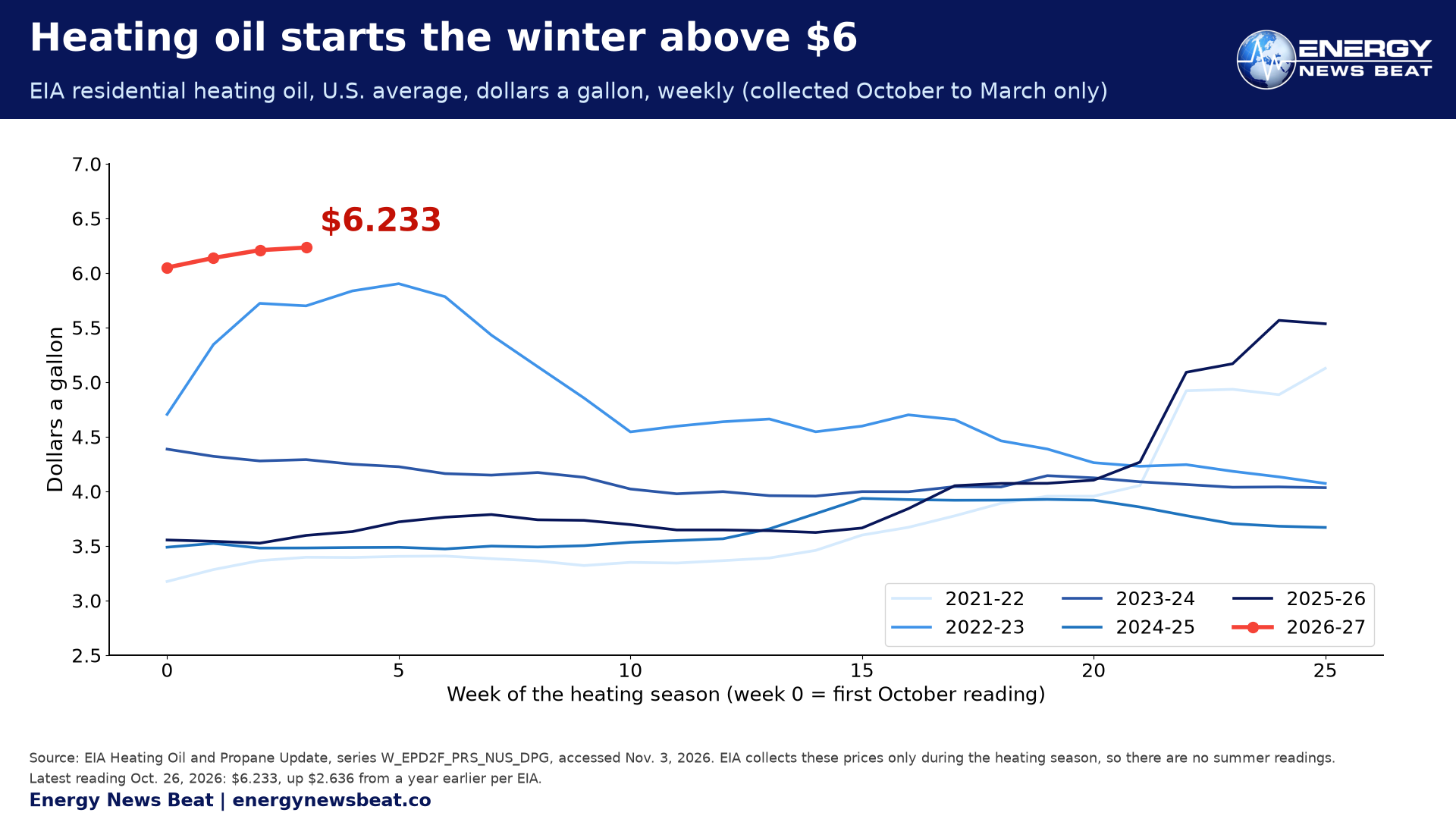
For homes that heat with oil, mostly in New England and the Mid-Atlantic, this is already showing up in the bill. EIA’s residential heating oil average was $6.233 a gallon on Oct. 26, up $2.636 from a year earlier. That is the highest reading in EIA’s weekly series, which goes back to 1990 (Chart 4). Residential propane was $2.730.
The meter: regulators on the ballot and a costlier winter
Most Americans get their electricity and natural gas from utilities whose rates are approved by state regulators. According to Stateline, those regulators are on the ballot today in nine states: Alabama, Arizona, Georgia, Louisiana, Montana, Nebraska, North Dakota, Oklahoma and South Dakota. Two of three Alabama Public Service Commission seats are up, and Arizona voters are filling two seats on its Corporation Commission. Oklahoma, where Energy News Beat is based, is one of the nine; Ballotpedia tracks each race.
Ted Thomas, a former chair of the Arkansas Public Service Commission and an adviser to the consumer group PowerLines, told Stateline that energy costs have become an issue in their own right. He also cautioned that a change of commissioners is no guarantee of quick relief: “It’s a large, complex system that costs a lot of money,” he said, while adding that affordability “needs to be more of a priority.” The Edison Electric Institute, which represents investor-owned utilities, points to wholesale power prices and regional grid costs, which neither utilities nor state regulators control, according to the same report.
The winter forecast is not gentle. The National Energy Assistance Directors Association projects the average household will spend $1,030 to heat its home this winter, $82 more than last year. That 8.7 percent increase is, in NEADA’s words, more than 2.5 times the rate of inflation. Electric heat is projected up 9.0 percent and natural gas up 5.8 percent.
Oil heat is the outlier. In a Sept. 25 update, NEADA projected the average heating oil bill up about 50 percent, from $1,749 to $2,627. That replaced the 31.3 percent in its Sept. 14 report. NEADA says the Northeast uses 82 percent of the nation’s heating oil. Natural gas itself is not the main pressure for now: December Henry Hub futures settled at $2.856 per million British thermal units on Nov. 2 (down 4.2 cents), per Energy Intelligence.
It is worth being clear about what a regulator can and cannot do. State commissions do not set gasoline, diesel or heating oil prices; those are market prices. Regulators decide what utilities may charge for delivering electricity and gas, which costs customers carry, and how quickly. That matters a great deal to monthly bills, but it is a different lever from the one moving the pump. Chart 6 shows pump prices in the nine states only as a common reference point.
Consumer and investor views
For households, the practical picture is mixed. Gasoline is falling week to week and could ease further if crude stays lower, but Tuesday’s bounce is a reminder that one headline can reverse a day’s gains. Heating oil customers face the steepest increase, and NEADA’s figures suggest budget plans and early fills deserve a look now rather than in January. Families who struggle with bills can ask their state’s energy assistance office, the agencies NEADA represents, whether they qualify. Electricity and gas customers in the nine states have a direct say today in who approves their rates.
For investors, diesel is where the tension sits. Wholesale diesel is up about 108 percent this year, while distillate inventories are below their five-year range heading into winter. Two things could ease it: more Russian exports under the exemptions, or a durable Iran deal that pulls crude lower. Two things could push it the other way: further refinery damage, or a breakdown in talks. None of this is advice to buy or sell anything, and the right answer depends on facts that do not exist yet.
Caveats and the case against the headline
A fair reader could push back on several points, and should. First, “record” is nominal. In inflation-adjusted terms, the 2010, 2012, 2014 and 2022 Election Days were more expensive, as shown above. Second, the record compares two different surveys, AAA daily and EIA weekly. Third, prices are falling, not rising, this week. Anyone describing today as a fresh spike has the direction wrong. Fourth, the refinery strikes are real, but their effect on supply is not measured, and claims of large outages should be treated as unverified until Russian output data or company statements confirm them. Fifth, NEADA’s winter figures are projections that depend on weather and on prices that have already moved since September. Finally, this article takes no view on any race or party. Energy prices are one of many issues voters weigh, and the record of who caused what is argued from every side.
What would change this picture? A sustained fall in crude below Monday’s settle would pull gasoline under $4, as De Haan expects. A confirmed, lasting outage at Kstovo or Ufa would tighten diesel further. A cold early winter in the Northeast would test those distillate stocks quickly.
| STU’S TAKE
Opinion. Every number is linked to its source. Here is the thing I keep coming back to this morning. Gas is $4.149, the highest Election Day price in nominal dollars, and it is also falling. Both are true. In real dollars, four recent Election Days, led by 2012, were higher, so let’s not pretend this is the worst ever. It is not, and you deserve the straight version. GasBuddy’s Patrick De Haan thinks we could dip under $4 within a week. I hope he is right, but Brent bounced to $106.13 early this morning after the Qeshm strike report. Diesel is where my concern sits. Wholesale ULSD settled at $4.4216 Monday, up about 108 percent this year per Dow Jones, and distillate stocks are 102.8 million barrels, below the bottom of the five-year range. Heating oil already hit $6.233, a record in EIA’s weekly data. If you heat with oil in the Northeast, NEADA says your bill could rise about 50 percent. That is not a political talking point. That is a family deciding between groceries and a tank fill. Ukraine is hitting Russian refineries again, and Russia extended its diesel export ban with carve-outs. I am not going to pretend anyone knows how those two net out. Watch the loadings, not the press releases. Here in Oklahoma, regular is $3.785, and Oklahoma is one of nine states where the people who approve your utility rates are on the ballot today. I am not telling you who to vote for. I am telling you those races matter to your bill more than most people realize, and they rarely get airtime. The world is healing, and it will get a little bumpier as we move forward. Prepare your homes for the bumps so that you can be there for your friends, neighbors and family. Also do not be deceived. There is a lot of false reporting out there, do your own research and trust nobody’s work. That is why we publish our links, sources (except when noted and we can’t) and Making Appendices Great Again is not just a cool saying. If you don’t vote, they win. Am I happy with the Republicans – NO WAY. They are acting like a Uni-Party, but I still voted. I will be tracking every vote impacting energy in Federal and State policies and publishing their records as I will not sit by while the mainstream media does not report facts.
|
Check out the World’s Greatest Podcast Show Notes at EnergyNewsBeat.co or EnergyNewsBeat.com. And subscribe to: The Energy News Beat Substack.
Appendix
Sources, verbatim excerpts, full data tables, methodology notes and corrections for “Voters Head to the Polls With the Highest Election Day Gas Price on Record in Dollar Terms”. Every figure in the article resolves to an entry below. Where a number is an Energy News Beat calculation it is labelled as one here and in the text. Access dates are Nov. 3, 2026 unless a document carries its own date.
A. Sources, with links and access dates
All accessed Nov. 3, 2026. Descriptions are plain text; the link is the source key.
AAA, national average gas prices (gasprices.aaa.com). Regular $4.149, diesel $6.288 on Nov. 3, 2026, with yesterday, week-ago, month-ago and year-ago columns. Accessed Nov. 3, 2026, about 6 a.m. Central. Link
AAA, state gas price averages. State regular and diesel averages used for Oklahoma, Texas, California, North Carolina and the nine regulator-ballot states. Accessed Nov. 3, 2026. Link
The Washington Post, Jarrell Dillard, “Gas prices are set to be highest for any Election Day in U.S. history,” published Nov. 2, 2026, 2:50 p.m. EST. Accessed Nov. 3, 2026. Link
Al Jazeera, Andy Hirschfeld, “US petrol prices dip ahead of midterms as voters eye costs,” published Nov. 2, 2026. Source for weekly and monthly changes, the Feb. 28 baseline and the De Haan quotation. Accessed Nov. 3, 2026. Link
U.S. Energy Information Administration, weekly U.S. regular all formulations retail gasoline price, series EMM_EPMR_PTE_NUS_DPG. Accessed Nov. 3, 2026; latest week Oct. 26, 2026. Link
EIA, weekly U.S. No. 2 diesel retail price, series EMD_EPD2D_PTE_NUS_DPG. Accessed Nov. 3, 2026. Link
EIA, Heating Oil and Propane Update, residential prices for the week of Oct. 26, 2026. Accessed Nov. 3, 2026. Link
EIA, weekly U.S. residential No. 2 heating oil price, series W_EPD2F_PRS_NUS_DPG, from Oct. 1, 1990. Accessed Nov. 3, 2026. Link
EIA, weekly U.S. ending stocks of distillate fuel oil, series WDISTUS1. Accessed Nov. 3, 2026. Link
EIA, daily New York Harbor ultra-low-sulfur No. 2 diesel spot price, series EER_EPD2F_PF4_Y35NY_DPG. Accessed Nov. 3, 2026; latest Oct. 27, 2026. Link
Federal Reserve Bank of St. Louis (FRED), Consumer Price Index for All Urban Consumers, series CPIAUCSL, from the Bureau of Labor Statistics. Latest month September 2026. Accessed Nov. 3, 2026. Link
Dow Jones Market Data via Morningstar, “Front Month Nymex ULSD Fell 5.44% to Settle at $4.4216 — Data Talk,” Nov. 2, 2026. Accessed Nov. 3, 2026. Link
Dow Jones Market Data via Morningstar, “Front Month Nymex ULSD Fell 1.45% to Settle at $4.9120 — Data Talk,” Oct. 26, 2026. Up $2.7914, or 131.63%, year to date. Accessed Nov. 3, 2026. Link
OilPrice.com, Charles Kennedy, “Ukraine Has Hit Three Russian Refineries Since Friday,” Nov. 2, 2026, 9:30 a.m. CST. Accessed Nov. 3, 2026. Link
Kyiv Post, Tymur Dubovyk, “Drones Strike Lukoil Refinery and Power Plant in Kstovo,” Nov. 1, 2026. Also covers the Oct. 30-31 Ufa strike and the Oct. 30 Novokuybyshevsk strike. Accessed Nov. 3, 2026. Link
Kyiv Post, “Russia Extends Diesel Export Ban to 2027 With Trump Carve-Out,” Nov. 1, 2026. Reports Bloomberg figures for planned November exports. Accessed Nov. 3, 2026. Link
TASS, “Russia to extend diesel export ban until late January 2027 — Novak.” Accessed Nov. 3, 2026. Link
TASS, “Russia could reach diesel export volumes of 3-3.5 mln tons per month in 2026 — Novak.” Used only in the corrections appendix. Accessed Nov. 3, 2026. Link
Reuters via Euronext Live, Ahmad Ghaddar, “Oil rises as Iran says war deal remains distant, US strikes Qeshm,” Nov. 3, 2026. Prices as of 1043 GMT. Accessed Nov. 3, 2026. Link
Stateline, Kevin Hardy, “Voters make governors, utility regulators answer for high power bills,” published Nov. 2, 2026. Accessed Nov. 3, 2026. Link
Ballotpedia, “Public service commission elections, 2026.” Accessed Nov. 3, 2026. Link
National Energy Assistance Directors Association, “Winter heating costs projected to jump 8.7 percent,” Sept. 14, 2026. Accessed Nov. 3, 2026. Link
NEADA, Winter Heating Report (PDF), September 2026. Accessed Nov. 3, 2026. Link
Fox Business, Aislinn Murphy, “Economy, rising prices top concerns as voters head to the polls,” Nov. 8, 2022, citing AAA: $3.804 national average as of Monday evening. Accessed Nov. 3, 2026. Link
Sprague Energy, “MarketWatch | Refined Products” (PDF), Dec. 31, 2025: January 2026 heating oil (ULSD) contract settled at $2.1505. Accessed Nov. 3, 2026. Link
Energy Intelligence, “Market Watch: Nymex Slides As Market Transitions Into Winter,” Nov. 2, 2026: December gas futures down 4.2 cents to $2.856 per million Btu. Accessed Nov. 3, 2026. Link
NEADA, heating oil press release (PDF), Sept. 25, 2026: average heating oil cost projected from $1,749 to $2,627. Accessed Nov. 3, 2026. Link
B. Key excerpts from primary documents
Quoted verbatim, with enough surrounding text that a reader can see what was cut. Where a quotation is commonly truncated, the tail is included and noted.
Washington Post, Nov. 2, 2026: Monday’s national average was $4.17 per AAA, “roughly 37 cents higher” than the average before the 2022 midterms, the previous Election Day record, according to the newspaper’s account of AAA and EIA data. Link
Patrick De Haan, GasBuddy, in a post on X quoted by Al Jazeera, Nov. 2, 2026: “Oil markets down significantly this morning after Trump signalled he favoured negotiations and not new attacks on Iran… Oil down [approximately] 5%, wholesale gasoline and diesel pointing to roughly 16 [cents per gallon] decline. The national average could fall under $4 a gallon in the next week barring a course change.” Brackets are Al Jazeera’s. Link
Stateline, Nov. 2, 2026: “State utility regulators, who are facing heightened levels of attention and scrutiny amid high prices, are on the ballot in nine states: Alabama, Arizona, Georgia, Louisiana, Montana, Nebraska, North Dakota, Oklahoma and South Dakota.” Link
Ted Thomas, quoted by Stateline: “It’s a large, complex system that costs a lot of money, and it provides an essential service that is a good value, even at an elevated price. But at the same time, (affordability) needs to be more of a priority. It doesn’t need to be the back burner issue.” Link
Stateline, on NEADA: “This winter, U.S. households are projected to spend an average of $1,030 to heat their homes, an increase of $82 over last year, according to the National Energy Assistance Directors Association. … said this winter’s predicted 8.7% increase is more than 2.5 times the rate of inflation.” Link
Kyiv Post, Nov. 1, 2026, on Kstovo: Ukrainian drones attacked the Lukoil-Nizhegorodnefteorgsintez refinery “overnight into Sunday, Nov. 1, triggering multiple large fires across the strategic industrial complex.” The refinery has “an annual design crude throughput capacity of approximately 17 million metric tons – equivalent to roughly 340,000 barrels per day.” Link
Dow Jones Market Data, Nov. 2, 2026 (via Morningstar): the front-month Nymex ULSD contract “Fell 5.44% to Settle at $4.4216.” Link
Dow Jones Market Data, Oct. 26, 2026 (via Morningstar): front-month ULSD settled at $4.9120, up $2.7914, or 131.63%, year to date; 6.65% below the 52-week high of $5.262. Link
C. Full data tables, with as-of dates
C1. AAA national averages, Nov. 3, 2026 (dollars a gallon)
| Fuel | Today | Week ago | Month ago | Year ago |
| Regular | 4.149 | 4.266 | 4.381 | 3.036 |
| Diesel | 6.288 | 6.352 | 6.355 | 3.680 |
Source: AAA, gasprices.aaa.com, accessed Nov. 3, 2026. Yesterday: regular 4.169, diesel 6.292. E85: 3.231.
C2. EIA weekly U.S. regular gasoline, Election Day weeks
| Election | EIA price | Sept. 2026 dollars |
| 2000 | 1.53 | — |
| 2004 | 2.03 | — |
| 2008 | 2.40 | 3.72 |
| 2010 | 2.81 | 4.31 |
| 2012 | 3.49 | 5.07 |
| 2014 | 2.99 | 4.24 |
| 2016 | 2.23 | — |
| 2018 | 2.75 | — |
| 2020 | 2.11 | — |
| 2022 | 3.80 | 4.28 |
| 2024 | 3.07 | — |
| 2026 (AAA, Nov. 3) | 4.149 | 4.149 |
Source: EIA series EMM_EPMR_PTE_NUS_DPG (Monday reading of Election Day week); CPI-U (CPIAUCSL) via FRED, October of each year to September 2026, Energy News Beat calculation. Dashes: not computed.
C3. AAA regular gasoline, nine states with utility regulator races, Nov. 3, 2026
| State | Regular | Versus U.S. |
| Arizona | 4.407 | +0.258 |
| Montana | 4.280 | +0.131 |
| Nebraska | 4.154 | +0.005 |
| South Dakota | 4.090 | -0.059 |
| North Dakota | 4.005 | -0.144 |
| Oklahoma | 3.785 | -0.364 |
| Alabama | 3.726 | -0.423 |
| Louisiana | 3.698 | -0.451 |
| Georgia | 3.569 | -0.580 |
Source: AAA state averages, accessed Nov. 3, 2026; Stateline for the list of states.
C4. Diesel and heating oil markers
| Measure | Value | As of |
| EIA retail diesel | 6.352 | Oct. 26, 2026 |
| EIA retail diesel record | 6.529 | Sept. 21, 2026 |
| NYMEX ULSD front-month settle | 4.4216 | Nov. 2, 2026 |
| NYMEX ULSD year-to-date gain | +2.301 (+108.51%) | Nov. 2, 2026, Dow Jones |
| NYMEX ULSD Jan. 2026 contract settle | 2.1505 | Dec. 31, 2025 |
| NY Harbor ULSD spot | 4.667 | Oct. 27, 2026 |
| EIA residential heating oil | 6.233 | Oct. 26, 2026 |
| Same, year earlier | 3.597 | Oct. 27, 2025 |
| Distillate stocks (million bbl) | 102.8 | Oct. 23, 2026 |
Sources: EIA; Dow Jones Market Data via Morningstar; Sprague Energy MarketWatch for the Dec. 31, 2025 settle. Accessed Nov. 3, 2026.
C5. NEADA winter heating cost projections, 2026-27
| Item | Projection |
| Average, all fuels | $1,030 (+$82, +8.7%) |
| Electricity | +9.0% |
| Natural gas | +5.8% |
| Propane | +8.7% |
| Heating oil (Sept. 25 update) | $1,749 to $2,627, about +50% |
| Heating oil (Sept. 14, superseded) | +31.3% |
Source: NEADA releases of Sept. 14 and Sept. 25, 2026, accessed Nov. 3, 2026.
D. Methodology notes
- Election Day comparison: for each federal Election Day since 2000 we took EIA’s weekly U.S. regular retail gasoline price for the Monday of Election Day week. 2026 uses AAA’s Nov. 3 daily average because EIA’s Nov. 2 weekly reading was not in the data downloaded the morning of Nov. 3. The two surveys differ.
- Inflation adjustment: each year’s price multiplied by CPI-U (series CPIAUCSL, seasonally adjusted) for September 2026 (336.298) divided by CPI-U for October of the election year. September 2026 is the latest CPI month available.
- Diesel futures year-to-date: Dow Jones Market Data reported the Nov. 2 settle of $4.4216 as up $2.301, or 108.51 percent, year to date, based on the current front-month contract (December, after the roll). On the January 2026 contract’s Dec. 31, 2025 settle of $2.1505 (Sprague Energy) the gain is about 106 percent. The article says “about 108 percent” and attributes it to Dow Jones.
- Distillate stocks five-year comparison: 2026 week compared with the same ISO week in each year 2021-2025 from EIA series WDISTUS1. Average 114.1 million barrels; lowest 106.8 (2022).
- All AAA figures are as printed on gasprices.aaa.com at about 6 a.m. Central on Nov. 3, 2026, rounded to three decimals.
- Brent and WTI on Nov. 3 are futures prices at 10:43 GMT from the Reuters report; EIA spot prices in the data tables are different instruments and dates.
E. Could not verify
Listed plainly so that nothing here reaches air or print as settled fact. Each item is either absent from the article or reported in the text as what it is: an estimate, a tracker figure, a single-source report, or a question this piece could not close.
- The extent of damage at Novokuibyshevsk, Ufa and Kstovo. Reports rest on open-source monitors and officials; no capacity-offline figure is used.
- AAA’s Election Day 2022 average ($3.804) comes from contemporaneous reporting of AAA data (Fox Business, Nov. 8, 2022), not from an AAA archive, which is not public.
- Whether Russia’s planned November diesel exports of about 2.15 million tons will load. The figure is a Bloomberg-reported plan relayed by the Kyiv Post.
- Whether the national average will fall below $4. This is GasBuddy’s forecast, not a fact.
- EIA’s weekly retail prices for Nov. 2, 2026, which were not available in the data series at the time of writing.
- December Henry Hub settled at $2.856/MMBtu on Nov. 2 (down 4.2 cents), per Energy Intelligence. The CME settlement bulletin itself could not be opened to confirm it, so no CME confirmation is claimed.
F. What the record supports, and what it does not
The argument of the piece, stated in one place so it can be checked line by line against the evidence above.
- Supported: today’s AAA regular price is the highest Election Day price in nominal dollars since at least 2000, and above the 2022 EIA reading of $3.796.
- Not supported: that this is the most expensive Election Day in real terms. 2012, 2010, 2022 and 2014 were higher in September 2026 dollars.
- Supported: retail gasoline is falling week over week; diesel is below its September record.
- Supported: wholesale diesel is up roughly 108 percent this year, and distillate stocks are below the 2021-2025 range for this week.
- Supported: residential heating oil is at the highest level in EIA’s weekly series since 1990.
- Not supported: any specific estimate of Russian refining lost to the strikes, or a forecast of how the export ban exemptions net against it.
- Supported: utility regulators are on the ballot in nine states. Not supported: any claim about how those races will turn out or what rates will do afterward.
G. Corrections to figures in circulation
Numbers that are being repeated and should not be, with what the record actually supports. Several of these appeared in early drafts of this article and were corrected before publication.
- Claim: “Diesel futures are up about 110 percent this year.”
Correction: Close, depending on the day. Dow Jones reported the Nov. 2 settle ($4.4216) up $2.301, or 108.51 percent, year to date; on Oct. 26 it reported 131.63 percent. On the January 2026 contract’s Dec. 31, 2025 settle of $2.1505 the gain is about 106 percent. The article uses “about 108 percent.”
- Claim: “Today’s gas price is the highest Election Day price ever.”
Correction: True in nominal dollars only. Adjusted for inflation, 2012 ($5.07), 2010 ($4.31), 2022 ($4.28) and 2014 ($4.24) were higher than today’s $4.149.
- Claim: “Gas is 37 cents above the 2022 midterm.”
Correction: That was Monday’s $4.17. Tuesday’s AAA average of $4.149 is 35.3 cents above EIA’s $3.796, and 34.5 cents above AAA’s own Election Day 2022 average of $3.804.
- Claim: “Heating oil bills will rise 31 percent this winter.”
Correction: NEADA’s Sept. 14 report said 31.3 percent; its Sept. 25 update raised the projection to about 50 percent ($1,749 to $2,627).
- Claim: “Russia will export up to 3.5 million tons of diesel by the end of 2026.”
Correction: TASS reports Novak’s figure as 3 to 3.5 million tons per month by year-end, not a cumulative total. The article does not use the figure.
- Claim: “Diesel is at a record.”
Correction: Retail diesel set its record at $6.529 in EIA’s weekly survey (Sept. 21); EIA’s latest, $6.352, is about 18 cents below it. On AAA’s daily average, $6.288 is about 24 cents below AAA’s $6.528 record of Sept. 22. Residential heating oil, not diesel, is at a record.
H. A note on what this article is not
- This is not election coverage and takes no position on any candidate, party or ballot measure, and makes no prediction of any result.
- This is not investment advice.
- This is not a forecast of gasoline, diesel or heating oil prices. Forecasts quoted are attributed to the people who made them.
- This is not an estimate of Russian refinery outages.
- This is not a live price feed. Every figure carries its date, and several will change during Election Day.


