German automakers put China and a brutal electric-vehicle price war first, and they are right to. Energy costs show up most clearly in the chemicals plant, in Britain’s steel towns, and at the California pump.
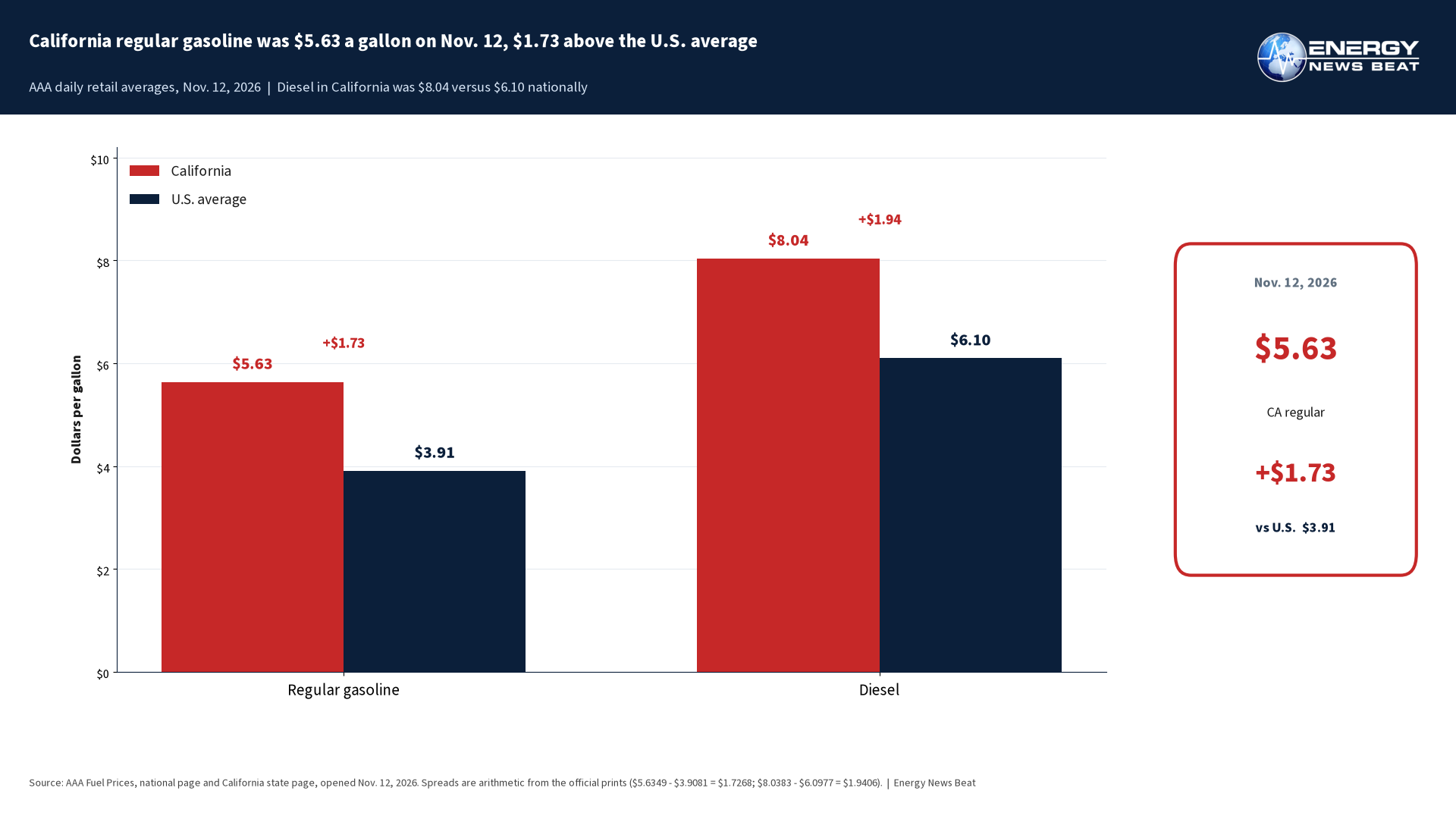
California drivers paid $5.6349 a gallon for regular gasoline on Nov. 12, $1.73 above the U.S. average of $3.9081. Diesel was $8.0383 versus $6.0977. A Bloomberg headline a day earlier said Germany’s carmakers are accelerating cuts at home on a China reckoning. The full Bloomberg text was not opened for this article. Free sources show a split-screen: auto executives put China and a brutal electric-vehicle price war first. Energy costs show up most clearly somewhere else — in chemical plants, in Britain’s steel towns, and in a California industrial power price more than three times Texas’s.
Germany’s carmakers put China first. Believe them.
AFP reported that Volkswagen booked a €5.8 billion ($6.5 billion) loss for the third quarter and that the German big three’s annual vehicle deliveries in China fell about a third between 2019 and 2025, to 3.87 million. Chinese brands’ domestic share rose to 65.3 percent from 37.8 percent. BMW, after third-quarter China deliveries fell 24.8 percent, said it would step up planned job cuts that a BMW source told AFP in July would total 8,000 by the end of 2027. Mercedes-Benz is restarting a Germany severance program in December. CEO Ola Kaellenius said Germany accounts for roughly 15 percent of sales but two-thirds of employees and structures, and that labor costs are lower in China, Hungary, Romania, and the United States. AFP put Volkswagen’s plan at up to 120,000 jobs by the end of the decade; The Local put it at up to about 100,000 globally by 2030, with about 50,000 in Germany. Neither is a settled official total.
Chemicals is where the energy bill shows up.
BASF has been more explicit. Its 2024 annual report said “higher gas prices than in other regions,” weak European demand, and “ongoing bureaucratic hurdles” had burdened the industry, “affect[ing] the Ludwigshafen site in Germany in particular.” About 4,800 employees left the company between the end of 2023 and the end of 2025, about half in Germany, the dpa news agency reported (via Zeit), citing the firm. BASF also cites overcapacity and China, and is investing in China even as it shrinks at Ludwigshafen.
The IEA found that in 2025, after falling from the 2022 peak, EU electricity prices for energy-intensive industries were still roughly double U.S. levels (the IEA’s U.S. comparator is Texas industrial electricity) and more than 50 percent higher than in China and India, even after emissions-trading compensation. German industrial gas in the second half of 2025 was €7.13 per 100 kilowatt-hours, the third-highest in the EU, against an EU average of €6.05, Eurostat reported (10,000–100,000 GJ band). Destatis said energy-intensive production in Germany rose 0.8 percent in September but was 3.5 percent lower in the third quarter than in the second, and 1.9 percent lower than in September 2025. Total industry rose 0.7 percent in September, lifted mainly by a 17.1 percent auto jump after holidays and changeovers — one good month, not a recovery.
Britain’s government has already admitted the power-price problem.
On Oct. 31, 2025, UK ministers wrote that some energy-intensive businesses “currently pay the highest industrial electricity prices in the G7,” and raised a network-charge discount from 60 percent to 90 percent from April 2026, estimated to save up to £420 million a year for about 500 firms, including Tata Steel at Port Talbot and INEOS at Grangemouth. A separate scheme is meant to cut energy costs 25 percent for more than 7,000 businesses from 2027 — government claims. In October 2026, UK Steel said the premium British steelmakers paid over French counterparts had widened to almost £30 a megawatt-hour.
Tata Steel shut the last blast furnace at Port Talbot on Sept. 30, 2024. A £1.25 billion electric-arc project, including a £500 million government grant, has slipped to late 2028 at the earliest, waiting on a grid connection, the BBC reported in September. British Steel’s Scunthorpe works, about 2,700 people and the UK’s last source of ‘virgin’ steel made from iron ore, the BBC reported, went into full public ownership on July 16, 2026. Official data published Nov. 12 show production up 0.3 percent in September and manufacturing up 0.7 percent, but basic metal and metal products down 2.1 percent, the largest manufacturing drag. Scotland’s Grangemouth refinery stopped crude processing on April 29, 2025. Lindsey closed after a corporate insolvency — not a simple Net Zero closure.
Canada is unwinding part of the squeeze, not copying it.
The federal consumer carbon tax was set to zero on April 1, 2025; industrial carbon pricing remains a pillar. In a May 15, 2026, agreement with Alberta, Canada honored its commitment not to introduce an oil-and-gas emissions cap. On Oct. 1, Prime Minister Mark Carney listed a new West Coast oil pipeline, Pacific Link, as a project of national interest — Canada and Alberta sharing ownership, a minimum 10 percent ownership stake offered to Indigenous communities, and Pembina Pipeline as a private-sector investor. Conditions are due by Sept. 1, 2027. Three Alberta First Nations have challenged the designation in court. The pipe is not in the ground. Statistics Canada said capital spending in mining, quarrying, and oil and gas extraction is intended to reach $65.3 billion in 2026, up 6.8 percent — intentions, not realized spending. Volkswagen delayed its Ontario PowerCo EV-battery plant two years, to 2029.
The California pump is the consumer hook.
As of Nov. 12, California regular was $1.73 above the U.S. average and diesel was $1.94 above it. California’s $5.63 is second only to Hawaii’s among states on AAA’s Nov. 12 map, and about 67 cents above the next state, Nevada ($4.97). California diesel set a high of $8.5123 on Oct. 18, 2026.
EIA wrote in July 2025 that California was set to lose 17 percent of its refinery capacity from two closures: Phillips 66’s 139,000-barrel-a-day Wilmington plant, and Valero’s Benicia refinery, which EIA put at 145,000 barrels a day (Valero lists 170,000). Together they were less than 2 percent of U.S. capacity but 17 percent of California’s and 11 percent of the West Coast. Phillips 66 ceased crude processing on Oct. 16, 2025; Valero completed full idling in April 2026. EIA expected a small 2026 West Coast retail increase, partly offset by cheaper crude. Unique fuel rules, thin Gulf Coast logistics, taxes, and operating costs all matter.
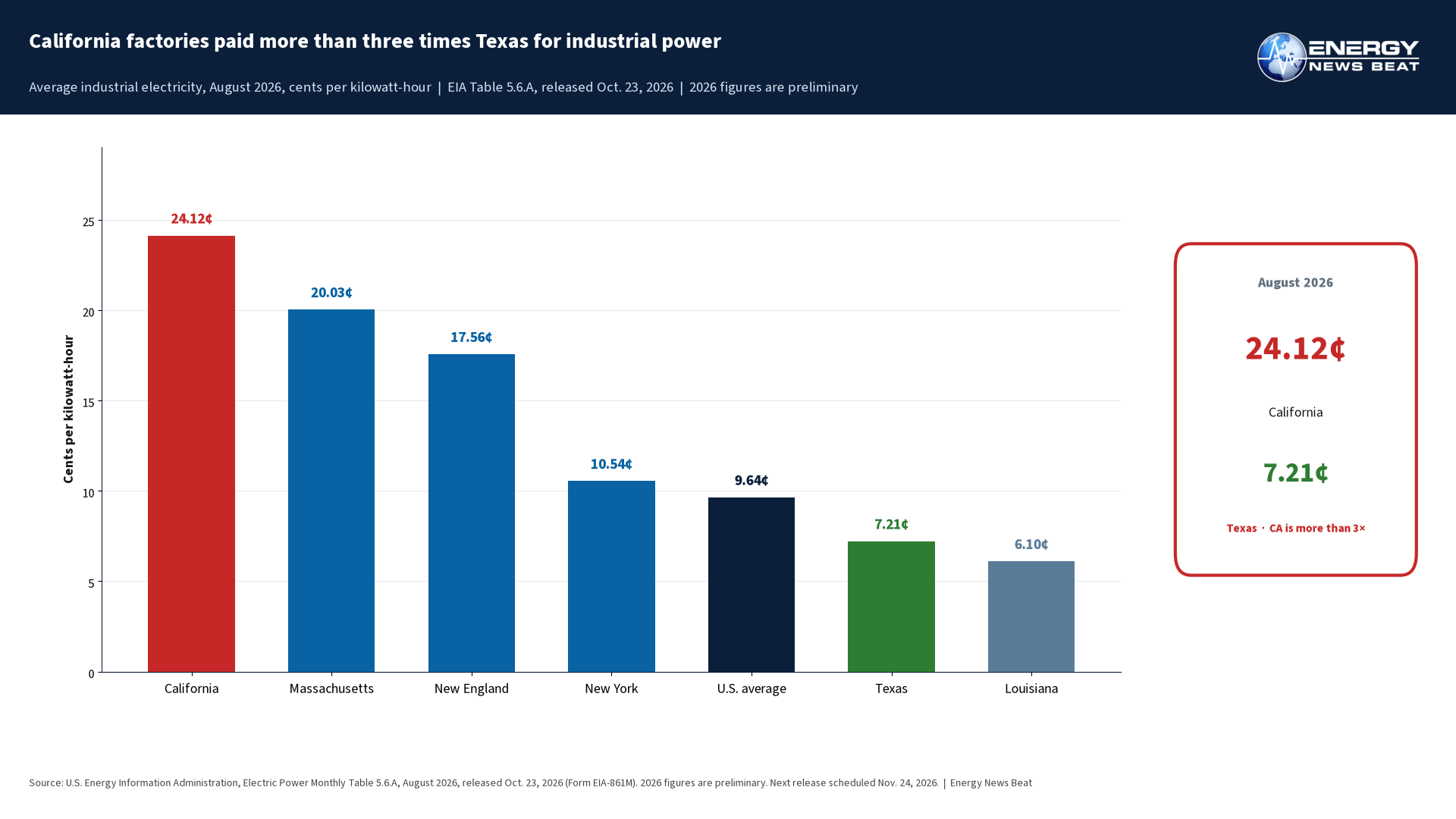
The factory-power gap is from one official table. EIA Electric Power Monthly, Table 5.6.A, for August 2026, released Oct. 23, 2026, puts California industrial electricity at 24.12 cents a kilowatt-hour — more than three times Texas’s 7.21 cents, and about 2.5 times the U.S. industrial average of 9.64 cents. New England was 17.56 cents; Massachusetts, 20.03. The table does not break out why; generation mix, transmission, wildfire costs and climate programs are commonly cited factors.
Climate programs are a real adder at the pump; they are not most of the $5.63 price. The California Energy Commission, in a January 2026 note still on a page last updated Oct. 15, 2026, said the Low Carbon Fuel Standard added about 17 cents a gallon and cap-and-trade about 25 cents. The same page lists a 61.2-cent state excise tax, an 18.4-cent federal excise tax, and a 2.0-cent underground-storage fee, and puts the August 2026 average at $5.46. The commission says the page is being updated. Those January figures are not a breakdown of today’s AAA price.
What it means for consumers — and for investors
For consumers, the California pump gap is not an abstraction. National diesel is still far above a year ago ($3.76), which hits food and freight even in lower-cost states. In Europe, expensive industrial power and gas show up as shuttered capacity and imported fuel, not as a line on a U.S. bill. This article does not invent a U.S. household savings figure from German factory cuts.
For investors, European autos and chemicals are in a restructuring cycle: lost China share plus a high-cost home base. UK steel at Scunthorpe is now a ward of the state, and Port Talbot’s return to steelmaking is a grid-connection trade. Canada is the policy-reversal case, with industrial carbon pricing still scheduled to rise, more slowly: Alberta’s TIER price is $95 a tonne in 2026, $100 in 2027–2029, and $130 by 2035 under the May 15 agreement. The California-Texas industrial power spread is a location decision, not a rounding error. West Coast refining tightness is a margin story, not a national shortage story. This is not investment advice.
Caveats
China competition and soft EV demand, not climate rules, are the first-order explanation for the German auto cuts. Some recent months look better: German industry rose in September, UK manufacturing rose 0.7 percent, and Canadian oil-and-gas capital spending is intended to rise in 2026. Governments are already trying to cut industrial power bills; if those close the gap, the data will show it. Renewable investment is real, and advocates argue that high fossil prices, not climate policy, caused the 2022 shock. France is a useful control: lower industrial power prices there are tied to nuclear plants, not to “no climate policy.” Policy design may matter more than the Net Zero label. California gasoline is also high because of taxes, a unique fuel blend, and geography. Germany completed its nuclear phaseout on April 15, 2023; that removed firm baseload, but it did not create BMW’s China drop.
Stu’s Take
| Watch two clocks at once. One is in Wolfsburg and Stuttgart, where German carmakers are cutting jobs because they lost ground in China and the electric-vehicle price war turned brutal. That is their story, and free coverage backs it up. The other is the energy bill. In 2025, electricity for the EU’s energy-intensive factories still ran about twice the U.S. (Texas) level, even after compensation, the IEA found. Britain’s government said in October 2025 that some of its energy-intensive firms pay the highest industrial power prices in the G7. In August 2026, California factories paid 24.12 cents a kilowatt-hour, more than three times Texas’s 7.21 cents. As of Nov. 12, California regular averaged $5.63, $1.73 above the national average. You do not have to blame climate policy for the China loss to notice the pattern. Countries and states that make heat and power expensive should not be surprised when the steel comes from somewhere else and gasoline arrives on a ship. Energy policy is industrial policy.
If you have listened to the Energy News Beat podcast, you should know that Net Zero is a wealth transfer program, and is a way to move your manufacturing to China, and loose high paying jobs. Now, California is only one refinery from closing to be at $10 diesel and gas permanently. The Jones Act curtailment has not been extended, so this will be an impact on consumers in California, and the East Coast. You get what you voted for. – Just saying. |
Appendix A | Linked source list (accessed Nov. 12, 2026 CST)
- Bloomberg, Nov. 11, 2026, “Germany’s Carmakers Accelerate Cuts at Home on China Reckoning” (headline and dateline confirmed; byline Laura Malsch and William Wilkes as listed on index copies; full text not opened, paywall) — https://www.bloomberg.com/news/articles/2026-11-11/germany-s-carmakers-accelerate-cuts-at-home-on-china-reckoning
- AFP, Nov. 6, 2026, “German carmakers hit a dead end as China drives past” (VW Q3 loss, China deliveries, brand shares) — https://www.afp.com/en/german-carmakers-hit-dead-end-china-drives-past
- AFP / Yahoo Finance, Nov. 4, 2026, BMW job cuts and China deliveries — https://finance.yahoo.com/markets/stocks/articles/bmw-step-job-cuts-china-095558143.html
- Straits Times / AFP, Oct. 28, 2026, Mercedes-Benz Germany severance program and Kaellenius remarks — https://www.straitstimes.com/world/europe/mercedes-to-cut-more-jobs-as-chinese-competition-bites
- The Local, Nov. 9, 2026, German company job-cut roundup (VW range) — https://www.thelocal.de/20261109/listed-the-major-german-companies-cutting-jobs-at-the-end-of-2026
- Destatis, press release No. 389, Nov. 6, 2026, industrial production in September 2026 — https://www.destatis.de/EN/Press/2026/11/PE26_389_421.html
- IEA, Electricity 2026, Prices chapter (energy-intensive industrial electricity, 2025; U.S. comparator is Texas; EU figures include ETS compensation) — https://www.iea.org/reports/electricity-2026/prices
- Eurostat, May 8, 2026, non-household gas prices in the second half of 2025 (band 10,000–100,000 GJ; dataset nrg_pc_203) — https://ec.europa.eu/eurostat/web/products-eurostat-news/w/ddn-20260508-3
- BASF, 2024 annual report, goals for the Ludwigshafen site (energy-cost language) — https://report.basf.com/2024/en/combined-managements-report/fundamentals-of-the-group/basf-group/goals-for-the-ludwigshafen-site.html
- dpa news agency, Feb. 27, 2026, via Zeit (unedited wire), BASF job cuts of about 4,800 from end-2023 to end-2025 — https://www.zeit.de/news/2026-02/27/basf-verschaerft-sparkurs-bereits-4-800-stellen-gestrichen
- UK government, Oct. 31, 2025, “highest industrial electricity prices in the G7”; 90% network-charge discount; up to £420 million a year — https://www.gov.uk/government/news/british-businesses-to-save-over-400m-a-year-as-government-slashes-electricity-costs
- The Guardian / UK Steel, Oct. 19, 2026, Franco-British industrial power premium — https://www.theguardian.com/business/2026/oct/19/electricity-costs-uk-steelmakers-worst-position-three-years-eu-rivals
- Tata Steel UK, Sept. 30, 2024, closure of blast furnace 4 at Port Talbot — https://www.tatasteeluk.com/corporate/news/closure-of-blast-furnace-4-but-green-steel-project-will-ensure-next-generation-of-steelmaking
- BBC, Sept. 29, 2026, Port Talbot electric-arc furnace delayed to at least late 2028 by grid connection — https://www.bbc.co.uk/news/articles/ck9dw7g452qeo
- UK House of Commons written statement HCWS273, July 16, 2026, British Steel nationalization (date and public ownership) — https://questions-statements.parliament.uk/written-statements/detail/2026-07-16/HCWS273
- BBC, July 16, 2026, British Steel nationalization; about 2,700 people at Scunthorpe and last UK source of virgin steel from iron ore — https://www.bbc.co.uk/news/articles/c5y680w62wno
- ONS, Index of Production, September 2026, published Nov. 12, 2026 — https://www.ons.gov.uk/economy/economicoutputandproductivity/output/bulletins/indexofproduction/september2026
- BBC, April 29, 2025, Grangemouth crude processing ends — https://www.bbc.co.uk/news/articles/cm24jlm08y9o
- Reuters, April 29, 2025, Grangemouth crude processing ends (401 on some fetches; BBC used for the date in the body) — https://www.reuters.com/business/energy/crude-processing-ends-scotlands-grangemouth-oil-refinery-2025-04-29/
- BBC, Aug. 2, 2025, Lindsey Oil Refinery ended production after Prax insolvency — https://www.bbc.co.uk/news/articles/cg50ye7pj6no
- House of Commons Library, UK refineries briefing — https://commonslibrary.parliament.uk/research-briefings/cdp-2025-0235/
- Department of Finance Canada, March 2025, federal fuel charge set to zero effective April 1, 2025 — https://www.canada.ca/en/department-finance/news/2025/03/removing-the-consumer-carbon-price-effective-april-1-2025.html
- Prime Minister of Canada, May 15, 2026, Canada-Alberta implementation agreement (emissions cap not introduced) — https://www.pm.gc.ca/en/news/backgrounders/2026/05/15/implementation-agreement-canada-alberta-memorandum-understanding
- Prime Minister of Canada, Oct. 1, 2026, Pacific Link listed as a project of national interest — https://www.pm.gc.ca/en/news/news-releases/2026/10/01/prime-minister-carney-lists-west-coast-oil-pipeline-now-known-pacific
- CBC, First Nations challenges to the Pacific Link national-interest designation — https://www.cbc.ca/news/canada/edmonton/northern-alberta-first-nation-pipeline-challenges-9.7411621
- Statistics Canada, Feb. 25, 2026, 2026 capital spending intentions, mining, quarrying, and oil and gas extraction — https://www150.statcan.gc.ca/n1/daily-quotidien/260225/dq260225b-eng.htm
- CBC, Oct. 3, 2026, Canada EV battery investment setbacks — https://www.cbc.ca/news/canada/canada-ev-battery-investments-9.7362430
- Statistics Canada Labour Force Survey table, manufacturing employment, October 2026 (release Nov. 6, 2026) — https://www150.statcan.gc.ca/n1/daily-quotidien/261106/t002a-eng.htm
- EIA Today in Energy, July 9, 2025, California refinery closures and the 17% capacity figure — https://www.eia.gov/todayinenergy/detail.php?id=65704
- Phillips 66, Oct. 29, 2025, Q3 2025 results: ceased processing crude oil at the Los Angeles Refinery on Oct. 16 — https://investor.phillips66.com/financial-information/news-releases/news-release-details/2025/Phillips-66-Highlights-Strong-3Q-Results-Attractive-Growth-Opportunities/default.aspx
- Valero, Benicia refinery page (170,000 b/d listed throughput; full idling completed April 2026; more than 400 employees) — https://www.valero.com/about/locations/benicia-refinery
- AAA Fuel Prices, U.S. averages and state map, as of Nov. 12, 2026 (Hawaii $5.6362; California $5.6349; Nevada $4.9676) — https://gasprices.aaa.com/
- AAA Fuel Prices, California averages, as of Nov. 12, 2026 — https://gasprices.aaa.com/?state=CA
- EIA Electric Power Monthly, Table 5.6.A, August 2026 data, released Oct. 23, 2026 (next release Nov. 24, 2026; 2026 figures preliminary) — https://www.eia.gov/electricity/monthly/epm_table_grapher.php?t=epmt_5_6_a
- California Energy Commission, estimated gasoline price breakdown and margins (page last updated Oct. 15, 2026; January 2026 LCFS and cap-and-trade adders; August 2026 average $5.46) — https://www.energy.ca.gov/estimated-gasoline-price-breakdown-and-margins
- German Environment Agency, nuclear phaseout completed April 15, 2023 — https://www.umweltbundesamt.de/themen/klima-energie/energieversorgung/kernenergie
Appendix B | Key excerpts
Excerpts below are taken from official or corroborating pages opened on Nov. 12, 2026, except where a source date is earlier and is labeled as such. The Bloomberg article is represented only by its confirmed headline and dateline; the byline is as listed on index copies; the full text was not opened.
Bloomberg headline (full text not opened; byline as listed on index copies): “Germany’s Carmakers Accelerate Cuts at Home on China Reckoning,” Laura Malsch and William Wilkes, Nov. 11, 2026. Only the headline and dateline were confirmed; the byline is as listed on index copies. No figures or quotations in this article are taken from the unpaid Bloomberg text.
IEA, Electricity 2026, Prices: In the European Union, after two years of significant declines since their 2022 peak, prices for energy-intensive industries in 2025 continued to be on average roughly double the prices in the United States and more than 50% higher than in China and India. … Electricity price compensation is included for countries that participate in EU-ETS. … The final electricity price for the United States is based off the final electricity for industry in Texas.
UK government, Oct. 31, 2025: Some of these businesses currently pay the highest industrial electricity prices in the G7, making it harder to stay competitive on the international stage… Around 500 of the UK’s most energy-intensive businesses are set to save up to £420 million per year on their electricity bills from next April…
Destatis, Nov. 6, 2026, September 2026 production: Production in energy-intensive industrial branches increased by 0.8% in September 2026 from August 2026, after adjustment for seasonal and calendar effects. The three-month on three-month comparison showed that production in energy-intensive industrial branches in the 3rd quarter of 2026 was 3.5% lower than in the 2nd quarter of 2026. Adjusted for calendar effects, production in energy-intensive industrial branches was down 1.9% in September 2026 compared with September 2025.
EIA, July 9, 2025: California is set to lose 17% of its oil refinery capacity over the next 12 months because of two planned refinery closures. … Although the Los Angeles and Benicia refineries make up less than 2% of current U.S. refining capacity, they account for 17% of California refinery capacity and 11% of West Coast (PADD 5) capacity.
Valero, Benicia page, opened Nov. 12, 2026: In accordance with our plan, full idling of all processing units was completed in April 2026. … More than 400 employees. 170,000 barrels per day (bpd) throughput capacity.
Finance Canada, March 2025: The Government of Canada has made regulations that cease the application of the federal fuel charge, effective April 1, 2025, and is also removing requirements for provinces and territories to have a consumer-facing carbon price as of that date. … A price on pollution for large emitters will continue to be a pillar…
Prime Minister of Canada, Oct. 1, 2026: Today, the Prime Minister, Mark Carney, announced that the Government of Canada is officially listing the new West Coast Oil Pipeline, now known as Pacific Link, as a project of national interest. Canada and Alberta will share equal ownership of Pacific Link. … Pembina Pipeline Corporation is a private sector investor…
CEC, January 2026 note on a page last updated Oct. 15, 2026: In January of 2026, that amounts to: Low Carbon Fuel Standard: adds about 17 cents (4%); Cap and Trade: adds about 25 cents (6%). The California state excise tax is currently 61.2 cents per gallon. The federal excise tax is currently 18.4 cents per gallon. The state underground storage tank fee is currently 2.0 cents per gallon. In August 2026, the average retail gasoline price was $5.46 per gallon.
Kaellenius, as quoted by Straits Times / AFP, Oct. 28, 2026: Germany accounts for roughly 15% of our sales, but two-thirds of our employees and structures are based here.
Appendix C | Key data table (as-of dates)
| Metric | Value | As-of / source |
| AAA CA regular | $5.6349/gal | AAA California, Nov. 12, 2026 |
| AAA U.S. regular | $3.9081/gal | AAA national, Nov. 12, 2026 |
| CA minus U.S., regular | +$1.7268 (~+$1.73) | ENB arithmetic from the AAA prints |
| AAA Hawaii / Nevada regular | $5.6362 / $4.9676 | AAA national state map, Nov. 12, 2026 |
| AAA CA diesel | $8.0383/gal | AAA California, Nov. 12, 2026 |
| AAA U.S. diesel | $6.0977/gal | AAA national, Nov. 12, 2026 |
| CA minus U.S., diesel | +$1.9406 (~+$1.94) | ENB arithmetic |
| CA regular, year earlier | $4.6906 | AAA California, Nov. 12, 2026 table |
| U.S. regular, year earlier | $3.0752 | AAA national, Nov. 12, 2026 table |
| CA diesel record on AAA state page | $8.5123 on Oct. 18, 2026 | AAA California |
| CA industrial electricity | 24.12 ¢/kWh | EIA Table 5.6.A, August 2026 (released Oct. 23, 2026; preliminary) |
| TX industrial electricity | 7.21 ¢/kWh | Same table |
| U.S. industrial electricity | 9.64 ¢/kWh | Same table |
| New England industrial electricity | 17.56 ¢/kWh | Same table |
| Massachusetts industrial electricity | 20.03 ¢/kWh | Same table |
| New York industrial electricity | 10.54 ¢/kWh | Same table |
| Louisiana industrial electricity | 6.10 ¢/kWh | Same table |
| CA share of capacity from two closures | 17% of CA, 11% of PADD 5, <2% of U.S. | EIA, July 9, 2025 |
| Phillips 66 Wilmington | 139,000 b/d (EIA) | EIA, July 9, 2025; crude processing ceased Oct. 16, 2025 (Phillips 66 Q3 2025 results, Oct. 29, 2025) |
| Valero Benicia | 145,000 b/d (EIA); 170,000 b/d (Valero); >400 employees | EIA July 9, 2025; Valero page; fully idled April 2026 |
| CEC August 2026 CA regular | $5.46/gal | CEC page, data last updated Oct. 15, 2026 |
| CEC program adders (January 2026) | LCFS ~17¢ (4%); cap-and-trade ~25¢ (6%) | Same CEC page; labeled January 2026 |
| CA / federal excise and UST | 61.2¢ / 18.4¢ / 2.0¢ | Same CEC page |
| IEA energy-intensive industrial power, 2025 | EU ≈ 2× U.S. (Texas-based); >50% above China and India | IEA Electricity 2026, Prices |
| EU wholesale power, 2025 | About USD 95/MWh, up ~10% y/y; EU-ETS ~EUR 75/t | IEA Electricity 2026, Prices |
| EU / Germany non-household gas, H2 2025 | €6.05 / €7.13 per 100 kWh (10,000–100,000 GJ band) | Eurostat, May 8, 2026, nrg_pc_203 |
| Destatis energy-intensive production | +0.8% m/m in Sept. 2026; Q3 3.5% below Q2; 1.9% below Sept. 2025 | Destatis, Nov. 6, 2026 |
| Destatis total industry, Sept. 2026 | +0.7% m/m; +0.4% y/y; increase primarily attributable to autos (+17.1% m/m), after two low months partly due to changeovers and factory holidays | Same release |
| VW China / Q3 | €5.8B ($6.5B) Q3 loss; German big-three China deliveries ~3.87 million in 2025, down about a third from 2019 | AFP, Nov. 6, 2026 |
| VW job-cut range | AFP: up to 120,000 by end of the decade; The Local: up to about 100,000 global by 2030, ~50,000 in Germany (neither a settled official total) | AFP Nov. 6; The Local Nov. 9 |
| BMW | Q3 net profit €1.45B, about −15%; China deliveries −24.8%; program aimed at 8,000 cuts by end-2027 | AFP, Nov. 4, 2026 |
| BASF departures | About 4,800 employees left end-2023 to end-2025, about half in Germany | dpa via Zeit, Feb. 27, 2026, citing the company |
| UK G7 industrial power statement | “Some of these businesses currently pay the highest industrial electricity prices in the G7” | UK government, Oct. 31, 2025 |
| UK network-charge relief | Discount 60% to 90% from April 2026; up to £420 million a year for about 500 firms | Same UK government release |
| Port Talbot | Last blast furnace closed Sept. 30, 2024; £1.25B EAF incl. £500M grant; slipped to late 2028 at the earliest (BBC, Sept. 29, 2026) | Tata Steel; BBC, Sept. 29, 2026 |
| British Steel, Scunthorpe | Full public ownership July 16, 2026 (HCWS273); about 2,700 people and last UK source of virgin steel from iron ore (BBC, July 16, 2026) | HCWS273, July 16, 2026 |
| ONS, Sept. 2026 | Production +0.3% in September; manufacturing +0.7%; basic metal and metal products −2.1% | ONS, published Nov. 12, 2026 |
| Grangemouth | Crude processing ended April 29, 2025 | BBC, April 29, 2025 |
| Canada consumer carbon tax | Federal fuel charge rates set to zero effective April 1, 2025; industrial pricing remains a pillar | Finance Canada |
| Canada emissions cap | Commitment not to introduce the oil-and-gas emissions cap, honored in the May 15, 2026 agreement | PMO, May 15, 2026 |
| Pacific Link | Listed as a project of national interest Oct. 1, 2026; conditions due Sept. 1, 2027; designation under legal challenge | PMO, Oct. 1, 2026; CBC |
| Canada capex intentions, 2026 | Mining, quarrying, and oil and gas extraction $65.3B, +6.8%; oil and gas extraction +3.7% (intentions) | Statistics Canada, Feb. 25, 2026 |
| Canada manufacturing jobs | 1,838,100 in October 2026, down 16,600 or 0.9% from October 2025 | Statistics Canada LFS table |
Appendix D | Background
Germany’s energy transition. Germany’s last three nuclear plants — Emsland, Isar 2, and Neckarwestheim 2 — shut on April 15, 2023, completing the nuclear phaseout (German Environment Agency). The phaseout removed firm, low-carbon baseload. It did not, by itself, create Chinese EV competition. The narrower energy-policy claim is that after the 2022 gas crisis, the nuclear exit, and years of Energiewende levies and gas-linked power pricing, German and EU industrial power and gas stayed structurally expensive relative to the United States, especially for chemicals, metals, and glass.
UK North Sea policy, for context. The UK Energy Independence Bill factsheet, published Nov. 4, 2026, says the government will not issue new licences to explore new oil and gas fields and will ban fracking, while allowing some additional production tied to already licensed fields. Offshore Energies UK, in an Oct. 28, 2026, budget statement, calls the Energy Profits Levy, which it puts at 78%, damaging, and says a successor levy is delayed until 2030. Those are industry figures on the tax rate. The North Sea is a mature basin; production would decline even with a friendlier tax. The policy choice is the pace of decline and whether UK upstream capital stays in the UK. This context is not used as a body claim that the levy “caused” Port Talbot or Lindsey.
California refining retreat is multi-year. EIA’s July 9, 2025, note placed the Wilmington and Benicia closures in a longer West Coast retreat, after Phillips 66’s Rodeo plant ended petroleum refining in 2024 and Marathon’s Martinez refinery closed in 2020. Replacement supply is likely to be imports, especially from Asia, and must meet CARBOB specifications. The West Coast has weak logistical ties to the Gulf Coast.