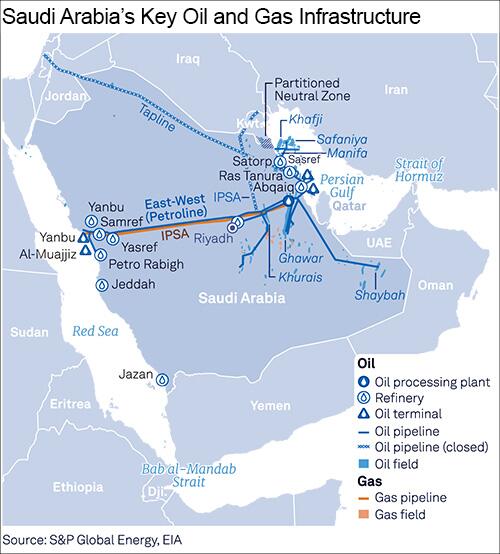
Saudi air defenses intercepted four drones at Ras Tanura on Wednesday as NASA satellite imagery showed smoke, with refinery damage unconfirmed. Days before OPEC+ meets Nov. 29 to set 2027 quotas, Iraq rejected a consultants’ capacity study—linking Gulf export security, Saudi spare capacity, and a looming global supply surplus.
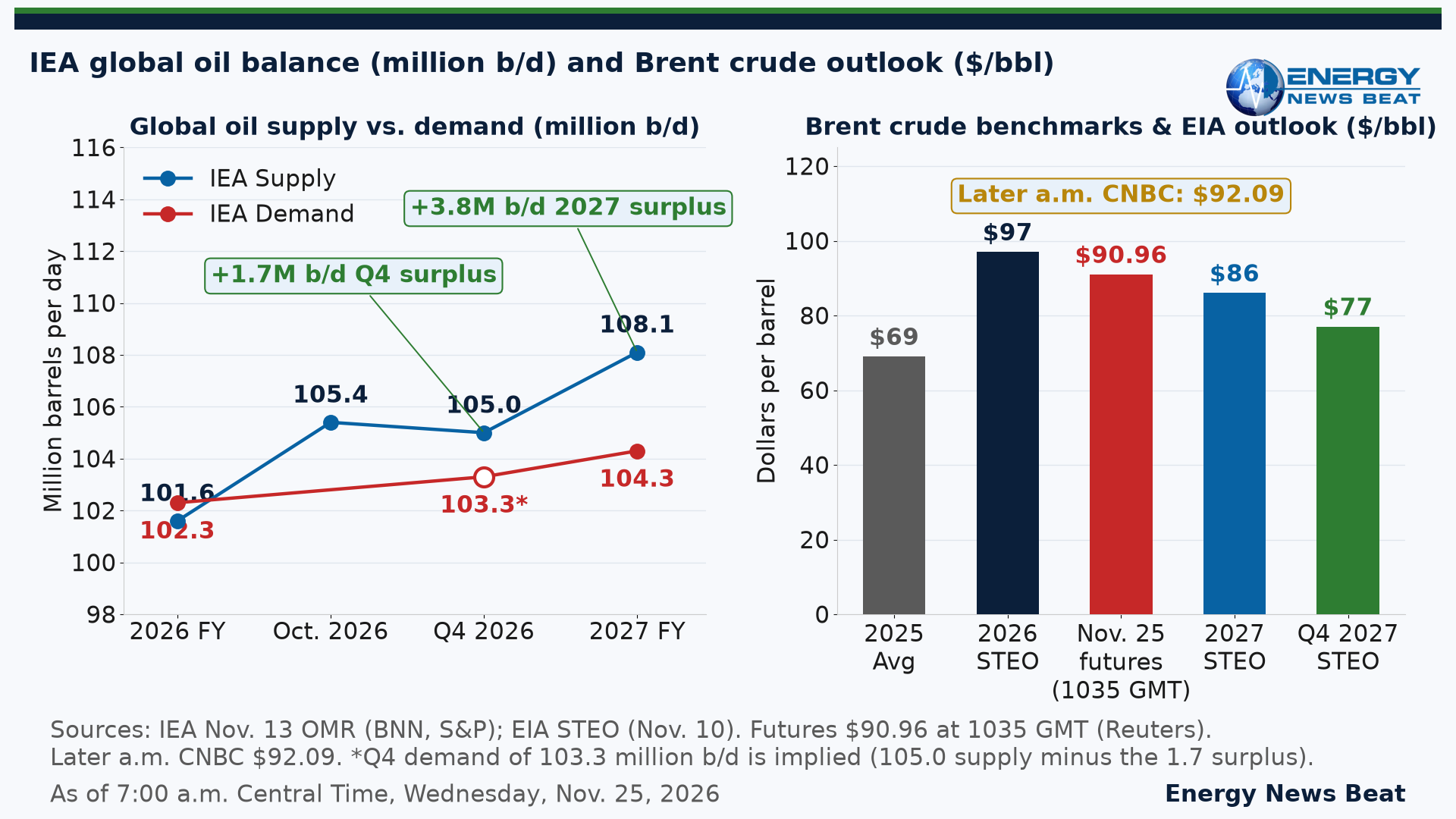
Even after Yemen’s Houthis claimed a strike on Saudi Arabia’s largest refinery, Brent crude futures were down 44 cents, or 0.5%, at $90.96 a barrel at 4:35 a.m. CT (1035 GMT), and U.S. West Texas Intermediate was down 62 cents, or 0.8%, at $81.43, trimming Tuesday’s gains of more than 2%. Later Wednesday morning, delayed CNBC quotes showed ICE Brent January 2027 last at $92.09, up 69 cents or 0.75% from Tuesday’s $91.40 settlement, with WTI January 2027 at $82.23, up 18 cents or 0.22%, as of 6:49 a.m. CT.
That rebound sits beside a second fight brewing for Sunday. The Saudi-led coalition reported intercepting four drones at Ras Tanura without confirming refinery damage. Days before OPEC+ meets online Nov. 29 to set 2027 quotas, Iraq rejected an outside capacity review shaping its share of next year’s market. Both stories hinge on how much oil the Gulf can reliably pump and ship into a market the International Energy Agency now sees tipping into surplus.
Smoke at Ras Tanura, 10 tanker strikes near Hormuz, and unconfirmed damage
Wednesday’s picture at Ras Tanura splits between competing claims and satellite imagery. Houthi military spokesman Yahya Saree said the group attacked the Ras Tanura refinery and caused fires, a day after a drone hit a Riyadh tower housing Saudi Arabia’s sovereign wealth fund and wounded 11 people. Saudi-led coalition spokesman Turki Al-Maliki said air defenses destroyed four drones at Ras Tanura, and said earlier that three more were shot down in the Eastern Province, with fragments falling and no initial casualties. The coalition did not confirm a refinery hit, Aramco did not immediately respond to Reuters, and The National noted the Houthi claim could not be independently verified. Still, NASA Worldview satellite imagery reviewed by Reuters showed thick black smoke covering roughly 600 square kilometers around the complex.
Even an unconfirmed scare matters because of the hardware on that peninsula. Ras Tanura is Saudi Arabia’s oldest and largest domestic refinery at 550,000 barrels per day, about 16% of domestic refining capacity, beside an adjoining terminal that can load about 6.5 million b/d. Iranian drones forced a brief refinery shutdown on March 2, while crude loadings only resumed June 26 after a nearly four-month halt; the Houthis also claimed a strike there Oct. 27.
At sea, gCaptain counts 10 reported tanker strikes near the Strait of Hormuz in one week—seven since Nov. 16 cited by the Joint Maritime Information Center plus three eastbound tankers reported by UK Maritime Trade Operations, alongside a bulk carrier off Khor Fakkan. Through Nov. 23, the International Maritime Organization tallied 141 incidents in the Strait of Hormuz and wider Middle East and 25 seafarer deaths. U.S.-facilitated transits averaged 38 ships a day Nov. 19–21—far below the 2025 average of 138—leaving 218 vessels waiting east of the strait while Iran blacklisted 26 tugboats atop 240 vessels.
Why oil dipped, then recovered: IEA’s Q4 surplus and Gulf export workarounds
Barrel math helps explain the early-morning dip. On Nov. 13, the International Energy Agency flipped its fourth-quarter call from deficit to a 1.7 million b/d global surplus, forecasting fourth-quarter supply at 105.0 million b/d—1.7 million b/d above forecast fourth-quarter demand—while full-year 2026 demand is projected at 102.3 million b/d, down 2.7 million b/d from 2025 on high prices and weaker Chinese fuel use. “Since the release of an IEA report this month, perceptions of a global supply glut have kept prices in check,” NLI Research Institute’s Tsuyoshi Ueno told Reuters, while cautioning that Hormuz and Saudi–Houthi attacks threaten that trend.
Producers have also built physical workarounds. Global output rose 5.3 million b/d from August to 105.4 million b/d in October, with Gulf exports outside Oman reaching 18.4 million b/d (74% of prewar; crude at 15.0 million b/d, or 82%) via dark AIS-off runs, ship-to-ship transfers off Oman, and pipelines. Saudi Arabia’s 7 million b/d East-West pipeline to Yanbu ran around 5.5 million b/d by Oct. 1 through a temporary bypass after a Sept. 10 drone strike, freeing 4 to 4.5 million b/d for Red Sea export. Libya’s Sharara pipeline reopened Monday, China and India are taking record Russian crude, API reported a 126,000-barrel U.S. stock build, and 71 million barrels of pledged IEA emergency reserves—including 15 million barrels of diesel—remain due by end-February. For 2027, the IEA projects a 3.8 million b/d surplus as supply hits 108.1 million b/d.
Iraq’s capacity revolt and how Ras Tanura links to Sunday’s OPEC+ fight
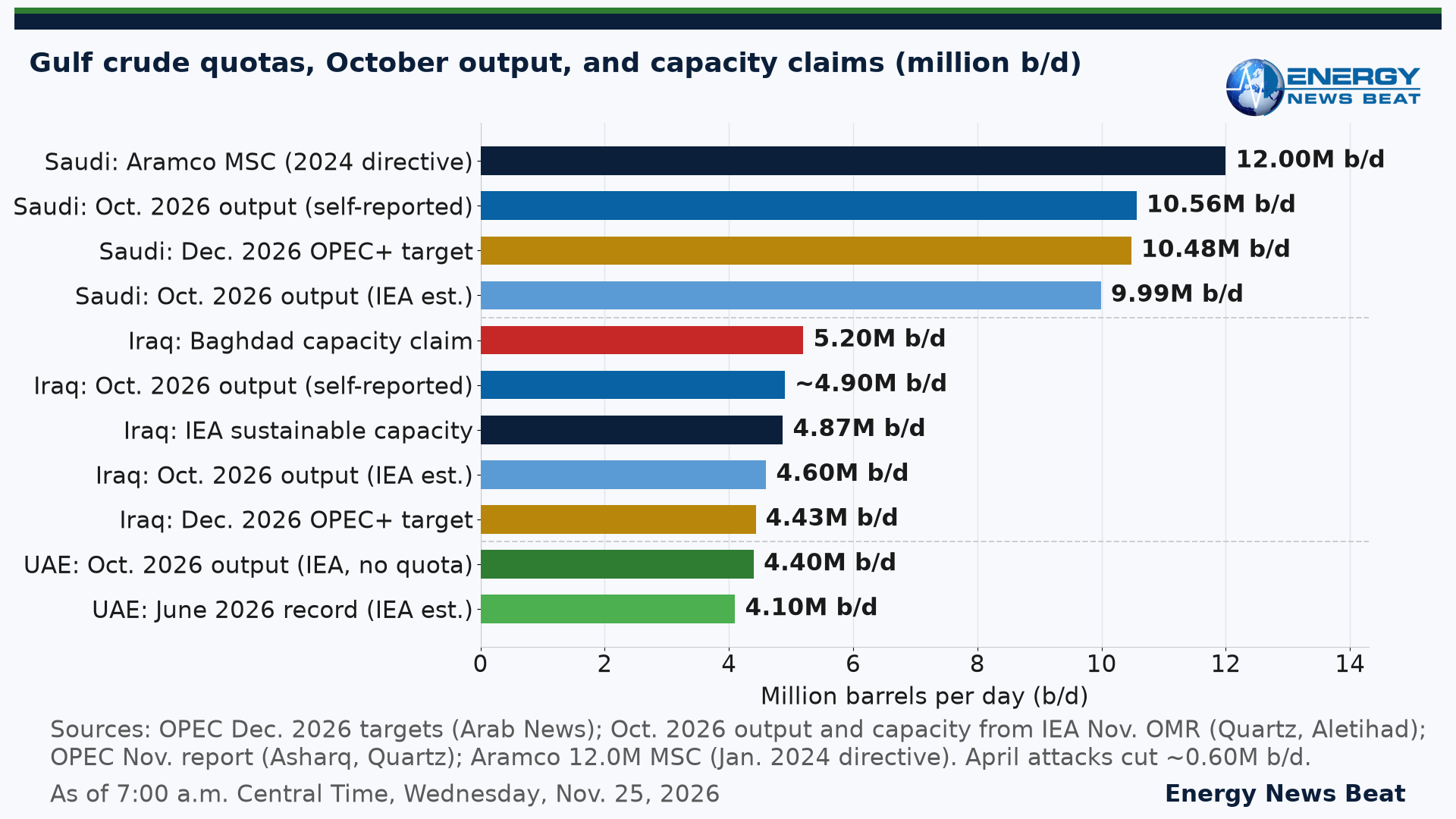
Those returning barrels raise the stakes for Sunday, Nov. 29, when OPEC+—the seven core members plus the full 21-country group—meets online to set 2027 quotas and weigh roughly 2 million b/d of remaining cuts. On Nov. 1, the seven core producers held December targets at 31.01 million b/d: 10.478 million b/d for Saudi Arabia, 9.949 million for Russia, 4.431 million for Iraq, and 2.676 million for Kuwait.
Ahead of Sunday, Quartz reported via Bloomberg that Iraq rejected an OPEC+ consultants’ review putting its maximum capacity below 5 million b/d. Oil Minister Basim Mohammed Khudair wrote to OPEC insisting Iraq can reach 5.2 million b/d, seeking stronger grounds for a larger 2027 quota. Output figures already clash: Iraq told OPEC it pumped nearly 4.9 million b/d in October, OPEC secondary sources put it at 4.491 million b/d, and the IEA estimated 4.60 million b/d—a seven-year high—against 4.87 million b/d of capacity.
Riyadh has reason to take Baghdad’s pushback seriously. Earlier this year Iraq threatened to quit OPEC if its assessment came in too low, a warning it later withdrew, echoing the United Arab Emirates’ May 1 exit from OPEC and OPEC+ over quota limits after nearly 60 years of membership. Free of caps, the UAE lifted crude output to 4.1 million b/d in June and 4.4 million b/d in September and October, per the IEA.
That puts Saudi output, spare capacity, and export security at the center of Sunday’s fight. Saudi Arabia told OPEC October output rose 26% to 10.563 million b/d, near its 10.882 million pre-war February pace, while the IEA estimated 9.99 million b/d. Aramco’s maximum sustainable capacity remains a 12.0 million b/d official ceiling under a January 2024 Energy Ministry directive, even after the Energy Ministry said April attacks cut production capacity by about 600,000 b/d. Riyadh still holds OPEC+’s main spare-barrel cushion. Yet war has disrupted regional expansion plans, and Kuwait, Bahrain, and Qatar lack Hormuz-bypass pipelines. Drone threats to Ras Tanura and Yanbu test whether Saudi spare capacity can actually reach buyers. “OPEC+ faces an extremely difficult call for 2027,” Rystad’s Jorge Leon told Reuters, citing war, Hormuz, and surplus risks.
What U.S. drivers and haulers see at the pump this Thanksgiving
For U.S. holiday travelers, lower crude is bringing pump relief, though prices remain high year over year. AAA’s national regular average hit $3.587 a gallon ($3.5866) Wednesday, down from $3.72 on Nov. 19 and hovering near the 2022 Thanksgiving record of $3.58. The EIA’s Nov. 23 survey put regular at $3.642 (down 16.3 cents weekly, up 58.1 cents from a year ago) and diesel at $5.695 (down 24.2 cents weekly, up $1.864 from a year ago)—the sharpest weekly diesel fall of the war per FreightWaves, yet still $1.798 above March 2. AAA’s national diesel average was $5.76 ($5.7645) Wednesday.
Looking ahead, EIA’s November Short-Term Energy Outlook—finalized Nov. 5—sees Brent near $100 through year-end before easing to $86 in 2027 and $77 in Q4 2027 if non-Iran Middle East output normalizes by mid-2027, with 2027 U.S. diesel averaging $5.03 and gasoline $3.73 amid tight refining margins.
Consumer and Investor Views
Consumer view. Drivers and freight haulers are seeing wholesale drops reach pumps as U.S. refiners ran at 95.7% and Brent–diesel spreads narrowed to 63.7 cents Monday. Still, OECD on-land oil stocks sit at their lowest since at least 2016 while oil at sea hits 2.03 billion barrels. Any confirmed damage at Ras Tanura’s 550,000 b/d refinery would hit distillate supply before crude, with Middle East product exports still near half of prewar levels.
Investor and industry view. Markets face a tug of war between physical shipping risks and an expected 2027 overhang, with no investment advice offered. Tanker attacks and OPEC+ friction support volatility for refiners and carriers, while UAE output of 4.4 million b/d, Iraq’s 5.2 million b/d capacity claim, and rising U.S. output (14.3 million b/d in 2027) leave OPEC+ choosing Sunday between defending market share or deepening the surplus.
Timeline
Key dates connecting Ras Tanura, Hormuz shipping, and Sunday’s OPEC+ quota meeting:
Late Feb. 2026. The U.S.–Iran war erupts, halting normal commercial traffic through the Strait of Hormuz.
March 2, 2026. Iranian drones target Ras Tanura (debris causes a limited fire); Aramco shuts the 550,000 b/d refinery (restarting mid-March) while crude loadings pause for nearly four months.
May 1, 2026. The UAE quits OPEC and OPEC+ over production caps, later lifting crude output to 4.1 million b/d in June and 4.4 million b/d in September and October per the IEA.
June 26, 2026. Saudi Aramco resumes crude loadings at the Ras Tanura terminal.
Sept. 10, 2026. A drone strike shuts Saudi Arabia’s 7 million b/d East-West pipeline; Aramco installs a temporary bypass restoring ~5.5 million b/d by Oct. 1.
Oct. 27, 2026. Houthis claim a missile strike on the Ras Tanura complex as a fire erupts near the export terminal.
Nov. 1, 2026. Seven core OPEC+ members keep December 2026 quotas steady at 31.01 million b/d and set a Nov. 29 decision for 2027.
Nov. 10–13, 2026. EIA forecasts Brent falling to $77/bbl by Q4 2027; OPEC reports Oct. OPEC+ output at 41.23 million b/d; IEA flips Q4 2026 to a 1.7 million b/d surplus.
Nov. 16–24, 2026. Ten tanker strikes hit near Hormuz in one week; Riyadh’s PIF tower is hit twice; Iraq rejects OPEC+’s capacity review and claims 5.2 million b/d; EIA diesel drops 24.2¢ to $5.695/gal.
Nov. 25, 2026. Coalition intercepts four drones at Ras Tanura; NASA imagery shows smoke while refinery damage stays unconfirmed; Brent futures are $90.96 at 1035 GMT, then turn higher later Wednesday morning.
Nov. 29, 2026. OPEC+ ministers meet online to set 2027 production quotas.
Caveats
Ras Tanura damage is not confirmed. As of publication, only Houthi spokesman Yahya Saree claimed fires at the refinery. The Saudi-led coalition reported intercepting four drones with falling fragments and no initial casualties, without confirming a refinery strike; Aramco did not immediately confirm damage or a shutdown, even though NASA imagery reviewed by Reuters showed thick black smoke.
OPEC+ numbers differ across assessors, and capacity is not output. The consultants’ capacity study has not been made public, per Bloomberg’s account. Iraq’s self-reported October output (~4.9 million b/d) sits roughly 400,000 b/d above OPEC secondary sources (4.491 million b/d) and 300,000 b/d above the IEA (4.60 million b/d), while Saudi Arabia’s 10.563 million submission differs from the IEA’s 9.99 million estimate. EIA’s November STEO was finalized Nov. 5 before late-November attacks. Nothing here is investment advice.
Stu’s Take
Saudi air defenses intercepted four drones at Ras Tanura while NASA satellite imagery reviewed by Reuters showed smoke spanning about 600 square kilometers. Brent futures were down 44 cents, or 0.5%, at $90.96 a barrel at 4:35 a.m. CT, before delayed CNBC quotes later showed ICE Brent at $92.09, up 0.75%. The IEA projects a 1.7 million b/d global fourth-quarter surplus as Gulf exports recover. That tug of war ties to Sunday’s Nov. 29 OPEC+ meeting: Iraq rejected an outside capacity study and claims 5.2 million b/d, eyeing how the UAE pushed output to 4.4 million b/d after quitting OPEC in May. Riyadh’s leverage rests on a 12 million b/d official capacity ceiling, a 2024 directive, and keeping Ras Tanura and Yanbu open. Meanwhile, AAA regular gasoline was $3.587 and EIA diesel dropped 24.2 cents to $5.695, though refined-product markets stay vulnerable if smoke at Ras Tanura signals real plant damage.
Sources
Links, what each source was used for, and the time accessed, in Central Time, on Wednesday, Nov. 25, 2026.
- CNBC / Reuters, ‘Oil prices fall as supply glut concerns offset Middle East disruption fears,’ Nov. 25, 2026. Used for the earlier 0137 GMT print (superseded in the body) and Tuesday’s gains of more than 2%. Accessed 7:00 a.m. CT. https://www.cnbc.com/2026/11/25/oil-wti-brent-hormuz-middle-east.html
- Reuters via Euronext, ‘Oil edges down as supply glut prospect offsets Middle East disruption fears,’ Nov. 25, 2026. Used for the 1035 GMT (4:35 a.m. CT) print: Brent $90.96 (-44¢, -0.5%) and WTI $81.43 (-62¢, -0.8%), the Houthi claim in the same story, the Tsuyoshi Ueno quote, API stock build, Sharara reopening, and Nov. 29 OPEC+ meeting. Accessed 7:00 a.m. CT. https://live.euronext.com/en/financial-news/oil-edges-down-supply-glut-prospect-offsets-middle-east-disruption-fears
- CNBC quote service, ICE Brent Crude (Jan’27) @LCO.1 and WTI Crude (Jan’27) @CL.1. Used for later Wednesday morning delayed quotes: Brent $92.09 (+$0.69, +0.75%) vs. $91.40 prior close; WTI $82.23 (+$0.18, +0.22%) vs. $82.05 prior close, as of 6:49 a.m. CT. Accessed 7:00 a.m. CT. https://www.cnbc.com/quotes/@LCO.1
- Al-Monitor / Reuters, ‘Yemen’s Houthis say they attacked Saudi Arabia’s Ras Tanura refinery,’ Nov. 25, 2026. Used for Yahya Saree’s claim, NASA Worldview ~600 sq km smoke imagery, Aramco non-response, 550,000 b/d capacity, and Riyadh PIF tower strike. Accessed 7:00 a.m. CT. https://www.al-monitor.com/originals/2026/11/yemens-houthis-say-they-attacked-saudi-arabias-ras-tanura-refinery
- Al Jazeera / AFP / Reuters, ‘Saudi-led coalition intercepts Houthi attacks after Hodeidah strike,’ Nov. 25, 2026. Used for Turki Al-Maliki’s statement on four drones intercepted at Ras Tanura, three in Eastern Province, falling fragments, and no initial casualties. Accessed 7:00 a.m. CT. https://www.aljazeera.com/news/2026/11/25/saudi-led-coalition-intercepts-houthi-attacks-after-hodeidah-strike
- The National, ‘Saudi defences destroy drones in Ras Tanura as footage shows smoke from refinery,’ Nov. 25, 2026. Used for unverified Houthi damage status, ~16% refining share, ~6.5M b/d terminal capacity, March 2 shutdown, and Oct. 27 strike claim. Accessed 7:00 a.m. CT. https://www.thenationalnews.com/news/gulf/2026/11/25/yemens-houthis-say-they-attacked-saudi-arabias-ras-tanura-refinery/
- gCaptain, ‘Four More Ships Attacked as Iran Widens Hormuz Crackdown to Tugboats,’ Nov. 24, 2026. Used for 10 weekly tanker strikes (JMIC 7 + UKMTO 3), Khor Fakkan bulk carrier, IMO 141 incidents and 25 deaths, 38 vs. 138 daily transits, 218 waiting ships, and 26 blacklisted tugboats atop 240 vessels. Accessed 7:00 a.m. CT. https://gcaptain.com/four-more-ships-attacked-as-iran-widens-hormuz-crackdown-to-tugboats/
- Quartz (citing Bloomberg), ‘Iraq is challenging OPEC+’s assessment of its oil production capacity,’ Nov. 24, 2026. Used for Iraq rejecting the <5M b/d consultants’ review, Oil Minister Basim Mohammed Khudair’s 5.2M b/d claim, and Oct. output comparison. Accessed 7:00 a.m. CT. https://qz.com/iraq-opec-oil-capacity-assessment-dispute-112426
- Quartz (citing IEA/Bloomberg), ‘Iraq’s oil output climbed to its highest level in seven years, the IEA said,’ Nov. 13, 2026. Used for IEA Oct. output (Iraq 4.60M, Saudi 9.99M, Kuwait 2.03M) and IEA Iraq capacity (4.87M b/d). Accessed 7:00 a.m. CT. https://qz.com/iraq-oil-output-seven-year-high-iea-october-111326
- Investing.com / Reuters, ‘OPEC+ keeps December oil output targets steady ahead of tougher call for 2027,’ Nov. 1, 2026. Used for 21-country Nov. 29 meeting, ~2M b/d remaining cut layer, war-disrupted capacity expansions, and Rystad analyst Jorge Leon quote. Accessed 7:00 a.m. CT. https://www.investing.com/news/commodities-news/opec-set-to-keep-oil-output-targets-steady-sources-say-4989496
- Arab News, ‘OPEC+ holds December oil output targets unchanged,’ Nov. 1, 2026. Used for the seven core members’ December 2026 targets totaling 31.01M b/d. Accessed 7:00 a.m. CT. https://www.arabnews.com/business/opec-holds-december-oil-output-targets-unchanged-3009277
- Asharq Al-Awsat / Reuters, ‘Saudi Arabia Leads OPEC+ Production Recovery Toward Pre-War Levels,’ Nov. 12, 2026. Used for OPEC Oct. output (41.23M b/d), Saudi Oct. submission (10.563M vs. 8.372M Sept. and 10.882M Feb.), and Russia/Kazakhstan figures. Accessed 7:00 a.m. CT. https://english.aawsat.com/business/5340358-saudi-arabia-leads-opec-production-recovery-toward-pre-war-levels
- S&P Global Energy, ‘World oil market set for Q4 surplus as Gulf supply rebounds: IEA,’ Nov. 13, 2026. Used for IEA Q4 2026 surplus (1.7M b/d), 2026/2027 supply and demand totals, Oct. 105.4M b/d output, and OECD on-land vs. oil-on-water stocks. Accessed 7:00 a.m. CT. https://www.spglobal.com/energy/en/news-research/latest-news/crude-oil/111326-world-oil-market-set-for-q4-surplus-as-gulf-supply-rebounds-iea
- BNN Bloomberg / Reuters, ‘World oil market is returning to surplus as Gulf exports recover, IEA says,’ Nov. 13, 2026. Used for the IEA Q4 2026 global surplus of 1.7M b/d (105.0M b/d Q4 supply vs. forecast Q4 demand), 71M barrels of remaining IEA emergency reserves (including 15M barrels of diesel), and 2027 3.8M b/d surplus. Accessed 7:00 a.m. CT. https://www.bnnbloomberg.ca/markets/oil/2026/11/13/world-oil-market-is-returning-to-surplus-as-gulf-exports-recover-iea-says/
- Aletihad News Center (citing IEA/Bloomberg), ‘UAE oil output steady at 4.4 million bpd in October as Gulf supply recovers: IEA,’ Nov. 15, 2026. Used for UAE 4.4M b/d in Sept. and Oct. and OPEC Oct. 23.83M b/d. Accessed 7:00 a.m. CT. https://en.aletihad.ae/news/business/4706059/uae-oil-output-steady-at-4-4-million-bpd-in-october-as-gulf
- Economy Middle East, ‘UAE crude oil production hits all-time high of 4.1 million bpd, surpassing 2020 milestone,’ July 10, 2026. Used for UAE June 2026 record vs. 2020 4.0M b/d peak. Accessed 7:00 a.m. CT. https://economymiddleeast.com/news/uae-crude-oil-production-hits-all-time-high-of-4-1-million-bpd-surpassing-2020-milestone/
- Reuters, ‘UAE crude output nears record following OPEC exit, sources say,’ July 6, 2026. Used for May 1, 2026 UAE exit from OPEC and OPEC+. Accessed 7:00 a.m. CT. https://www.reuters.com/business/energy/uae-crude-output-nears-record-following-opec-exit-sources-says-2026-07-06/
- Reuters, ‘Saudi Aramco resumes oil loading at Ras Tanura in boost to supply,’ June 26, 2026. Used for June 26 resumption of Ras Tanura crude loadings. Accessed 7:00 a.m. CT. https://www.reuters.com/business/energy/saudi-aramco-resumes-oil-loading-ras-tanura-after-4-month-halt-data-shows-2026-06-26/
- Saudi Aramco, ‘Aramco receives directive to maintain MSC at 12 MMBD,’ Jan. 30, 2024. Used for Saudi Arabia’s state-directed 12.0 million b/d maximum sustainable capacity. Accessed 7:00 a.m. CT. https://www.aramco.com/en/news-media/news/2024/aramco-receives-directive-to-maintain-msc
- Argus Media, ‘Saudi East-West crude pipeline at 5.5mn b/d: Source,’ Oct. 1, 2026. Used for 7M b/d pipeline capacity, Sept. 10 drone outage, bypass pipeline, ~5.5M b/d Oct. 1 flow, and 4–4.5M b/d Yanbu export availability. Accessed 7:00 a.m. CT. https://www.argusmedia.com/news-and-insights/latest-market-news/2885325-saudi-east-west-crude-pipeline-at-5.5mn-b-d-source
- Gulf Times / Reuters, ‘Saudi Arabia said to consider expansion of oil pipeline to Red Sea,’ July 7, 2026. Used for Hormuz-bypass constraints in Kuwait, Bahrain, Qatar, and Iraq. Accessed 7:00 a.m. CT. https://www.gulf-times.com/article/728800/business/saudi-arabia-said-to-consider-expansion-of-oil-pipeline-to-red-sea
- U.S. EIA, Country Analysis Brief: Saudi Arabia (Oct. 2024). Used for Ras Tanura 550,000 b/d refinery capacity out of 3,291,000 b/d total Aramco domestic refining. Accessed 7:00 a.m. CT. https://www.eia.gov/international/content/analysis/countries_long/Saudi_Arabia/pdf/Saudi-Arabia.pdf
- U.S. EIA, Short-Term Energy Outlook (released Nov. 10, 2026; model finalized Nov. 5, 2026). Used for Brent $97 (2026), $86 (2027), $77 (Q4 2027), U.S. crude 14.3M b/d (2027), and 2027 diesel ($5.03) and gas ($3.73) forecasts. Accessed 7:00 a.m. CT. https://www.eia.gov/outlooks/steo/
- U.S. EIA, Gasoline and Diesel Fuel Update (Nov. 23 weekly data, released Nov. 24, 2026). Used for U.S. regular $3.642/gal and U.S. on-highway diesel $5.695/gal. Accessed 7:00 a.m. CT. https://www.eia.gov/petroleum/gasdiesel/
- AAA Fuel Prices and AAA Newsroom, Nov. 25 and Nov. 19, 2026. Used for Nov. 25 regular national average ($3.5866/gal), Nov. 25 national diesel average ($5.7645/gal), and 2022 Thanksgiving Day record ($3.58). Accessed 7:00 a.m. CT. https://gasprices.aaa.com/
- FreightWaves, ‘Diesel price declines picking up pace,’ Nov. 24, 2026. Used for -24.2¢ weekly drop, $6.529 Sept. 22 record, +$1.798 vs. March 2, 95.7% U.S. refinery operating rate, and 63.7¢ Brent–ULSD spread. Accessed 7:00 a.m. CT. https://www.freightwaves.com/news/diesel-price-declines-picking-up-pace
- Gasolytics (AAA state diesel summary), Nov. 25, 2026. Secondary AAA-state compilation only; the published national diesel average is taken from gasprices.aaa.com ($5.7645). Accessed 7:00 a.m. CT. https://www.gasolytics.com/diesel-prices-by-state
Key Primary and Wire Excerpts
Saudi-led coalition spokesman Turki Al-Maliki, Nov. 25, 2026 (Al Jazeera). Saudi air defense systems destroyed four drones in Ras Tanura on Wednesday morning, with fragments falling and no casualties reported in the initial assessment; the coalition did not say the refinery had been struck.
NASA Worldview imagery reviewed by Reuters, Nov. 25, 2026 (Al-Monitor). “NASA satellite imagery reviewed by Reuters showed large swathes of thick black smoke around the refinery, covering an area spanning around 600 square kilometres.”
Tsuyoshi Ueno, NLI Research Institute, Nov. 25, 2026 (CNBC / Reuters). “Since the release of an IEA report this month, perceptions of a global supply glut have kept prices in check. However, attacks on ships near the Strait of Hormuz and exchanges of attacks between Saudi Arabia and the Houthis have raised uncertainty over the sustainability of this trend.”
International Energy Agency, Nov. 13, 2026 Oil Market Report (S&P Global). “The oil market is showing tentative signs of rebalancing, with global oil supplies surpassing demand for the first time since the outbreak of the war in Iran.”
Jorge Leon, Rystad Energy, Nov. 1, 2026 (Reuters / Investing.com). “OPEC+ faces an extremely difficult call for 2027. The group has to plan around huge uncertainty over the US-Iran war, the pace of recovery through the Strait of Hormuz, and the size of the surplus that could emerge once disrupted barrels return.”
Saudi Aramco directive disclosure, Jan. 30, 2024. “Aramco announces that it has received a directive from the Ministry of Energy to maintain its Maximum Sustainable Capacity (MSC) at 12 million barrels per day (MMBD), and not to continue increasing MSC to 13 MMBD.”
Data Tables
Figures below are as published by each named source as of Wednesday, Nov. 25, 2026. Capacity figures represent technical or directive benchmarks, not guaranteed actual exports.
Table A. OPEC+ December 2026 targets vs. October 2026 output and capacity benchmarks (million b/d)
| Country | Dec. 2026 Target | Oct. 2026 Output | Capacity Benchmark / Note |
| Saudi Arabia | 10.478 | 10.563 (self) / 9.99 (IEA) | 12.00 MSC (2024 dir.); Apr. ~0.60 cut |
| Russia | 9.949 | 8.668 (OPEC secondary) | Target held steady Nov. 1 |
| Iraq | 4.431 | ~4.9 (self) / 4.491 (OPEC sec.) / 4.60 (IEA) | 4.87 IEA vs. 5.20 Baghdad claim |
| Kuwait | 2.676 | 2.03 (IEA) | No Hormuz-bypass pipeline |
| Kazakhstan | 1.628 | 1.887 (OPEC secondary) | Target held steady Nov. 1 |
| Algeria | 1.007 | n/r in cited table | Target held steady Nov. 1 |
| Oman | 0.841 | n/r in cited table | Target held steady Nov. 1 |
| UAE (ex-OPEC) | None (quit May 1) | 4.40 (IEA, Sept. & Oct.) | 4.10 June rec.; left OPEC after ~60 yrs |
Sources: Arab News (Nov. 1, 2026, 7-country total = 31.010M b/d); Asharq Al-Awsat (Nov. 12); Quartz (Nov. 13 & 24); Aletihad (Nov. 15); Aramco (2024).
Table B. Global oil balances, crude benchmarks, and U.S. consumer fuel prices
| Indicator | Latest Figure | Prior / Baseline | Source & As-Of |
| Brent futures, 1035 GMT | $90.96/bbl | -44¢ (-0.5%); +2%+ Tuesday | Reuters via Euronext, 4:35 a.m. CT |
| WTI futures, 1035 GMT | $81.43/bbl | -62¢ (-0.8%) | Reuters via Euronext, 4:35 a.m. CT |
| Later Wed. morning quotes | Brent $92.09 / WTI $82.23 | Brent +69¢ (+0.75%) vs. $91.40 settle | CNBC delayed quotes, 6:49 a.m. CT |
| IEA Q4 2026 global balance | +1.7M b/d surplus | 105.0 Q4 supply vs. Q4 demand; FY26 102.3 | IEA OMR, Nov. 13 (BNN/Reuters) |
| IEA 2027 global balance | +3.8M b/d surplus | 108.1M b/d supply vs. 104.3M demand | IEA OMR, Nov. 13 (BNN/S&P Global) |
| EIA Brent Q4 2027 forecast | $77/bbl | $86/bbl 2027 avg; $69 2025 avg | EIA STEO, Nov. 10 (model Nov. 5) |
| AAA U.S. regular gasoline | $3.587/gal | $3.72 Nov. 19; $3.58 2022 record | AAA, Nov. 25 ($3.5866) |
| EIA U.S. regular / diesel | $3.642 / $5.695 | Diesel -24.2¢ wk; $6.529 Sept. 22 | EIA / FreightWaves, Nov. 23–24 |
As of Wednesday, Nov. 25, 2026, Central Time.
Table C. Gulf export bottlenecks and Strait of Hormuz shipping metrics
| Asset / Metric | Figure | Operational Context | Source |
| Ras Tanura refinery | 550,000 b/d | ~16% Saudi refining; Nov. 25 damage unconfirmed | EIA CAB / The National |
| Ras Tanura adjoining terminal | ~6.5M b/d | Can load ~6.5M b/d (not EIA CAB) | The National |
| Saudi East-West pipeline | 7.0M b/d cap. | ~5.5M b/d Oct. 1 via bypass; ~4–4.5M Yanbu export | Argus Media (Oct. 1) |
| Gulf exports (ex-Oman) | 18.4M b/d (Oct.) | 74% of prewar; crude 15.0M b/d (82% prewar) | IEA (Nov. 13) |
| Hormuz tanker strikes | 10 in one week | 7 (JMIC since Nov. 16) + 3 (UKMTO eastbound) | gCaptain (Nov. 24) |
| Hormuz daily transits | 38/day (Nov. 19–21) | U.S.-facilitated vs. ~138/day in 2025; 218 waiting | gCaptain / JMIC (Nov. 24) |
As of Wednesday, Nov. 25, 2026, Central Time.
Background
Since late February 2026, the U.S.–Iran conflict and renewed Houthi attacks starting in July have repeatedly tested Persian Gulf and Red Sea oil infrastructure, prompting emergency stock releases by the IEA and temporary shut-ins across the Gulf. On May 1, 2026, the United Arab Emirates withdrew from OPEC and OPEC+ after nearly 60 years of membership, arguing its capacity investments warranted unconstrained output. Ahead of Sunday’s Nov. 29 ministerial meeting, OPEC+ is auditing members’ technical capacities to set 2027 baselines while weighing how to unwind roughly 2 million barrels per day of remaining production cuts.