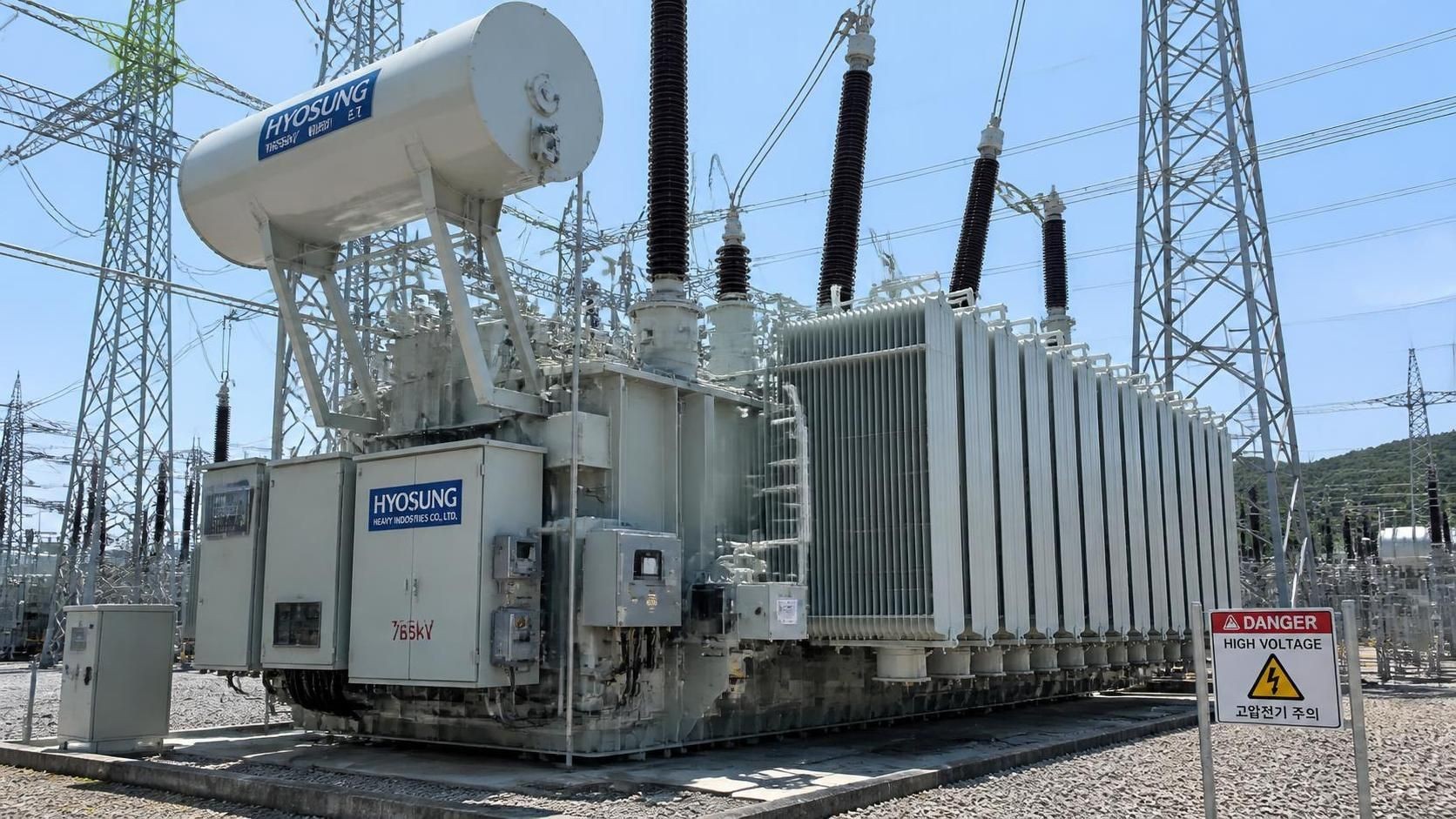
The award is smaller than some of Hyosung’s earlier 2026 utility mega-deals, but it is strategically important: hyperscalers are now buying grid hardware directly, and Hyosung is one of the few firms that can deliver 765 kV equipment from a U.S. factory.
The split is ₩220 billion of 765 kV transformers for the southern site and ₩166.5 billion of 345 kV units for the northern site. Hyosung Group Chairman Cho Hyun-joon framed the moment as a “supercycle for the first time in 60 years” and said the company intends to rank among the world’s top three power-equipment players within five years by bundling transformers, circuit breakers, HVDC, STATCOM, and energy storage.
The U.S. factory bet is finally showing up in Big Tech orders
Hyosung did not win this business from a Korean export dock. It won it because it spent years localizing production.
The Memphis, Tennessee plant—acquired from Mitsubishi Electric Power Products around 2019–2020 and operated as Hyosung HICO—is the only U.S. site that designs and builds 765 kV transformers. Since the purchase, Hyosung has put roughly $300 million into the campus through three expansion rounds. A $157 million phase announced in November 2025 is intended to lift capacity by more than 50% by 2028, add about 240 jobs, and make Memphis the largest ultra-high-voltage transformer plant in the country. Tennessee officials tied the project to domestic grid manufacturing and Korea–U.S. industrial partnership.
Hyosung says it has held the No. 1 share of the U.S. 765 kV transformer market since the early 2010s and has supplied roughly half of the 765 kV units now sitting on the American transmission grid. That installed base matters when hyperscalers need equipment that utilities already trust, and that can be tested and serviced on U.S. soil.
The second factory move is the July 2026 joint venture with Quanta Services (NYSE: PWR): Hyosung HICO Breaker, LLC, at Quanta’s Canonsburg, Pennsylvania complex near Pittsburgh. Production of gas circuit breakers from 72.5 kV to 800 kV is slated to begin in October 2026. That makes Hyosung the first Korean manufacturer with U.S. production for both large power transformers and ultra-high-voltage breakers—the two pieces of kit that sit at the heart of a data-center interconnect.
Orders tell the same story. Through August 2026, Hyosung booked about ₩9.3 trillion, already above full-year 2025, and raised its annual target from ₩8.4 trillion to ₩12 trillion. A dedicated data-center power team was stood up in early September to sell the full stack, not just iron.
Why the grid, not just the chips, is the bottleneck
AI data centers do not merely add load. They add large, relatively inflexible load in a few counties, on a grid that spent two decades with near-flat demand. Hyosung, citing Goldman Sachs research, points to roughly 15% average annual growth in U.S. data-center electricity demand through 2030 and on the order of $50 billion of related power-infrastructure investment. Goldman’s own public work has repeatedly put incremental generation spend near that $50 billion figure and described data-center demand growth in the mid-teens CAGR range, with data centers moving from a low-single-digit share of U.S. electricity toward high-single or low-double digits by 2030 depending on the vintage of the forecast.
765 kV lines move more power over longer distances with lower losses than 345 kV or 500 kV corridors. That is why utilities and now hyperscalers are specifying them as they stitch remote generation to campus-scale loads. Lead times for large transformers have stretched toward two years in tight markets. A U.S. plant that already makes 765 kV gear is a scarce asset.Impact: reliability first, rates later
For the power system, the near-term effect is constructive. More domestic 765 kV and breaker capacity shortens the queue for interconnection hardware, reduces dependence on overseas factories, and supports the high-voltage backbone that both AI campuses and ordinary peak demand will need. Memphis jobs and a new Pennsylvania breaker line are real industrial outcomes, not press-release abstractions.
The consumer story is mixed and should be stated that way. Faster, more local manufacturing can keep some data centers from stalling and can limit the worst reliability risks if a transformer fails and no spare exists. But if generation, transmission, and interconnection costs for hyperscale load are socialized across a utility’s entire rate base, households pay part of the bill. That tension is already political in several states. The opportunity for consumers is not cheaper power in 2026; it is a better chance that the lights stay on and that new supply gets built instead of rationed. Behind-the-meter generation, demand response, and clearer cost-allocation rules will decide who actually captures the benefit.
Investor angle: the backlog is the story, valuation is the risk
Hyosung Heavy Industries (KRX: 298040) is a pure-play way to own the “picks and shovels” of the U.S. AI power buildout. The stock has already rerated with the order surge: trailing multiples are elevated, consensus among covering analysts has been a Strong Buy with targets well above recent prices, and the business mix is shifting toward multi-year North American infrastructure rather than lumpy domestic Korean work. Parent Hyosung Corp. and Chairman Cho remain significant holders; Korea’s National Pension Service is a large institutional name. Quanta is the complementary U.S. listed name—EPC plus now a manufacturing JV.
What to underwrite:
- Multi-year visibility from a raised ₩12 trillion order target and a U.S. installed base that Big Tech and utilities already use.
- Vertical integration in the U.S. (Memphis transformers + Canonsburg breakers) as tariffs, “Buy America,” and security reviews tighten.
- Optionality in HVDC, STATCOM, and ESS if Cho’s “total solution” pitch lands with the same customers.
What can go wrong:
- Execution on Memphis expansion and a brand-new breaker JV.
- Customer concentration and undisclosed counterparties (the two Big Tech names were not published).
- Multiple compression if AI capex pauses or if Korean transformer peers flood the same U.S. channel.
- FX, raw-material costs, and the usual project-timing slippage on equipment that takes many months to build and test.
This is not a consumer-stock story. It is a mid-cycle industrial story sitting on a long-duration U.S. grid replacement-plus-AI overlay. Position size should reflect that the easy rerating already happened; the next leg depends on delivering Memphis capacity and converting more hyperscaler RFPs into factory slots.
The ₩386.5 billion print is confirmation, not the peak. The plants in Tennessee and Pennsylvania are the part that changes who can actually fill the orders.
Making Appendices Great Again
Appendix: Sources and Links
- Yonhap News Agency, “Hyosung Heavy secures 386.5 bln-won in deals from U.S. big tech firms amid chairman’s AI push,” Sept. 15, 2026: https://en.yna.co.kr/view/AEN20260915002800320
- The Korea Herald, “Cho Hyun-joon bets on AI power boom with W386.5b US orders,” Sept. 15, 2026: https://www.koreaherald.com/article/10873920
- The Korea Times, “Hyosung Heavy Industries secures $277 mil. in US Big Tech orders amid AI data center boom,” Sept. 15, 2026: https://www.koreatimes.co.kr/business/companies/20260915/hyosung-heavy-industries-secures-277-mil-in-us-big-tech-orders-amid-ai-data-center-boom
- Maeil Business / MK, “Hyosung Heavy Industries to Supply Transformers Worth 386.5 Billion Won to Two Big-Tech Companies,” Sept. 15, 2026: https://www.mk.co.kr/en/business/12153414
- Financial News, “Cho Hyun-joon’s U.S. Power-Market Investment Pays Off…,” Sept. 15, 2026: https://en.fnnews.com/news/202609151049476935
- PR Newswire / Hyosung, “Hyosung Chairman Cho Hyun-joon Secures $287M U.S. Orders in Global Top-3 Push,” Sept. 15, 2026: https://www.prnewswire.com/news-releases/hyosung-chairman-cho-hyun-joon-secures-287m-us-orders-in-global-top-3-push-302878541.html
- Hyosung corporate site: https://www.hyosung.com/en/
U.S. plant expansion — Memphis
- The Korea Herald, “Hyosung to expand Memphis site into largest transformer plant in US,” Nov. 18, 2025: https://www.koreaherald.com/article/10618541
- The Korea Herald, “Hyosung scales up US factories for AI power boom,” Sept. 10, 2026: https://www.koreaherald.com/article/10867456
- The Korea Herald, “Cho Hyun-joon’s early US bet powers Hyosung’s grid expansion,” Sept. 10, 2026: https://www.koreaherald.com/article/10868779
- The Korea Times, “Cho Hyun-joon positions Hyosung Heavy Industries for US power boom,” Sept. 10, 2026: https://www.koreatimes.co.kr/business/companies/20260910/cho-hyun-joon-positions-hyosung-heavy-industries-for-us-power-boom
- Businesskorea, “Hyosung Heavy Industries Expands U.S. Ultra-high Voltage Transformer Facility,” Nov. 18, 2025: https://www.businesskorea.co.kr/news/articleView.html?idxno=256750
- Tennessee ECD, “Hyosung HICO, Ltd. Expands U.S. Manufacturing Headquarters for Second Time in Six Months,” Nov. 12, 2025: https://www.tn.gov/ecd/news/2025/11/12/hyosung-hico–ltd–expands-u-s–manufacturing-headquarters-for-second-time-in-six-months.html
- Daily Memphian, “South Korean manufacturer to invest another $157M, create 240 new jobs in Memphis,” Nov. 12, 2025: https://dailymemphian.com/article/57081/hyosung-hico-to-invest-157-million-south-memphis
- Transformer Magazine, “Hyosung expands transformer production in Memphis,” Nov. 21, 2025: https://transformer-magazine.com/news/hyosung-expands-transformer-production-in-memphis/
Quanta joint venture — Canonsburg, PA
- Pennsylvania Business Report, “Quanta Services, Hyosung HICO form joint manufacturing operation in Canonsburg,” June 17, 2026: https://pennbizreport.com/news/32844-quanta-services-hyosung-hico-form-joint-manufacturing-operation-in-canonsburg/
- Transformer Magazine, “Hyosung HICO and Quanta launch joint venture,” June 17, 2026: https://transformer-magazine.com/news/hyosung-hico-and-quanta-launch-joint-venture/
- Hoodline, “High-Voltage Jolt: Hyosung, Quanta Plug Breaker Plant Into Canonsburg,” June 15, 2026: https://hoodline.com/2026/06/high-voltage-jolt-hyosung-quanta-plug-breaker-plant-into-canonsburg/
- Korea JoongAng Daily, “Hyosung to become first Korean firm to build ultra-high-voltage circuit breaker plant in the United States,” June 14, 2026: https://www.koreajoongangdaily.com/business/hyosung-to-become-first-korean-firm-to-build-ultrahighvoltage-circuit-breaker-plant-in-the-united-states/12721900
- PR Newswire, “Hyosung Heavy Industries Forms U.S. Joint Venture to Produce High-Voltage Circuit Breakers,” June 22, 2026: https://www.prnewswire.co.uk/news-releases/hyosung-heavy-industries-forms-us-joint-venture-to-produce-high-voltage-circuit-breakers-302805276.html
- Nelson Mullins client note on the JV: https://www.nelsonmullins.com/insights/news/press_releases/nelson-mullins-team-represents-hyosung-heavy-industries-hyosung-hico-and-hico-america-in-u-s-power-equipment-joint-venture
- HICO America / Hyosung HICO announcement page: https://www.hyosunghico.com/blog/hyosung-hico-and-quanta-services-form-joint-venture-to-expand-domestic-high–voltage-circuit-breaker-manufacturing
Earlier 2026 U.S. order context
- The Korea Times, “Hyosung secures record power equipment deal in US,” Feb. 10, 2026: https://www.koreatimes.co.kr/business/companies/20260210/hyosung-secures-record-power-equipment-deal-in-us
- Chosun Biz, “Hyosung Heavy wins record US power order as Korea extends 765kV lead,” Feb. 10, 2026: https://biz.chosun.com/en/en-industry/2026/02/10/MYUIOT4BF5DBRJPD64LY754BEE/
- Businesskorea, “Hyosung Heavy Industries Secures a Record U.S. Transformer Deal,” Feb. 10, 2026: https://www.businesskorea.co.kr/news/articleView.html?idxno=262913
Demand and grid backdrop
- Goldman Sachs Research, “Generational Growth: AI, data centers and the coming US power demand surge,” April 29, 2024: https://www.goldmansachs.com/insights/goldman-sachs-research/generational-growth-ai-data-centers-and-the-coming-us-power-demand-surge
- Goldman Sachs, “AI is poised to drive 160% increase in data center power demand,” May 14, 2024: https://www.goldmansachs.com/insights/articles/AI-poised-to-drive-160-increase-in-power-demand
- Goldman Sachs Exchanges, “The Outlook for Data Center Power Demand as AI Token Use Grows,” Sept. 1, 2026: https://www.goldmansachs.com/insights/goldman-sachs-exchanges/the-outlook-for-data-center-power-demand-as-ai-token-use-grows
Company / investor references
- StockAnalysis profile, Hyosung Heavy Industries (KRX:298040): https://stockanalysis.com/quote/krx/298040/
- MarketScreener company page: https://www.marketscreener.com/quote/stock/HYOSUNG-HEAVY-INDUSTRIES–46512725/company/
- Hyosung Heavy Industries site: https://www.hyosungheavyindustries.com
Dollar conversions in Korean press vary with the won–dollar rate on the day of publication; won figures are the official contract amounts.