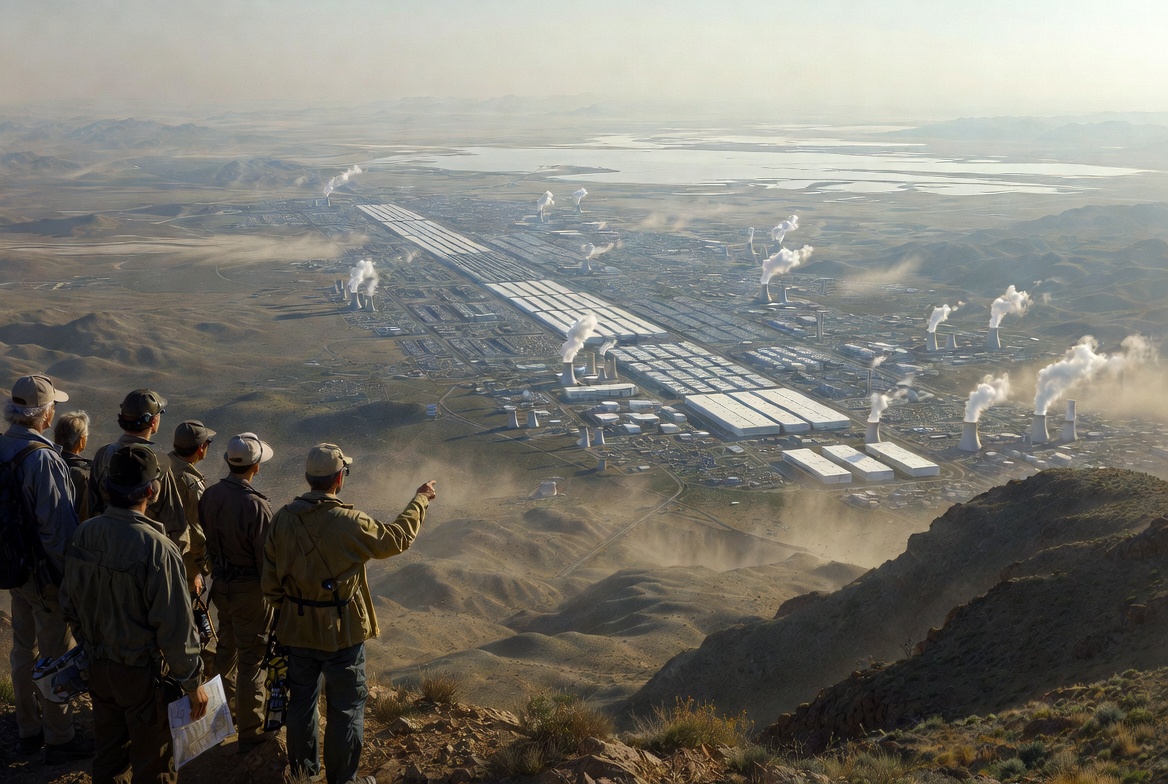
A massive hyperscale data center complex proposed for rural northern Utah has sparked intense debate among scientists, environmental groups, and local residents. Dubbed the Stratos Project, the development—backed by “Shark Tank” investor Kevin O’Leary—could become one of the largest data centers in the United States. Located in Hansel Valley in Box Elder County, at the northern edge of the Great Salt Lake watershed, critics warn that its unprecedented energy demands and waste heat could create a “heat island” effect capable of dramatically altering local climates, harming wildlife, and worsening the already precarious state of the Great Salt Lake.
The project, developed by O’Leary’s O’Leary Digital in partnership with Utah’s Military Installation Development Authority (MIDA), spans a staggering 40,000 acres—roughly the size of two Manhattans or about 2,000 Walmart Supercenters. At full buildout, it would require up to 9 gigawatts (GW) of electricity, more than double the entire state of Utah’s current total power consumption (approximately 4 GW). Power would be generated on-site via natural gas plants connected to the nearby Ruby Pipeline, with potential technologies including advanced Allam-cycle turbines or thousands of reciprocating gas engines. The campus is intended for AI, cloud computing, and national security applications, with developers negotiating with major hyperscalers such as Amazon, Microsoft, or Google.
Scale and Technical Details
Footprint and Timeline: 40,000 acres in unincorporated Hansel Valley, with phased development over years. Only a fraction of the land would host actual data halls; much would remain open space for grazing and wildlife corridors. Box Elder County approved an interlocal agreement with MIDA on May 4, 2026, without initial public comment.
Energy and Heat: The facility would consume 9 GW electrically but generate an additional 7–8 GW of waste heat, creating a roughly 16 GW thermal load. This is equivalent to dumping the energy of about 23 atomic bombs into the local environment daily.
Water Use: Developers claim a closed-loop dry (air-based) cooling system using on-site salty groundwater unsuitable for drinking or agriculture. Water would be recycled with minimal ongoing consumption (primarily for initial fill and employee needs). A water rights transfer application for 1,900 acre-feet was withdrawn on May 6, 2026, after nearly 4,000 public protests.
Environmental Concerns: Heat, Water, Energy, and Wildlife
Utah scientists have raised alarms about the project’s local and regional impacts. Physics professor Robert Davies of Utah State University analyzed the heat output and called it “so much worse than I even thought.” He estimates the continuous thermal dump in the valley’s bowl-like topography could raise daytime temperatures by about 5°F and nighttime temperatures by up to 28°F, potentially shifting the semi-arid high desert toward Sahara-like conditions with spiked evaporation and loss of dewpoint.
Ecology professor Ben Abbott of Brigham Young University echoed these fears: “This would absolutely change the landscape… Hansel Valley would become another dust source on the Wasatch Front, in addition to the exposed and drying lakebed of the shrinking Great Salt Lake.” The added heat and potential dust could devastate wildlife, native plants, and ranching viability while intensifying threats to the Great Salt Lake ecosystem, already stressed by drought, low inflows, and toxic dust from its exposed bed.
Energy drain and emissions are another major issue. Utah Clean Energy estimates that on-site gas generation could increase the state’s CO₂ emissions by 55–75%, depending on turbine vs. engine technology, while consuming billions of gallons of water annually for power production alone (2–16.6 billion gallons/year, equivalent to 3,000–25,000 Olympic swimming pools). NOx emissions could also spike dramatically. Even if the data center itself uses closed-loop cooling, the power plants add significant resource strain in an arid state.
Water concerns persist despite developer assurances. Critics note that even “minimal” evaporative or maintenance losses, combined with the project’s location in the GSL watershed, could indirectly reduce inflows. Logan Mitchell of Utah Clean Energy and others highlight risks from hot water discharge (potentially 100°F from certain gas processes) if cooling fails.
Pros: Economic Benefits and Developer Mitigations
Proponents, including Gov. Spencer Cox, Senate leaders, and Box Elder County officials, emphasize substantial upsides. The project is projected to create thousands of construction jobs and 2,000 permanent positions in IT, logistics, and trades. Tax revenues could reach $108 million annually at full buildout (initial phases ~$30 million), funding emergency services, roads, schools, and infrastructure—all paid for by private developers with no taxpayer burden. Landowners could continue grazing on much of the site.
O’Leary and MIDA stress national security benefits (supporting U.S. military AI and computing needs), economic competitiveness, and sustainability features: on-site power (no grid strain or rate hikes for residents), closed-loop cooling with non-potable water, and compliance with all air/water permits. The nearest facilities would be about 10 miles from the lake, separated by open space. Developers argue that net water consumption would be lower than prior agricultural use, benefiting the watershed overall.
Current Status and Next Steps
Box Elder County’s approval allows MIDA to create the project area, but full construction requires additional state permits from the Department of Environmental Quality (air and water quality) and the Department of Natural Resources. A referendum effort is underway, needing over 5,000 signatures to challenge the decision. Public backlash has been fierce, with residents citing rushed timelines and insufficient environmental review.
The Great Salt Lake continues to face record lows, making any additional pressures highly contentious. While data centers are booming nationwide to meet AI demands, Utah’s project highlights the tension between tech growth and environmental limits in the West.
Energy News Beat will continue monitoring developments as permitting and public input proceed.
All information is drawn from the following publicly available sources (accessed May 2026):
- Salt Lake Tribune: “‘So much worse than I even thought’: Utah’s ‘hyperscale’ data center could create massive heat island near Great Salt Lake” (May 7, 2026) – https://www.sltrib.com/news/environment/2026/05/07/utahs-data-center-could-create/
- Sierra Club Press Release: “Stratos Data Center Approval Threatens Great Salt Lake Basin” (May 6, 2026) – https://www.sierraclub.org/press-releases/2026/05/stratos-data-center-approval-threatens-great-salt-lake-basin
- Governor of Utah FAQ on Stratos Project – https://governor.utah.gov/wp-content/uploads/FAQ-on-Stratos-Project.pdf
- Utah Clean Energy: “Estimated Emissions and Water Consumption from the Proposed Stratos Data Center” – https://utahcleanenergy.org/estimated-emissions-and-water-consumption-from-the-proposed-stratos-data-center/
- Box Elder County: Stratos Project Fact Sheet – https://www.boxeldercountyut.gov/647/Stratos-Project-Fact-Sheet
- Additional reporting from ABC4, KSL, Utah News Dispatch, Business Insider, and others detailing approvals, protests, and developer statements (May 2026).
This article presents a balanced overview based on scientific analyses, official statements, and independent estimates. Further environmental reviews may provide additional data.