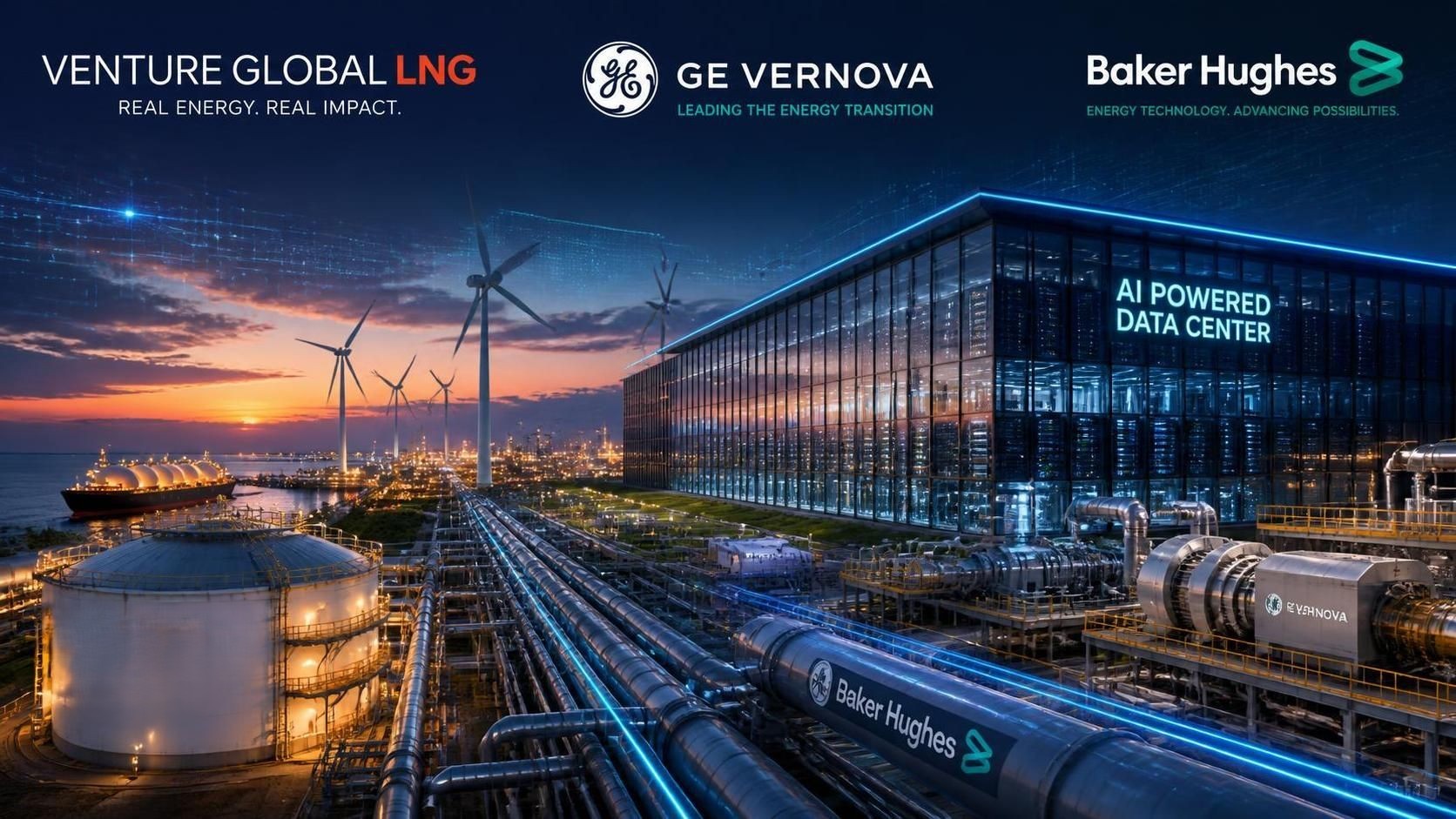
U.S. LNG exporter Venture Global (NYSE: VG) announced on October 15, 2026, that it has entered power and grid frame agreements with GE Vernova and Baker Hughes Energy Services. These cover up to 16 new 720 MW combined-cycle gas power island units plus associated transformers and grid equipment, potentially enabling roughly 11.5 GW of additional generation capacity. The company says this pathway could support up to 10 GW of new compute capacity by the end of 2034 at sites it owns or controls, primarily for adjacent data centers, while also supporting continued LNG growth.
This builds on Venture Global’s existing roughly 4.5 GW of modular, gas-fired “Island-Mode” (behind-the-meter) generation across six power islands that already power its LNG facilities independently of the public grid. CEO Mike Sabel described the move as a natural extension of the company’s proven private industrial power grid and positioned it as creating a “vertically integrated AI utility” that includes Island-Mode generation, gas supply, closed-loop water systems, land, and data centers. The expansion is staged and market-driven, with the first power-island purchase order expected by the end of 2026 and subsequent orders tied to customer commitments. An 8-K filing indicates that exercising all contemplated purchases under the agreements could total approximately $17.2 billion (including reservation fees, subject to adjustment). The company plans to file initial permit applications promptly and has emphasized that any third-party data center activity would be separate from and complementary to its LNG operations and existing sales commitments.
Latest Earnings Context
Venture Global’s most recent reported results are for Q2 2026 (ended June 30). The company generated revenue of $4.6 billion (up 48% year-over-year), income from operations of $2.2 billion (up 111%), net income attributable to common stockholders of $1.3 billion (up 266%), and Consolidated Adjusted EBITDA of $2.5 billion (up 79%). It exported 127 cargos and sold 466.4 TBtu of LNG. Management raised full-year 2026 Consolidated Adjusted EBITDA guidance to $8.7–$9.1 billion (from a prior $8.2–$8.5 billion range), tightened the expected cargo range to 500–518, and noted that 91% of 2026 cargos are contracted. Total assets stood at $61.5 billion. The company has also been active in refinancings that are projected to deliver more than $100 million in annual cost savings. These results reflect strong operational ramp-up at Calcasieu Pass and Plaquemines alongside ongoing construction at CP2. Q3 2026 earnings are scheduled for release around November 10, 2026.
Comparison to Liberty Energy, EQT, Chevron, and ExxonMobil
This is consistent with a broader trend of oil and gas companies expanding into dedicated power for AI data centers rather than becoming traditional regulated utilities. They are generally pursuing behind-the-meter or co-located generation that avoids adding load to constrained public grids.
- Liberty Energy (oilfield services) has pursued a power-as-a-service model through Liberty Power Innovations. It has partnered with Vantage Data Centers for up to 1 GW over five years (including 400 MW reserved for 2027), formed a joint venture with PowerBridge for a planned 2 GW West Texas campus (initial phase >300 MW, first power targeted late 2027), selected Bergen Engines for >500 MW of on-site generation, and aims for roughly 3 GW of power deployment by 2029. It is leveraging modular gas generation experience from oilfield operations.
- EQT (Appalachian gas producer) has focused on firm gas supply contracts rather than owning generation. It has secured deals covering roughly 1.4 Bcf/d for data center-linked projects in Pennsylvania, including supply for the Homer City Energy Campus (up to ~665 MMcf/d for a 4.4 GW gas plant + AI campus) and the former Bruce Mansfield site, plus a 10-year agreement for 325,000 Dth/d linked to PJM power prices for Competitive Power Ventures’ Shay Energy Center in West Virginia. Pricing is often structured to capture power-market upside rather than pure gas indexes.
- Chevron has advanced multi-GW co-located gas generation. Through Energy Forge One / Project Kilby (with Engine No. 1), it signed a 20-year take-or-pay PPA with Microsoft for ~2.67 GW of firm behind-the-meter capacity in West Texas, with FID targeted by end-2026 and first power around 2028. It has also pursued broader “power foundries” with GE Vernova targeting up to 4 GW across regions.
- ExxonMobil has outlined plans for more than 1.5 GW of detached natural-gas generation with carbon capture (>90% CO2 capture) for data centers, operating independently of the grid, and has been in discussions with hyperscalers.
Venture Global is not seeking to reclassify as a traditional utility. Like these peers, it is leveraging existing energy infrastructure, land, gas access, and execution capabilities for private, Island-Mode power that serves hyperscalers or co-located compute without relying on (or burdening) the public grid. It is closer to a vertically integrated energy-plus-compute platform than a pure hyperscaler itself—the data centers would be potential adjacent infrastructure, with development contingent on customer commitments. The company has explicitly framed it as an “AI utility” solution to buildout chokepoints while remaining primarily an LNG exporter.
Data Center Locations
Specific data center sites have not been named, and no customer agreements have been disclosed. The pathway targets sites owned or controlled by Venture Global, which are concentrated on the Louisiana Gulf Coast:
- Calcasieu Pass (Cameron Parish): ~432-acre site with existing power infrastructure and deep-water access on the Calcasieu Ship Channel.
- CP2 LNG (adjacent/nearby in Cameron Parish): Under development, with related power islands planned or under construction.
- Plaquemines LNG (Plaquemines Parish, ~20–50 miles south of New Orleans on the Mississippi River): Roughly 630-acre main site plus expansion acreage (hundreds of additional acres available or under option for facilities and workspace).
These locations offer advantages in land availability, gas pipeline access, existing industrial power islands, and isolation from dense urban grid constraints. The company has referenced “thousands of acres of land” in the context of the vertically integrated offering.
Impacts on Consumers and Investors
Consumers: Venture Global stresses that Island-Mode generation places no additional demand on the public electric grid or public water utilities and therefore imposes no added costs on local consumers. This is a key differentiator amid widespread concerns about data center load growth straining grids, delaying interconnections, and potentially raising rates elsewhere. Closed-loop water systems further limit external resource impacts. Any emissions or permitting will still require regulatory review, and the company is advancing carbon capture projects at its LNG facilities.
Investors: The announcement diversifies Venture Global beyond pure LNG export into a high-growth power and compute adjacency, potentially creating a new contracted revenue stream less correlated with LNG price spreads. The framework is flexible (most spending is contingent), which limits near-term capital commitment while securing scarce long-lead equipment (turbines and transformers). Near-term financial strength is already evident in the raised 2026 EBITDA guidance and strong volume growth. Risks include execution on permitting and construction, the need for actual customer commitments to trigger full deployment, capital intensity if fully exercised (~$17.2 billion equipment), and competition for hyperscaler offtake. For the sector overall, these private power solutions can help accelerate AI infrastructure while reducing public-grid pressure, supporting gas demand, and creating optionality for energy companies. Share reaction to the announcement was modestly positive in early trading.
In short, Venture Global is following the path of other energy players by converting its existing behind-the-meter power expertise and Gulf Coast footprint into optionality for AI-related power, without shifting its core classification or imposing costs on retail consumers.
Check out the World’s Greatest Podcast Show Notes at EnergyNewsBeat.co or EnergyNewsBeat.com. And subscribe to: The Energy News Beat Substack.
Appendix: Sources and Links
- Venture Global official press release (Oct. 15, 2026): https://ventureglobal.com/2026/10/15/venture-global-secures-new-agreements-to-support-expansion-of-existing-grid-independent-power-network/
- OilPrice.com summary: https://oilprice.com/Company-News/Venture-Global-Targets-10-GW-of-Gas-Fired-Power-for-AI-Data-Centers.html
- Reuters: https://www.reuters.com/business/energy/venture-global-inks-deals-with-ge-vernova-baker-hughes-power-expansion-2026-10-15/
- WSJ: https://www.wsj.com/business/energy-oil/gas-exporter-venture-global-wants-to-get-in-on-ai-power-boom-6b91b9e1
- Baker Hughes release: https://investors.bakerhughes.com/news/press-releases/news-details/2026/Baker-Hughes-and-Venture-Global-Expand-Strategic-Long-Term-Power-Generation-Partnership/default.aspx
- StockTitan / 8-K summary ($17.2B): https://www.stocktitan.net/sec-filings/VG/8-k-venture-global-inc-reports-material-event-246f9dab7820.html
- Venture Global Q2 2026 results: https://ventureglobal.com/2026/08/11/venture-global-reports-second-quarter-2026-results/
- Motley Fool Q2 2026 transcript summary: https://www.fool.com/earnings/call-transcripts/2026/08/18/venture-global-vg-q2-2026-earnings-call-transcript/
- Seeking Alpha Q2 notes: https://seekingalpha.com/news/4653307-venture-global-secures-deal-to-build-on-site-power-plants-for-data-centers
- American Buildout coverage: https://americanbuildout.com/venture-global-lines-up-16-gas-power-islands-for-up-to-10-gw-of-off-grid-data-center-capacity/
- Chevron / Microsoft Kilby: https://www.chevron.com/newsroom/2026/q2/chevron-signs-20-year-power-agreement-with-microsoft-for-west-texas-data-center
- Liberty Energy / Vantage and related deals (multiple sources including Data Center Dynamics and company releases)
- EQT gas supply agreements (Homer City, Mansfield, CPV Shay; S&P Global, Nasdaq, Hart Energy coverage)
- ExxonMobil data center power initiative coverage (RBN Energy and related reports)
- Facility locations: Venture Global project pages (Calcasieu Pass, Plaquemines) and Global Energy Monitor / FERC-related filings
All figures and characterizations are drawn from the company’s announcements, SEC filings, and contemporaneous reporting as of mid-October 2026. Forward-looking elements remain subject to customer commitments, permitting, and market conditions.