Two U.S. carriers sit in the Arabian Sea, tankers are still being hit near Hormuz, and refinery strikes in Russia have resumed. Brent just fell to its lowest since Aug. 31 anyway. Here is what is confirmed, what open-source trackers see, the signals for and against a new strike, and what each chokepoint means for your fuel bill.
By Stuart Turley, host of the Energy News Beat podcast
Published Nov. 5, 2026 | Prices as of 6:36 a.m. CT Nov. 5 (AAA) and 8:33 a.m. CT Nov. 5 (Brent futures, Reuters via RTE, 14:33 GMT) | Signals, not predictions | Not investment advice
Follows our Nov. 2 report, Crude Fell 4% on Iran Talks. The Diesel Price Barely Noticed. [ARTICLE LINK]
Oil traders spent Wednesday selling the war. Brent futures fell more than 8% to settle at their lowest since Aug. 31, then bounced $2.94 to $97.56 a barrel by mid-afternoon in London on Thursday, according to Reuters. The trigger was a political one: voters handed Democrats both chambers of Congress, and Vice President JD Vance wrote on X that “The reason we lost is the war” (CBS News).
The military picture did not change on election night. Two U.S. carrier strike groups are in the Arabian Sea, tankers are still being hit near the Strait of Hormuz, and Ukraine has resumed drone strikes on Russian refineries. That gap is the story for anyone who buys diesel, ships freight or owns energy stocks. This piece separates what is confirmed from what open-source trackers read into the imagery, and it lists the signals on both sides. It does not predict a strike.
What is confirmed: the force in the region
The USNI News fleet tracker for Nov. 2 places USS George Washington (CVN-73) and USS George H.W. Bush (CVN-77) with their strike groups in the Arabian Sea, about a dozen destroyers and cruisers in the region, two destroyers in the Red Sea, the Boxer Amphibious Ready Group with the 11th Marine Expeditionary Unit in the Indian Ocean, and three destroyers in the Mediterranean. USS Theodore Roosevelt was in the South China Sea after an exercise in Japan. The Navy had 104 ships deployed out of a battle force of 286.
U.S. forces struck an anti-aircraft site on Iran’s Qeshm Island on Nov. 2-3. U.S. officials described the strikes to CBS News as “limited, defensive,” and President Trump called it a “minor attack” that “wasn’t war” (Al Jazeera). The U.S. naval blockade of Iran remains in place, and senior advisers favor keeping it, per Axios (Iran International).
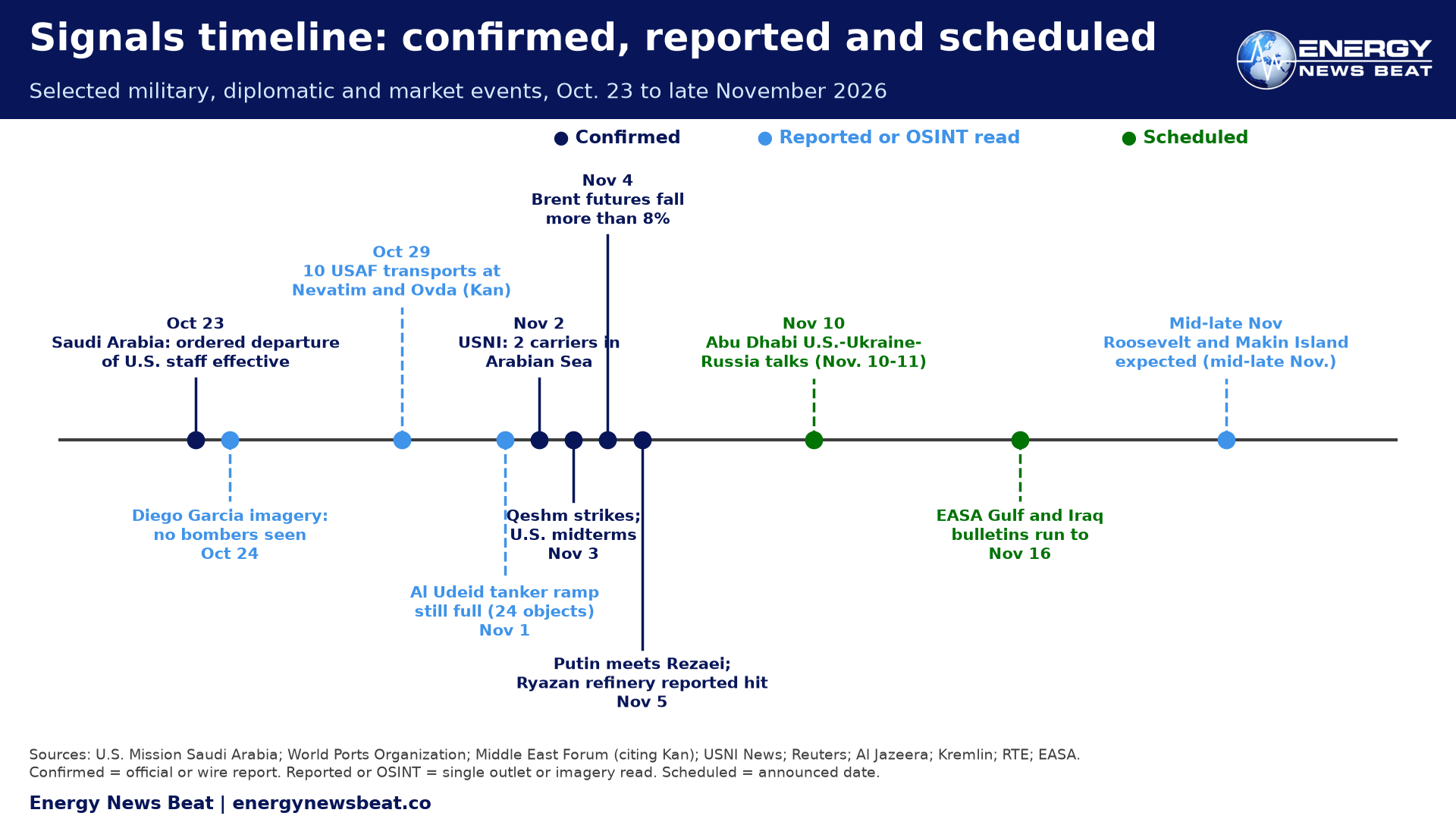
On the diplomatic and civil side, the U.S. Mission to Saudi Arabia says the State Department ordered non-emergency U.S. government employees and family members to leave Saudi Arabia effective Oct. 23, citing Houthi attacks on Saudi airports and infrastructure. The same alert says airports in Bahrain, Jordan, Oman, Qatar and the United Arab Emirates remain operational. Europe’s air safety regulator, EASA, lists active conflict-zone bulletins for the airspace of Iran, Iraq, and the Persian Gulf and Gulf of Oman; the Gulf and Iraq bulletins run to Nov. 16. In Israel, the Pentagon deployed a THAAD battery and U.S. crew in October 2024 (Defense Department). We could not confirm its current status from an official source.
What the open-source trackers see (reads, not facts)
The most detailed public read is a satellite survey by the Middle East Forum, which examined 43 U.S. and allied bases from Oct. 1 to Nov. 1 using 10-meter imagery. Treat it as analysis, not confirmation. Its key observations:
- Al Udeid, Qatar: the north ramp, where the tanker fleet parks, held 19 to 26 aircraft-size objects on five clear mornings through Nov. 1. Before the February war, an OSINT analyst cited by MEF says the tankers left on Feb. 27, one day before the first strikes. A full ramp can mean Washington expects no fire on Qatar while it hosts talks, or that tankers are parked where they would be needed on night one.
- Diego Garcia: Oct. 24 imagery showed a C-5, a C-40, at least two P-8s and at least four KC-135s, and “no B-2 or B-52 long-range bombers” (World Ports Organization).
- Israel: Israel’s Kan broadcaster reported 10 U.S. Air Force transports at Nevatim and Ovda on Oct. 28-30, and the Wall Street Journal reported a Patriot battery moving from Texas, both as cited by MEF. Channel 14’s claim of 80 U.S. tankers in Israel is not supported by MEF’s Oct. 31 imagery.
- Airlift: Hunterbrook counted 193 C-17 and C-5M flights from Sept. 29 to Oct. 29, and an airlift tracker logged 79 aircraft in the 24 hours to Nov. 1, about a third above its baseline, both as cited by MEF.
- The third carrier: MEF reports Theodore Roosevelt and the amphibious ship Makin Island are expected in Central Command by mid-to-late November. Its bottom line is a force “ready for a short war” now, with the heavier second wave weeks away.
One reported plan does not square neatly with the tracker. The New York Times, as cited by Middle East Eye, reported that Central Command had a strike plan that could begin as early as Nov. 4 (a date that has now passed without a reported strike), “when three aircraft carriers are in the region,” with moonless nights favoring air operations and one carrier due to return home after early November. USNI’s Nov. 2 tracker shows two carriers in the Arabian Sea. We could not reconcile the count.
Is a strike coming? Signals for and against
Signals that point toward renewed strikes:
- Two sources told Reuters that Trump is still likely to order resumed hostilities. “He is planning to bomb Iran. Don’t listen to what he’s saying. He held off because of the midterms,” one said.
- U.S. officials told Axios the military was completing preparations for a possible resumption of major combat operations, including additional assets, according to Iran International.
- Tehran has not budged. Mohsen Rezaei, secretary of Iran’s Supreme National Security Council, wrote on Nov. 3 that the U.S. response “was not convincing” and must “fully and explicitly address Iran’s seven conditions” (Al Jazeera). On Oct. 31 he said of the Vance letter, “I read the letter and haven’t responded to it yet,” though he said the letter’s tone “has completely changed” (APA).
- Ships are still being hit. UKMTO reports at least five vessel incidents since Nov. 1, after 35 vessels hit in October, the most of any month of the war (Reuters).
- Eurasia Group still puts renewed U.S. strikes at 60%, down from 65% (Reuters). Abdulaziz Sager of the Gulf Research Center warned that defeat could make Trump more willing to strike, not less (Reuters).
Signals that point away from a major strike:
- Trump told the Financial Times, “We’re locked and loaded if we need to go, but there may be no reason for it” (Anadolu).
- Vance leads the group pushing for a deal, and CIA Director John Ratcliffe and Treasury Secretary Scott Bessent favor keeping the blockade and economic pressure, per Axios (Iran International).
- Mediation is active. Qatar says both sides “remain committed” to talks (Al Jazeera), and Oman says it is still working with Iran on a joint Hormuz traffic mechanism that could “end the state of war” (CBS News).
- Two sources close to Gulf governments told Reuters a full-scale assault “now looks less likely,” though limited strikes on nuclear sites remain possible.
- The posture reads short of a full surge: no bombers seen at Diego Garcia, the third carrier not yet in theater, and the Al Udeid tankers not dispersed, per the open-source reads above.
A Hezbollah official quoted by Reuters put it this way: “At this moment, the chances of escalation and de-escalation may be equal.” MEF lists the tells to watch: the Al Udeid ramp falling below about 15 aircraft, bombers arriving at Diego Garcia or RAF Fairford, the third carrier arriving, and ordered departures spreading beyond Saudi Arabia.
The chokepoints, one by one
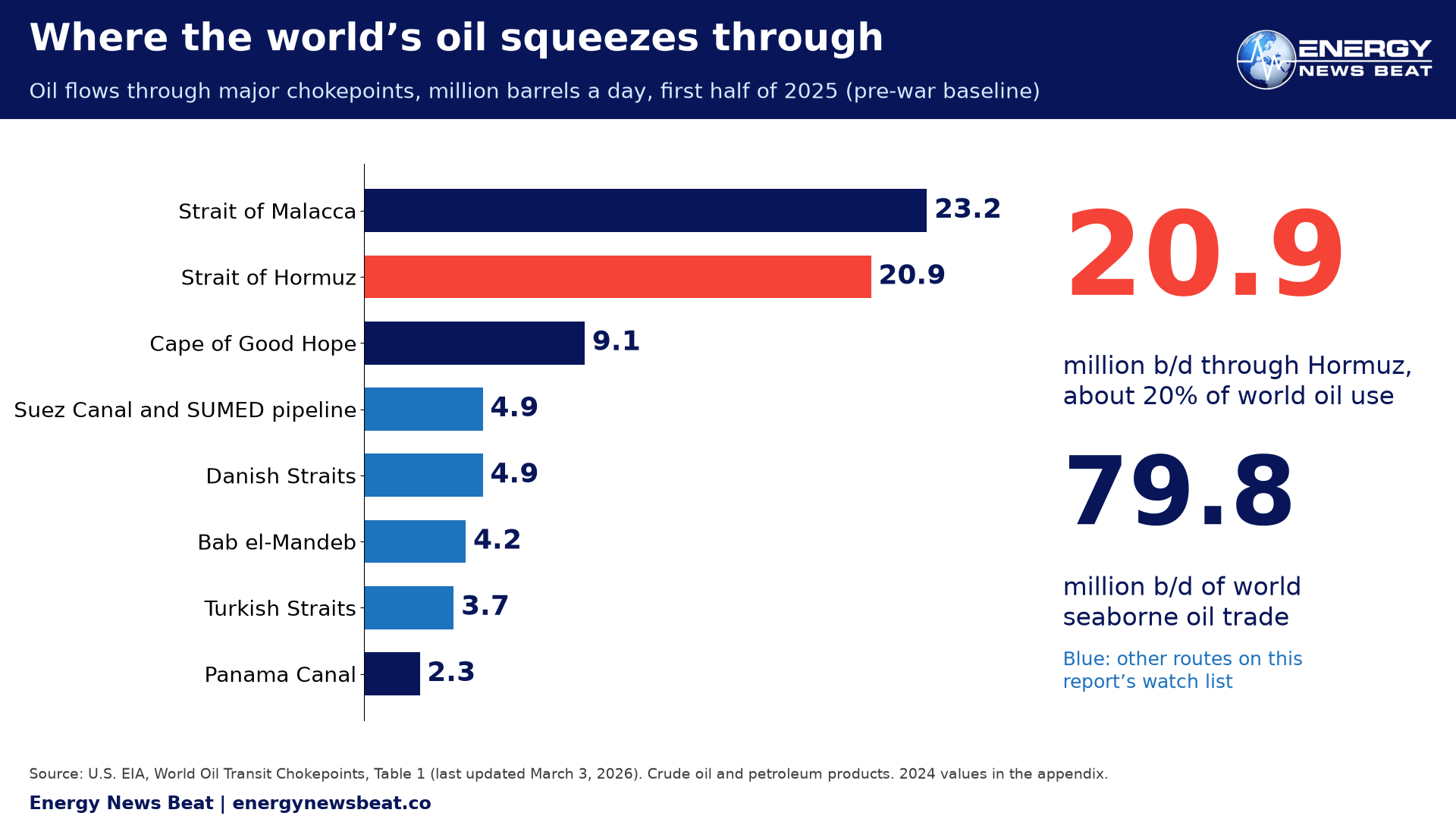
This report watches six chokepoints: five sea routes — Hormuz, Bab el-Mandeb, Suez, the Turkish Straits and Malacca — plus the Druzhba pipeline. The EIA baseline covers the sea routes; for context, it also tracks the Cape of Good Hope and the Danish Straits. In the first half of 2025, Malacca carried 23.2 million barrels a day, Hormuz 20.9 million (about one-fifth of world oil use), the Cape of Good Hope 9.1 million, Suez and the SUMED pipeline 4.9 million, the Danish Straits 4.9 million, Bab el-Mandeb 4.2 million and the Turkish Straits 3.7 million.
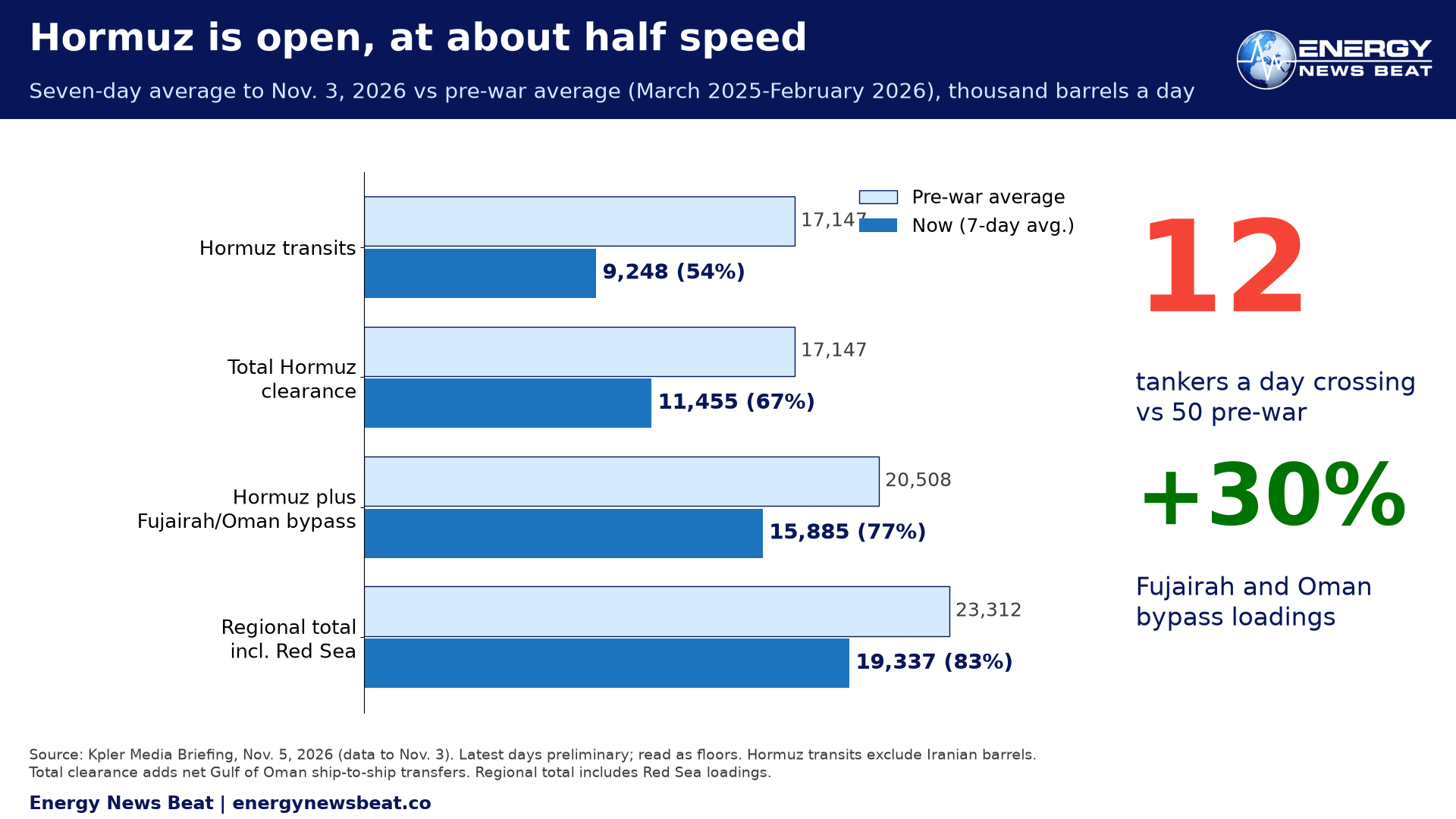
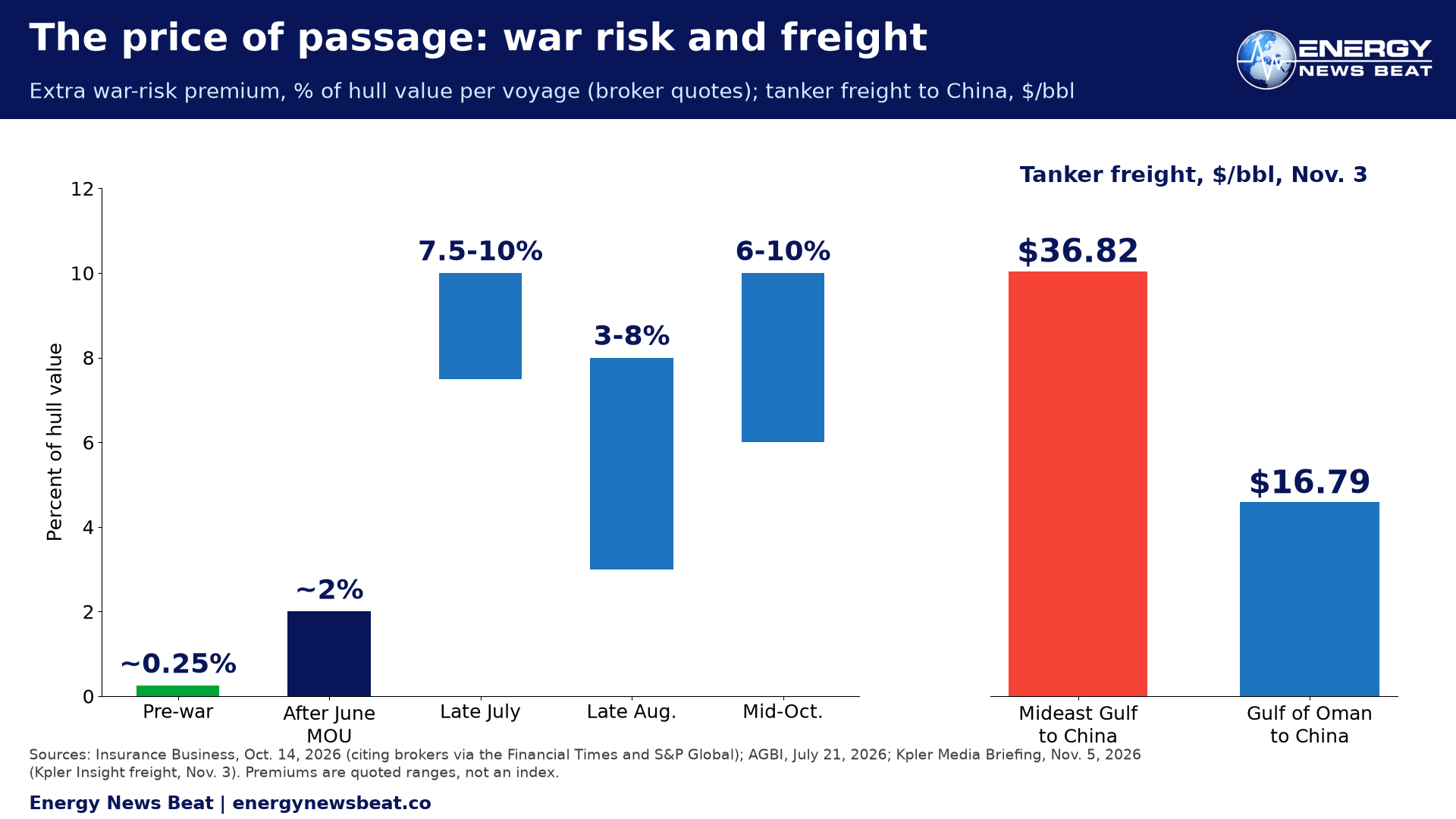
Hormuz is the one under fire. Kpler’s Nov. 5 briefing puts the seven-day average of transits, excluding Iranian barrels, at 9.25 million barrels a day through Nov. 3, 54% of its pre-war level, with about 12 tankers crossing a day against 50 before the war (Kpler). Add ship-to-ship transfers in the Gulf of Oman and total clearance is 67%. Bypass loadings at Fujairah and Oman are running 30% above normal, and the region as a whole, including the Red Sea, is at 83%. War-risk insurance has run 6% to 10% of a hull’s value per voyage as of mid-October, against about 0.25% before the war, per brokers cited by Insurance Business.
Bab el-Mandeb and the Red Sea are the bypass that is now under threat. The Houthis are at war with Saudi Arabia, and Saudi air defenses intercepted a Houthi missile fired toward the Madinah region, after which an all-clear was issued for Yanbu (Gulf News). Yanbu is the Red Sea end of the Saudi East-West pipeline. Kpler counts 99.9 million barrels of Saudi crude sent to Asia via the Suez route since a Houthi ban on Saudi-linked cargoes began in July, against 66.4 million through Bab el-Mandeb.
The Black Sea and Turkish Straits remain a war zone for cargo, not yet for crude flows. Russia’s Defence Ministry says it hit a cargo vessel 52 kilometers southwest of Odesa (CGTN), after claimed strikes on three ships (TradeWinds). On the Druzhba line, Kazakhstan has asked Russia to let it resume crude exports to Germany through Druzhba, which Russia rerouted in April; Germany’s Schwedt refinery relies partly on that crude (Hydrocarbon Processing). A drone strike on a Samara pumping station briefly halted Kazakh crude intake before flows restarted, Briefs reported.
Malacca has no conflict of its own, but it sits downstream of Hormuz. Most crude crossing it runs from the Middle East to East Asia, and China took 48% of its import volumes in the first half of 2025 (EIA). South Korea says it will send maritime patrol aircraft and an explosive ordnance disposal team to waters near Hormuz (Gulf News).
Russia and Ukraine: refineries back in the crosshairs
Ukraine has resumed strikes on Russian refineries. Ryazan appears to have been hit overnight, the second refinery this week after Yaroslavl, ending a pause (Reuters). Bloomberg data cited by Briefs say the pause lasted nearly two weeks and overlapped with Trump’s request to halt such strikes. Russia’s seaborne crude exports averaged 3.65 million barrels a day over the four weeks to Nov. 1.
For diesel, the direction matters. Under an October U.S.-Kremlin arrangement, Russian diesel exports resumed, and at least six Russian diesel cargoes are signaling transatlantic voyages, with the first due in New York this weekend. Kpler’s Matt Smith cautioned that discharge is not guaranteed (Reuters). Kpler says northwest European diesel cracks rose $7.7 a barrel, and it says renewed refinery attacks cast doubt on Russian export volumes. On the diplomatic track, U.S., Ukrainian and Russian officials are due in Abu Dhabi on Nov. 10-11, the first such talks since February (RTE). Rezaei met Vladimir Putin in Moscow on Nov. 5 (Kremlin) and, according to the Iranian government, delivered a message from Iran’s Supreme Leader (CBS News), while Russia’s Foreign Ministry kept its warning against travel to Iran, citing the “risk of a new escalation” (CBS News).
What it means at the pump and in the portfolio
EIA spot data show Brent at $107.03 on Nov. 3, down from $135.51 on Oct. 2, and New York Harbor ultra-low sulfur diesel at $4.823 a gallon (EIA). EIA’s spot series runs two days behind the futures quote above, so the two are not directly comparable. Kpler says the spot premium over futures shrank from $33 to about $6 a barrel during October (Kpler). At the pump, AAA shows diesel at $6.256 and regular at $4.100 this morning (AAA).
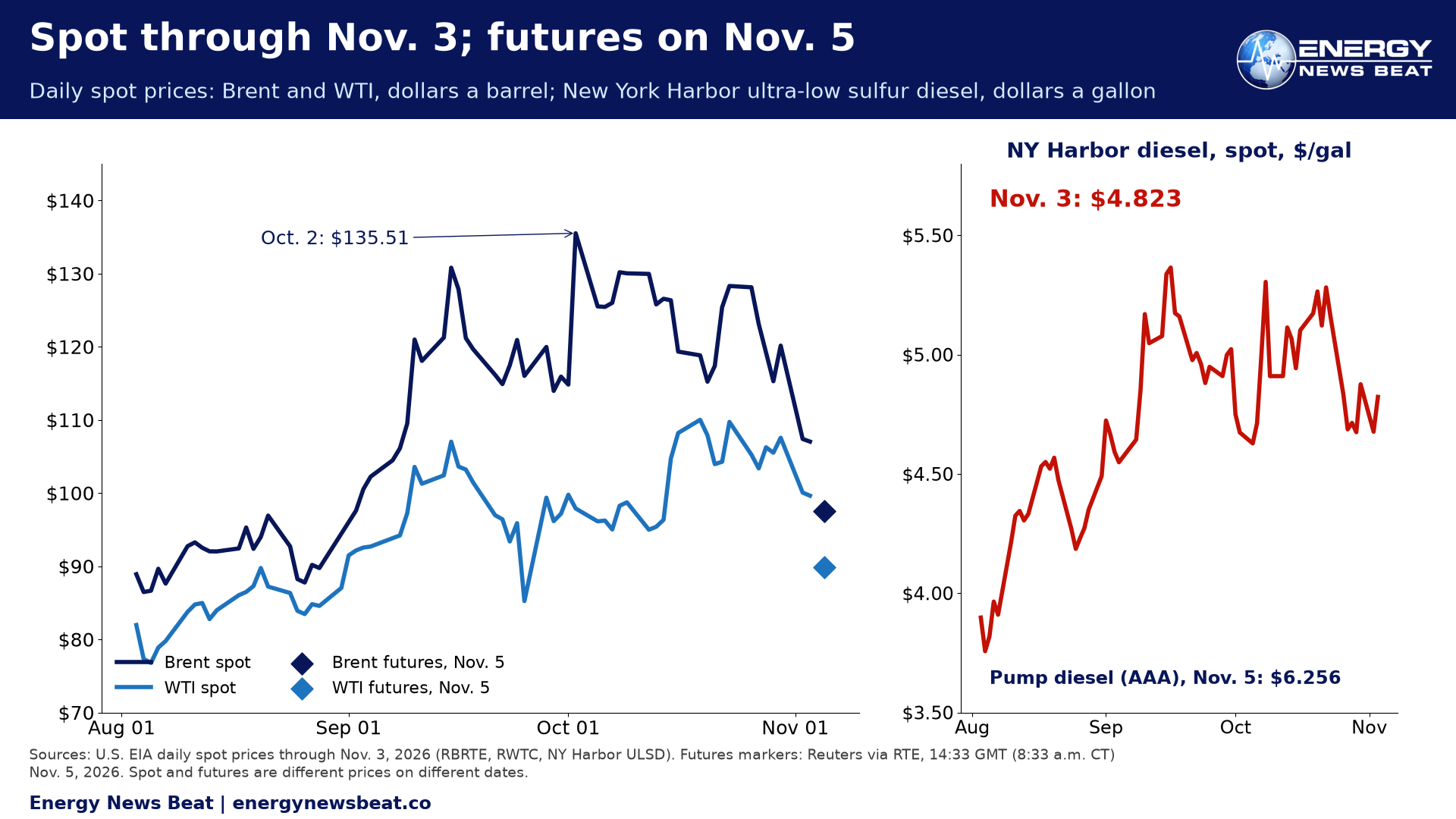
For consumers, the cheaper futures screen has not reached the diesel pump, and any renewed strike would hit diesel first because Gulf refineries and Russian plants are both in the line of fire. For investors, the risk is two-sided. Eurasia Group says escalation would likely push Brent into a $110 to $125 band (Reuters). JPMorgan says the market returned to a surplus of 1.4 million barrels a day in October as Gulf supply recovered (Reuters). A deal would test that surplus quickly, and Sparta Commodities warned that global strategic reserves “have drawn very thin.”
The bottom line: the market has priced a lower chance of escalation after the midterms, and the hardware has not moved yet. The tells above are the ones to watch.
| STU’S TAKE
Opinion. Every number is linked to its source. The market took the war premium out in one day. The ships, the tankers and the refineries did not get the memo. Brent futures closed at the lowest since Aug. 31 on Wednesday (Reuters), while Hormuz transits are still about half of pre-war (Kpler) and UKMTO counted 35 ships hit in October (Reuters). Diesel is $6.26 this morning (AAA). My view: the Iran war will not truly end until Iran’s oil is placed under Venezuelan-style controls, with the money run through the U.S. Treasury. Until that is on the table, every “deal” headline is a trading event, not an ending. My view on Russia and Ukraine: it will not end until the land bridge and the Russian-speaking areas up to Crimea go to Russia. The Abu Dhabi talks on Nov. 10-11 (RTE) are worth watching, but the refinery strikes tell you where the leverage fight is. For families and truckers: do not budget on the futures screen. Budget on the pump. For investors: two carriers are on station and a third is reported on the way (MEF). Respect both tails, and watch the tanker ramp at Al Udeid.
|
Appendix
Sources, verbatim excerpts, data tables and methodology for this article. Times are Central unless noted.
A. Sources, with links and access dates
All accessed Nov. 5, 2026.
- USNI News, Fleet and Marine Tracker, Nov. 2, 2026. Link
- CBS News, U.S. strikes Iran targets, Nov. 3, 2026. Link
- Al Jazeera, Iran says US reply to Hormuz plan ‘unconvincing’; Trump confirms strikes, Nov. 4, 2026. Link
- U.S. Mission to Saudi Arabia, Security Alert, Nov. 2, 2026 (official). Link
- U.S. Department of Defense, Statement on the Deployment of a THAAD Battery to Israel, Oct. 13, 2024 (official). Link
- European Union Aviation Safety Agency, Conflict Zone Information Bulletins list, read Nov. 5, 2026 (official). Link
- Middle East Forum (Gregg Roman), Out of Range, Poised to Strike: Mapping America’s Force Posture Against Iran, Nov. 2, 2026 (open-source satellite analysis). Link
- World Ports Organization, Amidst tensions with Iran, Diego Garcia fills up with support aircraft, Oct. 27, 2026 (open-source imagery read). Link
- Middle East Eye live blog, citing The New York Times, Nov. 3, 2026. Link
- Reuters via The Straits Times, Tankers hit in Hormuz as Iran keeps up pressure after US vote, Nov. 5, 2026. Link
- Reuters analysis via The Straits Times, Beaten at home, Trump faces stark choice on Iran: deal or escalation, Nov. 4, 2026 (Nov. 5 Singapore time). Link
- Iran International, summarizing Axios reporting, Nov. 5, 2026. Link
- Iran International, Rezaei on U.S. response, Nov. 3, 2026. Link
- Anadolu Agency, citing the Financial Times, US has no immediate plans to strike Iran: Trump, Nov. 3-4, 2026. Link
- CBS News, Vance blames Iran conflict for GOP midterm defeats, Nov. 4, 2026. Link
- CBS News live updates, Iran war, Nov. 5, 2026. Link
- Gulf News, Trump weighs Iran strikes or deal after midterm loss, live coverage, Nov. 5, 2026. Link
- APA (Azerbaijan), Iran has not yet responded to Vance’s letter, Oct. 31, 2026. Link
- Xinhua, Rezaei remarks, Oct. 31, 2026. Link
- Kremlin.ru, Meeting with Secretary of Iran’s Supreme National Security Council Mohsen Rezaei, Nov. 5, 2026 (official, Russian). Link
- Dawn, Putin meets Iran security chief, Nov. 5, 2026. Link
- U.S. EIA, World Oil Transit Chokepoints, last updated March 3, 2026 (official). Link
- Kpler Media Briefing, Nov. 5, 2026 (data to Nov. 3). Link
- Kpler, Hormuz normalisation no longer needs to wait for a deal, Oct. 1, 2026. Link
- Insurance Business, Hormuz sinking hands marine war underwriters another total loss, Oct. 14, 2026 (citing broker quotes reported by the Financial Times). Link
- AGBI, Gulf shipping cover still available as premiums hit 10%, July 21, 2026. Link
- Reuters via RTE, oil prices, Nov. 5, 2026. Link
- Reuters via CNBC, oil prices, Nov. 5, 2026. Link
- AAA national averages, Price as of 11/5/26, read 6:36 a.m. CT Nov. 5, 2026. Link
- U.S. EIA, Europe Brent Spot Price FOB (RBRTE), daily, through Nov. 3, 2026. Link
- U.S. EIA, WTI Cushing Spot Price (RWTC), daily, through Nov. 3, 2026. Link
- U.S. EIA, New York Harbor ULSD Spot Price, daily, through Nov. 3, 2026. Link
- Reuters via The Straits Times, Renewed refinery attacks deplete Russian diesel supply as US deal in focus, Nov. 5, 2026. Link
- Briefs, citing Bloomberg tanker tracking, Russian seaborne oil exports inch higher as refinery strikes resume, Nov. 3, 2026 (summary of Bloomberg tanker data plus its own reporting). Link
- Reuters via Hydrocarbon Processing, Kazakhstan asked Russia to allow resumption of oil exports to Germany via Druzhba, Nov. 4, 2026. Link
- RTE, Ukraine-Russia talks and truce, Nov. 5, 2026. Link
- TradeWinds, Russia claims string of strikes on dry-cargo ships off Ukraine, Nov. 2026. Link
- CGTN, citing the Russian Defence Ministry, cargo vessel hit 52 km southwest of Odesa, Nov. 5, 2026. Link
B. Excerpts
“He is planning to bomb Iran. Don’t listen to what he’s saying. He held off because of the midterms. We asked him to hold off until the midterms,” said one of the sources. Link
“At this moment, the chances of escalation and de-escalation may be equal,” he said. (Hezbollah official, quoted by Reuters) Link
“I’m ready, we’re ready. We’re locked and loaded if we need to go, but there may be no reason for it,” he said. Link
US officials told Axios that the military was completing preparations for a possible resumption of major combat operations against Iran, including deploying additional assets to the region. Link
“America’s response to Iran’s rights and demands was not convincing, and they must fully and explicitly address Iran’s seven conditions and act upon them,” he wrote on X. Link
“I read the letter and haven’t responded to it yet. The tone has completely changed, and this is a very good sign…” (Mohsen Rezaei, Oct. 31) Link
“The reason we lost is the war. The president himself said so last night,” Vance wrote. Link
Effective October 23, 2026, the Department of State ordered non-emergency U.S. government employees and U.S. government employee family members to leave Saudi Arabia due to safety risks. Link
The number held between 19 and 26 on each of five mornings: 23 on October 5, 26 on October 20, 24 on October 25, 19 on October 30, and 24 at 10:22 local time on November 1. Link
There are no B-2 or B-52 long-range bombers present. Link
At least five vessels have reported incidents since Nov 1, according to UK maritime security agency UKMTO, around the same rate as in October when the agency said 35 vessels were hit, the most of any month of the war. Link
Eurasia Group lowered its estimate for the chance of renewed US strikes on Iran to 60% from 65%, but also cut the probability of a deal to 10% from 20%… It raised the likelihood of a continued standoff to 30% from 15%. Link
Oman says still working with Iran on joint control system for Strait of Hormuz “that would end the state of war” Link
Russia said in April it was redirecting Kazakh crude en route to Germany to other export routes to avoid Druzhba, due to technical constraints. Link
C. Data tables, with as-of dates
C1. Oil flows through world chokepoints, million barrels a day (U.S. EIA, updated March 3, 2026)
| Route | 2024 | First half 2025 |
| Strait of Malacca | 22.5 | 23.2 |
| Strait of Hormuz | 20.7 | 20.9 |
| Cape of Good Hope | 9.3 | 9.1 |
| Suez Canal and SUMED pipeline | 4.8 | 4.9 |
| Danish Straits | 5.0 | 4.9 |
| Bab el-Mandeb | 4.1 | 4.2 |
| Turkish Straits | 3.6 | 3.7 |
| Panama Canal | 2.0 | 2.3 |
| World maritime oil trade | 79.7 | 79.8 |
C2. Hormuz and regional flows, seven-day average to Nov. 3, 2026, thousand barrels a day (Kpler Media Briefing, Nov. 5, 2026)
| Measure | Now | Pre-war average | Now vs pre-war |
| Hormuz transits, excluding Iranian barrels | 9,248 | 17,147 | 54% |
| Total Hormuz clearance (incl. Gulf of Oman ship-to-ship, 2,207) | 11,455 | 17,147 | 67% |
| of which crude | 10,519 | 13,499 | 78% |
| of which products | 936 | 3,592 | 26% |
| Fujairah and Oman loadings (bypass) | 4,430 | 3,417 | 130% |
| Hormuz plus bypass | 15,885 | 20,508 | 77% |
| Red Sea loadings | 3,452 | 2,804 | 123% |
| Regional total | 19,337 | 23,312 | 83% |
| Tanker crossings per day | 12 | 50 | 24% |
C3. Prices (EIA spot through Nov. 3; Reuters futures via RTE, 14:33 GMT (8:33 a.m. CT) Nov. 5; AAA 6:36 a.m. CT Nov. 5)
| Series | Recent high | Oct. 30 | Latest |
| Brent spot (EIA) | $135.51 (Oct. 2 high) | $120.15 (Oct. 30) | $107.03 (Nov. 3) |
| WTI spot (EIA) | $110.01 (Oct. 19 high) | $107.56 (Oct. 30) | $99.64 (Nov. 3) |
| NY Harbor ULSD spot (EIA), $/gal | $5.365 (Sept. 16 high) | $4.876 (Oct. 30) | $4.823 (Nov. 3) |
| Brent futures (Reuters via RTE) | — | — | $97.56 (+$2.94), 14:33 GMT Nov. 5 |
| WTI futures (Reuters via RTE) | — | — | $89.85 (+$1.73), 14:33 GMT Nov. 5 |
| AAA retail diesel, $/gal | — | — | $6.256 (Nov. 5) |
| AAA retail regular, $/gal | — | — | $4.100 (Nov. 5) |
C4. U.S. posture and indicators: what is confirmed and what is reported
| Status | Item | Source |
| Confirmed (official or wire) | USS George Washington and USS George H.W. Bush strike groups, Arabian Sea | USNI, Nov. 2 |
| Confirmed | Boxer ARG with 11th MEU, Indian Ocean; 2 destroyers Red Sea; 3 destroyers Mediterranean | USNI, Nov. 2 |
| Confirmed | USS Theodore Roosevelt in South China Sea (not in CENTCOM) | USNI, Nov. 2 |
| Confirmed | U.S. strikes on Qeshm Island anti-aircraft site, Nov. 2-3; described by U.S. officials as limited and defensive | CBS News; Trump to Fox via Al Jazeera |
| Confirmed | Ordered departure of non-emergency U.S. staff and families from Saudi Arabia, effective Oct. 23 | U.S. Mission Saudi Arabia |
| Confirmed | EASA conflict-zone bulletins active for Iran, Iraq, Persian Gulf and Gulf of Oman airspace | EASA |
| Confirmed (2024) | THAAD battery and U.S. crew deployed to Israel, Oct. 2024; current status not confirmed | DoD |
| OSINT read | Al Udeid north ramp 19 to 26 aircraft-size objects, Oct. 5 to Nov. 1; no dispersal seen | MEF imagery |
| OSINT read | No bombers at Diego Garcia, Oct. 24; C-5, C-40, 2+ P-8, 4+ KC-135 | World Ports Org. imagery |
| Reported | 10 USAF transports at Nevatim and Ovda, Oct. 28-30 (Kan); Patriot battery moving from Texas (WSJ) | via MEF |
| Reported | Theodore Roosevelt and Makin Island expected in CENTCOM mid-to-late November | via MEF |
| Reported | CENTCOM strike plan could begin as early as Nov. 4 (date passed without a reported strike) | NYT via Middle East Eye |
D. Methodology
- Confirmed means stated by a government body (DoD, State Department, EASA, Kremlin) or reported by Reuters, USNI News, CBS News or Al Jazeera on the record. OSINT read means an analyst interpretation of commercial imagery or flight tracking. Reported means a single-outlet report we could not see in the original.
- Chokepoint volumes are EIA Table 1 figures for 2024 and the first half of 2025, in million barrels a day, including crude and petroleum products. They are pre-war baselines.
- Current Hormuz and regional flows are Kpler seven-day averages through Nov. 3, 2026, from Kpler’s Nov. 5 media briefing. Pre-war baselines are Kpler averages for March 2025 to February 2026. Latest days are preliminary and should be read as floors. Crude and product shares are Energy News Beat calculations from those figures.
- Spot prices are EIA daily series through Nov. 3, 2026. Futures are Reuters readings via RTE, 14:33 GMT (8:33 a.m. CT) on Nov. 5. Spot and futures are different contracts and are shown for different dates.
- War-risk premiums are broker quotes as a percentage of hull value per voyage, reported by Insurance Business (citing the FT) and AGBI. They vary by ship, flag and owner and are not an index.
- Stu’s Take is opinion. Views on how the Iran and Russia-Ukraine wars end are attributed to Stu Turley and are not presented as reporting.
- The article lists signals for and against a strike. It assigns no probability of its own; the only probabilities shown are Eurasia Group’s, as reported by Reuters.
E. Could not verify
- Current status of the THAAD battery in Israel. The deployment was announced in October 2024; we found no official 2026 statement.
- Any NOTAM specifically tied to a planned U.S. strike. We found only standing conflict-zone bulletins (EASA) and an Iran FIR caution reported by a NOTAM aggregator.
- Al Dhafra Air Base (UAE) aircraft counts. No credible public figure found.
- The New York Times report of three carriers “in the region” versus USNI’s two in the Arabian Sea on Nov. 2. Not reconciled.
- Kan, WSJ, Hunterbrook and airlift-tracker figures are cited via the Middle East Forum; we did not see the originals.
- Claims of B-2s and B-52s at Diego Garcia and of 80 U.S. tankers in Israel: contradicted by open-source imagery and not used as fact.
- IRGC claims of tankers set on fire or mined on Nov. 4-5 are the IRGC’s claims and were not independently verified (Al Jazeera, Reuters).
- Russian Defence Ministry claims of strikes on cargo ships near Odesa are claims, not independently verified.
- The Brent futures peak in late October: sources give different figures ($116 on Oct. 23 per CBS; a close above $113 on Oct. 30 per Kpler). We used EIA spot data instead.
- Reuters war-risk insurance pages and the Reuters Qeshm report were not accessible to us on Nov. 5. USNI’s page blocked direct downloads; we read it in full on Nov. 5.
- Any Baltic or Bosporus disruption to crude flows this week. None found in credible reporting.