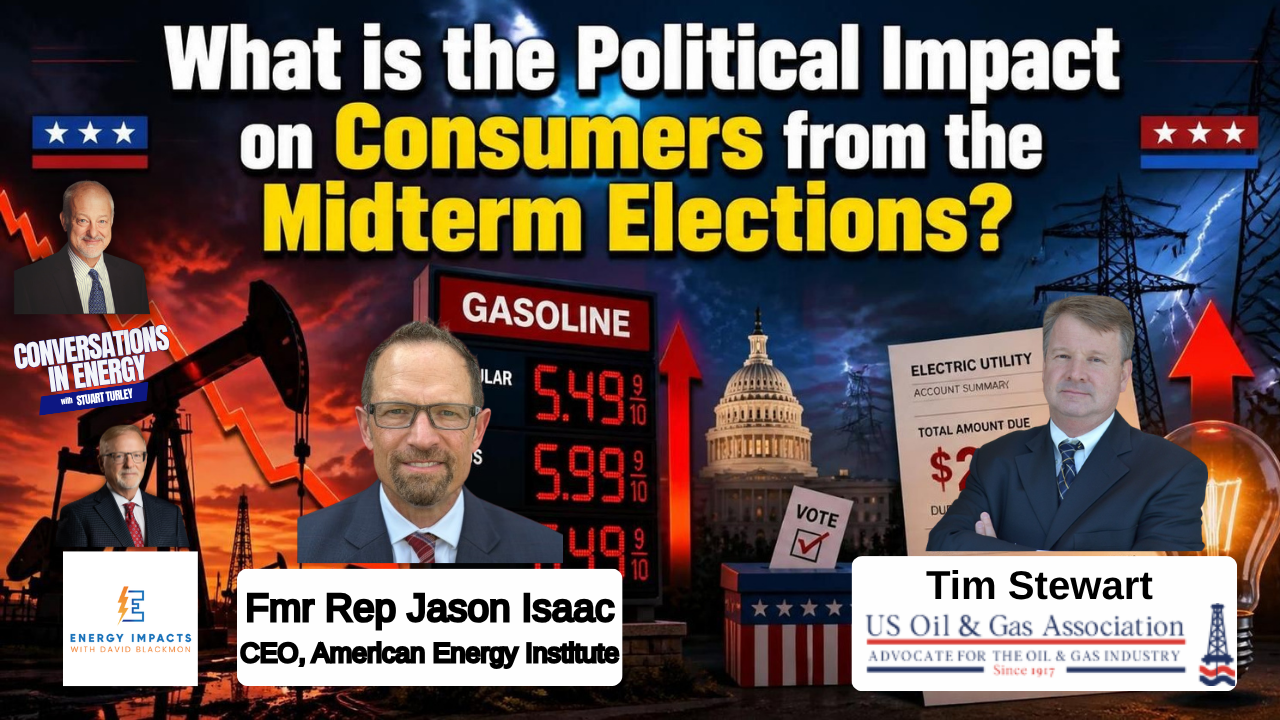
This roundtable discussion brings together energy industry leaders and policy experts—Jason Isaac (Founder and CEO of the American Energy Institute), Tim Stewart (President of the US Oil & Gas Association), David Blackmon (Forbes and Daily Caller contributor), and Stu Turley (Energy News Beat Podcast Host)—for a candid post-election analysis of the energy landscape facing America. In the wake of Democratic victories in key energy-producing states like Texas and New Mexico, the panel examines the critical challenges ahead: skyrocketing electricity costs in blue states, massive misallocations of capital toward unreliable renewables, and the urgent need for permitting reform.
They explore how voter concerns about affordability were weaponized against the energy industry despite its role in keeping prices competitive, discuss the looming threat of “Californication” spreading to Texas energy policy, and debate strategies for effective messaging and legislative action. With insights on federal lands, the Jones Act, capital flight, and the broader geopolitical implications of American energy policy, this conversation offers a comprehensive look at how energy policy decisions will shape the nation’s economic future.
Check out the American Energy Institute: https://americanenergyinstitute.com/
Check out the US Oil & Gas Association https://usoga.org/

1. Post-Election Energy Policy & Political Landscape
The hosts discuss the recent election results and concerns about how new Democratic leadership in energy-producing states (particularly Texas and New Mexico) may impact the oil and gas industry. They emphasize the importance of maintaining Republican majorities in state legislatures as a “firewall” against restrictive energy policies.
2. Electricity Costs & Affordability Crisis
A central theme is the stark disparity in electricity prices between blue and red states—blue states have 52% higher electricity costs. They cite specific examples: Hawaii, California, Massachusetts, Rhode Island, Connecticut, Maine, and New York have the highest rates, while North Dakota, Idaho, Nebraska, Louisiana, and Arkansas have the lowest. Texas, despite being an energy-producing state, isn’t even in the lowest 15 states for electricity costs.
3. Renewable Energy Misallocation & Grid Reliability
The panel criticizes massive investments in wind, solar, and battery storage in Texas—$53 billion in capital expenditures over five years—arguing these create inefficient jobs and unreliable power generation. They note that wind and solar require 8 times more jobs than natural gas to produce equivalent electricity.
4. Permitting Reform Bill
A major legislative focus is the permitting reform bill, which would streamline approval processes for energy infrastructure. The discussion covers the 73-25 cloture vote, opposition from environmental groups (Sierra Club, NRDC, Earth Justice), and the challenge of getting enough House members to return for votes.
5. Federal Lands & Oil/Gas Production
They discuss how federal lands represent 25% of U.S. oil and gas resources. Ironically, with restrictive state policies in New Mexico, federal lands become a saving grace for production since the state government has limited control there.
6. The Jones Act & Energy Supply Chain
The Trump administration’s suspension of the Jones Act has allowed Texas refineries to supply 90.3 million barrels of fuel to the East and West coasts, helping keep prices down. The expiration of this waiver is imminent and could significantly impact national energy costs.
7. Capital Flight & Business Environment
Companies are already shifting capital away from restrictive energy states toward more business-friendly jurisdictions. The panel warns that negative regulatory signals cause capital to relocate, threatening local economies dependent on energy production.
8. Voter Behavior & Messaging Failures
The discussion includes analysis of voting patterns—particularly Hispanic voters in Texas who switched to Democrats primarily due to affordability concerns. The panel criticizes Republicans for failing to effectively communicate their energy policy successes and counter Democratic messaging about affordability.
9. Lawfare Against Energy Infrastructure
They discuss a lawsuit by an electrician in Seattle against NGOs funded by billionaires and China that oppose data centers and AI infrastructure. This connects to broader concerns about left-wing organizations using litigation to block energy and infrastructure projects.
10. Global Energy Context
The panel touches on international energy dynamics, including China’s manipulation of oil markets before the election, the UK approving North Sea drilling, and the importance of American energy independence and responsible production compared to other nations.
The overall tone is cautionary but hopeful, emphasizing that the energy industry’s adaptability and the Trump administration’s pro-energy policies provide some protection against the most restrictive state-level policies.
We are on track to reach well over 3 million people through our news feed this month, even though it is the 10th, but we are on a roll, and we appreciate all of our subscribers.
Hat tip to Tim, David, and Jason, as it is truly hands-on deck as we cover the new political landscape. The alternative news source is more important now than it was in the past, and we are grateful for the support we are getting.
We would also like to give our sponsors a shout-out.
Check out the World’s Greatest Podcast Show Notes at EnergyNewsBeat.co or EnergyNewsBeat.com, and the Energy News Beat Substack at:

At The Intersection of Energy and Finance – By Sandstone Group
A shout-out to Steve Reese and the Reese Energy Consulting group for sponsoring the Podcast https://reeseenergyconsulting.com/.
Data2 if you have any business systems, can you trust A? Well, they have the patent on validation. . https://data2.zoholandingpage.com/energy
And we have WellDatabase rolling, and we use their tools for the Energy News Beat weekly Rig Reports: https://welldatabase.com/
Also entering Sponsor Rey Trevino, Pecos Operating https://pecos.energy/