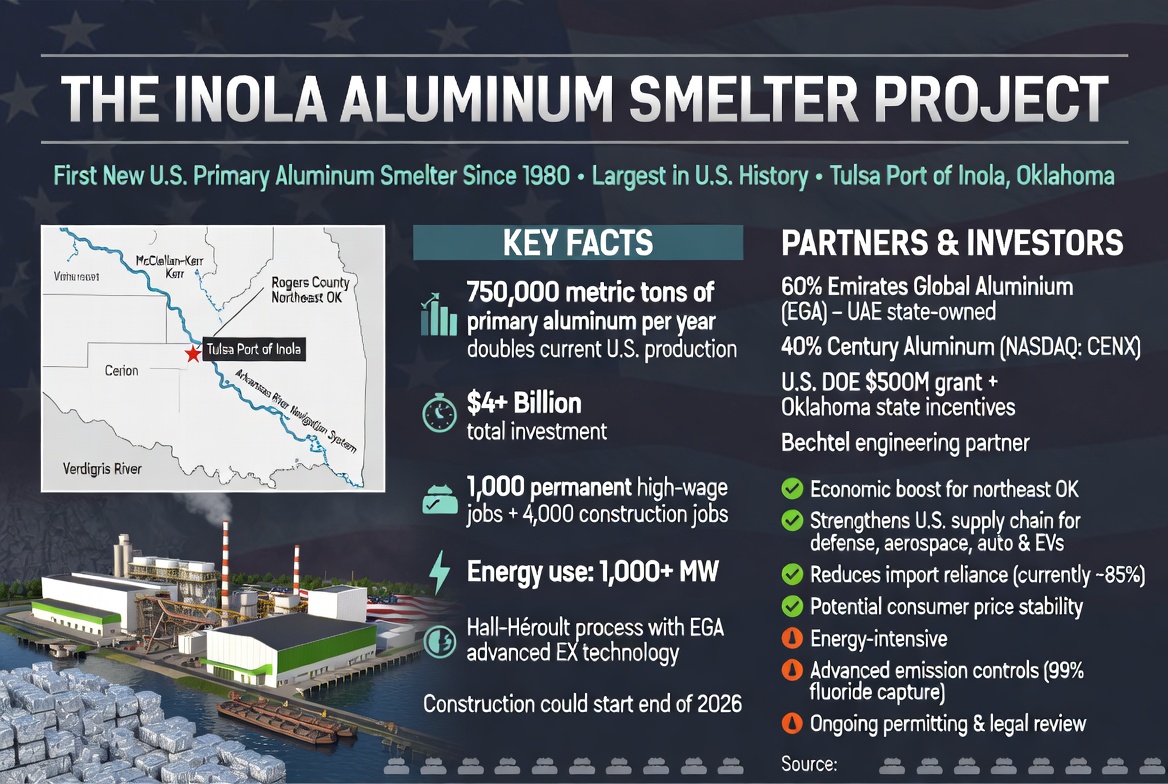
A major industrial proposal is advancing in northeast Oklahoma at the Tulsa Port of Inola along the Verdigris River. The Inola Aluminum Smelter—formally known as the Oklahoma Primary Aluminum project—represents the first new primary aluminum smelter in the United States since 1980 and would become the largest ever built in the country.
What Is the Inola Smelter?
The project is a joint venture between Emirates Global Aluminum (EGA) and Century Aluminum Company. It would use the Hall-Héroult process to produce approximately 750,000 metric tons of primary aluminum annually, more than doubling current U.S. primary aluminum production. The aluminum would supply critical sectors including defense, aerospace, automotive, and electrical manufacturing.
The facility is planned for an industrial park at the Tulsa Port of Inola, leveraging river transportation via the McClellan-Kerr Arkansas River Navigation System and existing infrastructure. Construction could begin by the end of 2026, pending permits, a final investment decision, and resolution of ongoing legal and regulatory hurdles. The total project cost is estimated at more than $4 billion.
Who’s Investing and Are the Companies Publicly Traded?
Ownership breaks down as follows in the joint venture (branded Oklahoma Primary Aluminum):
Emirates Global Aluminum (EGA): 60% stake. EGA is a UAE state-owned enterprise, jointly controlled by Mubadala Investment Company (Abu Dhabi) and the Investment Corporation of Dubai (50/50). It is not publicly traded.
Century Aluminum Company: 40% stake. Century is the largest primary aluminum producer in the United States and is publicly traded on NASDAQ under the ticker CENX.
Additional players include:
U.S. Aluminum Company (private, Oklahoma City-based firm founded by the Plotkin family, owners of M-D Building Products): Signed a memorandum of understanding to explore a downstream aluminum fabrication plant co-located with the smelter. It is not publicly traded.
Bechtel (private U.S. engineering firm): Selected to lead preparatory engineering and design work.
Funding support includes a $500 million grant from the U.S. Department of Energy (awarded to advance the project via Century Aluminum) and approximately $760 million in Oklahoma state tax incentives and financing.
Potential Impacts for Investors
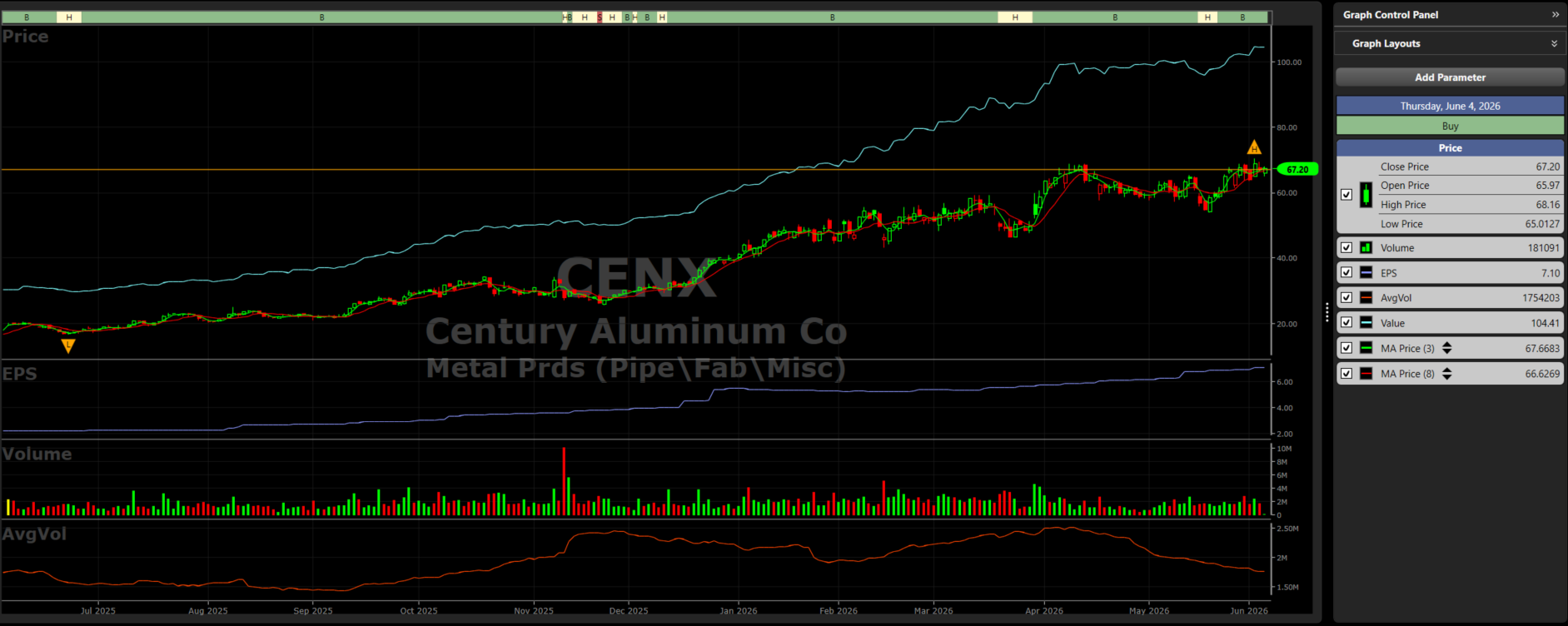
For Century Aluminum (CENX) shareholders:
The project offers significant upside as the first major U.S. greenfield smelter in decades. It would expand domestic capacity, reduce reliance on imports (which currently meet ~85% of U.S. needs), and position Century in a strategically vital supply chain for defense and advanced manufacturing. Success could drive revenue growth and strengthen the company’s market position, especially with EGA’s advanced EX reduction technology.
However, risks remain high: permitting delays, the recent Oklahoma Attorney General lawsuit (filed June 2, 2026, seeking to block the project as a public nuisance over pollution and resource demands), energy price volatility, and regulatory compliance could pressure timelines and returns.
For EGA and private partners: As a non-public entity, EGA’s investment aligns with UAE strategic goals to expand globally while securing U.S. market access. Downstream participants like U.S. Aluminum Company could benefit from direct access to molten aluminum, lowering costs and emissions compared to traditional remelt operations.
Broader investor takeaway: The project highlights opportunities in domestic critical minerals and reshoring, but execution hinges on political, regulatory, and community support.
Potential Impacts for Consumers and the Broader Economy
Economic and job benefits: Supporters project ~1,000 permanent high-wage jobs at the smelter, up to 4,000 construction jobs, and attraction of additional fabrication and manufacturing businesses. This could generate over $1 billion in state and local tax revenue over decades, boost housing demand, infrastructure, and local businesses in Rogers County and northeast Oklahoma.
Consumer-level effects: Increased domestic primary aluminum supply could help stabilize or reduce prices and volatility for end-use products (vehicles, electronics, packaging, construction materials). It strengthens U.S. supply-chain resilience for defense and aerospace, potentially benefiting national security and reducing exposure to foreign disruptions. Downstream fabrication (e.g., via U.S. Aluminum Company) could accelerate availability of high-value, traceable American-made aluminum products.’
Energy and environmental considerations: Aluminum smelting is highly energy-intensive, with the Inola facility expected to require more than 1,000 megawatts (roughly enough electricity to power 800,000 homes). This could influence regional power rates or necessitate new generation capacity.
Environmental concerns include air emissions (hydrogen fluoride, sulfur dioxide, particulates, heavy metals, greenhouse gases), water use, industrial waste, and potential impacts on the Verdigris River watershed, nearby farms, schools, and rural communities.
Developers emphasize modern mitigation: 99% fluoride capture, baghouse filtration, continuous monitoring, Best Available Control Technology (BACT), and wastewater treatment. The Oklahoma Department of Environmental Quality is reviewing permits.
The Ongoing Debate and Current Status
The project pits economic revitalization and national security against local environmental and quality-of-life concerns. An opposition group, Stop The Inola Smelter, has mobilized residents worried about proximity to homes, schools, and farmland (less than 3 miles in some cases). On June 2, 2026, Oklahoma Attorney General Gentner Drummond filed a lawsuit in Rogers County District Court seeking a permanent injunction, citing air and water pollution risks.
The outcome will depend on permitting, legal proceedings, public input, and final investment decisions. As of June 2026, the project remains in early development stages but carries strong federal and state backing.
Balancing Priorities
The Inola Aluminum Smelter could mark a pivotal step in rebuilding U.S. primary aluminum production capacity. For investors in CENX and related supply chains, it offers growth potential tempered by execution risks. For consumers, it promises greater supply security and potential price stability in aluminum-dependent goods. The coming months of regulatory and legal scrutiny will determine whether the economic promise outweighs the environmental and community trade-offs.
Appendix: Sources and Links
- Original X post by
@WinningintheUSA
(June 4, 2026): https://x.com/WinningintheUSA/status/2062358278412157068
- Oklahoma Department of Commerce announcements and agreements: https://www.okcommerce.gov/aluminum-hub-gets-boost-with-agreement-between-us-aluminum-company-ega-century-aluminum/ and related press releases
- U.S. Department of Energy announcement (Feb 10, 2026): https://www.energy.gov/articles/energy-department-awardee-build-first-american-aluminum-smelter-1980
- Century Aluminum press releases (Jan/Feb 2026): https://centuryaluminum.com/investors/press-releases/
- Bechtel announcement (Feb 9, 2026): https://centuryaluminum.com/investors/press-releases/press-release-details/2026/Bechtel-to-lead-preparatory-engineering-work-on-Oklahoma-aluminum-project/default.aspx
- Wall Street Journal coverage (Apr 12, 2026): https://www.wsj.com/business/how-oklahoma-landed-americas-first-aluminum-smelter-in-half-a-century-e00c83d3
- Oklahoma Voice on AG lawsuit (June 2, 2026): https://oklahomavoice.com/2026/06/02/oklahoma-ag-sues-to-stop-construction-of-trump-endorsed-aluminum-smelter-in-inola/
- Stop The Inola Smelter opposition site: https://www.stoptheinolasmelter.com/
- Additional reporting from FOX23, KFOR, Oklahoma Energy Today, and company websites (EGA, Century Aluminum, U.S. Aluminum Company) as referenced in search results.
This article was prepared for the Energy News Beat Channel based on publicly available information as of June 4, 2026. Developments in permitting and litigation may evolve rapidly.