
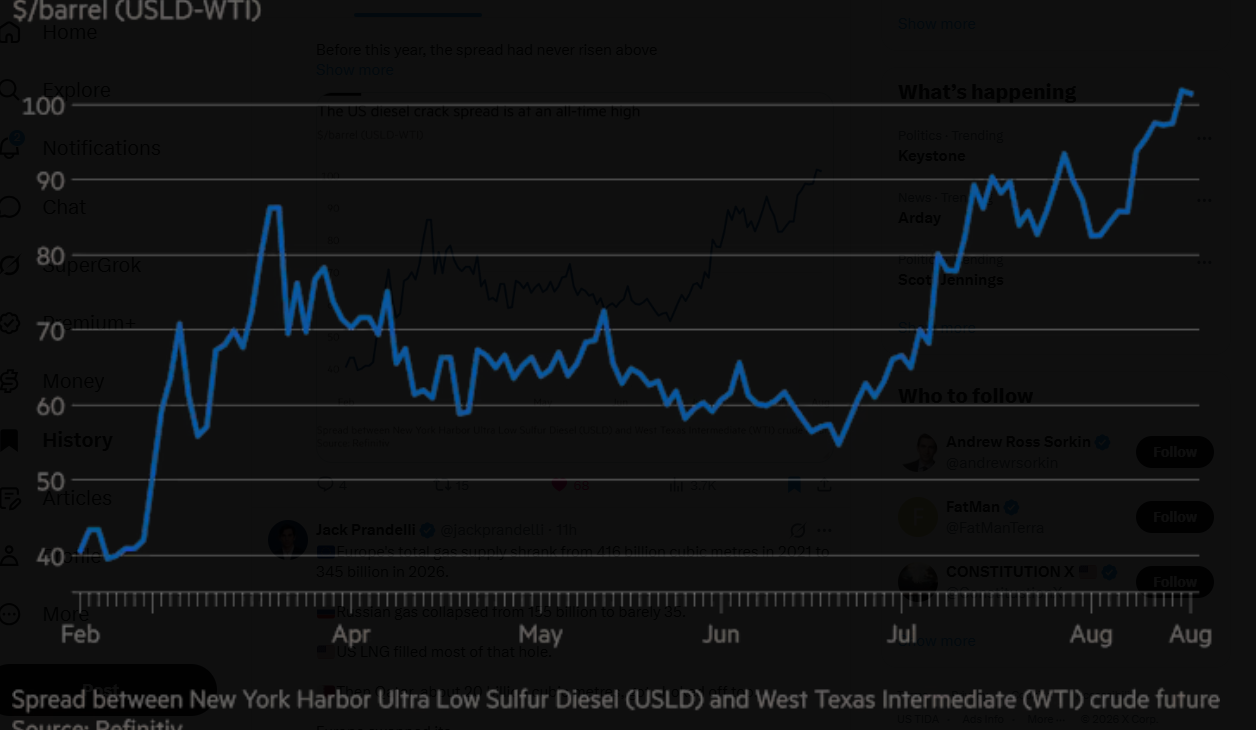
The U.S. diesel crack spread—the premium of ultra-low sulfur diesel (ULSD) futures over West Texas Intermediate (WTI) crude—has shattered every historical record. On Monday, August 17, 2026, it surged to an intraday all-time high of $102.20 per barrel and settled in triple digits for the first time, hovering around $100 the following day.
For context, pre-crisis diesel cracks typically ranged $15–$25 per barrel. The previous record was in the high $80s to low $90s, set in October 2022 during the early phase of the Russia-Ukraine war; another peak near $97–$98 occurred in March 2026. The current level is roughly four to six times normal and signals a severe global refined-product shortage rather than a pure crude-oil problem.
This is showing up at the pump. U.S. average retail diesel prices stood around $5.45–$5.47 per gallon in mid-August, with the steepest weekly jumps exceeding 50 cents in states including Indiana, Florida, Michigan, Ohio, and California. Diesel powers trucking, freight, farming, construction, and much of the broader supply chain, so elevated cracks act like a freight tax that feeds into grocery prices and broader inflation.
Commodity trader Jack Prandelli highlighted the milestone on X, noting that the prior all-time high of $89 had stood since the 2022 energy crisis and that the current spread is already well past it, with direct pass-through to drivers and midterm-sensitive inflation metrics.
What’s Driving the Record?
Multiple overlapping disruptions have converged:
- Ongoing U.S.-Iran hostilities and severe constraints on shipping through the Strait of Hormuz, which normally carries roughly 20 million barrels per day and is critical for Middle Eastern refined-product exports. Tanker crossings have fallen dramatically.
- Ukrainian drone strikes on Russian refineries, prompting Moscow to extend its diesel export ban at least through January.
- Peak seasonal agricultural demand.
- Critically low inventories: U.S. distillate stocks (diesel + heating oil) stood at 107.1 million barrels as of August 7—the lowest for this time of year since 1996, according to the Energy Information Administration (EIA).
- Global refinery crude throughput averaged only 80.9 million barrels per day in July, down about 5 million bpd year-over-year (International Energy Agency).
- U.S. refiners running flat-out at 96.2% utilization (week ending August 7), with Midwest and Gulf Coast regions near or at 97–100%.
- Crude inputs are near 17.1–17.2 million bpd, yet domestic stockpiles continue tightening because of record exports filling global gaps.
- Total U.S. refining capacity has seen little meaningful growth for years due to post-pandemic closures and limited new builds.
In short, crude is available; the ability to turn it into diesel is the binding constraint.
How Analysts Say This Will Get Solved
Analysts broadly agree that the “best cure for high prices is high prices” is already operating, but diesel demand is relatively inelastic in the short term—trucks, tractors, and construction equipment cannot easily switch fuels.
Near-term relief pathways include:
- Geopolitical de-escalation: Resumption of Russian diesel exports, stabilization of Middle Eastern refining and shipping through Hormuz, or increased Chinese product exports would restore barrels faster than anything else.
- Demand destruction and seasonal shifts once peak agricultural use eases.
- Inventory rebuilding.
- Modest supply response via higher utilization where spare capacity exists, deferred maintenance, “capacity creep,” and renewable diesel or other substitutes.
New refining capacity is unlikely in the near term because of multi-year build times and regulatory hurdles. Existing plants are already near practical limits. Refined-product markets are recovering more slowly than crude, so most analysts expect margins to remain elevated through much of the second half of 2026, with winter heating demand and ongoing geopolitical risks potentially re-intensifying the crunch.
Goldman Sachs, Bank of America, Jefferies, and others have flagged the diesel tightness as structural rather than fleeting, with scarcity risks rising into winter as maintenance season begins and heating demand picks up. Jeff Currie has emphasized that the real crisis is in products (European diesel trading near $170/bbl in some reports) rather than the relatively calmer crude benchmarks.
Will Prices Keep Going Up? Will Oil Prices Rise?
Wholesale diesel prices lead retail, and the record crack is a strong signal that pump prices are more likely to rise or stay elevated in the near term than fall sharply—regardless of what crude does. Some analysts warn the worst retail prices for consumers could still lie ahead as the squeeze persists into Q4 and winter.
Crude oil itself (WTI recently around $84–$86/bbl, Brent $91–$92) has been softer relative to products. The EIA’s August Short-Term Energy Outlook sees Brent averaging around $85 in Q3 2026 before declining later if Hormuz traffic normalizes and shut-in production returns. High product cracks encourage refiners to maximize runs, which can eventually pressure crude higher if demand for feedstock rises, but the dominant stress remains downstream. Persistent disruptions could still lift both, while de-escalation would ease product prices more than crude in the short run.
What Measures Can the Trump Administration Take?
Diesel is a key inflationary input for delivery, farming, building, and transportation. The administration has already taken steps including coordinated global Strategic Petroleum Reserve releases, Jones Act waivers, temporary sanctions relief on certain Iranian and Russian flows, and broader deregulatory actions aimed at energy dominance and lower costs (including vehicle and equipment repair freedoms and CAFE adjustments).
Additional options analysts and market observers discuss include:
- Further targeted SPR or product releases (though buffers are finite and must eventually be rebuilt).
- Diplomatic pressure to reopen Hormuz and resolve regional hostilities.
- Encouraging domestic refining investment and utilization (longer-term).
- Scrutiny of retail pricing practices (the administration has previously directed the DOJ to examine potential gouging when pump prices lagged crude declines).
- Avoiding export restrictions, which a White House official has indicated are not under consideration, as U.S. exports are currently helping fill global gaps.
White House statements emphasize continued commitment to unleashing American energy production and cutting costs. Structural refining constraints, however, cannot be solved overnight by inventory draws alone.
Implications for Consumers and Investors
Consumers: Higher diesel costs translate directly into elevated freight rates (diesel explains a large share of trucking cost variation), grocery prices, farm input costs, construction expenses, and eventual heating bills. Analysts warn of another wave of goods-price increases later in 2026 as these costs work through supply chains. Demand is inelastic, so relief will come mainly from supply restoration rather than rapid conservation.
Investors: This is a classic “product-tight, crude-looser” environment that favors pure-play refiners. Marathon Petroleum, Valero, and Phillips 66 posted strong Q2 2026 results with refining margins more than double year-ago levels and substantial shareholder returns. Refining stocks have outperformed as cracks exploded. History shows extremes eventually moderate, but elevated margins are expected to support strong cash flow through much of H2 2026. Downstream exposure remains preferred over pure upstream in the current setup.
The record diesel crack is a flashing red signal of refined-product scarcity. Resolution hinges more on geopolitics and inventory rebuilding than on crude prices alone. Until those factors improve, elevated diesel costs will remain a tangible pressure on the real economy—and a key variable for both policymakers and markets heading into the second half of 2026 and beyond.
Appendix: Sources and Links
- Energy News Beat original coverage: https://energynewsbeat.co/diesel/diesel-margins-top-100-a-barrel-to-reach-record-high-as-supply-crunch-grows/
- Jack Prandelli X post: https://x.com/jackprandelli/status/2089877955446980970
- Bloomberg: https://www.bloomberg.com/news/articles/2026-08-18/diesel-margins-top-100-a-barrel-to-reach-record-high-as-supply-crunch-grows
- Reuters: https://www.reuters.com/business/energy/us-diesel-crack-surpasses-100-barrel-first-time-supply-disruptions-2026-08-17/
- TT News / Transport Topics: https://www.ttnews.com/articles/diesel-margins-record-high
- 24/7 Wall St.: https://247wallst.com/investing/2026/08/18/diesel-crack-just-broke-100-a-barrel-for-the-first-time-ever-heres-what-it-means-for-your-grocery-bill/
- FreightWaves: https://www.freightwaves.com/news/some-diesel-analysts-are-warning-of-a-supply-crunch-nobody-in-washington-is-talking-about-here-is-what-holds-up-and-what-it-could-mean-for-q4
- Hedgeye: https://app.hedgeye.com/insights/186113-why-have-our-refiner-positions-been-performing-so-well
- Financial Times reporting on economic impact (via secondary coverage)
- EIA Weekly Petroleum Status Report and Short-Term Energy Outlook (August 2026)
- Company earnings releases (Marathon Petroleum, Valero, Phillips 66)
- International Energy Agency global throughput data
- Additional analyst commentary from Goldman Sachs, Bank of America, Jefferies, Jeff Currie (CNBC/OilPrice), and others referenced in the above outlets.