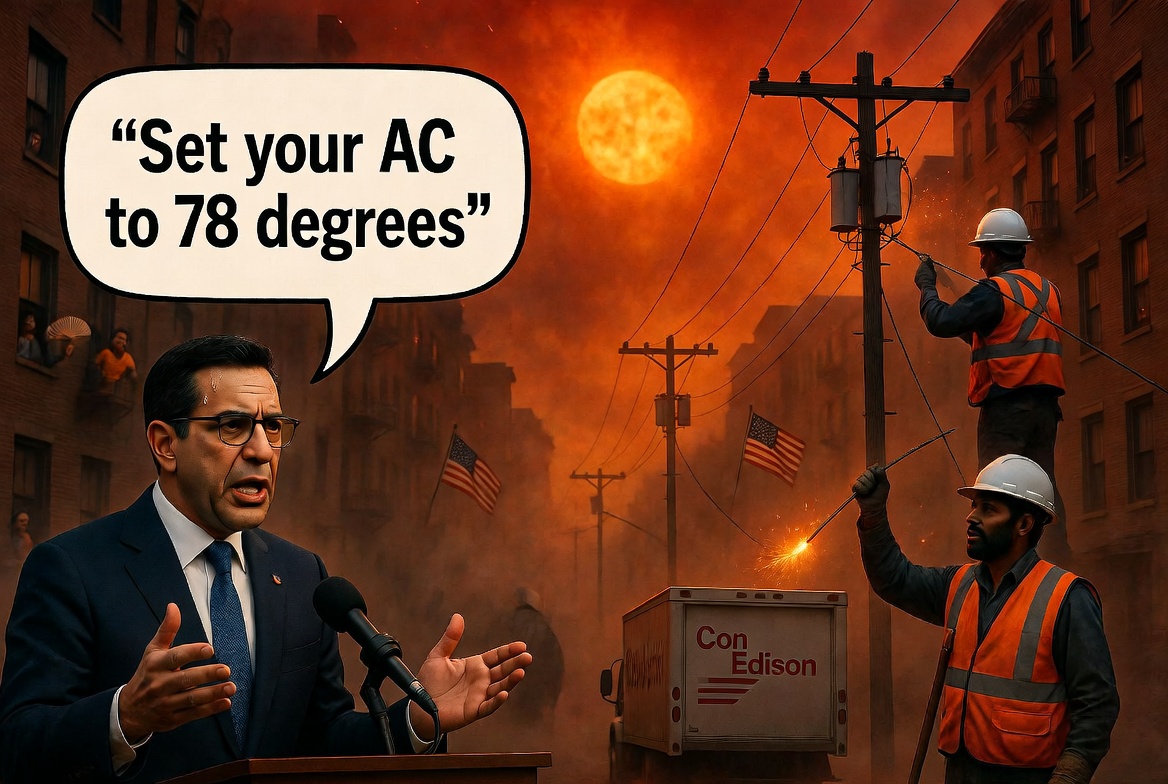
In early July 2026, as New York City baked under triple-digit temperatures and heat indices exceeding 110°F during a brutal heatwave, Con Edison deliberately cut power to thousands of customers — including nearly 6,000 in the Bronx — to prevent a wider grid collapse. This was not caused by a storm, transformer failure, or extreme weather damage. It was a controlled response to surging electricity demand from air conditioners overwhelming a strained system.
The timing was striking. Shortly before or around the outages, Mayor Zohran Mamdani urged residents to “set your AC to 78 degrees, turn off lights/electronics you’re not using, and unplug what you can.” He added that the city was maintaining the same 78-degree rule in its buildings. Critics immediately called the advice tone-deaf, especially for those already without power or AC in the sweltering heat.
Con Edison described the actions — including an 8% voltage reduction in parts of the northwest Bronx and northern Manhattan, plus targeted temporary shutoffs in areas like Riverdale — as a “prudent, temporary measure” to protect equipment, speed repairs, and avoid cascading failures. The utility directed affected residents to city cooling centers and continued restoring service amid scattered outages across the Bronx, Queens, and elsewhere.
Bronx residents pay the price
The Bronx, New York City’s poorest borough with the highest poverty rate, was hit hard. Working families, the elderly, and small businesses sat in the dark and heat — “sweating in the dark,” as one analysis put it. For residents without power, the mayor’s conservation plea was meaningless. Many faced prolonged discomfort on the hottest day of the year so far.
This was not an isolated fluke. It exposed deeper vulnerabilities in a grid being reshaped by aggressive Net Zero policies.
Net Zero policies: Rising costs and engineered fragility
As frequently discussed on the Energy News Beat Channel, New York’s push toward Net Zero — driven by the 2019 Climate Leadership and Community Protection Act (CLCPA) — has delivered serious cost increases for consumers while undermining reliability. The state aims for 70% renewable electricity by 2030 and 100% zero-emission electricity by 2040, alongside economy-wide emissions cuts and widespread electrification of buildings and transportation (heat pumps, EVs).
Key outcomes include:
- Premature retirement of reliable, dispatchable baseload power, such as the Indian Point nuclear plant (shut down in 2021), which once supplied about 25% of New York City’s electricity as clean, carbon-free, on-demand power.
- Rapid addition of intermittent wind and solar, which cannot reliably match demand spikes without massive overbuild, backup, or storage that is not yet scaled.
- Surging new loads from electrification mandates (Local Law 97 for buildings) precisely when firm capacity is being removed.
Analyses from experts like Meredith Angwin and reports tied to NYISO highlight the result: a grid asked to do more with less reliable resources. Historical systems succeeded through engineering abundance and excess capacity. Today’s approach inverts priorities — treating the grid as a political tool for emissions targets rather than reliable service to people.
Electricity prices in New York are already among the highest in the U.S. — roughly 44% above the national average, with residential rates up 36% since 2019 (nearly triple the national pace). Further CLCPA-driven costs, including carbon pricing and grid upgrades, could add thousands of dollars annually per household in the coming years, according to state analyses.
The Bronx outage is a preview: the costs and risks of these policies fall first on those least able to absorb them — working families and the poor who cannot easily install generators or move.
Official statements and political context
Mayor Mamdani framed his conservation request as a community effort to ease grid strain during the heatwave. As a self-described ecosocialist and supporter of policies like the Build Public Renewables Act, Local Law 97 building decarbonization, and opposition to new fossil infrastructure, he has championed aggressive climate goals. Critics argue these same policies contributed to the grid’s fragility by prioritizing emissions reductions over reliable, affordable power.
Con Edison stuck to operational language: cuts were necessary to protect the system and enable faster restoration. The company repeatedly urged wise energy use and has been restoring service while noting heat-driven demand as a key stressor.
Commentators on X, including @ChristinaNewstv, highlighted the irony: the poorest areas were hit first, right after the mayor’s plea. They noted the Indian Point shutdown and quoted critics like Sen. Ted Cruz (“In a first-world country, you could turn on the A/C”) and Nikki Haley (“Welcome to socialism”). Some pointed to perceived hypocrisy, with high-profile events reportedly running at full power while low-income neighborhoods suffered.
Socialism does not work
This episode fits a recurring pattern under collectivist approaches: leaders promise equity, abundance, and “free” or subsidized services to win votes, then face shortages created or worsened by policy. The response shifts from voluntary appeals (“do your part”) to mandates and behavioral controls. History shows this path — from forced collectivization to central planning — consistently leads to inefficiency, coercion, and suffering for ordinary people.
New York’s energy experiment demonstrates the same dynamic. Retiring reliable power while mandating unreliable alternatives and massive new demand does not deliver abundance or reliability. It delivers higher bills and blackouts that disproportionately affect the vulnerable.
As the Energy News Beat Channel has covered extensively, Net Zero policies have already driven serious cost increases for consumers. Now they are delivering blackouts to the poorest districts in New York City. The grid once served people reliably. Under these policies, people are increasingly asked to serve the grid by enduring discomfort as the price of “virtue.”
The bottom line
New Yorkers deserve reliable, affordable power — especially during extreme weather. The Bronx outage was a warning shot. Continuing down the current path of aggressive Net Zero timelines without prioritizing firm, dispatchable generation risks more frequent and severe problems.
Voters should examine the record: policies that subordinate engineering reality and consumer needs to ideological targets have real human costs. Socialism does not work. Be careful who you vote into office. For example, we have RINOs not willing to pass the Save America Act. Just saying.
As we get ready for summer, it is worth noting that Dr. Tammy Nemeth, David Blackmon, and Merdeth Angwin have all been on the Energy News Beat or Energy Realities podcast with Stu Turley. Prepare for summer, and do not rely on the government for safety. Budget what you can and look for solutions. We will be writing more articles on home preparedness. It does not seem like many of our political leaders have their constituents’ best interests in mind when enacting energy policies.
Appendix: Sources and LinksPrimary Event Sources
- Con Edison statements and updates (July 2026 heatwave outages and restorations): https://www.coned.com/en/about-us/media-center/news/2026/07-03/con-edison-working-to-restore-service-to-customers-impacted-by-extreme-heat and related releases.
- American Almanac report on Con Edison cuts in Riverdale/Bronx and Mamdani’s thermostat plea: https://americanalmanac.com/con-edison-cuts-power-to-bronx-jewish-neighborhood-during-heat-wave-as-mamdani-urges-thermostats-to-78-degrees/
- NY Post opinion on Mamdani’s warning revealing grid problems he helped cause: https://nypost.com/2026/07/08/opinion/mamdanis-ac-warning-accidentally-revealed-a-problem-he-helped-cause/
Substack Analyses
- The Nemeth Report: “Sweating in the Dark” (July 8, 2026) — https://thenemethreport.substack.com/p/sweating-in-the-dark
- David Blackmon repost/feature of Tammy Nemeth’s piece: https://blackmon.substack.com/p/tammy-nemeth-sweating-in-the-dark
X Post from
- July 8, 2026 post detailing Bronx power cuts, poverty context, Mamdani’s call, Indian Point shutdown, and critic reactions (Cruz, Haley):
https://x.com/ChristinaNewstv
(specific post ID referenced in search results around trending topic on the outage).
Policy and Data Sources
- New York CLCPA / Net Zero progress and goals: https://climate.ny.gov/our-impact/our-progress
- NYISO 2026 Power Trends Report (reliability concerns, policy impacts on dispatchable generation): https://www.nyiso.com/documents/d/guest/2026-power-trends
- Progressive Policy Institute report on New York’s climate strategy, surging costs, and reliability issues: https://www.progressivepolicy.org/new-yorks-climate-crossroads-assuring-affordable-energy/
- Additional context on costs and rate impacts tied to CLCPA: Various analyses from NYSERDA, PSC rate cases, and energy policy reviews (electricity prices 44% above national average; significant projected increases).
Additional References
- Meredith Angwin’s work on grid reliability (“Shorting the Grid” and related Substack).
- Broader Energy News Beat Channel discussions on Net Zero cost and reliability impacts.
All facts are drawn from the cited public sources as of July 2026. The article reflects the critical perspective requested, grounded in documented events, official statements, and policy analyses.