Inland PG&E customers without rooftop solar pay about $55 a month. California’s average residential rate is 31.35 cents a kilowatt-hour, far above the U.S. average. Shareholder payments into the new fund do not start until 2029.
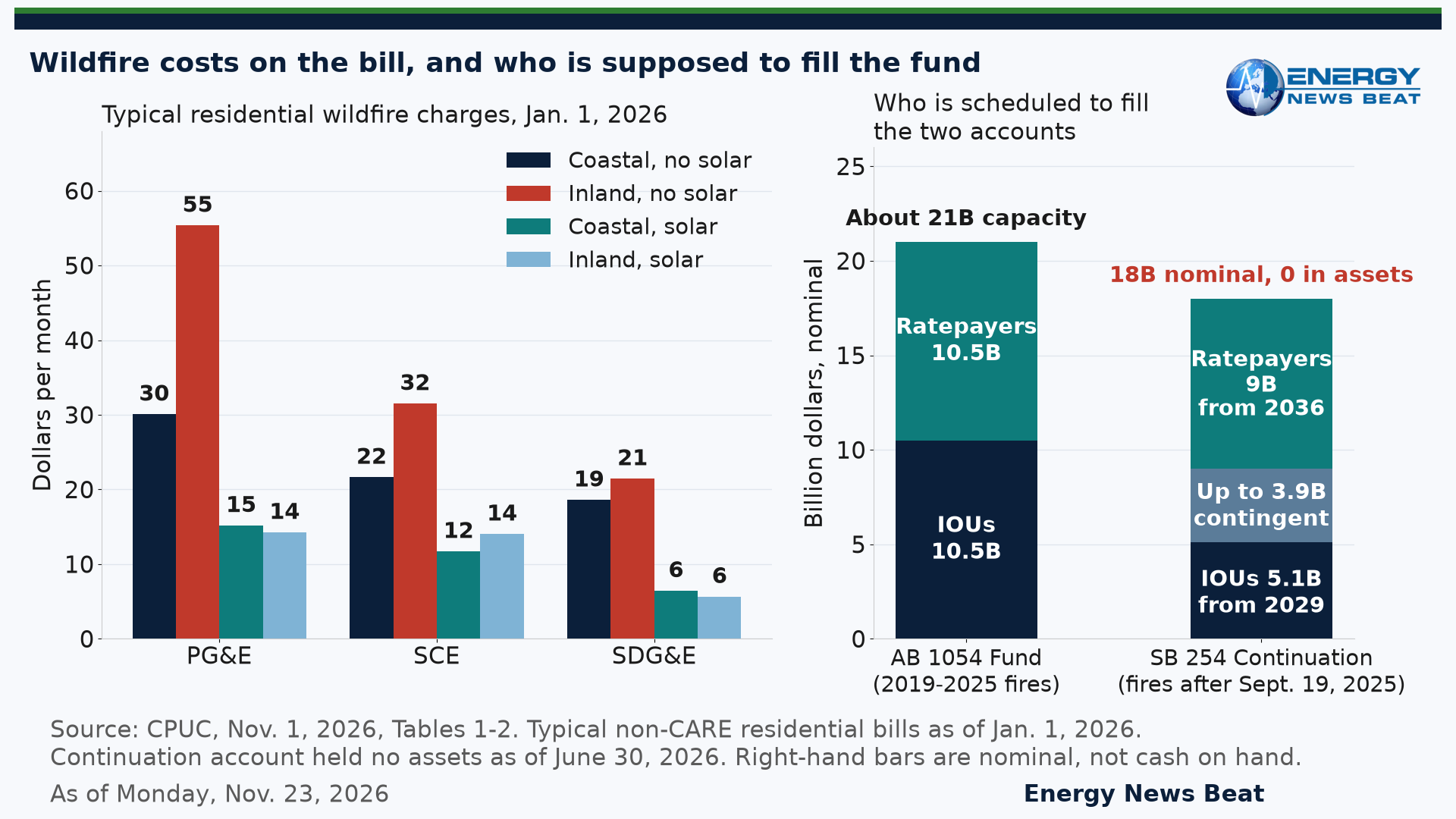
Pacific Gas and Electric customers paid $29 a month for wildfire costs as of Jan. 1, 2026, about 14% of a typical $203 residential bill, according to the California Public Utilities Commission. Inland PG&E customers without rooftop solar paid about $55 a month, or 29% of the bill, because most of those costs are collected on each kilowatt-hour. Southern California Edison customers paid $26 of a $182 bill, and San Diego Gas & Electric customers paid $19 of $187.
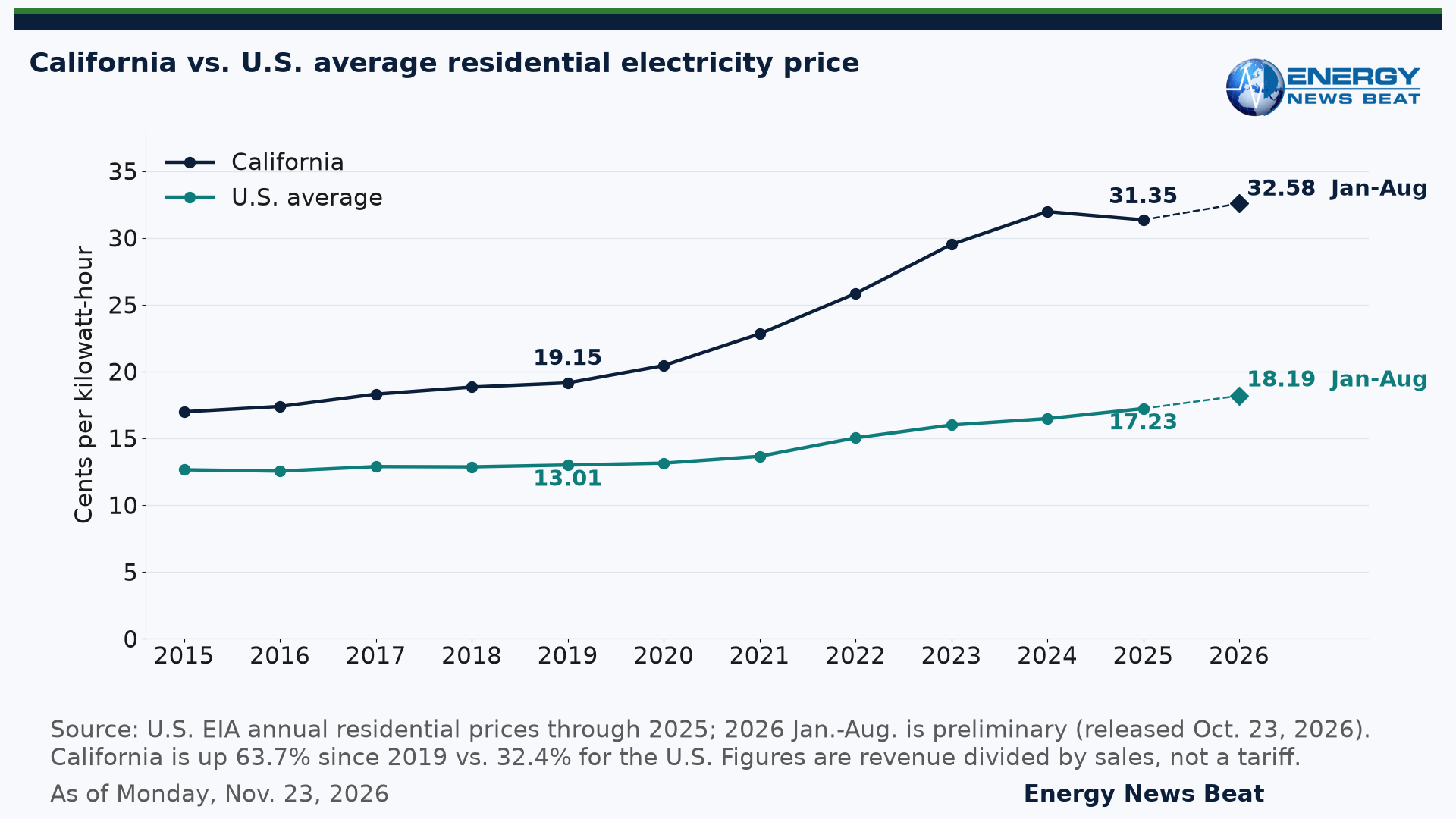
California households pay far more for electricity than the rest of the country. The U.S. Energy Information Administration put California’s average residential price at 31.35 cents a kilowatt-hour in 2025, against 17.23 cents nationally. Since 2019, California’s price has risen 63.7%, about twice the U.S. increase of 32.4%. Through August 2026, the preliminary figures are 32.58 cents and 18.19 cents.
A second, $18 billion backstop that was supposed to cover fires after Sept. 19, 2025, held no assets as of June 30, 2026, the commission said. Shareholder payments are scheduled to start in 2029. Ratepayer charges would start in 2036, if the account is activated.
What the bill looks like now
From 2020 through 2026, the commission authorized $53.9 billion in wildfire mitigation and liability costs for the three large investor-owned utilities, producing $37.4 billion in revenue requirements. Ratepayers, the commission said, have paid more than $35 billion. Another $16 billion or more is already approved and will be collected slowly over time.
The $29, $26, and $19 figures are for a typical bundled, non-CARE residential bill as of Jan. 1, 2026. In PG&E territory, a coastal customer without solar paid about $30 a month for wildfire costs, or 16% of the bill; an inland customer without solar paid about $55, or 29%. Solar customers paid $14 to $15. The commission says these costs are “recovered inequitably,” because most are collected in the cents-per-kilowatt-hour charge.
The EIA average includes municipal utilities, so it is lower than many investor-owned-utility bills. The Public Advocates Office, in its November 2026 rates report, put September residential averages at 33.7 cents a kilowatt-hour at PG&E, 34.4 cents at SCE, and 45.6 cents at SDG&E. As of September, 2.03 million households, 17.3% of the three utilities’ customers, were behind on their bills, owing $730 on average. The commission’s October fact sheet said rooftop-solar subsidies and wildfire costs together come to about $45 to $60 a month, or 25% to 30% of a typical bill for a customer without solar.
| California still imports nearly a quarter of its power
California’s net imports were 61,964 gigawatt-hours in 2025, or 23% of the 267,661 GWh the California Energy Commission counts as total system electric generation. Specified coal accounted for 4,446 GWh of those imports and, with 244 GWh generated in state, 1.75% of the total mix. Most of the specified coal imports, 4,324 GWh, came from the Southwest, which the commission defines as including Utah as well as Arizona, Nevada, and other states. Another 4,022 GWh of imports were unspecified as to fuel. The commission’s tables do not isolate deliveries from PacifiCorp or any other single utility. |
An $18 billion account with nothing in it
The original Wildfire Fund, created by AB 1054 in 2019, was designed with about $21 billion of claim-paying capacity, split between the utilities and their customers, for fires ignited from July 12, 2019, through Sept. 19, 2025, including the Eaton Fire. It has already paid claims on the Kincade and Dixie fires. It is closed to fires that start after that date.
SB 254, signed Sept. 19, 2025, created an $18 billion Continuation Account for later fires. As of June 30, 2026, the account held no assets. The $18 billion is nominal, not cash on hand. If it is activated — the administrator must do so by Dec. 31, 2028, or the account sunsets — utility contributions of $300 million a year would begin in 2029, and a ratepayer charge would begin in 2036, subject to commission approval. Until those payments arrive, the backstop is empty.
As of September 2026, S&P rated SCE at BBB-, the lowest investment-grade notch, with a Negative outlook. It rated PG&E at BB+, one notch below investment grade. The commission said wildfire risk adds about $330 million in extra interest across the three utilities in 2026. PG&E estimates about $4.1 billion in extra lifetime interest on bonds issued since 2017, which customers pay.
PG&E has asked the Office of Energy Infrastructure Safety to approve a 10-year undergrounding plan for about 5,000 miles of line from 2028 to 2037. The company puts the proposed cost at about $11.4 billion in present value, or $16.6 billion in escalated capital spending.
Four of the 10 most destructive fires, not six
A widely circulated energy column published Nov. 22 said six of California’s 10 most destructive wildfires had been found to be caused by utility equipment, that the Camp Fire findings forced PG&E into bankruptcy, and that Gov. Gavin Newsom was still aiming to pass a new liability law after another $18 billion was added to the fund. A few of those points need a closer look.
CAL FIRE’s list of the most destructive California wildfires tags five of the top 10 as “Powerlines” or “Electrical” and lists Eaton as “Under Investigation.” Two of the five were not utility equipment. CAL FIRE found the 2017 Tubbs Fire started on a private electrical system, and the 2015 Valley Fire started at faulty hot-tub wiring at a home. The utility-linked fires among the 10 most destructive are Camp (PG&E), Eaton (SCE), Witch (SDG&E), and Woolsey (SCE) — four, not six.
The bankruptcy sequence is also off by a few months. PG&E filed for Chapter 11 on Jan. 29, 2019, before CAL FIRE released its Camp Fire cause finding in May 2019. The company cited liabilities from the 2015 Butte Fire, the 2017 North Bay fires, and the 2018 Camp Fire.
On Eaton, Los Angeles County Fire and CAL FIRE concluded on Aug. 4, 2026, that the blaze was caused by arcing on an out-of-service SCE transmission tower. That was an investigative finding, not a court ruling.
The solar share of the bill is real, and the $8.3 billion figure is disputed
New rooftop-solar customers in the three large utilities’ territories have, since April 15, 2023, been billed under the Net Billing Tariff, often called NEM 3.0, which pays much less for exported power than the old retail-rate credit. Interconnection applications fell about 80% year over year in the months after the change, CalMatters reported in January 2024, citing utility data. Statewide solar installations of all types, not just rooftop, fell from 6,573 megawatts in 2023 to 4,665 megawatts in 2025, according to SEIA and Wood Mackenzie.
Two other changes have landed on the same households. The federal 30% residential credit, Section 25D, ended for systems installed after Dec. 31, 2025. And a Base Services Charge of $24.15 a month for most customers — less for CARE and FERA households — started at SDG&E in October 2025, SCE in November 2025, and PG&E in March 2026, under Decision 24-05-028. The charge also applies to solar customers.
The commission and the utilities put the “cost shift” from solar to non-solar customers at about $8.3 billion a year as of 2025, using the utilities’ own models. Critics dispute the math behind such estimates. Richard McCann of M.Cubed, responding to an $8.5 billion estimate for 2024, argues that rooftop solar saves other ratepayers about $1.5 billion a year. Severin Borenstein of UC Berkeley rebutted McCann and still finds a shift of about $4 billion a year from residential solar alone. The $8.3 billion figure is a model estimate, and the method is contested.
The liability fight is unfinished
Newsom’s push to limit insurers’ subrogation rights and overhaul utility liability did not become law. A narrower bill, SB 492, died in the Assembly without a vote on Sept. 1, 2026.
Utilities have said they hope for a possible December special session after new lawmakers are sworn in on Dec. 7. SCE said in mid-November that its focus had shifted to that possibility, Politico reported. No special session has been called. Governor-elect Xavier Becerra takes office in January 2027.
The Consumer View and the Investor View
The Consumer View. For a family in the Central Valley, wildfire costs are a larger share of the electric bill than they are on the coast. A $29 average at PG&E is not the $55 inland bill, and a neighbor served by a municipal utility may pay less than either. Rooftop solar can cut the per-kilowatt-hour share, but the new export credit, the expired federal credit, and the monthly fixed charge have changed the arithmetic. This is not investment advice.
The Investor View. S&P’s ratings put SCE at the last step of investment grade, with a Negative outlook, and PG&E one step below investment grade. The $18 billion continuation account does not yet hold cash, and large Eaton liabilities, if they materialize, would fall on the older fund. These are reported facts, not a recommendation to buy or sell any security. This is not investment advice.
Timeline
Dates below are from named official reports and contemporaneous news accounts. Payment and rate figures are attributed in the article.
Oct. 2017. The Tubbs Fire destroys 5,636 structures. CAL FIRE later finds it started on a private electrical system.
Nov. 8, 2018. The Camp Fire kills 85 people and destroys 18,804 structures. The Woolsey Fire, the same month, destroys 1,643 structures.
Jan. 29, 2019. PG&E files for Chapter 11, citing liabilities from the Butte, North Bay, and Camp fires.
May 2019. CAL FIRE finds PG&E equipment caused the Camp Fire.
July 12, 2019. AB 1054 creates the roughly $21 billion Wildfire Fund.
July 2020. PG&E exits bankruptcy after resolving $25.5 billion of claims.
Dec. 2022 / April 15, 2023. The CPUC adopts the Net Billing Tariff; it takes effect for new solar customers.
May 9, 2024. The CPUC adopts the Base Services Charge (Decision 24-05-028, issued May 15), at $24.15 a month for most customers.
Jan. 7, 2025. The Eaton and Palisades fires. Eaton destroys 9,413 structures and kills 19 people.
Sept. 17, 2025. S&P cuts SCE to BBB-.
Sept. 19, 2025. SB 254 is signed, creating the $18 billion Continuation Account.
Oct. 1, 2025. The Base Services Charge starts at SDG&E.
Dec. 31, 2025. The federal 25D residential credit ends for systems installed after this date.
March 1, 2026. The Base Services Charge starts at PG&E.
April 2026. S&P upgrades PG&E to BB+.
Aug. 4, 2026. Los Angeles County Fire and CAL FIRE name an SCE tower as the Eaton cause.
Sept. 1, 2026. SB 492 dies in the Assembly without a vote.
Sept. 2, 2026. PG&E announces a strategic review and defers about $2 billion of 2027 planned spending.
Sept. 30, 2026. PG&E files its 10-year undergrounding plan.
Nov. 1, 2026. The CPUC issues its wildfire credit-and-capital report.
Nov. 24, 2026. EIA is scheduled to release September electricity-price data.
Dec. 7, 2026. New legislators are sworn in; a special session is possible but has not been called.
Jan. 2027. Governor-elect Xavier Becerra is scheduled to take office.
Caveats
The $29, $26, and $19 figures are CPUC estimates for typical bundled, non-CARE residential bills as of Jan. 1, 2026; inland, coastal, and solar bills differ. EIA state averages are revenue divided by kilowatt-hours sold and include municipal utilities; they are not a tariff. The 2026 year-to-date prices are preliminary, from the Electric Power Monthly released Oct. 23, 2026. EIA is scheduled to release September 2026 figures on Nov. 24, 2026; those numbers may revise the averages used here. The $18 billion continuation account is a nominal capacity figure; it held no assets as of June 30, 2026. Eaton’s final liability is unknown. The $8.3 billion solar cost-shift figure comes from utility models and is disputed. Credit ratings can change. This article is not investment advice. As of Monday, Nov. 23, 2026
Stu’s Take
Pacific Gas and Electric’s typical residential customer paid $29 a month, or 14% of a $203 bill, for wildfire costs as of Jan. 1, 2026, according to the California Public Utilities Commission. An inland PG&E customer without rooftop solar paid about $55. Southern California Edison customers paid $26, and San Diego Gas & Electric customers paid $19. From 2020 through 2026 the commission authorized $53.9 billion in wildfire costs for the three utilities, and it says customers have paid more than $35 billion. The $18 billion continuation account created by SB 254 held no assets as of June 30, 2026; shareholder payments are scheduled to start in 2029 and ratepayer payments in 2036. California’s average residential electricity price was 31.35 cents a kilowatt-hour in 2025, against 17.23 cents nationally, according to the Energy Information Administration, up 63.7% since 2019 compared with 32.4% for the United States. S&P rates SCE at BBB-, the lowest investment-grade notch, with a Negative outlook, and PG&E at BB+.
This is criminal. The California Government asked the Cartels and Mobs how to run a Utility, and then said Hold My Beer
Sources
Primary and named secondary sources used in this article. Residential price figures are from the U.S. Energy Information Administration. Bill, fund, and credit-rating figures are from the California Public Utilities Commission unless another source is named. Source dates and access are Monday, Nov. 23, 2026, unless a source carries an earlier date.
- U.S. Energy Information Administration, API v2 retail-sales, annual residential average prices for California and the United States, 2015–2025, accessed Nov. 23, 2026. California 31.35 cents/kWh and U.S. 17.23 cents/kWh in 2025; 19.15 and 13.01 in 2019. https://www.eia.gov/opendata/browser/electricity/retail-sales
- U.S. Energy Information Administration, Electric Power Monthly, Table 5.6.B, average price of electricity to ultimate customers by end-use sector, by state, year-to-date through August 2026, released Oct. 23, 2026. Next release scheduled Nov. 24, 2026. California 32.58 cents/kWh; U.S. 18.19 cents/kWh. Figures are preliminary. https://www.eia.gov/electricity/monthly/epm_table_grapher.php?t=epmt_5_6_b
- California Public Utilities Commission, “Statewide Impacts of Wildfires on Utility Credit and Access to Capital,” response to the governor’s request, Nov. 1, 2026, including Tables 1–3 and the discussion of the AB 1054 Wildfire Fund and the SB 254 Continuation Account. https://www.cpuc.ca.gov/-/media/cpuc-website/industries-and-topics/documents/wildfire/wildfire-2026/nov-1-report—final.pdf
- California Public Utilities Commission, fact sheet, “California Electric & Natural Gas Rates: Cost Drivers and Mitigation,” Oct. 28, 2026, including the $8.3 billion rooftop-solar cost-shift estimate and the $45–$60 combined wildfire-and-solar bill range. https://www.cpuc.ca.gov/-/media/cpuc-website/industries-and-topics/documents/energy/electric-energy/rates-and-grc-materials/2026-rates-reports-factsheet.pdf
- California Public Utilities Commission, 2026 Senate Bill 695 Report, Oct. 28, 2026, the underlying source for the typical-bill tables reprinted in the Nov. 1 report and for the utilities’ cost-shift modeling. https://www.cpuc.ca.gov/-/media/cpuc-website/divisions/office-of-governmental-affairs-division/reports/2026/2026-sb-695-report—final.pdf
- Public Advocates Office, Q3 2026 Electric Rates Report, November 2026. September residential average rates: PG&E $0.337/kWh, SCE $0.344/kWh, SDG&E $0.456/kWh. 2,032,712 households, 17.3%, behind on bills, owing $730 on average. https://www.publicadvocates.cpuc.ca.gov/-/media/cal-advocates-website/files/press-room/reports-and-analyses/261112-public-advocates-office-q3-2026-electric-rates-report.pdf
- CAL FIRE, “Top 20 Most Destructive California Wildfires,” dated Oct. 9, 2025; lists Eaton as “Under Investigation.” https://34c031f8-c9fd-4018-8c5a-4159cdff6b0d-cdn-endpoint.azureedge.net/-/media/calfire-website/our-impact/fire-statistics/top-20-destructive-ca-wildfires.pdf
- NPR, “California Investigation Finds PG&E Blameless In Massive 2017 Wine Country Wildfire,” Jan. 24, 2019, quoting CAL FIRE’s finding that the Tubbs Fire was caused by a private electrical system adjacent to a residential structure. https://text.npr.org/2019/01/24/688394549/california-investigation-finds-pg-e-blameless-in-massive-2017-wine-region-wildfi
- CNN, “Valley Fire: Faulty hot tub wiring sparked $57 million blaze,” Aug. 11, 2016, on CAL FIRE’s Valley Fire cause finding. https://edition.cnn.com/2016/08/11/us/california-valley-fire-faulty-hot-tub
- Pacific Gas and Electric Company, “PG&E Responds to Camp Fire Announcement from CAL FIRE,” May 15, 2019, quoting CAL FIRE’s determination that PG&E electrical transmission lines near Pulga were a cause of the Camp Fire. https://investor.pgecorp.com/news-events/press-releases/press-release-details/2019/PGE-Responds-to-Camp-Fire-Announcement-from-CAL-FIRE/default.aspx
- Pacific Gas and Electric Company, 10-Year Electrical Undergrounding Plan, Volume 1, filed Sept. 30, 2026, errata dated Nov. 9, 2026, putting the proposed cost at about $11.4 billion in present value, or $16.6 billion in escalated capital expenditures, for 5,000 miles from 2028 to 2037. https://www.pge.com/assets/pge/docs/outages-and-safety/safety/11-09-2026-eup-vol-1-r0.pdf
- SEIA / Wood Mackenzie, U.S. Solar Market Insight, 2025 Year in Review, March 2026. California solar installations of all segments: 6,573 MWdc in 2023, 4,869 in 2024, and 4,665 in 2025. https://seia.org/wp-content/uploads/2026/06/US-SMI-2025-YIR-ES.pdf
- CalMatters, “What’s happened since California cut home solar payments? Demand has plunged 80%,” January 2024, reporting an about 80% year-over-year drop in interconnection applications after NEM 3.0, citing utility data. https://calmatters.org/environment/climate-change/2024/01/california-solar-demand-plummets/
- Southern California Edison, “Understanding the Base Services Charge,” describing the $24.15 monthly charge adopted in CPUC Decision 24-05-028. https://www.sce.com/customer-service-center/help-center/rate-plans-pricing/base-services-charge/understanding-base-services-charge
- California Public Utilities Commission, Low-Income Oversight Board, “Update on the Implementation of the Base Services Charge,” December 2025, listing Go-Live dates of Oct. 1, 2025, for SDG&E, Nov. 15, 2025, for SCE, and March 1, 2026, for PG&E. https://liob.cpuc.ca.gov/wp-content/uploads/sites/14/2025/12/Item-8-Update-on-the-Implemntation-of-BSC.pdf
- Richard McCann, M.Cubed, “How California’s Rooftop Solar Customers Benefit Other Ratepayers Financially to the Tune of $1.5 Billion,” November 2024. https://mcubedecon.com/2024/11/14/how-californias-rooftop-solar-customers-benefit-other-ratepayers-financially-to-the-tune-of-1-5-billion/
- Severin Borenstein, “Response to McCann NEM document,” Jan. 27, 2025, still finding a residential cost shift of about $4 billion a year. https://faculty.haas.berkeley.edu/borenste/ResponseMcCann250127.pdf
- CalMatters, “Wildfire liability bill dies without a vote on final day of session,” Sept. 1, 2026, on SB 492. https://calmatters.org/economy/2026/09/wildfire-liability-bill-dies-without-a-vote-on-final-day-of-session/
- Los Angeles Times, “California lawmakers kill wildfire bill after utility complaints,” Sept. 1, 2026. https://www.latimes.com/business/story/2026-09-01/state-lawmakers-kill-wildfire-bill-after-utility-complaints
- Politico California Currents, “Cold days for the wildfire liability deal,” Nov. 16, 2026, reporting that SCE’s focus had shifted to a possible December special session. https://www.politico.com/newsletters/california-currents/2026/11/16/cold-days-for-the-wildfire-liability-deal-01168704
- Felicity Bradstock, OilPrice.com, “California’s Wildfire Crisis Is Threatening Its Energy Future,” Nov. 22, 2026, the column whose 6-of-10, bankruptcy-sequence, Newsom-plan, and $18 billion-fund points are corrected in the article. https://oilprice.com/Energy/Energy-General/Californias-Wildfire-Crisis-Is-Threatening-Its-Energy-Future.html
- California Energy Commission, 2025 Total System Electric Generation. Total system electric generation 267,661 GWh; imports 61,964 GWh (23%); specified coal imports 4,446 GWh; in-state coal 244 GWh; coal 1.75% of the total mix; unspecified imports 4,022 GWh. Northwest includes Wyoming; Southwest includes Utah. Accessed Nov. 23, 2026. https://www.energy.ca.gov/data-reports/energy-almanac/california-electricity-data/2025-total-system-electric-generation
Key Excerpts
CPUC, Nov. 1, 2026, on typical bills. As of January 1, 2026, wildfire-related costs accounted for approximately $29 of PG&E’s average monthly residential non-CARE bill, or roughly 14 percent of an average bill. Table 1 lists PG&E $29 of $203 (14%), SCE $26 of $182 (14%), and SDG&E $19 of $187 (10%). Table 2 lists an inland PG&E non-NEM customer at $55.35 a month, or 29 percent.
CPUC, Nov. 1, 2026, on authorized costs. From 2020 through 2026, PG&E, SCE, and SDG&E were authorized to recover approximately $53.9 billion in wildfire mitigation and liability costs, resulting in approximately $37.4 billion in associated revenue requirements over the period. From 2020 through 2026, ratepayers alone paid more than $35 billion in wildfire-related costs.
CPUC, Nov. 1, 2026, on the Continuation Account. As of June 30, 2026, the Continuation Account held no assets. The SB 254 Continuation Account has $18 billion in nominal claim-paying capacity but remains unfunded, with shareholder contributions beginning in 2029 and ratepayer contributions in 2036.
CPUC, Nov. 1, 2026, on credit ratings as of September 2026. SCE’s S&P rating was BBB-, the lowest investment-grade rating, with a Negative outlook. S&P upgraded PG&E to BB+ in April 2026, one notch below investment grade.
U.S. EIA, annual residential prices. California 19.15 cents/kWh in 2019 and 31.35 cents in 2025, a 63.7% increase. U.S. average 13.01 cents in 2019 and 17.23 cents in 2025, a 32.4% increase. January–August 2026 preliminary: California 32.58 cents, U.S. 18.19 cents (Electric Power Monthly Table 5.6.B, released Oct. 23, 2026).
PG&E Electrical Undergrounding Plan, Vol. 1, footnote 3. $11.4 billion is the present value of the estimated capital expenditure costs for 5,000 underground miles from 2028 to 2037. This is equivalent to approximately $16.6 billion in escalated capital expenditures.
Data Tables
Table A repeats the CPUC’s typical-bill comparison. Table B is the inland, coastal, and solar breakdown. Table C is EIA residential prices. Table D is the scheduled capitalization of the two wildfire accounts. Table E reports 2025 in-state generation, imports, and coal. Figures are rounded as in the source tables except where a more precise EIA decimal is shown.
Table A. Wildfire-related portion of a typical monthly residential bill (Jan. 1, 2026)
| Utility | Mitigation | Liability | Total wildfire | Total bill | Wildfire share |
| PG&E | $24 | $5 | $29 | $203 | 14% |
| SCE | $19 | $7 | $26 | $182 | 14% |
| SDG&E | $11 | $8 | $19 | $187 | 10% |
Bundled residential non-CARE customers. Source: CPUC, Nov. 1, 2026, Table 1, from the 2026 SB 695 report, p. 13. Not investment advice.
Table B. Estimated monthly wildfire charges by location and solar status
| Utility | Average | Coastal, no solar | Coastal, solar | Inland, no solar | Inland, solar |
| PG&E | $29 | $30.07 | $15.17 | $55.35 | $14.25 |
| SCE | $26 | $21.63 | $11.70 | $31.50 | $14.03 |
| SDG&E | $19 | $18.59 | $6.44 | $21.44 | $5.65 |
Source: CPUC, Nov. 1, 2026, Table 2. Shares of the bill are 29% for an inland PG&E customer without solar and 16% for a coastal one. Not investment advice.
Table C. Average residential electricity prices, cents per kilowatt-hour
| Year | California | U.S. average | California premium |
| 2019 | 19.15 | 13.01 | +47% |
| 2020 | 20.45 | 13.15 | +56% |
| 2021 | 22.82 | 13.66 | +67% |
| 2022 | 25.84 | 15.04 | +72% |
| 2023 | 29.51 | 16.00 | +84% |
| 2024 | 31.97 | 16.48 | +94% |
| 2025 | 31.35 | 17.23 | +82% |
| 2026 Jan.–Aug., prelim. | 32.58 | 18.19 | +79% |
Annual figures are EIA API v2 retail-sales, accessed Nov. 23, 2026. 2026 year-to-date is Electric Power Monthly Table 5.6.B, released Oct. 23, 2026; EIA is scheduled to release September data on Nov. 24, 2026. Not investment advice.
Table D. Scheduled capitalization of the two wildfire accounts, nominal dollars
| Item | AB 1054 account | SB 254 Continuation Account |
| Fires covered | July 12, 2019–Sept. 19, 2025, including Eaton | Ignited on or after Sept. 19, 2025 |
| Headline capacity | About $21 billion | $18 billion nominal |
| Assets as of June 30, 2026 | Already paying claims; Eaton reserved | $0 |
| Utility contributions | $10.5 billion; most paid; $300 million/year through 2028 | $300 million/year 2029–2045 ($5.1 billion), plus up to $3.9 billion contingent |
| Ratepayer contributions | Non-bypassable charge through 2035 | About $902 million/year 2036–2045 ($9 billion), subject to CPUC approval |
Source: CPUC, Nov. 1, 2026, citing the Wildfire Fund Administrator’s 2026 annual report (Aug. 15, 2026). The $18 billion figure is nominal, not cash. Not investment advice.
Table E. California total system electric generation, 2025
| Item | Gigawatt-hours | Share of total mix |
| In-state generation | 205,698 | 77% |
| Net imports | 61,964 | 23% |
| Total system electric generation | 267,661 | 100% |
| Specified coal imports | 4,446 | 1.66% of the mix |
| In-state coal | 244 | 0.09% |
| Coal, in-state plus imports | 4,691 | 1.75% |
| Unspecified imports | 4,022 | 1.50% |
Source: California Energy Commission, 2025 Total System Electric Generation, accessed Nov. 23, 2026. Import-fuel allocation comes from Power Source Disclosure reports. Northwest includes Wyoming; Southwest includes Utah. The tables do not isolate PacifiCorp. Not investment advice.
Background
California utilities are strictly liable, under the state’s interpretation of inverse condemnation, for property damage from fires ignited by their equipment even when they acted reasonably. AB 1054 created a roughly $21 billion Wildfire Fund in 2019, paid for by utilities and their customers, and tied access to a safety-certification process. After the January 2025 Los Angeles-area fires, SB 254 added an $18 billion Continuation Account, directed the California Earthquake Authority to study longer-term options, and barred an equity return on the first $6 billion of approved wildfire-mitigation capital after Jan. 1, 2026. The commission’s Nov. 1, 2026, report was written at the governor’s request after SB 492 died without a vote on Sept. 1. Governor-elect Xavier Becerra is scheduled to take office in January 2027.
Methodology