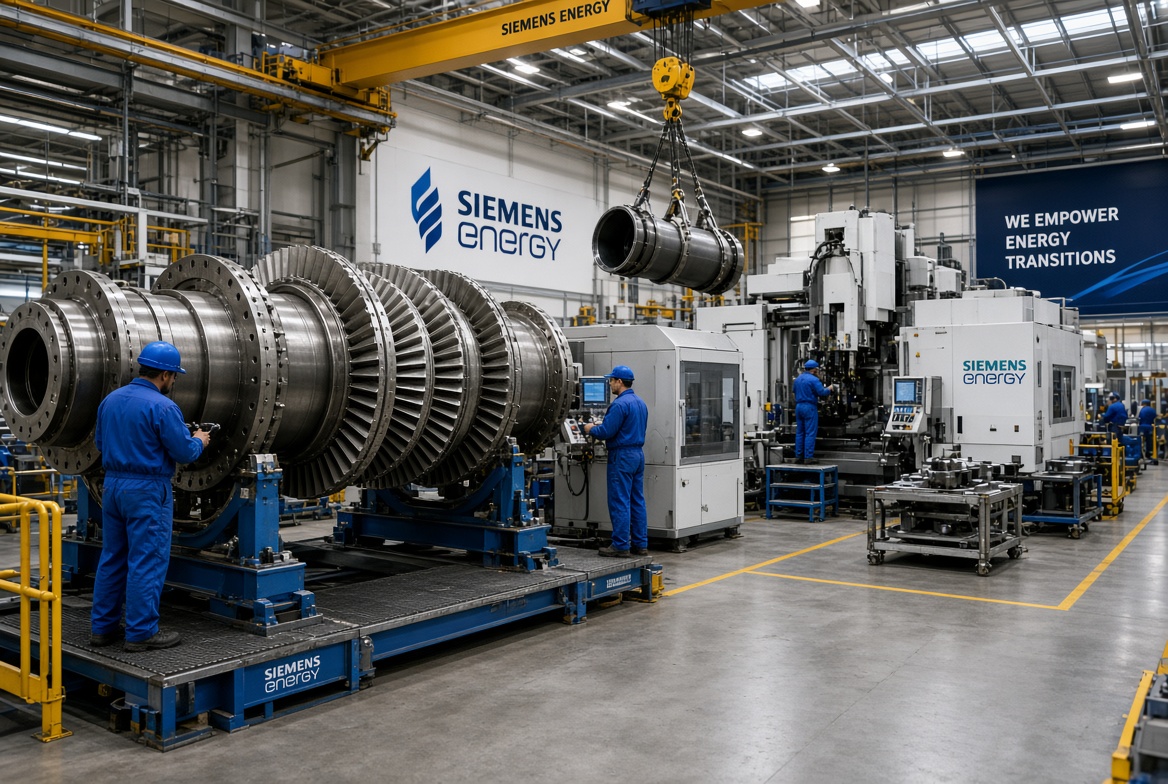
Siemens Energy’s gas services division closed the third quarter of fiscal 2026 (ended June 30) with a firm gas turbine backlog of 69 GW after booking 15 GW in new orders and shipping 6 GW during the period. Lead times across the company now stretch to three years or more, executives said, as surging demand—particularly from U.S. data centers and power projects in the Middle East and Asia—continues to outpace supply.
Christian Bruch, president and CEO, projected that the addressable market for gas turbines could reach 120 GW per year in coming years, with roughly half of that demand originating in the United States. “We had seen over the last quarters a lot of capacity going into data centers and the U.S. This led to the situation that a lot of other applications [for turbines] have pushed out decision-making, and this is why we see Asia coming up; we see the Middle East things coming up. This supports our positive view on 2027,” Bruch said. CFO Maria Ferraro noted that sales could dip slightly in the fourth quarter on seasonal trends but were expected to pick up again in early 2027.
Gas services orders reached nearly €10 billion in the quarter (up about 62% year-over-year on a comparable basis), with sales of roughly €3.8 billion. The division’s order backlog stood at €73 billion. At the group level, Siemens Energy reported record orders of €17.9 billion, a total order backlog of €162 billion, revenue of €11.45 billion (up 18.5% comparable), and a sharp improvement in profitability. The company reaffirmed its fiscal 2026 outlook of 14–16% comparable revenue growth and a profit margin before special items of 10–12%, trending toward the upper end, with net income around €4 billion and free cash flow pre-tax near €8 billion. Siemens Gamesa, the wind unit, posted its first profitable quarter since late 2022.
Manufacturing expansion underwaySiemens Energy has added approximately 30 units of medium-sized gas turbine manufacturing capacity since 2025. Current medium-sized capacity stands at about 80 units, with plans to add another 20 to reach roughly 100 units by 2028. Large gas turbine capacity is around 35 units, with another 15 units planned for 2027. With the added capacity, the company expects it could deliver 15–16 GW of gas turbines in the current year. It also plans to expand transformer and gas-insulated switchgear manufacturing capacity by about 50% by 2030. Grid Technologies carried a €51 billion order backlog as of June 30.
These steps build on earlier commitments, including a roughly $1 billion U.S. investment program announced in early 2026 to expand gas turbine and grid equipment manufacturing (including restarting production in Charlotte, North Carolina, and other sites in North Carolina, Florida, Mississippi, and elsewhere), aimed at adding more than 1,500 jobs and supporting strong U.S. demand. Capacity expansions for both gas services and grid technologies were described as fully on track in the latest analyst presentation.
Earlier in 2026, the company had raised its view of the sustained annual gas turbine market to 110–120 GW (from a prior 90–100 GW range), citing no signs of demand slowdown and a supply-constrained rather than demand-constrained environment. Slot reservations and firm orders have left the company largely booked into 2028 and beyond, with later years filling rapidly.
What this means for investors
The near-70 GW backlog (plus additional slot reservation agreements) provides multi-year revenue visibility and supports higher margins as newer, better-priced orders flow through. Service contracts tied to the growing installed fleet offer long-term recurring revenue potential measured in the tens of billions of euros over decades. Strong cash generation underpins shareholder returns, including ongoing buybacks. Management’s reaffirmation of guidance toward the upper end of the margin range and the wind business’s return to quarterly profitability reduce some execution risks that had weighed on the stock in prior years.
Shares have shown strength on the results and the broader AI/data-center power narrative but have also experienced volatility and periods of lag relative to peaks earlier in 2026, reflecting valuation debates amid elevated expectations. The combination of structural electricity demand growth, pricing power in a tight market, and capacity investments positions Siemens Energy well if execution on the ramp continues and conversion of reservations remains solid. Risks include potential project delays, supply-chain bottlenecks for components or labor, geopolitical factors affecting energy markets, and any slowdown in data-center or regional power investment.
What this means for consumers and electricity markets
Record turbine demand and multi-year lead times are contributing to higher costs and delays for new gas-fired generation. Turbine prices have risen sharply in recent years (analysts have projected substantial further increases into 2027 relative to earlier baselines), and combined-cycle plant costs have climbed significantly. These expenses are typically passed through to ratepayers via regulated utility rates or higher wholesale power prices in competitive markets.
In the near term, constrained turbine availability can slow the addition of flexible capacity needed to support rising loads from data centers, electrification, and coal-to-gas switching. This raises risks of tighter reserve margins, greater reliance on existing plants or higher-cost alternatives during peaks, and potential upward pressure on electricity bills—especially in regions heavily dependent on gas generation. Longer construction timelines also amplify exposure to labor shortages, financing costs, and commodity price volatility.
Over the medium term, Siemens Energy’s (and peers’) capacity expansions should increase annual delivery volumes, helping ease the bottleneck. A larger installed base of efficient modern turbines can support reliability and, where plants incorporate carbon-capture readiness or hydrogen capability, contribute to lower-emissions pathways. Diversified demand (U.S. data centers alongside Middle East and Asian power projects) reduces dependence on any single end market. Consumers ultimately benefit from more generation capacity coming online, but the current supply-constrained phase means higher near-term costs and the need for careful planning by utilities, developers, and policymakers to avoid reliability shortfalls.
The broader context remains a structurally growing electricity market driven by electrification and digital infrastructure. Siemens Energy’s backlog growth and manufacturing investments reflect that reality while underscoring the challenge of matching supply with unprecedented demand.
- Utility Dive primary article: https://www.utilitydive.com/news/siemens-gas-turbine-backlog-nears-70-gw-as-company-expands-manufacturing/827390/
- Siemens Energy Q3 FY2026 Analyst Presentation: https://assets.siemens-energy.com/dam/3e846440-66dd-4a56-be75-b49d004e6741/2026-08-05_Q3_Analyst_presentation-pdf_Original%20file.pdf
- Siemens Energy Q3 FY2026 Earnings Release (English summary/PDF references): https://egyptoil-gas.com/wp-content/uploads/2026/08/earnings-release-q3-fy2026-en-pdf_Original20file.pdf and related company materials
- S&P Global on earlier market outlook raise: https://www.spglobal.com/energy/en/news-research/latest-news/electric-power/063026-siemens-energy-lifts-global-gas-turbine-outlook-on-data-center-demand
- Reuters on developers adapting to tight supply and manufacturing investments: https://www.reuters.com/business/energy/power-developers-adapt-gas-turbine-strategies-mitigate-tight-supply–reeii-2026-03-02/
- Turbomachinery Magazine on $1B U.S. investment: https://www.turbomachinerymag.com/view/siemens-energy-invests-1b-to-upscale-u-s-grid-gas-turbine-manufacturing
- Industrial Info on U.S. investments: https://www.industrialinfo.com/iirenergy/industry-news/article/siemens-ge-vernova-increase-us-investment-to-meet-gas-turbine-power-demand–352984
- Wood Mackenzie / Utility Dive on turbine price projections: https://www.utilitydive.com/news/gas-turbine-supply-crunch-set-to-raise-prices-195-by-2027-woodmac/816904/
- IEEFA report on gas plant buildout risks and consumer costs: https://ieefa.org/resources/misguided-stampede-build-gas-power-plants
- Additional context from company pre-close calls, Capital Markets Day materials, and peer comparisons (GE Vernova backlog reports via Utility Dive).
All figures and statements are drawn from the company’s fiscal Q3 2026 results, related presentations, and contemporaneous reporting as of early August 2026. Market conditions and company plans remain subject to change.